Key takeaways
- AirOps and similar content workflow tools are good at producing content faster, but they have no visibility into whether that content gets cited by AI search engines like ChatGPT, Perplexity, or Google AI Overviews.
- The ROI problem isn't the content quality -- it's the missing feedback loop. Without knowing which prompts you're losing, which pages AI models are reading, and whether new content moves the needle, you're optimizing blind.
- Task-based pricing models (common in AirOps-style tools) make ROI calculations especially murky -- costs scale with output, not outcomes.
- The fix is a closed-loop architecture: gap analysis to find what's missing, content generation grounded in real prompt data, and tracking that connects published pages to actual AI citations.
- Platforms built around this loop -- where monitoring, creation, and measurement are integrated -- are the ones teams can actually justify to finance.
There's a pattern playing out across content and SEO teams in 2026. A team adopts an AI content workflow tool, builds pipelines, scales output, and then hits a wall when someone in finance asks: "What did all this content actually do?"
The honest answer, for most teams using tools like AirOps, is: "We're not sure."
That's not a knock on AirOps specifically. The platform does what it says -- it lets you build repeatable, multi-step AI pipelines for content production. It has real customers (Webflow, Ramp, Carta), a 4.6/5 rating on G2, and genuine time-saving value for teams that think in workflows. But across G2 reviews and practitioner analyses, a recurring complaint surfaces: more than 21 out of 111 G2 reviewers specifically flag that the pricing is too steep relative to the ROI they can demonstrate. And that's just the people who bothered to write it down.
The ROI problem isn't unique to AirOps. It's structural. It's about what these tools were built to do -- and what they weren't.
The content production trap
AirOps is a workflow platform. It helps you produce content faster by chaining AI steps together: pull a keyword, generate an outline, write a draft, apply brand voice, push to CMS. That's genuinely useful if your bottleneck is execution speed.
But speed is not the same as effectiveness. And in 2026, "effective" increasingly means one specific thing: does your content get cited by AI search engines?
The shift matters because a growing share of search traffic now flows through AI-generated answers. When someone asks ChatGPT or Perplexity a question, the model pulls from sources it trusts. If your content isn't in those sources, you're invisible -- regardless of how efficiently you produced it.
AirOps doesn't tell you any of this. It has no mechanism to show you which prompts AI models are answering without citing you, which of your pages are being read by AI crawlers, or whether the content you just published moved your AI visibility at all. You publish into a void and hope.

Why task-based pricing makes the problem worse
AirOps uses task-based billing at higher tiers. Every time a workflow runs, tasks are consumed. At scale, this creates a cost structure that grows with output -- not with outcomes.
If you're running content refresh workflows across hundreds of URLs, your task count climbs fast. The Slate HQ analysis of AirOps pricing notes that this billing model makes it genuinely difficult to calculate ROI per article, because the cost per piece isn't fixed -- it depends on how complex your pipeline is, how many steps run, and how often you trigger it.
Compare that to what you'd need to justify the spend: evidence that specific pieces of content are being cited by AI models, driving traffic, and converting. AirOps gives you none of that. So you end up in a situation where costs are visible and rising, but value is invisible and assumed.
This is the trap. And it's not just an AirOps problem -- it's the trap of any content tool that treats publishing as the finish line.
The architectural gap: no feedback loop
The deeper issue is architectural. AirOps-style tools are built on a linear model:
Input (keyword/brief) → Process (AI pipeline) → Output (content)
That's it. The loop doesn't close. There's no step that says: "Here's what AI models are actually citing. Here's what they're not citing. Here's the gap between what you published and what's working."
Without that feedback, you can't improve. You can produce more, but you can't produce smarter. Every new piece of content is a guess -- a slightly more efficient guess than before, but still a guess.
The teams that are actually proving AI content ROI in 2026 are using a different architecture. It looks like this:
- Find the specific prompts where competitors are visible and you're not
- Generate content that directly addresses those gaps, grounded in real prompt data
- Track whether that content gets crawled, cited, and drives traffic
That's a closed loop. And it's a fundamentally different thing from a content workflow tool.
What "grounded in real prompt data" actually means
This is worth unpacking because it sounds like marketing language but it's a real technical distinction.
When AirOps generates content, it works from whatever inputs you give it: a keyword, a brief, a competitor URL. The AI writes something plausible and on-topic. That's fine for traditional SEO, where you're optimizing for keyword relevance.
But AI search engines don't work like keyword-based search. They have specific questions they're trying to answer, specific sources they trust, and specific gaps in their knowledge. If you want to be cited, you need to know what questions are being asked, how often, and what the current answers look like.
Real prompt data means: here are the actual queries flowing through ChatGPT, Perplexity, and Google AI Overviews right now. Here's what they're citing. Here's what they're not finding. Here's the volume and difficulty for each prompt. That's the raw material for content that actually gets cited -- not keyword lists, not competitor URLs.
Without this, you're writing for a search paradigm that's already changing under your feet.
The hidden cost of monitoring-only tools
Some teams try to solve the feedback problem by adding a separate monitoring tool on top of their content workflow. Track AI visibility in one platform, generate content in another, and manually connect the dots.
This works, sort of. But it creates its own problems.
The connection between "what AI models are missing" and "what content to create" requires manual interpretation. Someone has to look at the monitoring data, figure out what it means, translate it into a brief, hand it to the content tool, and then remember to go back and check whether the new content helped. That's a lot of steps, and each one is a place where the signal gets lost.
It also means you're paying for two platforms. And the ROI problem doesn't go away -- it just gets harder to diagnose because the data lives in different places.
What a closed-loop platform actually looks like
The architecture that fixes this integrates three things that are currently split across separate tools:
Gap analysis that shows you exactly which prompts competitors are visible for and you're not. Not "here are some keywords to consider" -- the specific questions AI models are being asked right now, with your brand absent from the answers.
Content generation grounded in that gap data. Not generic AI writing, but articles and briefs built around the actual prompts, the current citations, the competitor angles, and your brand voice. The content is engineered to fill a specific hole in AI model knowledge.
Page-level tracking that connects what you published to what happened. Which pages are AI crawlers reading? Which ones are being cited, by which models, how often? Did the new article move your visibility score for the target prompt?
When those three things are in one platform, ROI becomes measurable. You can show: "We identified 40 prompts where competitors were cited and we weren't. We published content targeting 15 of them. 11 are now generating citations. Here's the traffic attribution."
That's a conversation you can have with finance. "We published 200 articles this quarter" is not.
Promptwatch is built around this loop -- gap analysis, AI-grounded content generation, and page-level citation tracking across 10 AI models including ChatGPT, Perplexity, Google AI Overviews, Claude, and Gemini.

Comparing the approaches
Here's how the different platform types stack up against the core ROI problem:
| Platform type | Finds AI gaps | Generates gap-targeted content | Tracks citations | Connects to revenue |
|---|---|---|---|---|
| AirOps-style workflow tools | No | No (generic AI writing) | No | No |
| Monitoring-only tools (Otterly.AI, Peec.ai) | Yes | No | Basic | No |
| Traditional SEO tools (Semrush, Ahrefs) | Partial | No | Limited | No |
| Closed-loop GEO platforms (Promptwatch) | Yes | Yes | Yes (page-level) | Yes |
The monitoring-only tools are worth a mention here because they're a common first step. They show you where you're invisible in AI search, which is genuinely useful. But they stop there. You still have to figure out what to do about it, and you have no way to measure whether what you did worked.


Traditional SEO platforms like Semrush and Ahrefs have added some AI visibility features, but they're built on fixed prompt sets and don't connect to content generation or AI traffic attribution in any meaningful way.

The team maturity question
There's a fair counterargument to all of this: AirOps works well for teams that are already sophisticated. If you have a proven content strategy, strong editorial processes, and a separate analytics setup, you can use AirOps to execute faster and measure results through your existing stack.
That's true. But it describes a small percentage of the teams actually buying these tools.
The Slate HQ analysis of AirOps notes that 54+ of 111 G2 reviews reference learning difficulties, and the platform "assumes foundational knowledge of content strategy, SERP analysis, and editorial operations." Most teams don't have that foundation -- or they have it for traditional SEO but not for AI search, which is a different discipline.
The teams that struggle most with AirOps ROI are the ones who bought it hoping it would tell them what to create, not just help them create it faster. That's a product expectation mismatch, and it's partly on the buyer -- but it's also a gap the market is actively filling.
What to actually do about it
If you're currently using an AirOps-style tool and struggling to prove ROI, the path forward depends on where the gap is.
If you have no visibility into AI search performance at all, the first step is getting that data. You need to know which prompts matter for your category, which competitors are being cited, and where your content stands. Without that baseline, any content investment is speculative.
If you have monitoring data but no way to act on it, the bottleneck is the connection between insight and execution. You need content generation that's grounded in the gap data, not just a general-purpose AI writer.
If you have both but can't connect output to outcomes, the missing piece is page-level citation tracking -- something that shows you which specific pages are being read and cited by AI models, and how that changes over time.
The cleanest solution is a platform that handles all three. The more duct-taped your stack is, the more places the signal gets lost, and the harder it is to build a coherent ROI story.
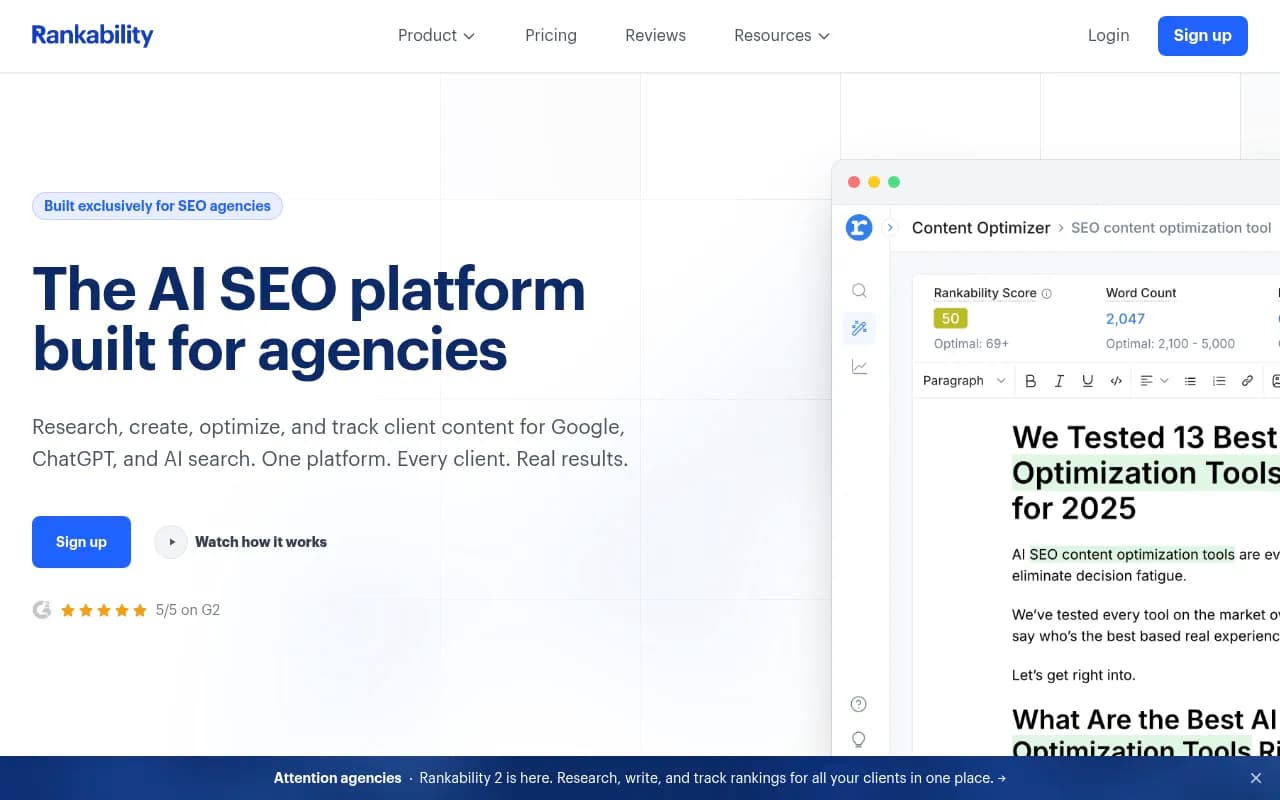
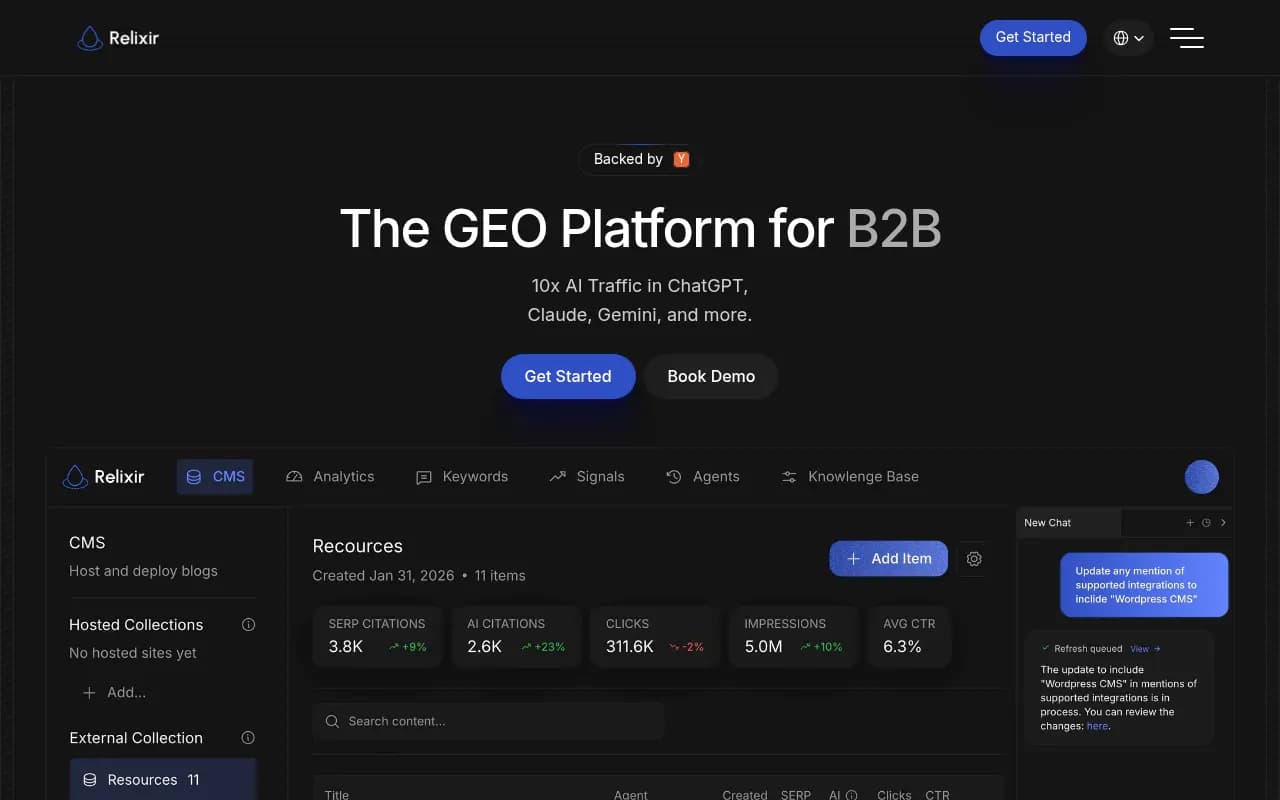
For teams specifically focused on AI search visibility and content optimization, a few platforms worth evaluating:
The real benchmark for content ROI in 2026
The question used to be: "Did this content rank on page one?" That's still relevant, but it's no longer sufficient. AI search engines are now the first stop for a growing share of queries, and being cited in those answers is a distinct outcome that requires distinct measurement.
Content tools that were built before this shift -- or that were built to optimize for traditional search -- don't have the architecture to answer the new question. They can tell you how many articles you published, how fast, and at what cost. They can't tell you whether any of those articles are showing up when someone asks ChatGPT to recommend a product in your category.
That's the gap. And it's not a gap you can close by running more workflows or publishing more content. You close it by changing what you measure and building a feedback loop that connects creation to citation to revenue.
The teams figuring this out in 2026 aren't necessarily publishing more. They're publishing smarter -- because they know exactly what AI models are looking for and can track whether they delivered it.