Key takeaways
- More than half of new web articles are now AI-generated or AI-assisted, and volume alone stopped being a competitive advantage somewhere around mid-2026.
- Google's spam detection has shifted from grading individual pages to spotting coordinated clusters of similar content, published by a paper describing a system called S-CTS that terminated 50,000 clusters across 130,000 channels in six months.
- Lily Ray's study of 220+ sites tied to AI content scaling vendors found 54% lost 30%+ of peak organic traffic, and 39% lost half or more, often after they published case studies bragging about the growth.
- Citation slots in ChatGPT are shrinking, not growing, down roughly 27% since the GPT-5.3 rollout in March 2026, which means more competitors are fighting over fewer spots, not more.
- The publishing-frequency-to-traffic curve flattens hard past 11 posts a month. Going from zero to 11 nearly triples traffic; going from 11 to 30+ adds less than half again.
The volume trap, explained
Somewhere in the last two years, a lot of marketing teams decided that if one good article gets traffic, fifty mediocre ones must get fifty times the traffic. It's an understandable bet. It's also, per the data we now have from 2026, mostly wrong.
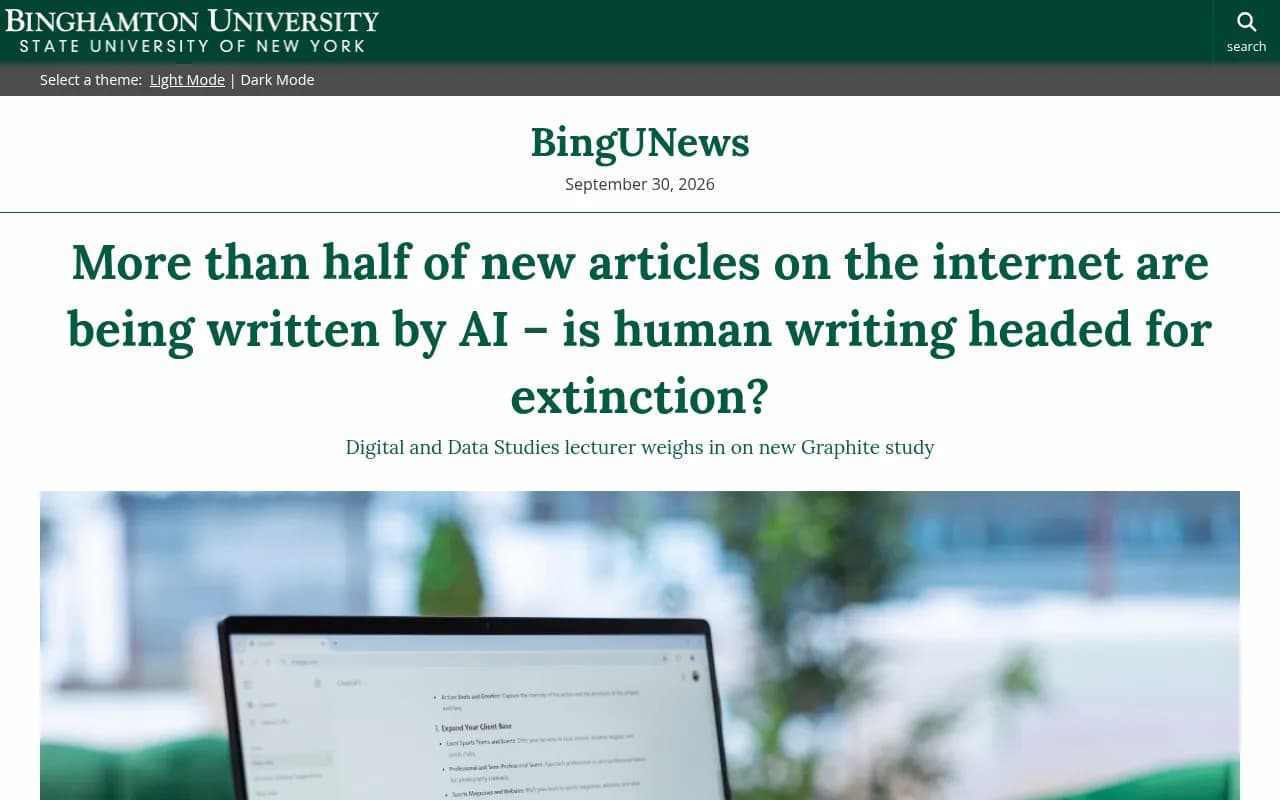
A Graphite study cited by Binghamton University found that more than half of new articles published on the internet are now written by AI. Neil Patel has put the number even higher for marketing content specifically, around 85% fully AI-generated or AI-modified. Pangram's browser-extension research shows AI content flooding social platforms too, with LinkedIn alone accounting for nearly two-thirds of the AI content Pangram flagged across its entire dataset, despite making up only a third of scanned posts.
So yes, if a competitor is publishing 50 articles a day, they're not alone, and they're not even doing anything unusual anymore. The interesting question isn't whether AI content is everywhere. It's whether publishing more of it still works, and for most sites in 2026, the answer has become no.
What Google actually started catching
For a while, the working theory among SEOs was that Google grades individual pages for AI-ness, and if you make each article "unique enough," you slip through. That theory is dead. Google researchers published a paper describing a system called S-CTS, the Scalable Cluster Termination System, originally built to catch coordinated abuse on a major video platform. The mechanism matters because it explains exactly why the old workaround stopped working.
S-CTS requires two independent signals to fire before anything gets enforced: a bot-net-style detector that flags whether a group of accounts or pages behaves like a coordinated cluster (same cadence, same templates, same infrastructure fingerprints), and a content classifier that scores whether the material looks synthetic. Only when both conditions are true does the system escalate to enforcement. Isolated AI use by itself doesn't trigger anything.
The text side of this leans on Sentence-BERT embeddings, which convert sentences into vectors and measure semantic similarity across a whole network of pages. The trick here is subtle: templated AI writing clusters together mathematically even when every individual article reads as "unique" to a human skimming it. Reword a sentence, swap a synonym, restructure a paragraph, and the underlying semantic fingerprint barely moves. Making each article "slightly different" stopped being a defense the moment detection started judging the network instead of the page.
Across six months of deployment, the system terminated 50,000 clusters covering 130,000 channels while cutting the human review workload roughly in half. That's not a hypothetical. That's a working system already running at scale.
The August 2026 spam update, and who it actually hit
Google's August 2026 spam update rolled out fast, confirmed complete within just over two days, the third spam update of the year. Glenn Gabe's case studies from that rollout are worth paying attention to because they show the damage wasn't confined to Google's classic search results. As Gabe put it, when a site gets hit, "it can drop across surfaces, including AI Overviews and AI Mode," and because ChatGPT frequently grounds its answers through Google, sites can lose visibility there too.
One case Gabe documented: a YMYL (your-money-or-your-life) site combining programmatic templates with fully AI-generated text lost rankings for over 200,000 queries. Not a decline. A near-total wipeout. Google's official policy name for this is "scaled content abuse," defined plainly as pages generated primarily to manipulate rankings rather than help anyone.
The pattern that separates who gets caught from who doesn't isn't really about AI use at all.
| Publishing pattern | Risk level under cluster-based detection |
|---|---|
| AI drafts, followed by real editing, fact-checking, and an actual point of view | Low, this is what most competent content teams already do |
| Fully automated pipelines publishing dozens of articles a day, no human review | High, close to the exact pattern the detection system targets |
| Networks of near-duplicate sites reworking the same keyword clusters | Very high, this is the specific coordinated abuse the system was built to find |
The businesses that get flattened by updates like this were never really competing on quality. They were betting that volume could outrun scrutiny long enough to cash out the traffic. For a while, that bet paid off. It stopped paying off around mid-2026.
What the traffic data actually shows
Lily Ray's study is the most useful real-world dataset here because it doesn't rely on Google's own framing, it tracks outcomes. She monitored more than 220 sites that had publicly identified themselves, or been identified by their vendors, as customers of AI content scaling platforms. Using Ahrefs traffic time series cross-checked against the Sistrix Visibility Index, she found:
- 54% lost 30% or more of their peak organic traffic
- 39% lost 50% or more
- 22% lost 75% or more
The trajectory she describes is almost a pattern you could set your watch to: rapid page-count growth over 6 to 12 months, a traffic peak that lands 3 to 6 months after the content-volume peak, then a steep decline that erases most of the gains and frequently drops below the original baseline within a year. There's a darkly funny detail buried in her findings too. Most of the traffic collapses happened after the case studies bragging about the wins were published. Ray raises the obvious question: did the bragging itself draw the scrutiny?
Separately, the broader publishing data backs up the idea that more isn't simply better. Pure AI-generated content underperforms human-written content by 23% in organic rankings after 12 months, according to compiled 2026 blogging data, while AI-assisted content edited by a human actually outperforms purely human-written content on productivity without sacrificing ranking performance. The takeaway isn't "avoid AI." It's that augmentation beats replacement, every time the data has been checked.
Even the publishing-frequency curve tells the same story. HubSpot's data (compiled into 2026 figures) shows diminishing returns kick in around 11 posts a month:
| Posts per month | Relative traffic vs. baseline |
|---|---|
| 0-4 | 1x |
| 5-8 | 1.8x |
| 9-11 | 2.5x |
| 12-15 | 2.9x |
| 16-20 | 3.5x |
| 21-30 | 3.7x |
| 30+ | 3.9x |
Going from zero to 11 posts a month gets you 2.5x the traffic. Going from 11 all the way up to 30-plus only adds another 1.4x on top of that. A competitor cranking out 50 articles a day isn't 50 times more visible than a team publishing carefully twice a week. They're maybe getting incremental gains on a curve that's already flattened out, while absorbing all the risk of looking like a cluster to a detection system built specifically to find clusters.
Why AI search engines make volume even less useful
Here's the part a lot of content-mill operators seem to have missed: even if you dodge Google's spam filters, the newer AI search surfaces have far fewer citation slots than classic search ever did. Promptwatch's data on average sources per response shows ChatGPT typically cites only around 5 sources per web-search-enabled answer, compared to roughly 10 for Google AI Overviews and almost exactly 10 for Perplexity. That's a much smaller inventory of "winning spots" than the ten blue links of old Google search.

It gets tighter. Around the GPT-5.3 rollout on March 4, 2026, average citations per ChatGPT response dropped from roughly 6.4 to somewhere between 4.7 and 4.9, a 27% reduction, and it never recovered in the following month. ChatGPT's own query fanout, the number of separate searches it runs per prompt, fell from 2.15 in December 2025 to exactly 1.0 by April 2026. Fewer searches per response means fewer retrieval opportunities for any given page to get pulled in at all.
And when content does get cited, it's not going to the biggest domains by default. Promptwatch's citation-by-domain-rank data for August 2026 shows DR 46-75 domains earning nearly half of all ChatGPT citations, while the very highest-authority domains (DR 91-100) dropped from about 7% of citations in early August down to roughly 3% and stayed there. Meanwhile DR 0-30 sites still picked up about 14%. The lesson: mid-authority sites with genuinely useful pages are competing on reasonably even footing, but that footing gets no wider just because you publish more pages.
There's also a cautionary tale already playing out for anyone assuming AI engines will just keep citing whatever category of content is currently easy to produce at scale. Reddit held a steady 3.8% share of ChatGPT Search citations from mid-July through early August 2026, then collapsed to 0.5% in a single day on August 14. That's an 86% relative drop, overnight, for an entire content category. AI search engines clearly have the ability to de-weight whole swaths of scaled or low-effort sourcing in one move. Content mills betting on any single tactic staying rewarded indefinitely are betting against a system that has already shown it can flip a switch.
So what actually works when everyone's flooding the zone
The research keeps pointing in the same direction, regardless of which dataset you pull from: publish less, but make sure what you publish has a human fingerprint on it. That doesn't mean banning AI from your workflow, 67% of bloggers already use AI writing tools in some capacity. It means AI drafts a first pass, and a person edits it hard, fact-checks it, and adds a point of view that a cluster-detection algorithm can't template.
A few concrete moves that the data supports:
- Cap new content at a sustainable cadence rather than chasing the top of the frequency curve. The jump from 11 to 30+ posts a month barely moves traffic and raises your exposure to cluster-based detection.
- Update existing pages instead of only publishing new ones. Updating old posts has been measured as 2-3x more effective than adding thin new content.
- Stay consistent rather than sporadic. Blogs with a fixed weekly schedule get 67% higher traffic than sporadic publishers, and stopping consistent publishing triggers a 23% traffic decline within 90 days.
- Track how your content actually performs in AI answers, not just classic search rankings, since citation behavior and citation slot counts are moving targets month to month. Tools built for this, like Promptwatch, track citation share and content-type performance across ChatGPT, Perplexity, Gemini, and Google's AI surfaces so you can see whether your content strategy is actually landing anywhere.
If you're evaluating options in this space more broadly, the GEO software directory at bestgeosoftware.com is a decent starting point for comparing platforms built specifically around AI visibility rather than repurposed traditional rank trackers.
The honest bottom line
A competitor publishing 50 articles a day in 2026 isn't the threat it would have been in 2022. The citation slots they're fighting for have shrunk. The detection systems looking for their pattern have gotten a lot more sophisticated, and they're not grading individual articles anymore, they're grading the network those articles form. The traffic curve rewarding volume flattens out well before 50 a day. And the one dataset that tracks actual outcomes for sites that went all-in on AI content scaling shows the majority of them losing a third or more of their traffic, often not long after they told everyone how well it was working.
The competitor flooding the zone isn't necessarily winning. They might just be running the clock down on their own visibility while nobody, including them, is watching closely enough yet to notice.