Key takeaways
- Searchable covers the basics of AI visibility monitoring but lacks the depth most serious teams need in 2026
- No crawler log access, no Reddit/YouTube tracking, and no native content generation are the three biggest gaps
- Prompt volume data and difficulty scoring are absent, making it hard to prioritize which queries to target
- The platform works best as an entry-level monitoring tool -- but teams that want to actually improve their AI visibility will hit a ceiling fast
- Several alternatives offer more complete feature sets at comparable or lower price points
Let's be honest: most reviews of AI visibility platforms read like rewritten press releases. They list features, note the pricing, and conclude with something vague about "choosing the right tool for your needs." That's not useful when you're trying to decide whether to spend real budget on a platform.
So here's a different approach. This is a genuine look at where Searchable falls short -- the limitations that don't show up in demos, the missing features that only matter once you're three months in, and the honest comparison against what else is available in 2026.
What Searchable actually does
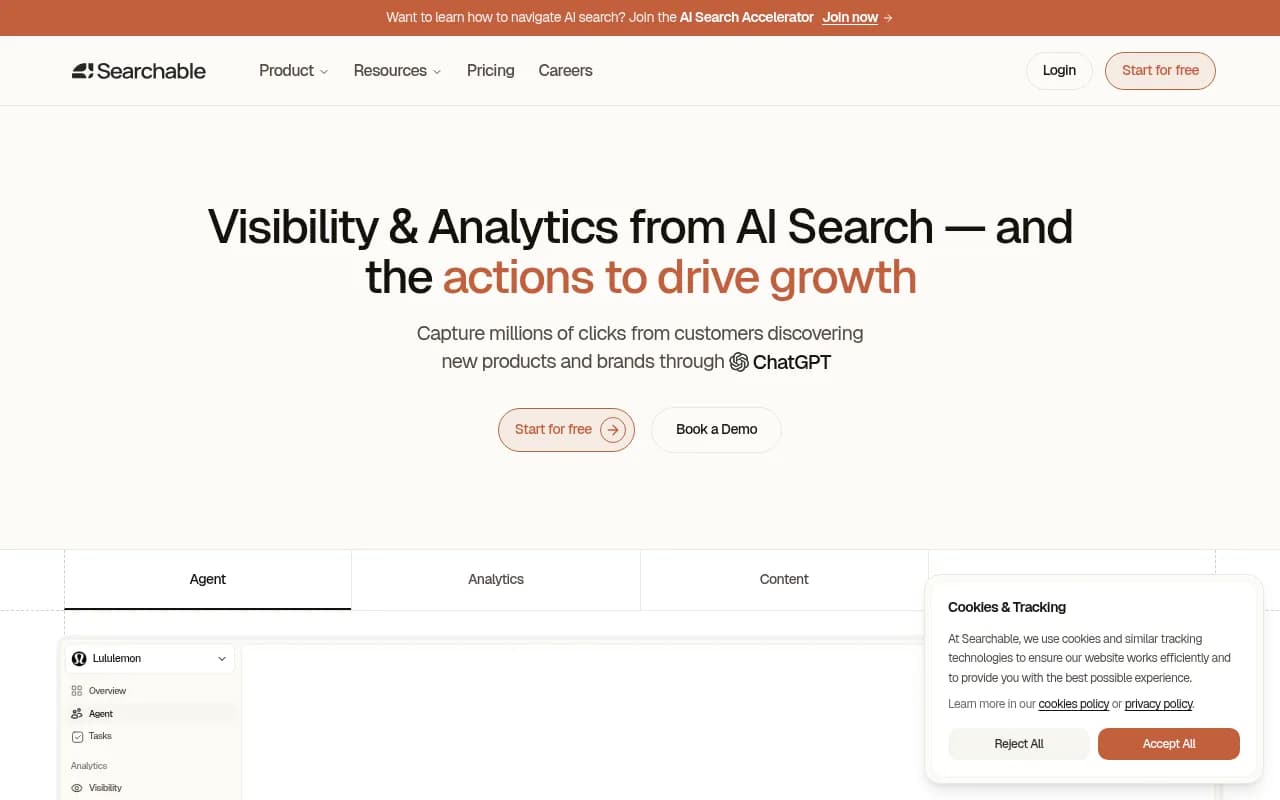
Searchable is an AI search visibility platform. The core pitch is that it monitors how your brand appears across AI engines like ChatGPT, Perplexity, Gemini, and Google AI Overviews -- tracking mentions, citations, and sentiment in AI-generated responses.
That's a real and legitimate need. AI search is now a meaningful traffic source for most brands, and knowing whether you're being cited (or ignored) matters. Searchable does deliver on the basic monitoring promise: you can set up prompts, track responses across a handful of models, and see whether your brand appears.
The problem isn't what it does. It's what it doesn't do -- and how quickly you run into those walls.
The monitoring-only ceiling
The most significant limitation is structural. Searchable is built as a monitoring dashboard. It shows you data. What it doesn't do is help you act on that data.
This sounds like a minor complaint until you're actually trying to improve your AI visibility. You can see that competitors are being cited for a set of prompts you're not appearing in. Now what? Searchable doesn't have answer gap analysis that identifies which specific content is missing from your site. It doesn't generate content briefs. It doesn't have AI writing tools to help you create the pages that would close those gaps.
You're left with a dashboard full of interesting numbers and no clear path from "I'm invisible here" to "I fixed it."
In 2026, with the GEO space maturing rapidly, the monitoring-only model is starting to feel dated. The platforms that are pulling ahead are the ones that close the loop between insight and action.
Missing: crawler logs and agent analytics
This one is underappreciated until you need it. When AI crawlers like GPTBot, ClaudeBot, or PerplexityBot visit your site, they leave traces in your server logs. Knowing which pages they're reading, how often they return, which pages throw errors, and when a page moves from "crawled" to "cited" is genuinely valuable diagnostic information.
Searchable doesn't surface this. There's no crawler log integration, no real-time view of which AI agents are hitting your site, and no way to connect crawl activity to citation outcomes.
For teams trying to debug why a page isn't getting cited despite being well-optimized, this is a significant blind spot. You can't fix what you can't see.
Platforms like Promptwatch have built crawler log analysis directly into their workflow -- connecting Cloudflare, Fastly, Vercel, or server log data to show exactly what AI agents are doing on your site.

Missing: prompt volume and difficulty data
Not all prompts are equal. "Best CRM software" gets asked by AI users millions of times. "Best CRM for solo consultants in the Netherlands" gets asked far less. If you're going to invest in creating content to win visibility for specific prompts, you need to know which ones are worth targeting.
Searchable doesn't provide prompt volume estimates or difficulty scoring. You're essentially flying blind when it comes to prioritization -- you can track prompts you already know about, but you have no way to discover high-value prompts you're missing, or to understand the competitive difficulty of ranking for them.
This matters more than it sounds. Without prompt intelligence, your GEO strategy is guesswork. You might spend three months optimizing for prompts that get almost no traffic while ignoring high-volume queries where you could realistically compete.
Missing: Reddit and YouTube tracking
Here's something the AI visibility space mostly ignores: a huge portion of what AI models cite comes from Reddit threads and YouTube videos, not just brand websites. When someone asks ChatGPT for a software recommendation, the response is often shaped by Reddit discussions and YouTube reviews that the model has ingested.
Searchable doesn't track Reddit or YouTube as citation sources. So if a Reddit thread is actively hurting your brand's representation in AI responses -- or if a YouTube review is driving positive citations -- you won't know from Searchable's data.
This is a genuine gap in competitive intelligence. Understanding the full citation ecosystem means looking beyond your own domain.
Missing: ChatGPT Shopping and entity tracking
ChatGPT's shopping recommendations and product carousels are a growing traffic source, particularly for e-commerce and SaaS brands. When ChatGPT recommends products or services in response to buying-intent queries, appearing in those recommendations is increasingly valuable.
Searchable doesn't track ChatGPT Shopping appearances or entity mentions in a structured way. For brands where this channel matters, that's a meaningful gap.
The prompt coverage question
One thing worth examining before committing to any AI visibility platform is how prompts are tracked. Some platforms use fixed prompt libraries -- they track a set of industry-standard queries that may or may not reflect how your actual customers are searching. Others let you build custom prompt sets from real user behavior.
Searchable's prompt tracking is largely manual and custom -- you define the prompts you want to monitor. That's fine for getting started, but it means you're limited to prompts you already know about. There's no mechanism for discovering new prompts that are emerging in your category, no query fan-out analysis showing how one prompt branches into related sub-queries, and no data-driven way to expand your prompt coverage over time.
What Searchable does reasonably well
To be fair: Searchable is not a bad product. For teams that are just starting to think about AI visibility and want a clean, accessible way to monitor brand mentions across a few AI models, it works. The interface is relatively straightforward, setup is quick, and the basic citation tracking is functional.
If your goal is simply to answer "is our brand being mentioned in AI responses?" -- Searchable can answer that question. The problems start when you want to go deeper.
How it compares to the alternatives
The AI visibility space has gotten crowded fast. Here's an honest comparison of where Searchable sits relative to the main alternatives:
| Platform | Crawler logs | Content generation | Prompt volume data | Reddit/YouTube tracking | ChatGPT Shopping | Best for |
|---|---|---|---|---|---|---|
| Searchable | No | No | No | No | No | Basic monitoring |
| Otterly.AI | No | No | No | No | No | Budget monitoring |
| Peec.ai | No | No | Limited | No | No | Multi-language monitoring |
| AthenaHQ | No | No | Limited | No | No | Monitoring + basic optimization |
| Profound | No | Limited | Yes | No | No | Mid-market monitoring |
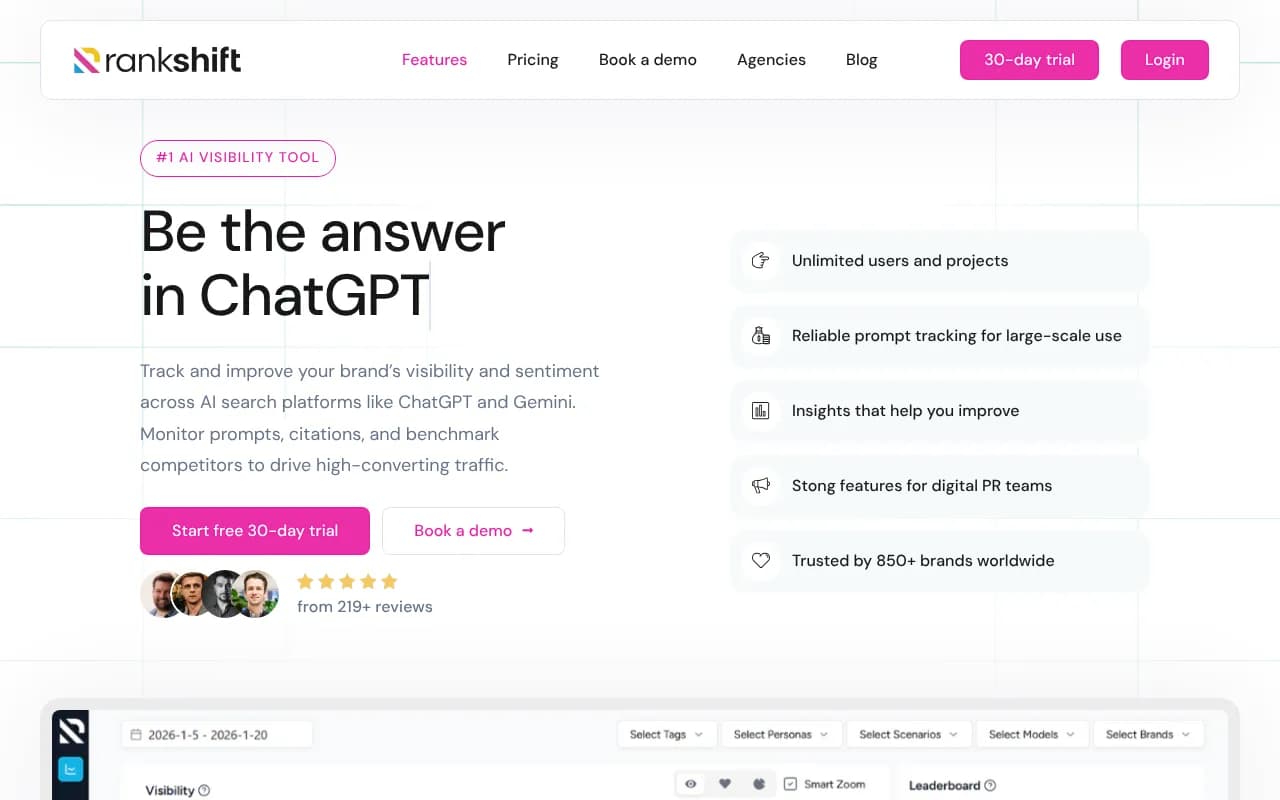
| Promptwatch | Yes | Yes (Content Agents) | Yes | Yes | Yes | Full GEO optimization |




The pattern is clear: most platforms in this space, including Searchable, are monitoring tools. They show you what's happening but don't help you change it. The gap between "we can see we're invisible" and "we know how to fix it" is where most teams get stuck.
The content generation gap matters more in 2026
A year ago, you could reasonably argue that monitoring was enough -- just knowing where you stood was valuable. In 2026, that argument is weaker. The brands that are winning AI visibility aren't just tracking their scores; they're systematically creating content that answers the specific questions AI models are being asked.
That requires knowing which content gaps exist (answer gap analysis), having a way to generate content that's grounded in real prompt data, and tracking whether that content actually moves the needle. Searchable doesn't support any of those steps.
This isn't a minor feature gap. It's a different philosophy about what an AI visibility platform should do.
Who Searchable actually makes sense for
Despite the limitations, there are scenarios where Searchable is a reasonable choice:
- Teams with very limited budgets who just need basic brand mention tracking across AI models
- Companies in the early stages of thinking about AI visibility, who want to understand the landscape before investing in a more complete solution
- Agencies that need a lightweight tool to show clients their current AI visibility baseline before pitching a larger engagement
For anyone who wants to actually improve their AI visibility -- not just measure it -- Searchable will feel limiting within a few months.
What to look for instead
If you're evaluating AI visibility platforms and the gaps above matter to you, the key questions to ask any vendor are:
- Do you have crawler log integration that shows which AI agents are visiting my site and which pages they're reading?
- Do you provide prompt volume estimates and difficulty scoring so I can prioritize?
- Do you track Reddit and YouTube as citation sources?
- Do you have content generation tools that are grounded in real prompt and citation data?
- Can I see which specific content gaps are causing me to lose visibility to competitors?
Most platforms will struggle to answer yes to more than two of those questions. That's the honest state of the market.
The bottom line
Searchable is a functional entry-level monitoring tool that does what it says on the tin. The problem is that "monitoring" is increasingly the floor, not the ceiling, of what AI visibility platforms need to deliver.
The missing crawler logs mean you can't diagnose why content isn't getting cited. The missing prompt volume data means you can't prioritize intelligently. The missing content tools mean every insight requires manual follow-through with a separate workflow. And the lack of Reddit/YouTube tracking means your competitive intelligence has a significant blind spot.
None of these are dealbreakers if you're just starting out and want to understand your baseline. But if you're serious about AI search as a growth channel in 2026, you'll likely outgrow Searchable faster than you'd like -- and switching costs are real.
The platforms that are genuinely useful right now are the ones that close the loop: find the gaps, create the content, track the results. Monitoring alone isn't a strategy.