Key takeaways
- Otterly.AI and Peec.ai are solid entry points for basic brand monitoring in AI search, but both stop at reporting -- there's no content generation, no crawler logs, and no optimization workflow.
- Qwairy positions itself as a GEO strategy platform, but its feature depth is still catching up to the more established players.
- Promptwatch is the only platform in this comparison that covers the full loop: find visibility gaps, generate content to close them, and track the results as AI models start citing your pages.
- If you're just getting started and want cheap monitoring, Otterly.AI at $29/month is hard to beat. If you're serious about actually improving your AI search presence, you need something that goes further.
- The "monitoring-only trap" is real: knowing you're invisible is only useful if you know what to do about it.
The AI visibility tool market has matured fast. In 2024, any tool that could tell you whether ChatGPT mentioned your brand felt like magic. By 2026, that bar is embarrassingly low. The question isn't whether a tool can monitor -- it's whether it can help you act.
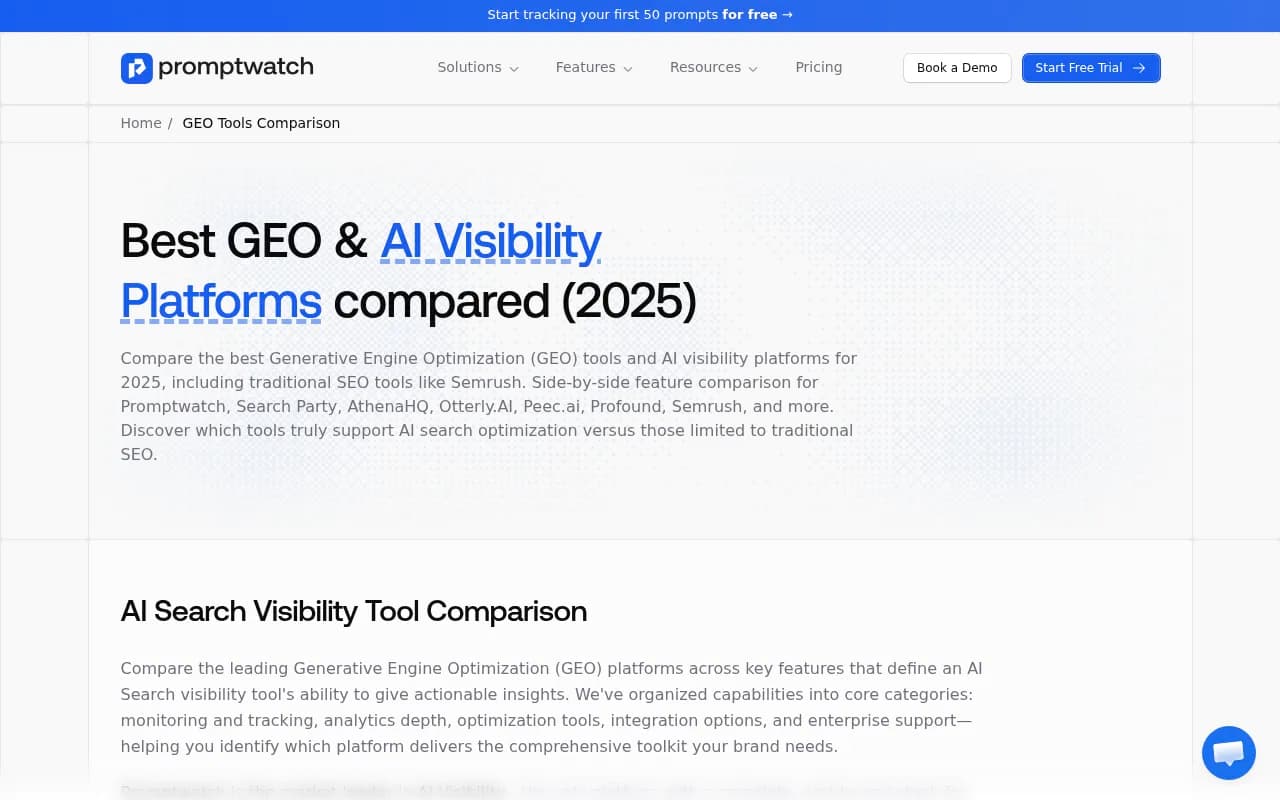
This comparison looks at four tools that come up frequently in the conversation: Qwairy, Promptwatch, Peec.ai, and Otterly.AI. They're not all playing the same game, and that difference matters more than most comparison guides admit.
What the monitoring-only trap actually looks like
Here's the scenario that plays out constantly. A marketing team sets up an AI visibility tool, runs their prompts, and discovers their brand barely appears in ChatGPT or Perplexity responses. The dashboard shows a visibility score of 12%. Competitors are at 40-60%. The tool sends a weekly report confirming this gap is still there.
Three months later, the gap is still there. The tool is still sending reports.
That's the trap. Monitoring without optimization is just a recurring reminder that you have a problem. The data is real and useful -- but only if it connects to something you can actually do. Most tools in this category were built as dashboards first, and the question of "what do I do with this information?" was left as an exercise for the user.
The tools in this comparison sit at different points on that spectrum.
The four tools, briefly
Otterly.AI
Otterly.AI is the most accessible entry point in this comparison. It tracks brand mentions across four AI models at the base tier, with a starting price of $29/month. The interface is clean and fast to set up. For teams that just want to know whether they're appearing in AI responses and roughly how often, it does the job.
What it doesn't do: there's no crawler log data, no content generation, no gap analysis that tells you what topics you're missing. It's a monitoring tool, and it's honest about being one.

Peec.ai
Peec.ai covers more ground than Otterly.AI in terms of model coverage -- up to 10 AI models depending on the plan -- and it supports multi-language tracking, which matters for brands operating across markets. Starting at around €85/month, it's priced for teams that need more than the basics.
The core limitation is similar though. Peec.ai gives you visibility data and sentiment analysis, but the workflow stops there. You can see that you're not being cited for a particular topic, but the tool won't help you create content to fix that. Users who've outgrown Peec.ai tend to describe the same frustration: great data, no clear next step.

Qwairy
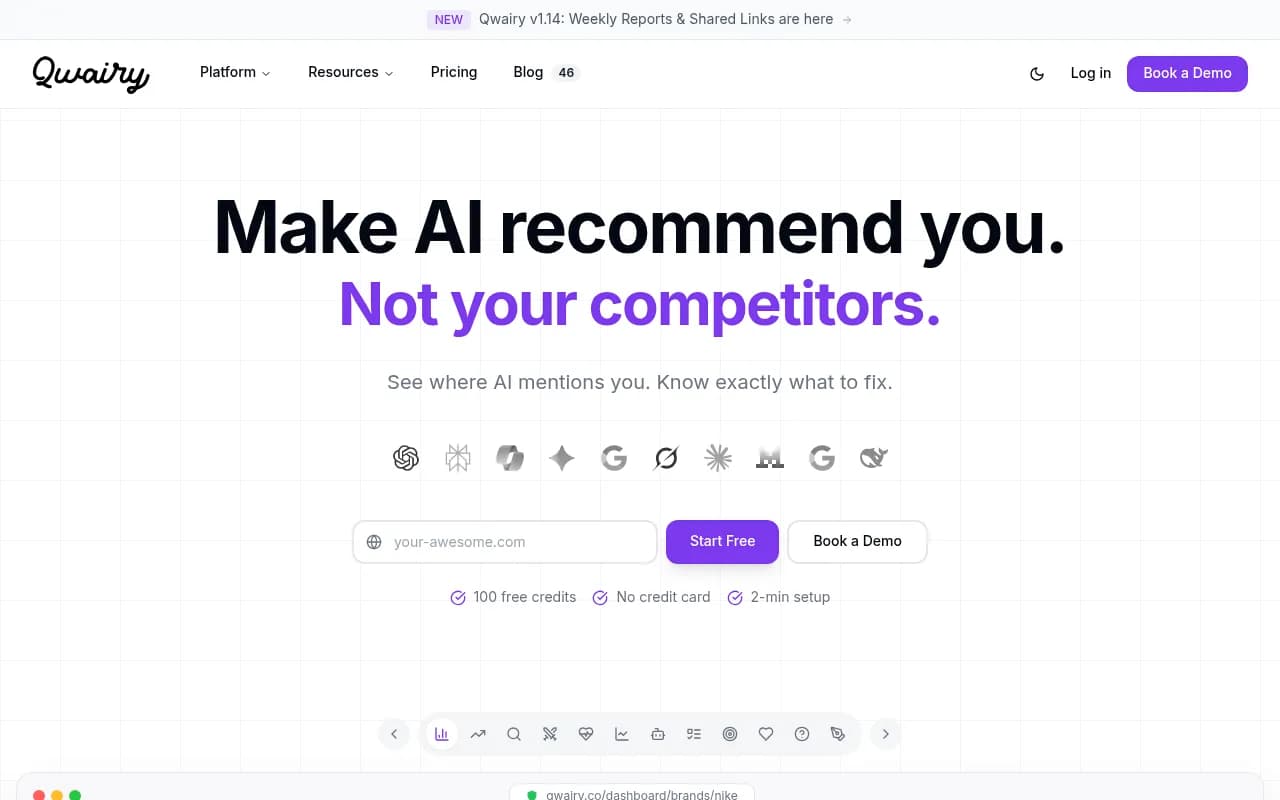
Qwairy markets itself as a GEO strategy and optimization platform, which puts it in a different category than pure monitoring tools. It's worth including here because it's increasingly showing up in conversations about AI visibility strategy, particularly for agencies.
The honest assessment in 2026 is that Qwairy has ambitions that exceed its current feature depth. It offers prompt tracking and some optimization guidance, but the content generation capabilities and crawler-level insights that would make it a genuine end-to-end platform aren't fully there yet. It's worth watching, but it's not yet the complete solution it positions itself as.
Promptwatch
Promptwatch is the most feature-complete platform in this comparison. It monitors 10 AI models (ChatGPT, Perplexity, Claude, Gemini, Google AI Overviews, Google AI Mode, Grok, DeepSeek, Copilot, and Meta AI), and it's the only tool here that connects monitoring to action in a structured way.
The core workflow is: Answer Gap Analysis shows you which prompts competitors are visible for but you're not. Content Agents then generate articles, listicles, and briefs grounded in that gap data. And page-level tracking shows you when those new pages start getting cited by AI models. That cycle -- find gaps, create content, track results -- is what separates it from the other three.
It also has AI crawler logs, which is genuinely rare. You can see when ChatGPT or Perplexity's crawlers hit your site, which pages they read, and when a crawled page transitions to an actual citation. That's a level of technical visibility that monitoring-only tools simply can't offer.

Feature comparison
| Feature | Qwairy | Promptwatch | Peec.ai | Otterly.AI |
|---|---|---|---|---|
| AI models tracked | ~5 | 10 | Up to 10 | 4 (base) |
| Brand mention monitoring | Yes | Yes | Yes | Yes |
| Share of voice / visibility score | Yes | Yes | Yes | Yes |
| Competitor tracking | Yes | Yes | Yes | Limited |
| Multi-language support | Limited | Yes | Yes | Limited |
| Answer gap analysis | Partial | Yes | No | No |
| Content generation / Content Agents | No | Yes | No | No |
| AI crawler logs | No | Yes | No | No |
| Page-level citation tracking | No | Yes | No | No |
| Reddit & YouTube insights | No | Yes | No | No |
| ChatGPT Shopping tracking | No | Yes | No | No |
| Traffic attribution | No | Yes | No | No |
| Prompt volume & difficulty scoring | No | Yes | No | No |
| Starting price | Custom | $99/mo | €85/mo | $29/mo |
| Free trial | Yes | Yes | Yes | Yes |
Where each tool actually fits
The honest version of this comparison isn't "which tool is best" -- it's "which tool fits where you are right now."
If your team is just starting to pay attention to AI search and you want a low-cost way to see whether your brand is showing up in ChatGPT and Perplexity, Otterly.AI is a reasonable first step. The $29/month entry point is low enough to justify as a monitoring experiment. You'll outgrow it, but it's a good starting point.
If you need multi-language coverage and broader model tracking at a mid-range price, Peec.ai fills that gap. It's particularly useful for European brands that need to track AI visibility across languages. The lack of optimization tools is a real limitation, but if your team handles content strategy separately and just needs reliable data, it works.
Qwairy is worth keeping an eye on, especially for agencies building GEO practices. The strategic framing is right -- it's thinking about AI visibility as something to optimize, not just monitor. But right now, the execution doesn't fully match the positioning. If you're evaluating it, ask specifically about content generation depth and crawler log access before committing.
Promptwatch is the right choice when monitoring data alone isn't enough. If you've already been through the cycle of seeing low visibility scores and not knowing what to do about them, the gap analysis and content generation capabilities are what break that loop. The pricing starts at $99/month for the Essential plan (1 site, 50 prompts, 5 articles per month), which is reasonable for what you get. The Professional plan at $249/month adds crawler logs, which is where the technical depth really opens up.
The deeper problem with monitoring-only tools
There's a structural reason why monitoring-only tools leave teams stuck. Knowing your visibility score is 15% while a competitor sits at 45% tells you there's a gap. It doesn't tell you which specific topics the AI models are drawing on when they recommend that competitor. It doesn't tell you whether you have content that addresses those topics or whether you're missing it entirely. And it definitely doesn't write that content for you.
The research from Similarweb's 2025 Generative AI Report puts this in context: AI platforms generated over 1.1 billion referral visits in June 2025, up 357% year-over-year. That's not a niche channel anymore. And AI-referred visits convert at significantly higher rates than traditional organic traffic. The stakes of being invisible in AI responses are real and growing.
That context makes the monitoring-only trap more costly over time. Every month a team spends looking at a dashboard without acting on it is a month competitors are building the citations and content relationships that AI models rely on.
What to look for when evaluating these tools
A few questions worth asking before committing to any platform:
Does it show you what's missing, not just what's there? Visibility scores tell you how often you appear. Gap analysis tells you what topics you're not appearing for -- and that's the actionable piece.
Can it tell you why AI models are or aren't citing your pages? Crawler log access is the difference between guessing and knowing. If a tool can't show you whether AI crawlers are even visiting your site, you're flying blind on the technical side.
Does it connect to content creation? The gap between "we need content on X topic" and "here's a brief grounded in real prompt data and competitor analysis" is significant. Tools that bridge that gap save weeks of work.
Does it track results at the page level? Aggregate visibility scores are useful for trend reporting. Page-level citation tracking tells you which specific pieces of content are working and which aren't.
Does it cover the models your customers actually use? Four models is fine for a quick experiment. If you're serious about AI search visibility, you need coverage across ChatGPT, Perplexity, Google AI Overviews, Claude, and Gemini at minimum.
The bottom line
The monitoring-only trap isn't a criticism of tools like Otterly.AI or Peec.ai -- they do what they say they do, and they do it reasonably well. The trap is treating monitoring as the end goal rather than the starting point.
If you're evaluating these four tools in 2026, the decision mostly comes down to what you need to do after you see the data. For teams that just need visibility data to report upward, Otterly.AI or Peec.ai will cover it. For teams that need to actually move the number -- to go from 15% visibility to 45% -- Promptwatch is the only platform in this comparison that gives you the full workflow to do that.
Qwairy sits in an interesting middle ground and may close that gap over time. But right now, the gap is real.
The AI search channel is too significant to treat as a reporting exercise. The brands building AI visibility right now are doing it by creating content that AI models actually want to cite -- and that requires knowing what's missing, not just knowing the score.