Key takeaways
- Monitoring your AI visibility is table stakes in 2026. The real differentiator is whether a platform helps you act on what it finds.
- Promptwatch is the only platform in this comparison that closes the full loop: gap analysis, AI content generation, and traffic attribution in one place.
- Rankshift and Rankscale are solid tracking tools but stop short of telling you what to do about the gaps they surface.
- Ranksmith sits in the middle -- more actionable than a pure tracker, but lighter on content generation and crawler intelligence than Promptwatch.
- If you're an agency or brand serious about growing AI search share, the platform that generates content grounded in citation data will outperform one that just shows you a dashboard.
There are now dozens of tools claiming to help you "rank in AI search." Most of them show you a score, a chart, and a competitor comparison -- then leave you staring at the screen wondering what to actually do next.
This guide cuts through four of the most-searched platforms right now: Promptwatch, Rankshift, Ranksmith, and Rankscale. They all live in the GEO (Generative Engine Optimization) space, they all track how brands appear in AI answers, and they all look roughly similar at first glance. But dig into what each one actually does, and the differences matter a lot.
Let's get into it.
What problem are these tools solving?
Before comparing features, it's worth being clear about what we're even measuring. When someone searches in ChatGPT, Perplexity, Claude, or Google's AI Overviews, those models pull from a set of sources they've decided are credible and relevant. If your brand isn't in those sources, you're invisible -- regardless of how well you rank in traditional Google search.
GEO tools exist to answer three questions:
- Are you being cited by AI models right now?
- Where are the gaps -- prompts your competitors show up for but you don't?
- What do you do about it?
Most tools handle questions one and two reasonably well. Question three is where the field splits sharply.
Promptwatch
Promptwatch is the most complete platform in this comparison by a meaningful margin. It's used by 6,700+ brands and agencies including Booking.com and Center Parcs, and it's built around what it calls the "action loop": find gaps, create content, track results.

The gap analysis is genuinely useful. You can see exactly which prompts your competitors appear in but you don't -- not as a vague "opportunity score" but as specific questions and topics your site isn't answering. That alone is more actionable than what most trackers provide.
What sets Promptwatch apart is what comes next. There's a built-in AI writing agent that generates articles, listicles, and comparisons grounded in citation data from over 880 million citations analyzed. This isn't generic content -- it's engineered around the specific prompts and angles that AI models are already citing. You're not guessing what to write; you're filling documented gaps with content that matches the pattern of what gets cited.
The platform also has AI crawler logs, which show you in real time which AI bots (ChatGPT, Claude, Perplexity, etc.) are hitting your site, which pages they're reading, and what errors they're encountering. Most competitors don't have this at all. It's the kind of feature that sounds niche until you realize your site has a crawl error blocking Perplexity from reading your most important pages.
Other notable capabilities: Reddit and YouTube source tracking (AI models cite these heavily and most platforms ignore them entirely), ChatGPT Shopping monitoring, prompt volume and difficulty scoring, query fan-outs, and traffic attribution via GSC integration, code snippet, or server log analysis.
Pricing runs from $99/month (Essential: 1 site, 50 prompts, 5 articles) to $579/month (Business: 5 sites, 350 prompts, 30 articles). Agency and enterprise pricing is custom. There's a free trial.
Rankshift
Rankshift is a focused LLM tracking tool. It monitors how your brand appears across AI search engines and gives you visibility scores, competitor comparisons, and prompt-level breakdowns.
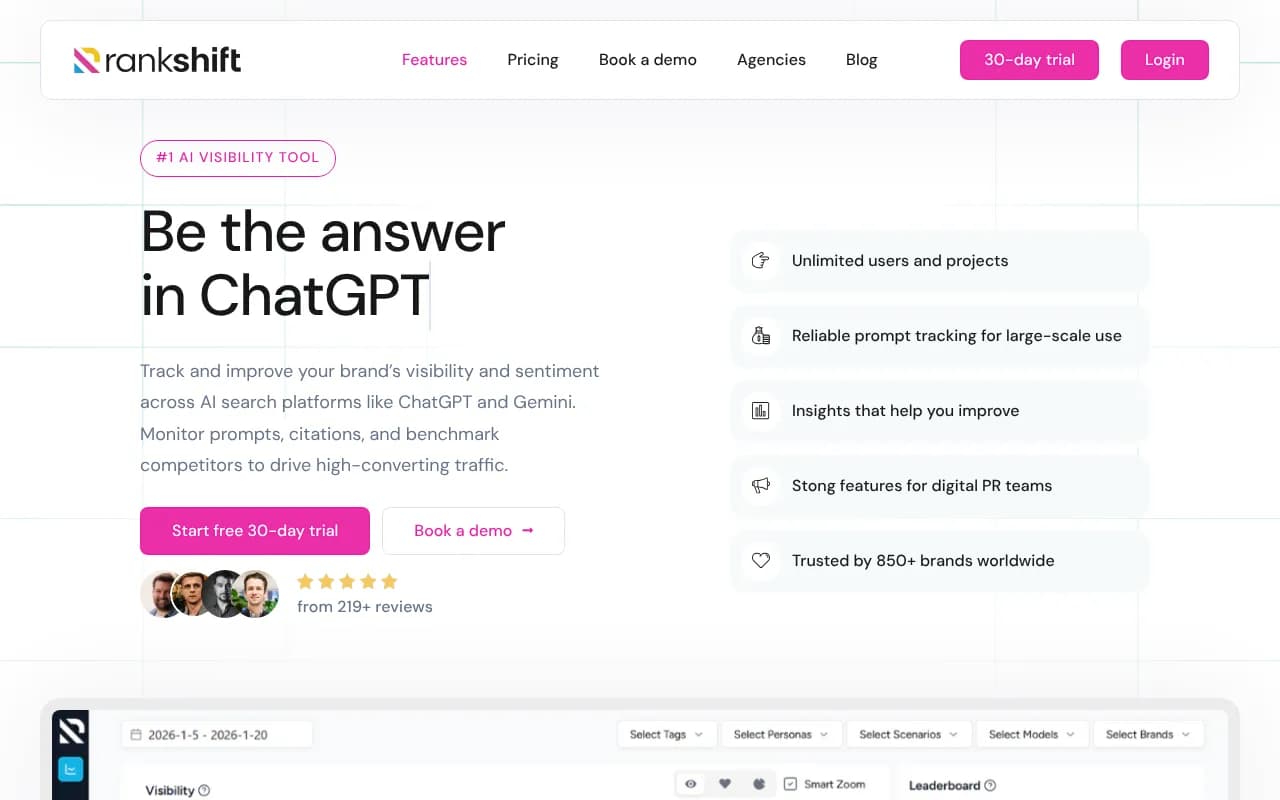
The interface is clean and the tracking is reliable. You can set up prompts relevant to your category and watch how your brand's mention rate changes over time. Rankshift covers the major models -- ChatGPT, Perplexity, Gemini, and others -- and the reporting is straightforward enough that a marketing manager can interpret it without needing to be a GEO specialist.
Where Rankshift falls short is the "now what?" problem. It surfaces the data well but doesn't help you act on it. There's no content generation, no crawler log analysis, no Reddit/YouTube source tracking. If you see your competitor is appearing in 40% of relevant prompts and you're at 12%, Rankshift will tell you that clearly. It won't tell you why, which pages are getting cited, or what content you'd need to create to close the gap.
For teams that already have strong content production capabilities and just need the monitoring layer, Rankshift is a reasonable choice. For teams that need the full workflow, it's a starting point, not a complete solution.
Ranksmith
Ranksmith positions itself around actionable AI visibility insights, which puts it a step closer to Promptwatch's philosophy than Rankshift.
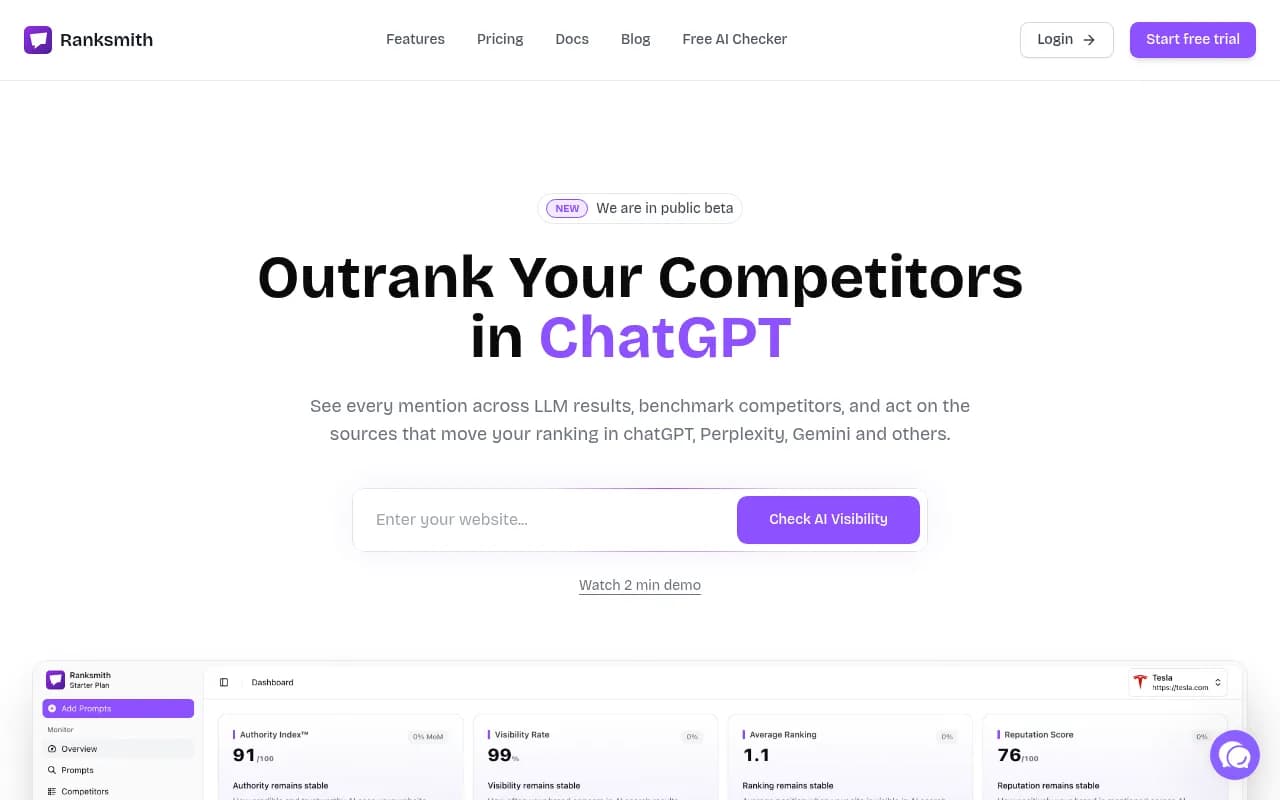
The platform tracks brand mentions across AI models and surfaces what it calls "visibility opportunities" -- prompts and topics where you're underperforming relative to your category. The interface leans into recommendations more than raw data, which is a sensible design choice for teams that don't want to spend hours interpreting dashboards.
Ranksmith is genuinely useful for identifying content angles you're missing. The recommendations are specific enough to be useful -- not just "write more content about X" but more directional guidance about the types of questions and formats that tend to get cited.
The gap relative to Promptwatch is in depth and execution. Ranksmith doesn't have an integrated content generation tool, so you're still bridging to a separate writing workflow. It also lacks crawler logs and the kind of citation-level analysis (which specific pages, Reddit threads, and YouTube videos are being cited) that Promptwatch provides. The prompt intelligence -- volume estimates, difficulty scores, query fan-outs -- is also thinner.
For smaller teams or those just getting started with GEO, Ranksmith's more guided approach can be a good fit. For teams running GEO at scale, the missing pieces add up.
Rankscale
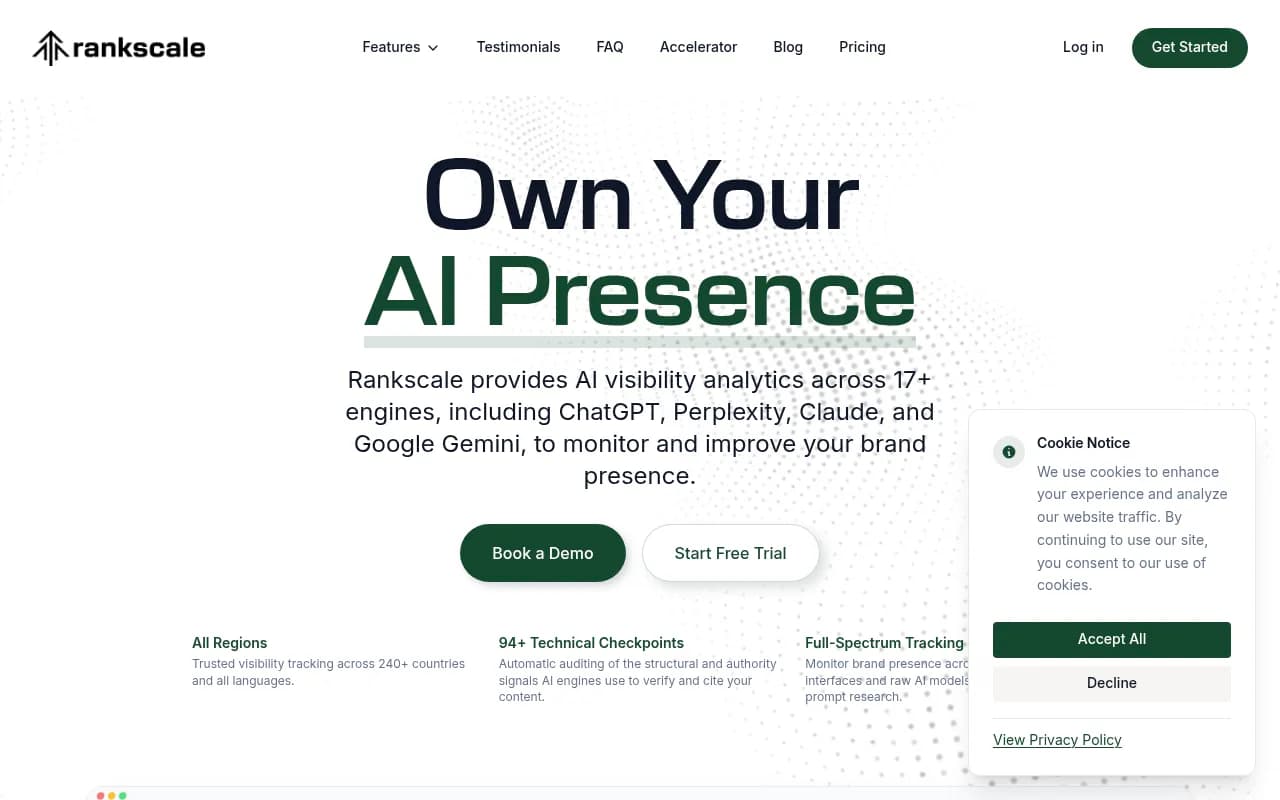
Rankscale is an AI search ranking and visibility platform that covers the monitoring fundamentals.
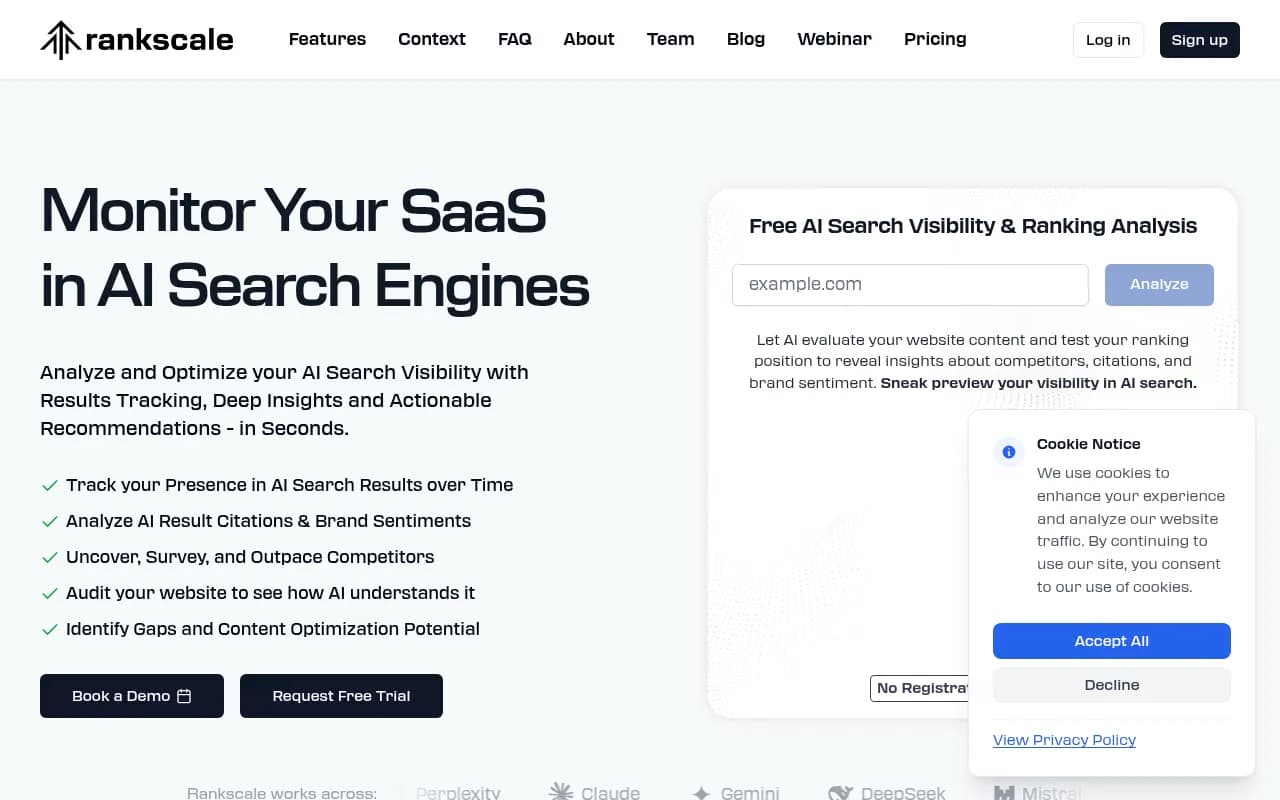
It tracks brand visibility across AI models, shows you how you compare to competitors, and gives you a view of which prompts you're winning and losing. The platform is reasonably priced and accessible, which makes it a popular entry point for teams new to AI visibility tracking.
The honest assessment: Rankscale does the basics well. Prompt tracking, competitor benchmarking, visibility scores over time -- these work. But it's firmly in the monitoring camp. There's no content generation, no crawler intelligence, no Reddit tracking, and no traffic attribution. It tells you where you stand; it doesn't help you move.
There's also a separate tool called Rankscale AI (slug: rankscale-ai) that focuses specifically on AI search rank tracking for GEO. Worth noting if you're evaluating both.
Side-by-side comparison
| Feature | Promptwatch | Rankshift | Ranksmith | Rankscale |
|---|---|---|---|---|
| AI model coverage | 10+ models | Major models | Major models | Major models |
| Prompt tracking | Yes | Yes | Yes | Yes |
| Competitor benchmarking | Yes | Yes | Yes | Yes |
| Answer gap analysis | Yes (detailed) | Limited | Yes | Limited |
| Content generation | Yes (built-in AI writer) | No | No | No |
| AI crawler logs | Yes | No | No | No |
| Reddit/YouTube tracking | Yes | No | No | No |
| ChatGPT Shopping tracking | Yes | No | No | No |
| Prompt volume + difficulty | Yes | No | Partial | No |
| Query fan-outs | Yes | No | No | No |
| Traffic attribution | Yes (GSC, snippet, logs) | No | No | No |
| Page-level citation tracking | Yes | No | Partial | No |
| Multi-language/region | Yes | Limited | Limited | Limited |
| Free trial | Yes | Yes | Yes | Yes |
| Starting price | $99/mo | Varies | Varies | Varies |
Which one should you actually use?
The honest answer depends on what you need from the tool.
If you're a marketing or SEO team that wants to understand your AI visibility, run competitive benchmarks, and feed that data into your existing content workflow, Rankshift or Rankscale can get you there at a lower cost and complexity. They're monitoring tools, and they do that job adequately.
If you want guidance on what to do with what you find -- specific content opportunities, directional recommendations -- Ranksmith is a step up. It's more opinionated about next steps, which helps teams that are newer to GEO.
If you're serious about actually improving your AI visibility and not just measuring it, Promptwatch is the only platform here that closes the full loop. The combination of gap analysis, citation-grounded content generation, crawler logs, and traffic attribution means you're not just watching your score -- you're doing something about it. For agencies managing multiple clients, or brands where AI search is becoming a meaningful traffic channel, that difference compounds quickly.
The monitoring-only approach made sense in 2023 when GEO was new and teams were still figuring out what to track. In 2026, with AI search driving real traffic and real revenue for many brands, "we know we have a problem" isn't enough. You need to fix it.
A note on the broader GEO tool landscape
These four aren't the only options. Tools like Profound, AthenaHQ, and Otterly.AI are also worth knowing about depending on your use case.

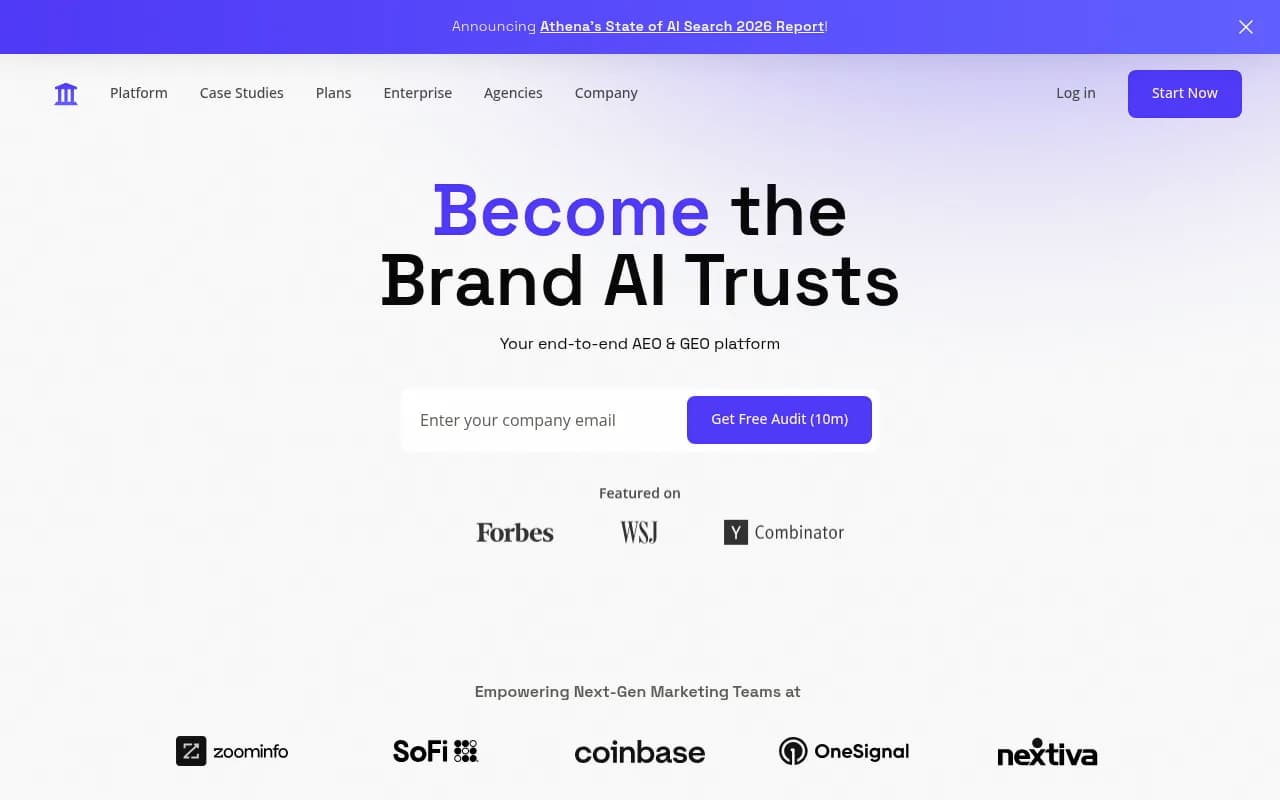

Profound and AthenaHQ have strong feature sets but tend to sit at higher price points and don't include Reddit tracking or ChatGPT Shopping monitoring. Otterly.AI is a popular entry-level option but is firmly monitoring-only -- no crawler logs, no content generation, no traffic attribution.
The pattern holds across the category: most tools are good at showing you the problem. Fewer help you solve it.
Bottom line
Rankshift, Ranksmith, and Rankscale are all legitimate tools. They track the right things, they're reasonably priced, and they'll give you a clearer picture of your AI visibility than flying blind. If your team is just starting to take GEO seriously, any of them is a reasonable first step.
But if you've been tracking your AI visibility for a while and the score isn't moving, the issue probably isn't that you need better data. It's that you need to act on the data you already have. That's where Promptwatch pulls ahead -- it's built to do both, and the gap between "monitoring" and "optimization" is where most GEO programs stall out.