Key takeaways
- Otterly.AI has three self-serve tiers: Lite ($29/mo, 15 prompts), Standard ($189/mo, 100 prompts), and Premium ($489/mo, 400 prompts), plus a Pro tier at $989/mo.
- The Lite plan is genuinely too small for real brand monitoring -- 15 prompts covers a narrow slice of how AI engines actually discuss your category.
- Claude, Gemini, and Google AI Mode are paid add-ons on every tier, not included by default.
- Otterly is a monitoring tool. It shows you where you stand but doesn't help you fix it -- no content generation, no crawler logs, no gap analysis.
- If you need to act on the data (not just read it), you'll likely outgrow Otterly faster than you expect.
Otterly.AI was one of the first tools to put AI search visibility into a clean dashboard that non-technical marketers could actually use. That matters. When ChatGPT and Perplexity started eating into referral traffic in 2024 and 2025, most teams had no way to even measure the problem. Otterly gave them a starting point.
But "a starting point" is doing a lot of work in that sentence. In 2026, the question isn't whether you should track AI visibility -- it's whether Otterly's pricing and feature set still make sense given what's available. Let's go tier by tier.

The Otterly.AI pricing structure
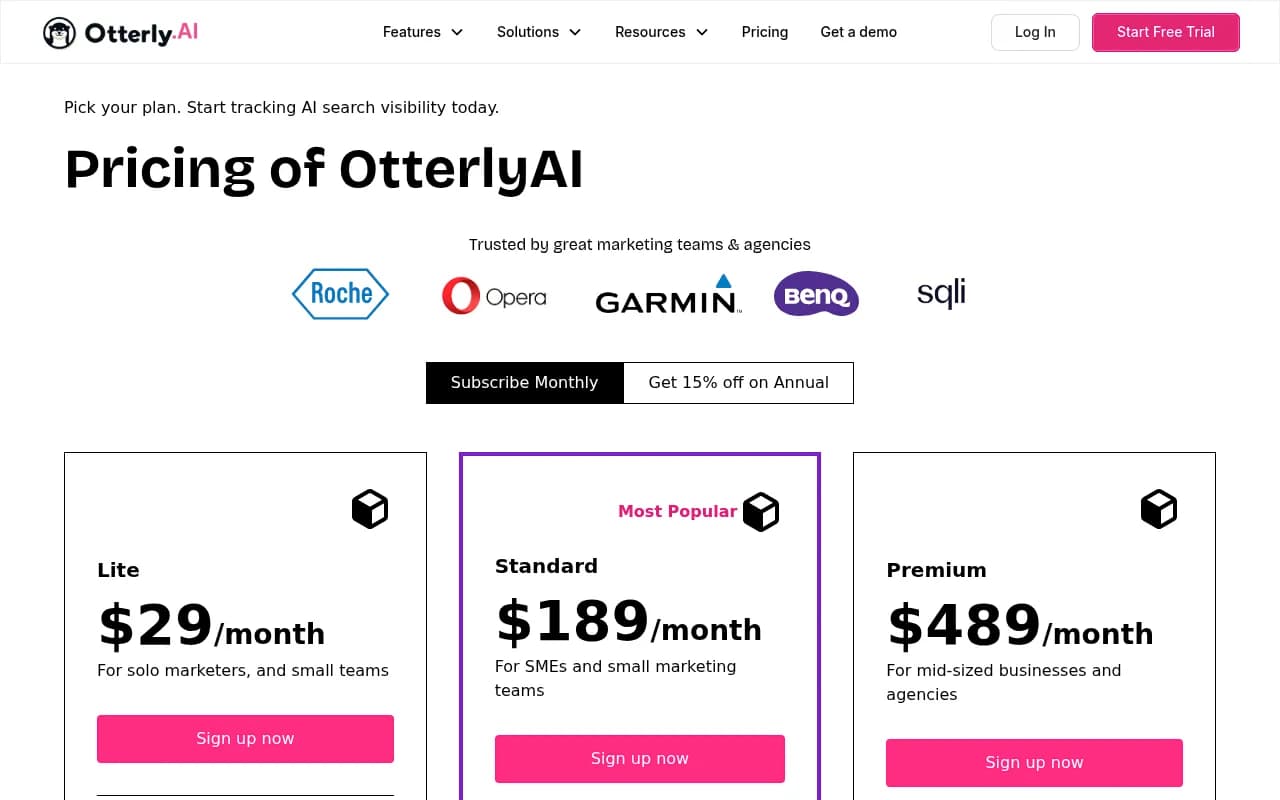
Otterly offers monthly and annual billing (15% off annual). Here's the full breakdown:
| Plan | Price (monthly) | Prompts | AI engines included | Notable extras |
|---|---|---|---|---|
| Lite | $29/mo | 15 | ChatGPT, Google AI Overviews, Perplexity, Copilot | Unlimited team members, daily tracking |
| Standard | $189/mo | 100 | Same 4 engines | API access, MCP, add 100 prompts for $99 |
| Premium | $489/mo | 400 | Same 4 engines | Higher volume, agency use |
| Pro | $989/mo | ~1,000+ | Same 4 engines | Enterprise scale |
Claude, Gemini, and Google AI Mode are listed as "add-ons" across all tiers. That's worth pausing on -- these aren't obscure engines. Claude is one of the fastest-growing AI assistants in 2026, and Google AI Mode is how a large chunk of Google's search traffic now gets handled. Paying extra for them on top of an already-paid plan is a real cost to factor in.
Lite plan ($29/month): who it's actually for
Fifteen prompts. That's what you get.
To put that in context: if you're a SaaS company, you might want to track "best project management software," "alternatives to Asana," "project management tools for remote teams," "what's the best tool for task tracking," and a handful of branded queries. You've already used half your budget, and you haven't touched competitor comparisons or industry-specific questions.
The Lite plan works for one narrow use case: someone who wants to see whether their brand shows up in AI results at all, before committing to a real monitoring budget. It's a proof-of-concept tier, not a working tool.
For solo consultants doing a one-time audit for a client, $29 is reasonable. For anyone trying to track a real brand in a competitive category month over month, you'll hit the prompt ceiling almost immediately.
One thing Otterly does get right at this tier: unlimited team members and daily tracking frequency. Most tools at this price point restrict seats or run weekly refreshes. Daily data on 15 prompts is genuinely useful if those 15 prompts are the right ones.
Standard plan ($189/month): where real monitoring starts
This is the tier most teams will actually need, and the jump from $29 to $189 is steep. That's a 6.5x price increase for roughly 6.5x the prompts -- so the per-prompt cost stays flat, but the sticker shock is real.
At 100 prompts, you can run a meaningful monitoring setup. You can cover your core category queries, a set of branded questions, competitor comparisons, and some long-tail conversational prompts. It's not unlimited, but it's workable.
Standard adds API access and MCP (Model Context Protocol) support, which matters if you want to pull data into your own dashboards or connect Otterly to other tools. For teams that live in Looker Studio or have a custom reporting setup, this is a meaningful unlock.
The add-on pricing ($99 for 100 extra prompts) is also available here, which gives you some flexibility without jumping to Premium. If you need 150 prompts, you pay $288 instead of $489. That's a reasonable middle ground.
What Standard still doesn't give you: any help acting on what you find. You'll see that a competitor is mentioned in 40% of responses to a key query and you're in 8%. Great. Now what? Otterly doesn't have content gap analysis, content generation, or crawler logs to show you why the gap exists. You're on your own to figure out the fix.
Premium plan ($489/month): for agencies and larger brands
At 400 prompts and $489/month, Premium is aimed at mid-sized businesses and agencies managing multiple brands or a large keyword universe. The per-prompt cost ($1.22) is actually slightly better than Standard ($1.89), so if you genuinely need the volume, the math works out.
For agencies, the unlimited team members feature becomes more valuable here -- you can give clients dashboard access without worrying about seat costs.
The core limitation doesn't change at this tier, though. Premium is still a monitoring-only platform. More prompts, same fundamental constraint: you see the data, you don't get tools to act on it.
What Otterly does well
It's worth being fair here. Otterly has a clean interface, and the Brand Visibility Index gives you a single score to track over time -- useful for reporting to stakeholders who don't want to dig into raw data. The GEO Audit with SWOT analysis is a decent structured way to think about your AI visibility gaps, even if the recommendations are fairly generic.
Citation analysis is solid. You can see which URLs are being cited in AI responses, which is genuinely useful for understanding what content AI engines are pulling from. If a competitor's blog post keeps showing up as a source, you know what you're competing against.
Daily tracking frequency across all tiers is a real differentiator at the lower price points. Some competitors run weekly or even monthly refreshes on entry plans.
Where Otterly falls short
The monitoring-only problem is the big one. Otterly shows you a gap. It doesn't help you close it.
There's no content generation, no content briefs grounded in prompt data, no AI crawler logs showing which pages AI engines are actually reading on your site, and no traffic attribution connecting AI visibility to revenue. For teams that want to move from "we know we have a problem" to "we fixed it," Otterly is the first step of a longer process that requires other tools.
The add-on engine situation is also frustrating. Paying for a monitoring tool and then paying extra to monitor Claude feels like being charged for a car and then paying extra for the steering wheel.
And the prompt limits are genuinely constraining. A mid-sized brand in a competitive category can easily need 200-300 prompts to get meaningful coverage. That puts you at Standard plus add-ons, or Premium -- and you're spending $300-500/month on a tool that still only tells you what's happening, not what to do.
How Otterly compares to alternatives
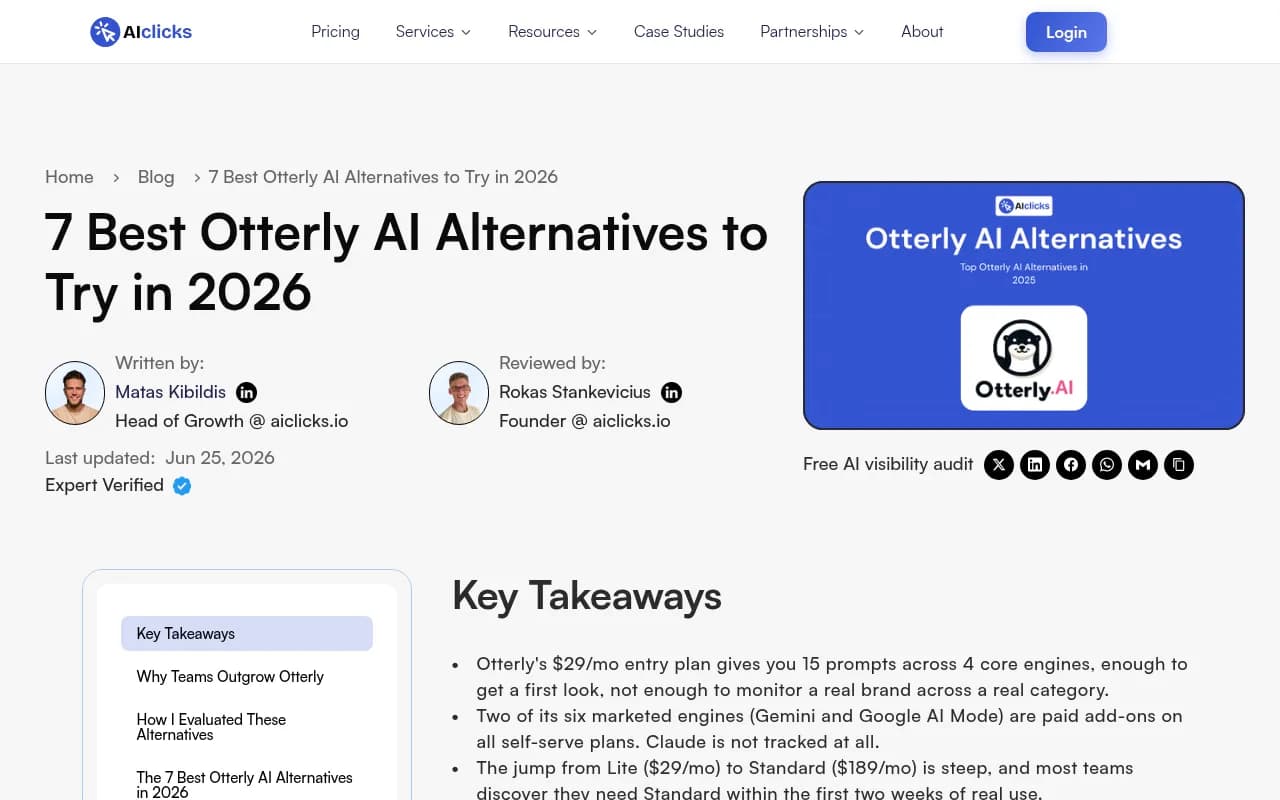
The GEO monitoring space has gotten crowded fast. Here's how Otterly sits relative to the main alternatives:
| Tool | Entry price | Prompts at entry | Content generation | Crawler logs | Best for |
|---|---|---|---|---|---|
| Otterly.AI | $29/mo | 15 | No | No | First-look monitoring |
| Peec AI | Mid-range | Varies | No | No | Clean analytics, multi-language |
| AthenaHQ | Higher | More | No | No | Enterprise, revenue-tied visibility |
| SE Ranking | Bundled | Varies | No | No | Teams already in SE Ranking |
| Promptwatch | $99/mo | 50 | Yes | Yes | Full-cycle optimization |
Promptwatch is the one tool in this comparison that covers the full loop: tracking, gap analysis, content generation, and crawler logs. If you're at the point where monitoring data alone isn't enough, that's where the category goes next.



Is Otterly.AI worth it in 2026?
It depends entirely on what you need.
If you're a solo marketer or consultant who wants to check whether a brand shows up in AI responses, the $29 Lite plan is a reasonable experiment. You'll get a real sense of AI visibility in a few weeks without a major commitment.
If you're a marketing team that needs to monitor a real brand across a real category, you're looking at Standard ($189/mo) at minimum. That's a legitimate tool at a legitimate price, and the daily tracking and citation analysis are genuinely useful. Just go in knowing you'll need other tools to act on what you find.
If you're an agency or a brand that needs to close visibility gaps -- not just measure them -- Otterly's monitoring-only model will leave you wanting more. The data is good, but data without action is just a dashboard.
The honest answer: Otterly is a solid entry point into AI visibility monitoring. It's not a complete solution. Whether that's worth $29, $189, or $489 depends on whether "knowing" is enough for your team right now, or whether you need to actually move the needle.
For teams ready to go beyond monitoring, tools like Promptwatch cover the gap analysis and content generation side that Otterly leaves open.