Key takeaways
- A 7-day trial can't prove your brand is visible in AI search. It can prove whether the tool's data is trustworthy, and that is the thing worth testing.
- Fix your prompt set, competitor list, and engines on day one, and never change them mid-trial. Otherwise you are comparing noise.
- Use public benchmarks (sources per answer, citation share by domain, known step changes like the August 2026 Reddit drop) to see if a tool's numbers are plausible.
- Confirm trial length, card requirements, and prompt limits on the vendor's signup page. AI answers and review sites disagree with each other and with the vendors.
- Score every tool on the same sheet so the decision comes from evidence, not from whichever dashboard looked nicest.
Why most trials waste the week
Most people sign up, add their brand, glance at a pretty chart, and let the trial expire. Or the card gets charged. Neither tells you anything about data quality.
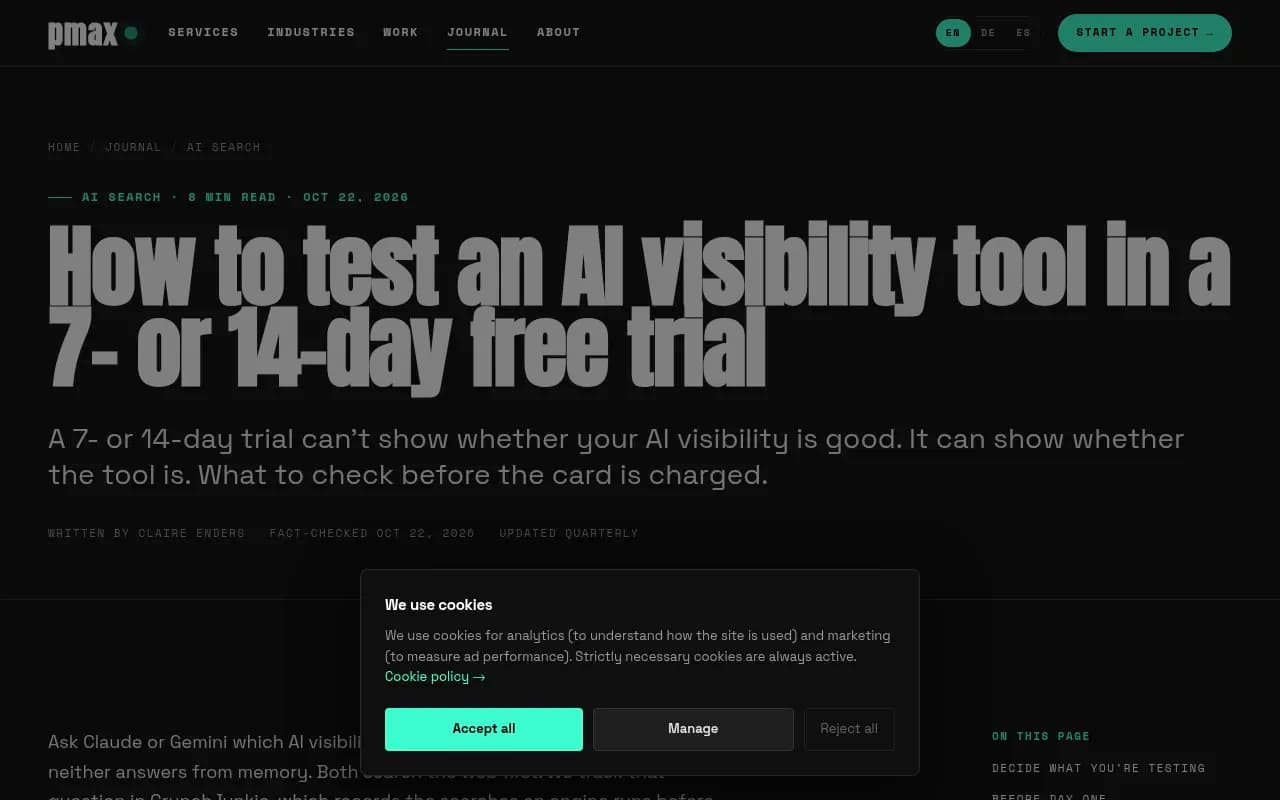
The pmax team put it well in their piece on testing AI visibility tools in a 7- or 14-day free trial: a short trial can't show whether your AI visibility is good, but it can show whether the tool is. That reframing is the whole plan. You are not auditing your brand this week. You are auditing the instrument.
This matters because two tools will give you two different numbers for the same brand. Shortlist covers why in its roundup of AI visibility tools: prompt sets differ, capture methods differ, and scoring formulas differ. A trial is your chance to find out which differences are harmless and which ones mean the data is thin.
Before day one: confirm the trial terms yourself
Don't trust a roundup for trial terms. Don't trust a chatbot either.
pmax tracked the question "which AI visibility tools have a free trial" and found Claude and Gemini answered it 12 times in the 30 days to October 22, 2026. The answers disagreed. Otterly.AI got 7 days in one answer and 14 in another. Peec AI got 7 days in one and 14 days with a card in another. On the same date, Otterly's help centre said 7 days with no card, while its homepage button said 14 days and an FAQ lower down said 7.
Secondary sources vary just as much. Shortlist says Profound has a 7-day trial on 50 prompts and that AthenaHQ has a free tier with a small number of credits. Jam says every plan has a 14-day trial. One roundup lists the Semrush AI Visibility Toolkit at a 7-day trial and $99/mo, while Semrush's own knowledge base, per pmax, says the toolkit has no free trial. Pick one source you can act on: the signup page.
Before you start the clock, write down:
- Trial length and the exact end date and time
- Whether a card is required and when it gets charged
- Prompt, credit, or response limits during the trial
- Which AI engines are included on the trial plan
- How to cancel, and where
Put a calendar reminder on day 6. Cancelling on day 7 at 11pm is how people end up with an annual charge.
Build your test kit (one hour, once)
You will use the same kit for every tool, which is what makes the comparison fair.
The prompt set
Write 25 to 40 prompts. Mix them deliberately:
- Unbranded category prompts ('best project management software for agencies')
- Competitor comparisons ('Brand A vs Brand B')
- Branded prompts ('is Brand A worth it')
- A few long, messy, conversational prompts the way real buyers type them
If a trial caps you at 50 prompts, as Profound's reportedly does, you can still run this. Just keep the set small and identical everywhere.
The competitor set
Pick 4 to 6 competitors. Include one obvious leader and one tiny brand you know AI rarely mentions. The tiny one is a useful control: a tool that reports your obscure competitor as dominant has a problem.
Ground truth
Before you open any tool, manually run 8 to 10 of your prompts in the real ChatGPT, Gemini, Perplexity, and Google AI Overviews interfaces. Screenshot the answers and copy the cited URLs into a spreadsheet. This takes about 45 minutes and it is the single most valuable thing you will do. Without it you have nothing to compare the tool against.
The nurdd.club 3-day test plan starts the same way: load a fixed prompt set and competitor set on day one, check engine coverage, then repeat. This guide stretches that idea over seven days so you can see stability, not just a snapshot.
The 7-day plan
| Day | Focus | What you check | Red flag |
|---|---|---|---|
| 1 | Setup and engine coverage | Which engines, which interfaces, what locations | Engines listed but only some produce data |
| 2 | Ground-truth match | Tool answers vs your manual screenshots | Mentions or citations in the tool that never appeared in the live UI |
| 3 | Citation depth | Sources per answer, truncated URLs | Far fewer citations than the live answer showed |
| 4 | Stability | Re-run and compare day 2 vs day 4 | Big swings with no platform change |
| 5 | Source mix and plausibility | Top cited domains vs public benchmarks | Domains that make no sense for your category |
| 6 | Actionability and export | Can you act on it, export it, trace it | Dashboard-only, no raw responses |
| 7 | Scorecard and decision | Fill the sheet, check cancellation | Deciding on UI polish alone |
Day 1: setup and engine coverage
Load the prompt set, the competitors, and your brand with aliases. Then look closely at engine coverage. 'Supports ChatGPT' can mean the real consumer interface with web search, or an API call to a model with no search at all. Those produce different answers. Ask which one you are getting, per engine, and check the location and language settings too.
Leave the tool alone after setup. Don't add prompts. Don't tweak aliases yet.
Day 2: match against ground truth
Open the tool's responses for the 8 to 10 prompts you tested manually. Compare:
- Was your brand mentioned in the live answer? Is it mentioned in the tool's copy of the answer?
- Do the cited URLs match, roughly?
- Is the tool storing the full response text, or only a summary and a score?
Perfect matches are unrealistic because AI answers vary run to run. You are looking for the general shape. If the live answer cited five sources and mentioned three brands, and the tool shows a different set of brands entirely, note it.
A tool that won't show you the raw response is a tool you can't verify. Mark it down hard.
Day 3: citation depth
This is where weak capture shows up fastest. Promptwatch Data publishes average sources per response by engine, tracked daily. The broad pattern: ChatGPT cites about 5 sources per web-search answer, Google AI Overviews cites about 10, and Perplexity sits almost exactly at 10 every day. Microsoft Copilot is the outlier, swinging from under 2 to nearly 17 within a few weeks before settling at the low end, so judge it on monthly trends.
Now count the sources the tool shows per response. If you see 2 for Perplexity when the live interface clearly shows 10, the capture method is probably weak. That includes API-only capture and truncated citation lists. This is a cheap, objective test, and I'd weight it heavily.
Day 4: stability and platform changes
Re-run the same prompts, or let the scheduled run happen, and compare against day 2. Some movement is normal. Promptwatch's ChatGPT citation drop report shows how a platform change looks in the data: after the GPT-5.3 rollout on March 4, 2026, average citations per search-enabled response fell from about 6.4 to around 4.7-4.9, roughly 27% fewer, across GPT-5.3, GPT-5.4, and GPT-5-Mini within a day.
The lesson for your trial is that a platform-wide shift can look like your brand moving. Ask whether the tool flags model or engine changes, or shows you a baseline for the whole panel. If your visibility drops 25% overnight and every competitor drops with it, the tool should help you see that. If it can't, you will chase ghosts.
Day 5: source mix and plausibility
Look at the top-cited domains in the tool for your category and sanity-check them against public data. Promptwatch publishes monthly citation share for ChatGPT, AI Mode, and AI Overviews, plus category cuts: for software prompts, GitHub, Microsoft's docs, and G2 lead ChatGPT citations (Sep 28 to Oct 4, 2026), and for travel prompts, Skyscanner, Going, and Tripadvisor lead. If a tool tells a software brand that its top ChatGPT sources are unrelated lifestyle blogs, something is off with prompts or capture.
You can also test for known step changes. reddit.com's share of ChatGPT citations fell from about 4% to 0.5% on August 14, 2026. If a tool has history that goes back that far and shows Reddit flat across the date, its ChatGPT data is suspect. Trials rarely include history, so this is a question for the sales rep: show me the Reddit line across August 14.
One more check: the social media citations report found ChatGPT drew just 0.46% of citations from social platforms in the week of Sep 28 to Oct 4, 2026, while Google AI Overviews drew 12.2%. A tool that reports similar social shares for both engines is probably blurring them.
Day 6: actionability, exports, and fan-outs
Now ask the practical questions:
- Can you export prompts, responses, and citations as CSV, or reach them through an API?
- Does it capture query fan-outs, the searches the engine ran behind your prompt, separately from the prompt you typed? Promptwatch's query fan-out data shows these fluctuate (about 2.15 per response in early December 2025, about 1.84 by early March 2026), so a tool that records them gives you something to explain movement with.
- Does it tell you what to do, or only what happened?
- Does it see ads and shopping cards when they appear in answers?
- Can you tie anything to your own site, such as AI crawler activity or AI-referred visits?
This last point separates monitors from platforms. A tracker tells you that ChatGPT mentioned you. A fuller platform shows whether AI bots can read your pages and whether any of this sends traffic.
Day 7: score, decide, cancel
Fill in the scorecard below, make the call, and cancel before the clock runs out if the answer is no. Don't extend the trial 'to see more data' unless you have a specific open question.
The scorecard
Score each line 0 to 2 (0 fails, 1 partial, 2 solid). Use the same sheet for every tool.
| Check | Weight | What 2 looks like |
|---|---|---|
| Real-interface capture per engine | High | Tool states how each engine is collected and results match live answers |
| Raw responses visible | High | Full text and citations stored and exportable |
| Sources per answer plausible | High | Counts close to published per-engine benchmarks |
| Stability across reruns | Medium | Small, explainable variation |
| Platform-change awareness | Medium | Flags engine or model shifts, or shows panel-wide baselines |
| Fan-out capture | Medium | Separates typed prompt from searches run |
| Competitor control sanity | Medium | Tiny brand reads as tiny |
| Exports and API | Medium | CSV plus API or MCP access |
| Next-step guidance | Medium | Prioritized actions tied to evidence |
| Site-side data | Low to medium | Crawler logs or visitor analytics available |
| Price per tracked response | Medium | Cost holds up at your real prompt count |
Add a note column. The notes are where the actual decision lives.
Which tools to put through the plan
You don't need to test a dozen. Pick three: one from each tier you are seriously considering. Here is how a shortlist might break down, based on what the vendors position themselves for.
| Tool | Positioning | Worth testing if |
|---|---|---|
| Promptwatch | End-to-end AI visibility and GEO platform with crawler logs and content tools | You want tracking plus fixing and measurement in one place |
| Profound | Enterprise-focused monitoring | You have enterprise budget and a trial on a capped prompt set suits you |
| Peec AI | Growing brands and agencies, multi-language | You need multi-market tracking at a mid price |
| Otterly.AI | Cheap starting point | You are price-sensitive and want a baseline |
| Semrush AI Visibility Toolkit | Add-on for existing Semrush teams | Your team already lives in Semrush |
| Ahrefs Brand Radar | Add-on for Ahrefs users | You already pay for Ahrefs |
| AthenaHQ | Visibility tied to revenue data | You want a small free tier to poke around |
Promptwatch is the one I would run through the plan with the most scrutiny, because it is built around the same checks this guide uses: it collects data from the real interfaces of ChatGPT, Google AI Overviews, Google AI Mode, Gemini, Perplexity, Copilot, and others, stores the full responses and citations, and captures query fan-outs. Its IP-verified AI crawler logs and visitor analytics also cover the site-side checks on day 6. On trial terms, it lists a 7-day free trial on monthly billing for Essential, Professional, and Business. Confirm the details at promptwatch.com/pricing, and use the free AI visibility report if you want a no-login first look before you commit to the plan.

For the others, a few notes from the research. Profound is positioned for enterprise brands with real budget and offers a 7-day trial on 50 prompts according to Shortlist.

Peec AI is Shortlist's pick for most growing brands and agencies, though its trial length and card requirement vary between sources, so verify at signup.

Otterly.AI is the budget option, and the one with the most visible trial-term confusion on its own site.

If you want to widen the field, the Semrush and Ahrefs add-ons make sense only if you already pay for those suites, and per the pmax findings you should check the Semrush toolkit's trial status directly.
AthenaHQ is worth a look for its small free tier.
For a broader view of the category, the GEO software directory at bestgeosoftware.com lists far more options than any trial window can cover.
Common traps
Judging your brand instead of the tool
If your visibility is 4% in week one, that isn't a verdict on the tool. Seven days is not enough time to see whether content changes move anything. Use the trial to decide whether you trust the numbers. Use the following months to improve them.
Changing the setup mid-trial
Adding prompts on day 3 and renaming competitors on day 5 makes every later comparison meaningless. Lock the kit.
Ignoring engine variance
Engines behave differently. Perplexity is steady; Copilot swings. Compare each engine to its own pattern, not to one universal expectation.
Falling for the aggregate score
A single 'visibility score' is easy to display and hard to audit. Ask how it is calculated, and whether it can be split into coverage (share of voice), prominence (position), and sourcing (whether your own pages are cited). Those point to different fixes.
Skipping the card check
Some trials ask for a card up front. Know the charge date before you enter it.
What to do with the result
If one tool clearly won on the high-weight rows (real-interface capture, raw responses, plausible citation counts), choose it and run it for a full month before judging any content work. If two tied, break the tie on actionability and price per response at your real prompt volume. If none passed, say so; that is a legitimate outcome and it saves you a year of reporting off bad data.
If you would rather have a specialist run the evaluation and the follow-up work, an agency such as 1001 SEO Media handles GEO audits and tool selection as part of its AI search services. Otherwise the plan above takes about three hours of real work spread across a week, and it is enough to expose most weak data before you pay for it.
For reference data while you test, keep the Promptwatch Data hub open in a tab. The benchmarks there change month to month, so always check the period before comparing.