Key takeaways
- A comms prompt set is a reputation instrument, not a keyword list. Start with 20 to 40 prompts, write them as real questions, and freeze them so you can compare month to month.
- Brand-specific prompts behave differently from category prompts. In Promptwatch Data (28 Sep to 4 Oct 2026), brand prompts most often cited 5 domains, while unbranded prompts cited 10 or more about half the time. Track and report them separately.
- Log the exact wording, engine, location, date, full answer, citations, and competitors for every run. Without that, you cannot explain a change.
- The sources AI cites matter as much as the words it uses. Reviews, forums, news, and Wikipedia-style pages usually shape the description of your brand.
- Tag each prompt by risk (crisis, leadership, trust, ESG) so the weekly report can lead with what an executive actually worries about.
Why comms teams need their own prompt set
Most prompt-tracking advice is written for SEO and growth teams. It tells you to track "best [category] tool" and count how often you appear. That is useful for demand generation. It tells a communications team almost nothing.
Comms teams care about a different question: when someone asks an AI assistant about us, what does it say, who does it quote, and is any of it wrong? A buyer asking "is [brand] legit?" is a reputation moment. So is a journalist asking "what controversies has [brand] been involved in?" or a candidate asking "what is it like to work at [brand]?"
Those questions rarely show up in a standard SEO prompt list. The research I reviewed (VisiScan, SE Ranking, Atyla, and others) covers branded, category, local, comparison, and source-discovery prompts well. It says very little about crisis, leadership, ESG, or trust prompts. That gap is what this guide fills.
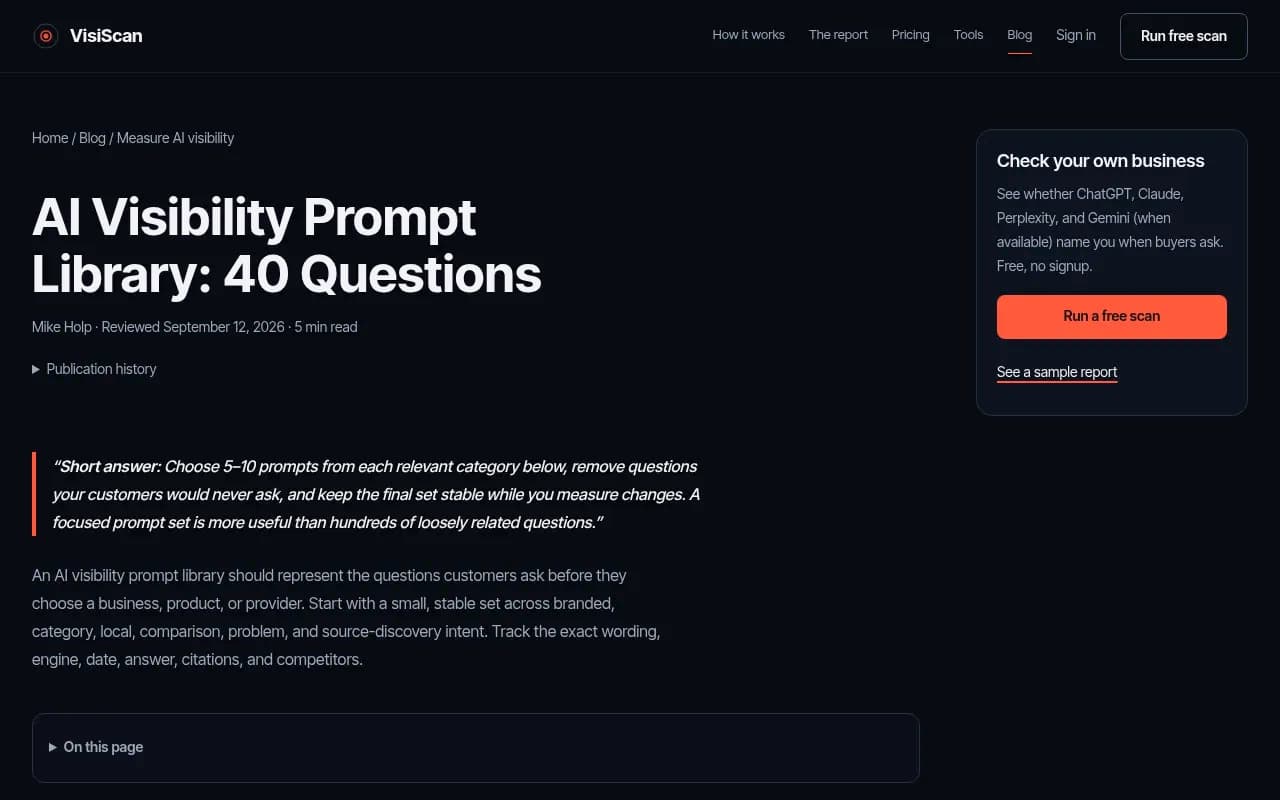
VisiScan's library is a good generic starting point. Its short advice is worth repeating: pick a focused set, remove questions your audience would never ask, and keep the set stable while you measure. I have adapted that structure below for reputation work.
How AI answers shape reputation
Before writing prompts, it helps to know how the answers are built, because it changes what you track.
Brand prompts cite fewer sources
Promptwatch Data on unique domains per ChatGPT response (28 Sep to 4 Oct 2026, responses with at least one citation) shows a clear split:
- Unbranded organic prompts: 52.5% cite 10 or more domains.
- Brand-specific prompts (like "is Asana good for small teams"): 5 domains was the most common count at 14.9%, and 40.7% cite 5 or fewer.
- Competitor comparison prompts: 49.1% cite 10 or more.
For comms, the brand-specific number is the interesting one. When someone asks directly about you, the answer leans on a short list of sources. If two or three of them are a review site, a forum thread, and an old news story, those three pages are effectively writing your reputation. Promptwatch's own advice is to check which review sites and forums land on that short list for brand prompts.
The prompt is not what gets searched
AI assistants rewrite your prompt into short searches. Promptwatch's ChatGPT query fanout data showed average query length falling from about 117 characters in December 2025 to about 53 in April 2026. A long, careful reputation question becomes a few keyword-style searches behind the scenes. So when you find a bad answer, look at the fan-out queries and the pages they retrieve, not just the prompt you typed.
Engines behave differently
Promptwatch's average sources per response page (dated September 2025, so treat it as indicative) put ChatGPT at about 5 sources per web-search answer, Google AI Overviews at about 10, and Perplexity at almost exactly 10 every day. Perplexity's steadiness makes it a decent test bench: if your results move there, it is more likely your content than engine noise.
And platforms shift. Promptwatch Data recorded reddit.com's share of ChatGPT citations falling from roughly 4% to 0.5% on August 14, 2026, while social platforms made up 12.2% of AI Overviews citations versus 0.46% in ChatGPT from Sep 28 to Oct 4, 2026. A forum thread that damages you in one engine may be invisible in another. Track more than one engine.
Step-by-step: building the prompt set
1. List what needs protecting
Write down the entities AI might be asked about: the company, the CEO and two or three other executives, flagship products, the parent brand or subsidiaries, and the top three competitors. Add known sensitivities, such as a past recall, a lawsuit, a data incident, a layoff, or a regulatory issue.
2. Write natural questions, not keywords
VisiScan's advice holds here: turn each item into a question a real person would type. "Is Acme safe to use with patient data?" beats "Acme security." Include some longer, messier prompts too, since real users write them.
3. Separate branded from unbranded
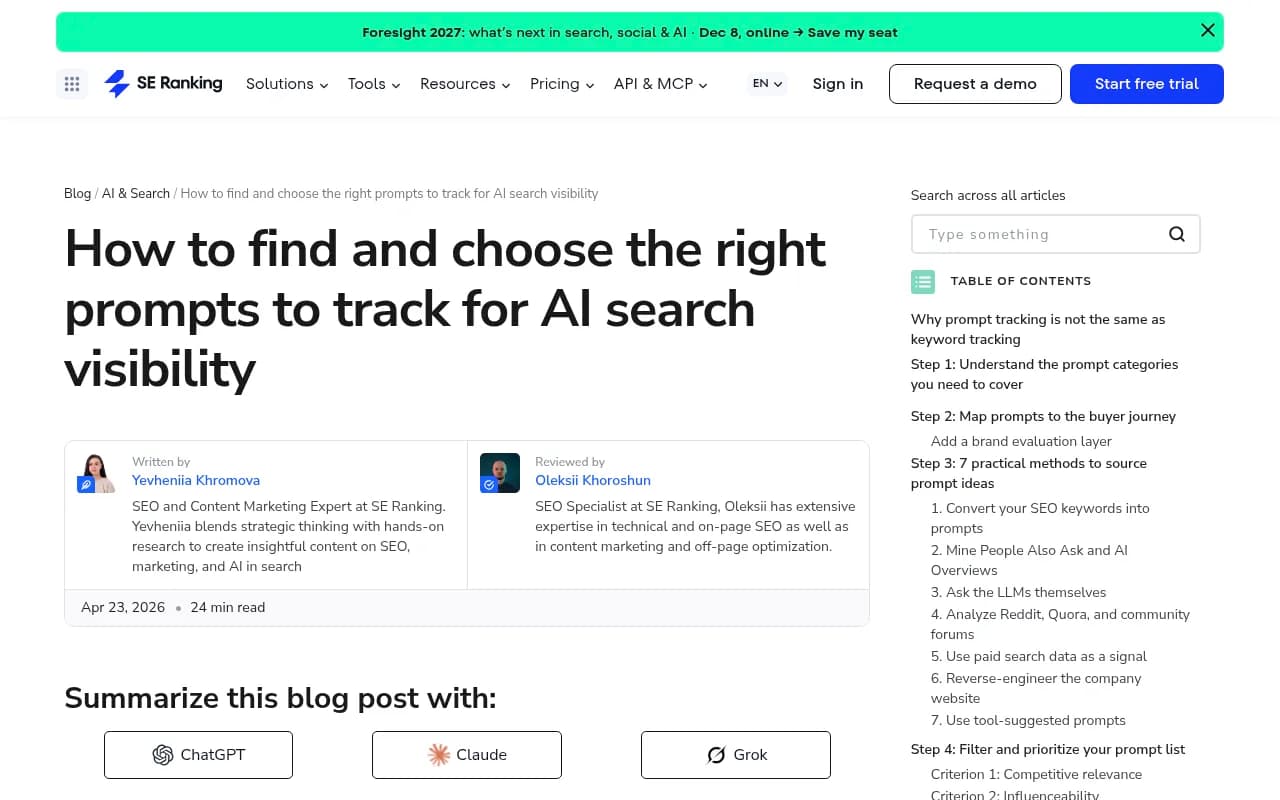
SE Ranking's guide warns that brand comparison prompts skew category metrics when mixed in. Keep branded, competitor, and category prompts in different groups so entity recognition and category visibility are never blended into one number.
4. Choose a size you can read
VisiScan recommends 10 to 30 prompts for a first baseline. The 40 below are a menu, not a mandate. A comms team of two should pick 20 to 25, run them weekly, and actually read the answers. A hundred prompts nobody reviews is worse than twenty someone does.
5. Tag every prompt
Add columns for risk area (crisis, leadership, trust, ESG, product, hiring), audience (customer, journalist, investor, candidate, regulator), and engine. These tags let you answer "how are we doing on trust questions with journalists?" without rebuilding anything.
6. Freeze the set
Once the baseline is running, do not edit the wording. Add new prompts as a separate group instead. If you change a prompt, you have broken the trend line for it.
40 reputation prompts to track
Replace the bracketed terms. Keep the structure.
Brand identity (prompts 1 to 6)
- What is [brand]?
- What does [brand] do, and who is it best for?
- Who owns [brand], and where is it based?
- What is [brand] known for?
- How long has [brand] been around, and how big is it?
- What are the strengths and weaknesses of [brand]?
Trust and legitimacy (prompts 7 to 12)
- Is [brand] legit?
- Is [brand] safe to use?
- Can I trust [brand] with my data?
- Is [brand] a scam, or are there complaints about it?
- What do customers say about [brand]?
- Is [brand] worth the price?
Leadership (prompts 13 to 17)
- Who is the CEO of [brand], and what is their background?
- Who leads [brand], and what is their reputation?
- Has [executive name] been involved in any controversy?
- What has [executive name] said publicly about [industry topic]?
- Who are the founders of [brand]?
Crisis and controversy (prompts 18 to 23)
- What controversies has [brand] been involved in?
- Has [brand] had a data breach or security incident?
- Has [brand] been sued or fined?
- Why did [brand] [past event, such as a recall, layoff, or outage]?
- What happened with [brand] in [month and year]?
- Is [brand] under investigation?
Values, ESG and employer reputation (prompts 24 to 28)
- Is [brand] a good company to work for?
- What is [brand]'s record on sustainability?
- Does [brand] treat its employees and suppliers fairly?
- What does [brand] stand for, and does it follow through?
- How diverse and inclusive is [brand] as an employer?
Competitor and category (prompts 29 to 34)
- How does [brand] compare with [competitor]?
- What are the best alternatives to [brand]?
- Which [category] companies are the most trustworthy?
- What are the best [category] providers for [audience]?
- Which [category] providers serve [location]?
- What should I look for in a [category] provider?
Sources and evidence (prompts 35 to 40)
- Which sources explain [brand]'s [product or policy] clearly?
- Where can I find reviews of [brand] from real customers?
- What do journalists and analysts say about [brand]?
- Which sources compare [brand] with its alternatives?
- What is the latest news about [brand]?
- What are the most reliable sources on [topic your brand is an authority on]?
What to record on every run
For each prompt run, log the exact wording, engine, location, date, the full answer text, every citation, competitors named, and a classification. VisiScan's list is a good one. For comms I would add three more columns:
- Accuracy: accurate, partly accurate, or inaccurate, with a note on what is wrong.
- Tone: positive, neutral, or negative, in your own judgment.
- Source of the claim: the cited page the statement most plausibly came from.
The accuracy column is the one that turns monitoring into action. An inaccurate claim with a traceable source is a task: correct the page, contact the publisher, or publish a clearer first-party page. An inaccurate claim with no source is a model-knowledge problem, which is slower to fix and worth escalating separately.
Metrics that make sense for comms
Atyla's framework splits visibility into mention, citation, recommendation, and category association. That is a sensible base. For reputation, I would layer on a few specific measures:
- Accuracy rate: share of brand answers with no factual errors.
- Sentiment: how the answer frames you, tracked by prompt group.
- Source mix: what share of citations come from owned, earned, review, and forum pages.
- Crisis residue: how often an old incident still appears in answers to neutral prompts like "what is [brand]?"
- Share of voice against named competitors on category prompts.
One prompt tells you little. Promptwatch's advice, and mine, is to read the average across a group of prompts, and to watch the trend rather than any single run. Answers vary by session, location, and history, so a single odd response is not a finding.
Tools to run the set
You can run the first baseline by hand in a spreadsheet and a few browser sessions. It is tedious, but it teaches you what the answers look like. Past 20 prompts across several engines, you will want automation.
| Tool | Good for comms teams because | Watch out for |
|---|---|---|
| Promptwatch | Tracks real-UI answers, sentiment, Brand Narrative claims, and cited sources, then helps fix gaps | More depth than a small team may need at first |
| Profound | Enterprise-grade monitoring across engines | Higher price point, monitoring-focused |
| Peec AI | Simple multi-language tracking | Basic tracker, little on crawlers or content |
| Otterly.AI | Affordable monitoring for small teams | Light on action and analysis |
| VisiScan | Free five-question check, clean prompt library | Not a full ongoing platform |
| Brand24 / Meltwater | Traditional media and social listening, good for pairing with AI tracking | Not built to track AI answers on its own |
If you want a tool that covers the full loop, Promptwatch is the one I would look at first for reputation work. Its Brand Narrative feature pulls the individual claims AI makes about you, such as "affordable for small teams" or "its support is slow", and groups them by theme with a score you can compare against competitors. Fact Check then lets you mark a claim accurate or inaccurate and finds the pages on your own site that state it. That is the comms workflow in one place: see the claim, judge it, find the source.

Promptwatch's pricing starts at $95 per month on Essential, and Fact Check sits on the Business plan ($579 per month), so confirm what you need at promptwatch.com/pricing. The free AI visibility report is a quick way to see a first answer without signing up.
For alternatives, Profound is a common enterprise pick.

Peec AI and Otterly.AI cover basic tracking at lower cost.


VisiScan's free check runs five buyer questions across up to four engines, which suits a first test before you commit to a tool.
If you also need social listening and media monitoring, tools like Meltwater and Brand24 remain useful next to an AI tracker, because they catch the coverage that AI later learns from.
For a wider look at the category, the GEO software directory at bestgeosoftware.com lists more options.
Running the process week to week
Weekly
Run the crisis, trust, and leadership groups. These are the prompts where a bad answer costs you the most. Scan for new claims, new sources, and anything inaccurate. Escalate immediately if an engine repeats a false statement about an executive or a safety issue.
Monthly
Run the full set. Compare against the frozen baseline. Report accuracy rate, sentiment by group, and source mix. Note which engines moved and whether a platform change (like the Reddit citation drop) explains it.
Quarterly
Review the set itself. Remove prompts nobody would ask. Add a new group for a new product, market, or issue, but keep the old frozen panel running so trends stay comparable.
Turning findings into action
When you find a problem, work backwards through the source. Fix or update your own pages first, since that is the fastest lever. Then address third-party pages: request corrections, publish clearer reference content, and encourage accurate reviews. Re-run the prompt after a few weeks and log whether the answer changed. A fix you cannot verify is just a hope.
Common mistakes
- Tracking only prompts where you look good. Include the uncomfortable ones. That is the point.
- Editing prompts mid-stream, which breaks every trend line.
- Reading single answers as facts. Run enough prompts, enough times.
- Mixing branded and category prompts in one score.
- Ignoring location. Answers can differ by country and city, so set the location per run and log it.
- Tracking one engine. Sources differ sharply between engines, as the social citation data shows.
A starter plan for a two-person comms team
Pick 6 prompts from brand identity, 6 from trust, 4 from leadership, 4 from crisis, and 4 from sources. That is 24 prompts. Run them across ChatGPT, Perplexity, and Google AI Overviews. Log everything in a sheet for four weeks, then decide whether automation is worth paying for. Most teams find the answer within the first month, because the first read of the actual answers is usually surprising.
If you want help building the program rather than running it yourself, an agency such as 1001 SEO Media works on generative engine optimization and AI search visibility, and uses Promptwatch as its platform for this work. For the DIY route, the prompts above are enough to start this week.