Key takeaways
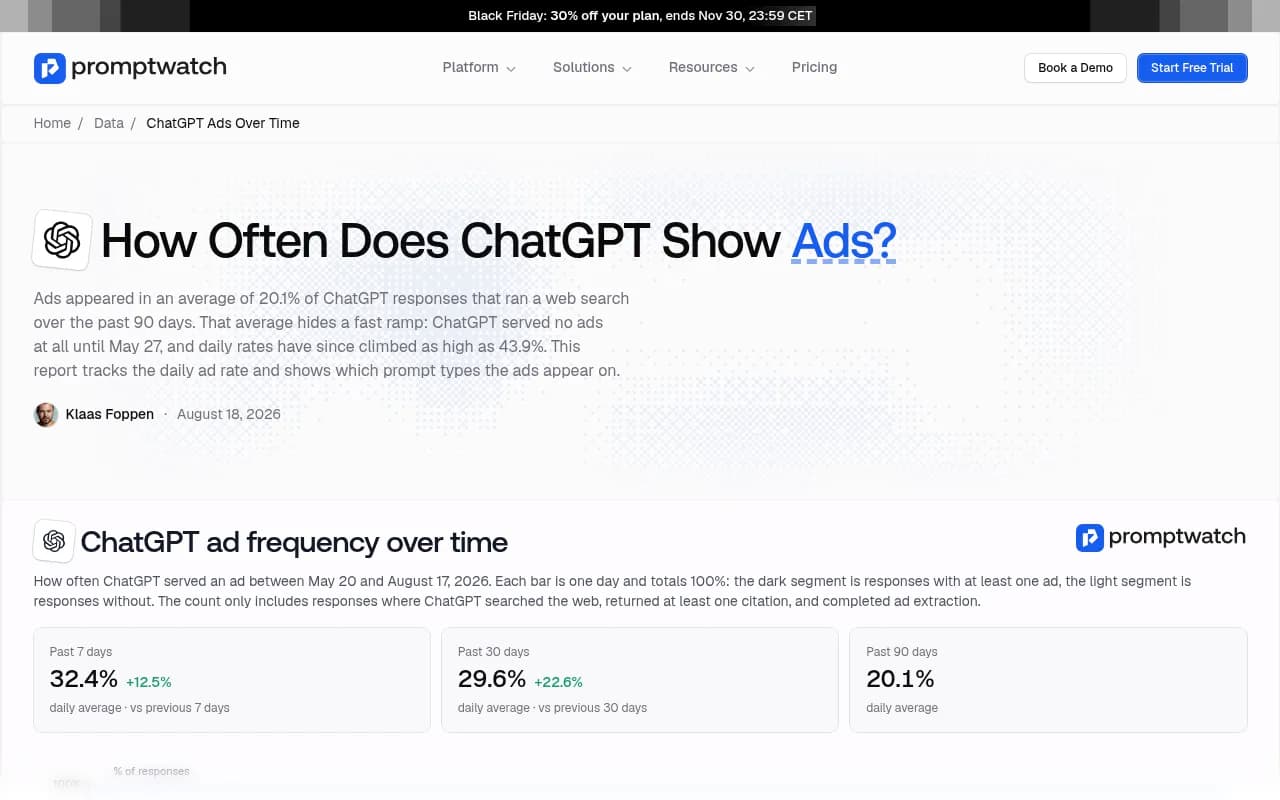
- Across the 90 days from May 20 to August 17, 2026, ads appeared in 20.1% of ChatGPT responses that ran a web search, according to Promptwatch Data.
- The average hides a steep ramp. There were no ads until May 27 (1.69% of responses), the rate jumped past 30% on July 1, and the past 30 days averaged 29.6%, with a single-day peak of 43.9%.
- Organic prompts carry roughly 73% of ad-bearing responses. Brand-specific prompts take about 18% and competitor comparisons about 9%.
- A separate SE Ranking study found ads on about 26% of 50,006 commercial prompts, and about 1 in 7 ads had no real topical link to the prompt.
- One run of a prompt tells you almost nothing. You need several days of data per prompt, plus the advertiser and landing page, before drawing conclusions.
The short answer
It depends on the week you ask. Over the full 90-day window, Promptwatch Data puts the ad rate at 20.1% of responses where ChatGPT searched the web. Over the most recent 30 days it is 29.6%. Over the most recent 7 days it is 32.4%.
Those are three very different numbers describing the same product, and that is the point. ChatGPT ads are a young channel, and the rate has been moving up quickly. If you read a statistic from June, it is already out of date.

The figures here come from Promptwatch's ChatGPT ads over time report, published August 18, 2026 by Klaas Foppen and covering May 20 to August 17, 2026. Promptwatch collects responses from the real ChatGPT interface rather than the API, which matters here because ads only exist in the consumer product.
What counts as a response in this data
Before comparing any ad rate to another, check the denominator. Promptwatch only counts responses where three things happened:
- ChatGPT searched the web.
- The response returned at least one citation.
- Ad extraction completed.
So "20.1%" does not mean 20.1% of everything anyone types into ChatGPT. It means 20.1% of search-powered, citation-bearing answers. Plenty of ChatGPT conversations never touch the web, and those are outside this measurement.
This also explains why different studies land on different numbers. They use different prompt sets and different definitions of a countable response.
The 90-day timeline
May 20 to May 26: nothing
The tracking window opened on May 20. For the first week, ChatGPT served no ads at all in the sampled responses.
May 27: the first ads
On May 27 ads showed up in 1.69% of responses. Small, but it is the first day in this dataset with any ads.
June: climbing in bursts
The rate did not rise smoothly. There was a brief spike on June 25 and 26, then it fell back. That kind of jump-and-retreat pattern looks like testing and rollout adjustments, though Promptwatch is careful to describe when things changed, not why.
July 1: the step change
The rate jumped past 30% on July 1 and stayed there. Since then the daily rate has mostly sat between the low 20s and high 30s. The highest single day in the window reached 43.9%.
Mid-August: still rising
The past 7 days averaged 32.4%, up 12.5% against the previous 7 days. The 30-day average of 29.6% was up 22.6% against the previous 30 days.
| Window | Average ad rate | Change vs prior window |
|---|---|---|
| Launch day (May 27) | 1.69% | n/a |
| Past 90 days | 20.1% | n/a |
| Past 30 days | 29.6% | +22.6% |
| Past 7 days | 32.4% | +12.5% |
| Best single day | 43.9% | n/a |
A second tracker, Seer Interactive, reported in a July 28 update that ads appeared in 7 out of 10 tracked responses in their sample. That is far above Promptwatch's numbers, which is a good reminder that the prompt mix drives the result. A panel full of high-intent commercial queries will see more ads than a broad one.
Which prompts get the ads
Promptwatch splits ad-bearing responses by prompt type. Over the past seven days:
| Prompt type | Share of ad-bearing responses |
|---|---|
| Organic | 73.3% |
| Brand-specific | 18.0% |
| Competitor comparison | 8.6% |
Over the full period, on an average day, the split was 73.1% organic, 17.9% brand-specific and 9.1% competitor comparison. In the early weeks organic swung between 62.71% and 78.32%, and competitor comparisons between 7.24% and 15.60%. Since July 1 the mix has been much steadier.
A trap in this chart
This is a volume mix, not a likelihood. It says where ads appeared, not how likely each prompt type is to trigger one. If your monitor holds mostly organic prompts, organic will dominate the chart even if nothing changed at OpenAI. Add 50 more organic prompts and their share rises on paper.
So do not read the table as "competitor comparison prompts rarely get ads." Read it as "most ad-bearing responses in this sample came from organic prompts."
What other studies found
SE Ranking published a study on August 10, 2026 that approaches the question from the commercial-intent side. They ran 50,006 commercial prompts across 20 US niches on July 23, 2026. Their findings:
- ChatGPT showed ads on 25.94% of commercial prompts, close to Google AI Mode's 29.45%.
- ChatGPT has one ad slot per answer.
- About 1 in 7 ads had no meaningful topical connection to the prompt. In News & Politics and Relationships niches, more than half of ads were off-topic.
- Ads appeared on 28.69% of healthcare prompts in ChatGPT, versus 2.64% in AI Mode.
- In 96.37% of placements, the advertiser was not among the sources cited in the answer.
- BestMoney alone accounted for 13.56% of all ads they saw, across 1,159 unique advertisers.
That last point deserves a second look. Paying for the ad slot rarely puts you in the answer. The paid slot and the cited sources are separate systems, so a brand can be advertising on a prompt while a competitor earns the organic citation.
The SE Ranking figures are a one-day snapshot with a different method, so I would not average them with Promptwatch's numbers. Treat them as a second angle on the same trend: ads are common, concentrated among a handful of advertisers, and not always relevant.
Who sees these ads
According to Promptwatch's roundup of ad tracking tools, OpenAI does not show ads to Plus, Pro or Business accounts, or to users under 18. The ad program started as a US pilot in February 2026, added Canada, Australia and New Zealand in March, and expanded to the UK, Mexico, Brazil, Japan, South Korea and 31 European countries in August 2026.
This has a practical consequence. If your team checks ChatGPT from paid accounts, you will see no ads and conclude the problem does not exist. Seeing ads requires a logged-out or free-tier session in a supported country. It is also why manual spot-checking is unreliable.
How to monitor ads on your own prompts
The report itself gives three pieces of advice, and they hold up.
Look across several days
A single run can land on an outlier day. The daily rate in this data swings between the low 20s and high 30s even after the July step change. One check on one prompt is noise.
Track the advertiser, not just the rate
The rate tells you how often a slot appears. The ad details tell you who wins it. For each prompt you care about, log:
- Advertiser name
- Ad title and description
- Landing page URL
- Date and country
Compare advertisers per prompt segment
Branded prompts, competitor-comparison prompts and generic category prompts attract different advertisers. A competitor bidding on your brand name is a different problem from a marketplace dominating a category query.
Keep your own panel stable
If you change the mix of prompts, your ad rate will change for reasons that have nothing to do with ChatGPT. Hold the panel fixed when you want a trend, and add new prompts as a separate monitor.
Tools for tracking ChatGPT ads
OpenAI's Ads Manager only reports on your own campaigns, and its impressions, clicks and CTR refresh roughly every 15 minutes. It will not show you what competitors run. For that you need a tool that captures real ChatGPT responses.
| Option | What it covers | Best for |
|---|---|---|
| OpenAI Ads Manager | Your own campaign impressions, clicks, CTR | Reporting on ads you buy |
| Promptwatch Ads Radar | Competitor advertisers, ad copy, claims and landing pages by prompt, next to organic visibility | Competitive ad intelligence |
| SE Ranking | Ad detection under AI Search prompts in its Competitive Research | Teams already on SE Ranking |
Promptwatch's Ads Radar captures sponsored placements in ChatGPT, shows which advertisers bid on your prompts, and lets you view them by ad or by prompt. It sits on the Business plan, every agency plan and Enterprise, and it can be pinned to a country, state or city. Its advantage is context: the paid placement sits beside your organic citations and visibility on the same prompts, so you can see when a competitor buys a slot on a query where you are already cited, or where nobody is.
If you want to see your starting position before committing to anything, the free AI visibility report scans how ChatGPT, Gemini and Perplexity talk about your brand. Pricing is on promptwatch.com/pricing, and monthly Business billing starts with a 7-day free trial.
For broader category comparisons, the GEO software directory at bestgeosoftware.com lists other AI visibility platforms.
What this means if you run a brand
Paid and organic are separate fights
Buying an ad does not make ChatGPT cite you. If 96% of advertisers are absent from the answer's sources, as SE Ranking found, then organic citation work still has to happen. Promptwatch's data on which content types ChatGPT cites most shows product pages at 22.4% of citations for September 28 to October 4, 2026, which is where to start.
Expect crowding on organic prompts
Since organic prompts account for most ad-bearing responses, the generic category questions your buyers ask are where an ad card is most likely to sit above your cited page. Knowing which of your tracked prompts attract ads tells you where organic visibility is being diluted.
Watch the sensitive categories
Healthcare and news prompts showed ads at several times the AI Mode rate in SE Ranking's data. If you operate in a regulated or reputation-sensitive space, check what appears next to your brand and whether it is relevant.
Do not benchmark on one number
The honest summary is that the ad rate was 1.69% on launch day and over 30% a month later. Any figure you quote should carry a date and a definition of the denominator.
Limits of this data
- It covers only responses where ChatGPT searched the web and returned a citation.
- The window ends August 17, 2026, so it describes the early rollout, not the current rate.
- Promptwatch's prompts are a panel, not a random sample of all ChatGPT usage, so rates for your niche may differ.
- The data shows when the rate changed, not why.
For a live view rather than a snapshot, the Promptwatch Data hub is updated regularly, and the ChatGPT ads report is the one to bookmark.
Bottom line
ChatGPT went from no ads to roughly a third of search-powered responses in under three months. The 20.1% 90-day average is accurate and also misleading, because the recent rate is closer to 30%. Pick a fixed prompt panel, track it daily, log who is advertising and where they land, and treat any single-day number as noise.