Key takeaways
- A PR agency fixes what trusted publications say about you. A GEO agency fixes whether your own pages answer the questions buyers ask AI engines. An SEO agency fixes whether engines can reach your site at all.
- Promptwatch Data shows owned product and landing pages are the biggest slice of ChatGPT citations (39% combined), while press releases are tiny. That qualifies the claim that earned media is everything.
- News coverage decays fast in ChatGPT (half of cited news pages gone after 36 days). Evergreen listicles, comparisons and reviews last longer.
- Nobody fully owns AI reputation today. Pick the hire based on which layer is empty, and assign one person internally to own the measurement.
- Run a one-afternoon diagnosis before signing any retainer.
The question behind the question
Every few weeks someone asks me some version of this: "Our reputation in ChatGPT is bad or missing. Do we call our PR agency or hire a GEO specialist?" The honest answer is that the question is framed wrong. It is not which acronym wins. It is which layer of the answer is empty for your brand right now.
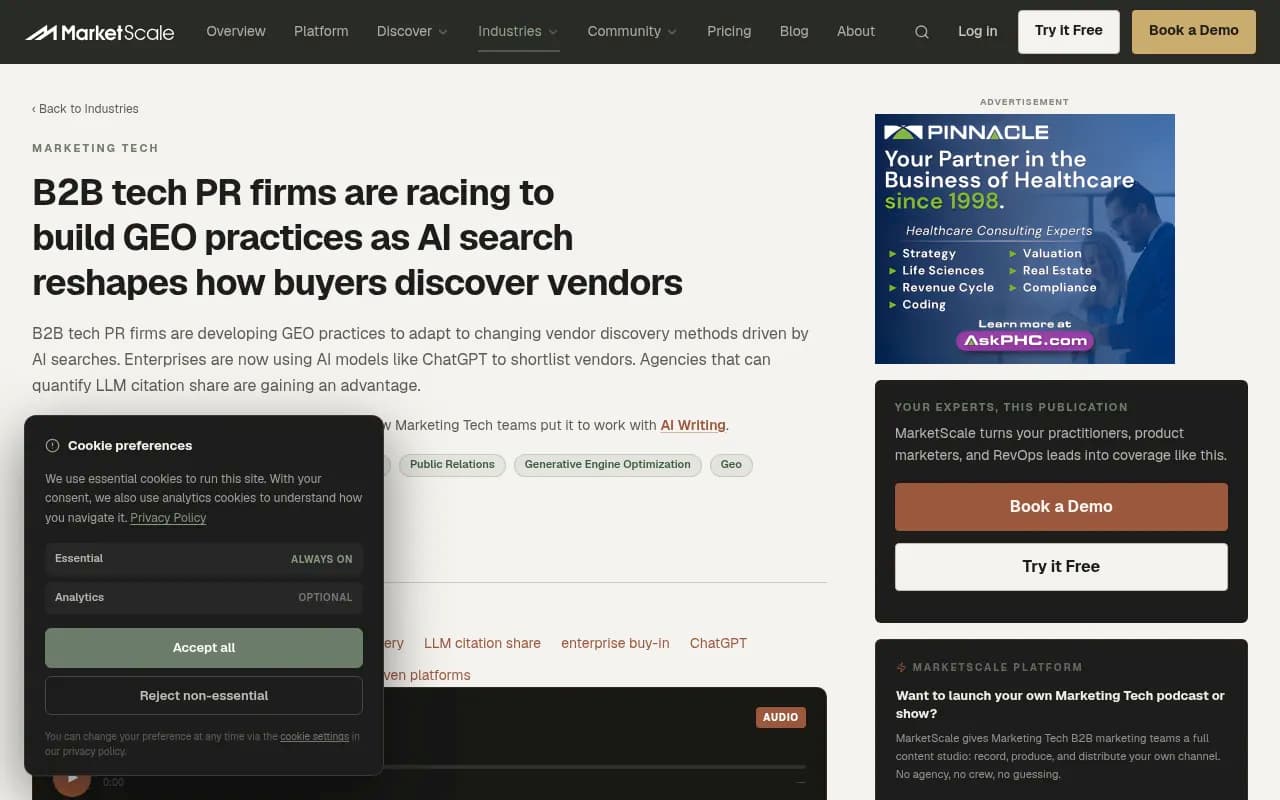
PR and GEO agencies are both racing toward each other's turf. A MarketScale piece from August 2026 describes B2B tech PR firms building GEO practices because enterprises now use ChatGPT to shortlist vendors, and agencies that can quantify LLM citation share are winning RFPs. Worth knowing: the firm-ranking claims in that piece come from Crackle PR's own index changelog, so treat them as self-reported.
Meanwhile, much of the writing on this topic comes from vendors with a stake. PR firms say GEO agencies cannot build earned authority. GEO agencies say PR cannot fix your site. Both are partly right. I will try to separate the evidence from the pitch.
What each type of agency actually does
PR agency
A PR agency earns coverage in publications, podcasts, analyst reports and review roundups. For AI visibility, the useful output is placement in the third-party sources engines pull from: listicles, best-of roundups, reviews, expert quotes and reported features.
What a PR firm usually cannot do: rewrite your product pages, fix crawler access, restructure documentation, or measure citation share per prompt. Many are learning, but most have not run those programs.
GEO agency
A GEO (generative engine optimization) agency works on owned content and technical structure so AI engines can read, understand and cite you. That means pages that answer comparison, pricing and fit questions, original data, schema and entity consistency, and measurement across ChatGPT, Perplexity, Gemini, Claude and Google AI surfaces.
What a GEO agency usually cannot do: get a journalist to write about you. It can brief you and find where competitors are cited, but earned placements need relationships and a story.
SEO agency
Still the foundation. If AI crawlers are blocked, pages are not indexed, or canonicals are a mess, nothing else matters. Most good GEO work includes this, but not every SEO agency has adapted.
What the data says engines actually cite
This is where the debate gets less tribal. Promptwatch publishes first-party research on what ChatGPT cites, and it complicates both sales pitches.

In Promptwatch's data on ChatGPT citation share by content type (Sep 28 to Oct 4, 2026), product pages were 22.4% of classified citations and landing pages 16.8%. That is 39% of citations going to pages describing what a company sells. Listicles were 13.6%, how-tos 8.7%, docs 7.5%, comparisons 5.9%, news 5.7%, reviews 1.7%, and FAQ 3.3%.
For commercial prompts the owned-page share is even higher: product pages 26.0%, landing pages 20.6%, listicles 15.0%, comparisons 7.9%. Those four types make up almost 70% of commercial citations. For branded prompts, reviews climb to 5.6% and social posts to 3.0%, while press releases sit at 2.1%.
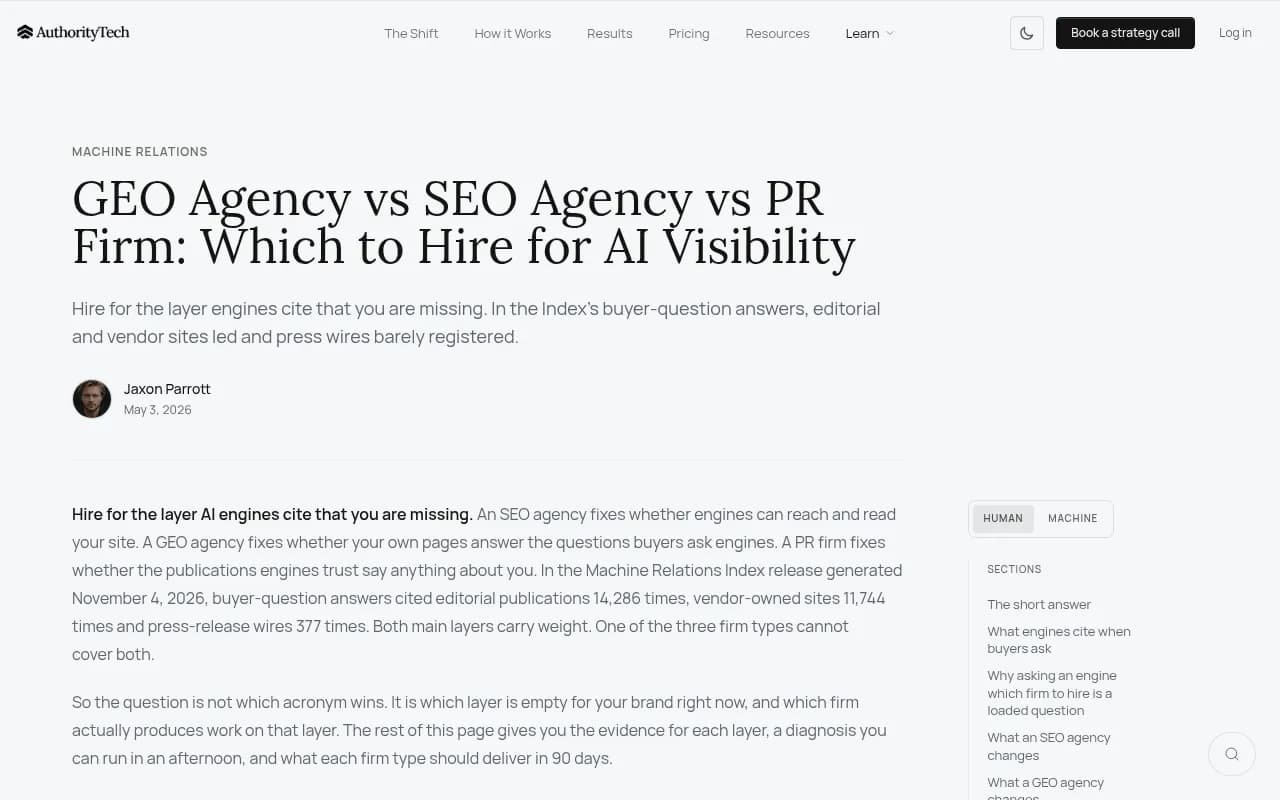
A separate Machine Relations Index release (via authoritytech.io, which sells PR-style services, so weigh accordingly) counted buyer-question answers citing editorial publications 14,286 times, vendor-owned sites 11,744 times and press-release wires 377 times. Different methodology, same shape: editorial and owned sites both matter, wires barely register.
My read: the "earned media is the highest-weight input" line, pushed by some PR-side vendors, is not something I could verify. The data supports a split of labor instead.
| Citation type | Who is best placed to move it |
|---|---|
| Product pages, landing pages, docs, FAQ | GEO agency or in-house content team |
| Listicles, roundups, reviews | PR agency (earned placements) |
| Comparisons | Both: your own comparison pages plus third-party ones |
| News and press releases | PR agency, for short bursts |
| Crawl access, indexing, canonicals | SEO agency or technical lead |
Durability matters: what a retainer buys you
The other thing PR retainers rarely get asked about is decay. Promptwatch Data on content half-life in ChatGPT tracked every page ChatGPT cited on July 6, 2026 for 90 days.
- Landing pages: 78% still cited after 30 days, 69% after 60.
- Docs: 76% after 30 days, 67% after 60.
- Comparisons: 72% after 30 days, 63% after 60.
- Listicles: about 60% still cited after 60 days.
- Product pages, reviews and how-tos: about 55% after 60 days, with half-lives of 74 to 77 days.
- News: half of pages gone after 36 days, and almost a quarter never cited again after day 0.
If your PR program is mostly news announcements, expect short bursts. If it lands evergreen roundups and comparison placements, those hang around. Ask any PR agency which of the two they are selling you.
Where social and community work fits
Community and social presence is often a comms remit, and its value depends heavily on the engine. Promptwatch's November 2026 social citation data (Oct 11 to Nov 9) shows social platforms were 13.16% of Google AI Overviews citations, 1.94% of Perplexity's and 0.64% of ChatGPT's. YouTube alone was 6.71% of AI Overviews citations. Reddit was 0.40% of ChatGPT's.
And Reddit is volatile: reddit.com's share of ChatGPT citations fell from about 4% to 0.5% on August 14, 2026. Building a Reddit strategy for ChatGPT alone is a shaky bet. For AI Overviews and Perplexity it is a different story.
The diagnosis you can run in an afternoon
Pick 20 to 30 real buyer questions: "best X for Y", "X vs Y", "is X worth it", "how to choose X". Run them across ChatGPT, Perplexity, Gemini, Claude and Google AI Overviews. For each answer, note three things: are you mentioned, what sources are cited, and is the description accurate.
Then match the pattern to the hire.
| What you see | Empty layer | Hire first |
|---|---|---|
| Engines can't crawl or index your pages | Access | SEO agency |
| Engines read your site but cite competitors' pages for your category | Owned answers | GEO agency or content team |
| Engines cite publications and reviews where you are absent | Earned evidence | PR firm |
| Engines mention you but describe you wrong | Entity accuracy | Whoever controls both owned and earned sources |
| Gaps on several layers | All | One accountable owner, or a coordinated pair |
Most brands land in the last row. That is uncomfortable, but it is the usual result.
What each should deliver in 90 days
Set expectations before signing.
- SEO agency: AI crawlers allowed (check robots.txt and CDN rules), clean canonicals, indexed and snippet-eligible pages. You can check crawler access yourself with Promptwatch's free Agentic Readiness Check.
- GEO agency: a prompt set tied to your buyers, a gap report, new or rewritten pages that answer the exact questions, original data worth citing, and a baseline plus movement in citation share and visibility.
- PR agency: a target list of the specific outlets and roundups engines cite for your category (not just the ones with the biggest readership), a handful of earned placements in them, and a corrected, consistent description of the company across coverage.
If a PR firm's report is impressions and share of voice in traditional media, and nothing about which cited sources changed, you are buying reach, not AI visibility. If a GEO agency's report is a visibility score and no plan for earned sources, you are getting half the picture.
Questions to ask before you sign
- Which prompts will you track for us, and in which engines, countries and languages?
- How do you measure citations, not just mentions?
- Which cited sources in our category will you target, and why those?
- How do you separate an access problem from a content problem?
- Who owns fixes to our own site? Do you ship them, or hand us a to-do list?
- What does reporting look like at day 30, 60 and 90, and can we see raw data?
- Are you accountable for outcomes in the answers, or for deliverables?
I did not find reliable public pricing for either category, so ask for retainer ranges up front and compare scope, not just fees.
Tools that make either agency accountable
Whoever you hire, you want your own view of the data so you are not grading their homework with their numbers. Promptwatch fits that role: it monitors real AI interfaces, traces which sources get cited, and (on Business plans) has a Content Agent that writes and publishes pages for the gaps. Its AI crawler logs show whether bots can actually read your pages, which is the SEO-agency layer in the table above. Agencies themselves can look at its agency plans. Check pricing for current plan details, or start with the free AI visibility report.
On the PR side, media monitoring tools help you see what coverage exists:
Other monitoring options include Profound and Peec AI:


| Need | Example tools |
|---|---|
| AI citation tracking plus content fixes | Promptwatch |
| AI visibility monitoring | Profound, Peec AI, Otterly.AI |
| Traditional media and brand monitoring | Meltwater, Brand24, Mention |
| Technical crawl and site health | Screaming Frog, Sitebulb |
If you want to browse more options, the GEO software directory at bestgeosoftware.com lists many of them.
When you need both
If your diagnosis shows gaps on owned and earned layers, you have three workable setups.
- One firm covering both. A hybrid agency can be accountable to the answers rather than to its own deliverables. Verify they have actually run earned programs and technical content programs, not just one of them.
- A GEO agency plus your existing PR firm, with a shared prompt list and a shared dashboard. Give them the same target list of cited sources so the work compounds.
- In-house ownership with specialist contractors. One internal person owns AI visibility metrics and briefs both sides.
The third works best in my experience, simply because someone has to own the number. 1001 SEO Media, which publishes this site, runs this kind of work as a combined technical, content, digital PR and GEO service, so I will admit a bias toward integrated setups. Still, the evidence above is what drives the recommendation, not the pitch.
So who owns AI reputation?
Neither agency, on its own. PR owns the sources that talk about you. GEO owns the pages that speak for you. SEO owns whether engines can hear either. The brand owns the measurement and the facts.
Start with the afternoon diagnosis. If the empty layer is access, hire technical help. If it is owned answers, hire GEO. If it is third-party evidence, hire PR with a list of named, AI-cited targets, and favor evergreen placements over news bursts. Then re-run the same prompts after 90 days and see whether the answers moved.