Key takeaways
- Solo marketers and agency teams have fundamentally different needs from GEO tools -- budget, multi-client support, and white-labeling matter as much as raw features
- Monitoring-only tools are fine for basic awareness, but if you want to actually improve AI visibility, you need a platform that helps you act on the data
- Entry-level GEO monitoring now starts under $30/month, making it accessible to individual consultants and small teams
- Agencies should prioritize platforms with multi-site management, client reporting, and content generation -- not just dashboards
- The biggest mistake teams make is picking a tool based on feature lists rather than workflow fit
The GEO tool market has exploded. Two years ago, there were maybe a handful of platforms tracking AI citations. Now there are dozens, each with slightly different positioning, pricing, and depth. That's good for competition, but genuinely confusing when you're trying to figure out which one to actually buy.
The problem is that most comparisons treat "GEO tools" as a single category. They're not. A solo consultant managing one brand has completely different needs from an agency running 40 client accounts. The features that matter, the pricing that makes sense, and the workflows that fit are different enough that a tool perfect for one context is actively wrong for the other.
This guide cuts through that. We've mapped 15 platforms against two distinct use cases -- solo marketers and agency teams -- so you can skip the feature-list rabbit hole and find what actually fits your situation.
What makes a GEO tool right for solo marketers?
Solo marketers -- whether in-house at a small brand or working as independent consultants -- have a few non-negotiable constraints. Budget is real. Time is limited. There's usually no dedicated analyst to interpret dashboards, so the tool needs to surface clear, actionable insights without requiring a lot of setup or interpretation.
The ideal solo GEO tool:
- Has a low entry price (under $100/month ideally)
- Covers the core AI platforms: ChatGPT, Perplexity, Google AI Overviews, Claude, Gemini
- Gives you clear visibility scores without needing a data analyst to make sense of them
- Ideally helps you do something about gaps, not just identify them
- Doesn't require you to manage multiple workspaces or client accounts
What solo marketers don't need: white-label reporting, multi-seat access, API integrations, or enterprise-grade SLAs. Paying for those is just waste.
What makes a GEO tool right for agency teams?
Agencies have the opposite problem. They manage multiple clients, often in different industries, and need to demonstrate value on a regular cadence. The tool needs to scale horizontally across accounts, not just go deep on one.
The ideal agency GEO tool:
- Supports multiple sites or clients under one account
- Has white-label or branded reporting options
- Allows team members to collaborate without buying separate seats
- Provides prompt-level data that can be translated into client deliverables
- Ideally connects visibility data to content recommendations so the agency can show work, not just numbers
Agencies also tend to care more about competitive benchmarking -- clients want to know how they compare to competitors, not just their absolute score.
The 15 platforms, mapped by use case
Here's the full comparison. Pricing reflects 2026 published rates where available.
| Platform | Best for | Entry price | Multi-site | Content generation | AI models tracked |
|---|---|---|---|---|---|
| Promptwatch | Solo + Agency | $99/mo | Yes (Business: 5 sites) | Yes | 10+ |
| Peec AI | Agency | ~$29/mo | Yes | No | 6+ |
| Otterly.AI | Solo | ~$19/mo | Limited | No | 5+ |
| Profound | Enterprise/Agency | Custom | Yes | No | 6+ |
| AthenaHQ | Agency | Custom | Yes | No | 8+ |
| Scrunch AI | Agency | Custom | Yes | No | 5+ |
| SE Ranking | Solo + Agency | $65/mo | Yes | Limited | 4+ |
| Semrush | Solo + Agency | $139/mo | Yes | Limited | 3 (fixed prompts) |
| Ahrefs Brand Radar | Solo | $129/mo | Limited | No | 4 (fixed prompts) |
| Rankscale | Solo | ~$49/mo | Limited | No | 5+ |
| Brandlight | Solo | ~$39/mo | Limited | No | 4+ |
| Writesonic | Solo | $16/mo | Limited | Yes (general AI writing) | 4+ |
| ZipTie | Solo | Free tier | No | No | 4+ |
| Search Party | Agency | Custom | Yes | No | 5+ |
| Bluefish | Enterprise | Custom | Yes | No | 6+ |
Let's go deeper on the ones that actually matter.
Best GEO tools for solo marketers
Promptwatch -- best overall for solo marketers who want to act, not just watch
Most solo marketers start with a monitoring tool, see the data, and then have no idea what to do with it. That's the fundamental problem with the majority of GEO platforms: they show you where you're invisible but leave you to figure out the fix yourself.
Promptwatch is different because it's built around a full loop: find gaps, create content, track results. The Answer Gap Analysis shows you exactly which prompts competitors are appearing for that you're not. The built-in AI writing agent then generates content specifically engineered to get cited -- not generic blog posts, but articles grounded in real citation data from over 880 million citations analyzed.
For a solo marketer, that's significant. You don't need a content team or an SEO analyst. The tool tells you what's missing and helps you build it.

The Essential plan at $99/month covers one site, 50 prompts, and 5 articles per month. That's enough for most solo marketers to get meaningful visibility data and start producing optimized content. The AI crawler logs (available on Professional and above) are genuinely useful -- they show you which pages ChatGPT and Perplexity are actually reading on your site, which is something most tools don't surface at all.
Otterly.AI -- best for solo marketers on a tight budget
If $99/month is too much and you just need basic monitoring, Otterly.AI is the most accessible entry point in the market. At around $19/month, you get prompt tracking across the main AI platforms and a simple visibility score.

The honest limitation: it's monitoring only. You'll see where you appear and where you don't, but there's no guidance on what to do about it. For someone just starting to understand their AI visibility, that's fine. For someone who wants to improve it, you'll hit a ceiling fast.
SE Ranking -- best for solo marketers who already use traditional SEO tools
SE Ranking has been a solid mid-market SEO platform for years, and its AI visibility toolkit is a genuine addition rather than a bolt-on. If you're already tracking keyword rankings and running site audits in SE Ranking, adding AI visibility monitoring to the same workflow makes sense.
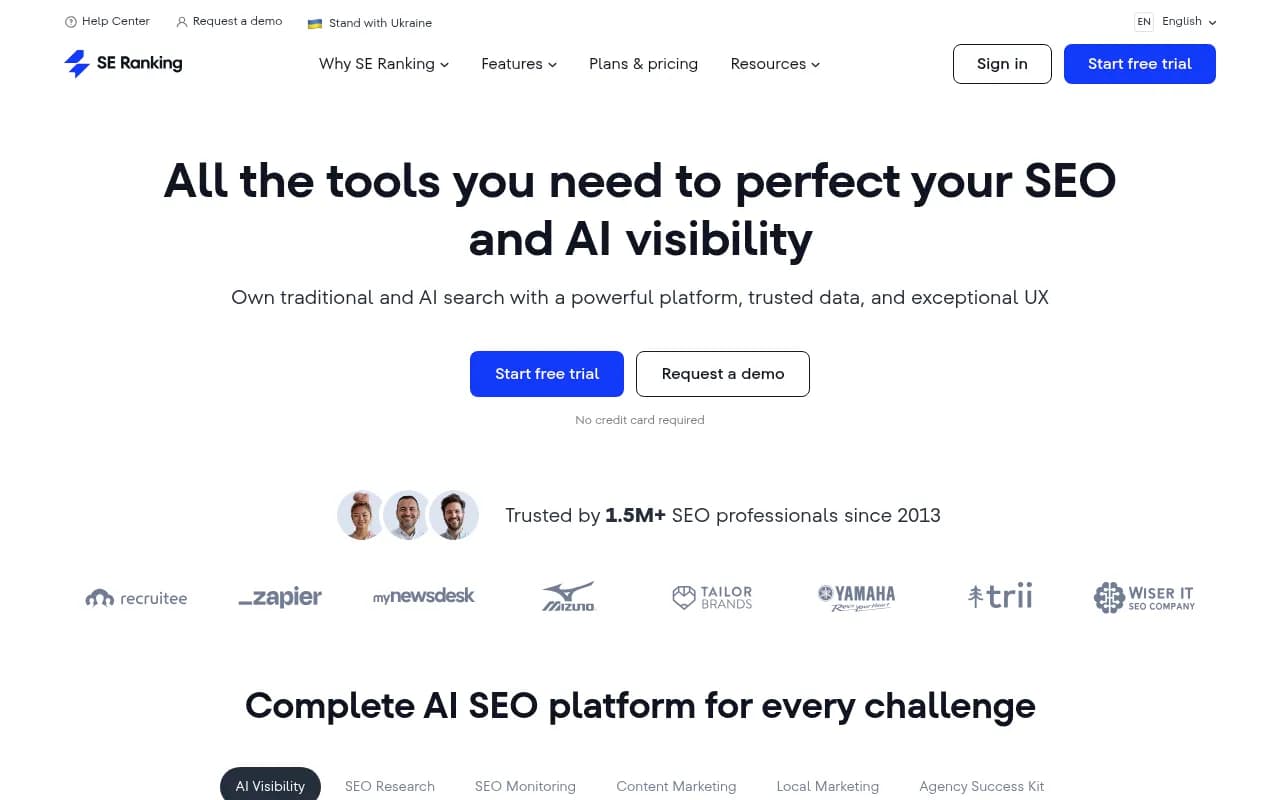
The AI tracking covers Google AI Overviews particularly well, which matters if your audience is primarily Google users. Coverage of ChatGPT and Perplexity is improving but not as deep as dedicated GEO platforms.
Rankscale -- best for solo marketers who want simple, clean data
Rankscale keeps things simple. You add your brand, your competitors, and a set of prompts, and it tracks how often each appears across AI models. The interface is clean and the data is easy to interpret without any training.
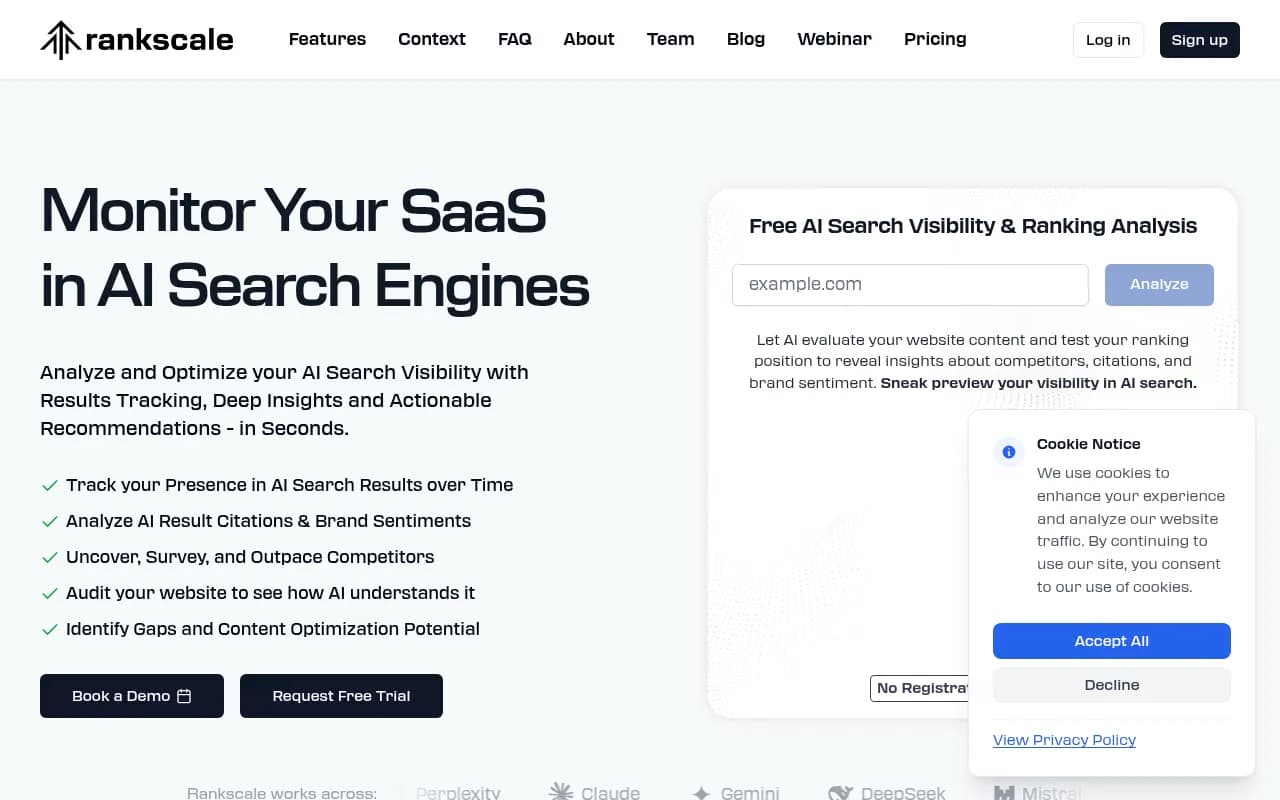
It's not trying to be an all-in-one platform, which is actually a strength for solo users who don't want to spend hours learning a complex tool. The trade-off is limited depth -- no content recommendations, no crawler logs, no traffic attribution.
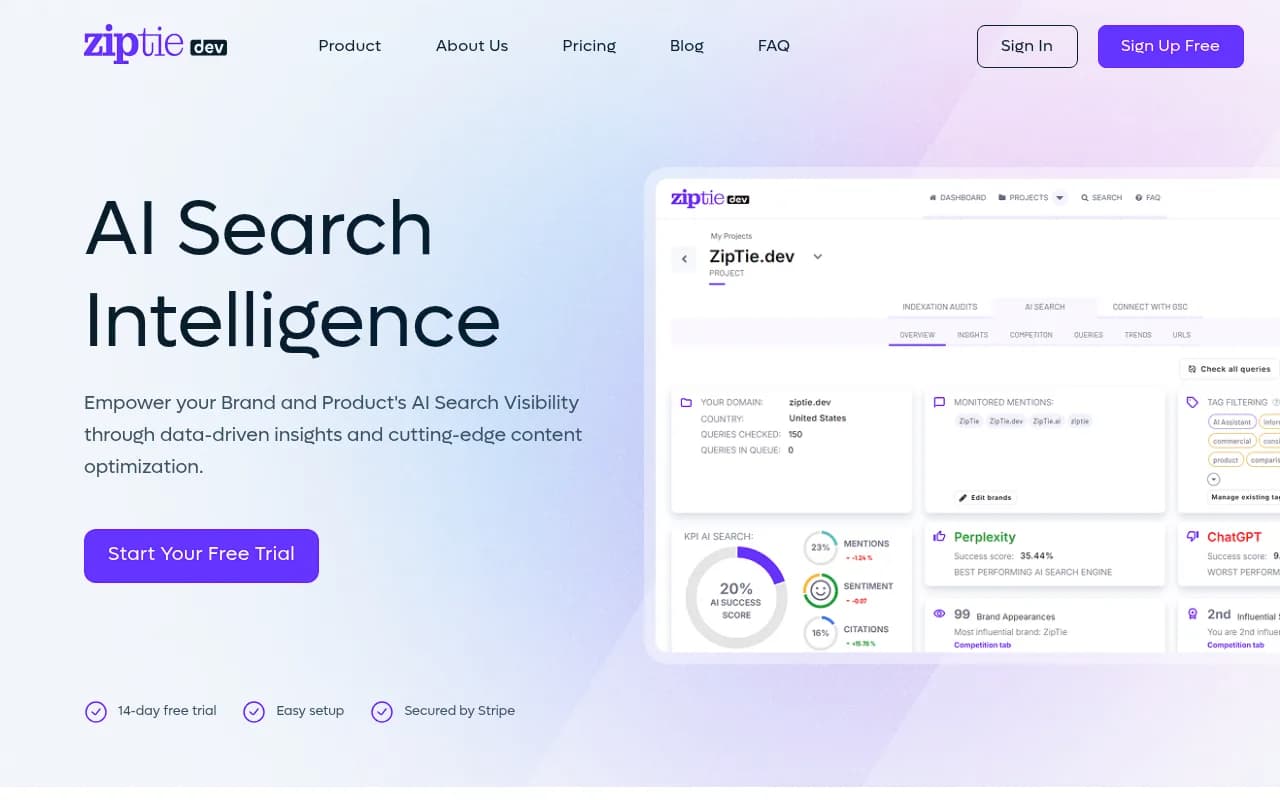
ZipTie -- best free option for initial diagnosis
If you want to get a quick read on your AI visibility before committing to a paid tool, ZipTie offers a free diagnostic that's worth running. It's not a full monitoring platform, but it gives you a starting point.
Best GEO tools for agency teams
Promptwatch -- best for agencies that need to show work, not just data
Agencies live and die by client deliverables. A dashboard showing visibility scores is fine, but clients want to know: what did you do this month, and did it work?
Promptwatch's action loop is built for exactly that narrative. You can show a client their Answer Gap Analysis (here are the prompts your competitors own that you don't), then show the content you created to close those gaps, then show the visibility improvement over time. That's a story. Most GEO tools give you data; Promptwatch gives you a story you can tell in a client meeting.
The Business plan at $579/month covers 5 sites, 350 prompts, and 30 articles per month. For agencies with more than 5 clients, custom agency pricing is available. The Looker Studio integration and API are particularly useful for agencies that want to build custom reporting dashboards for clients.
The competitor heatmaps are another agency-friendly feature -- clients love seeing how they stack up against specific competitors across different AI models.
Peec AI -- best for agencies prioritizing margin
Peec AI is worth a look if you're running a lean agency and need to keep tool costs low relative to client billing. It's one of the more affordable multi-client platforms, and it handles multi-language tracking well, which matters if you have international clients.

The limitation is that it's monitoring-focused. There's no content generation, no crawler logs, and no traffic attribution. For agencies that handle content strategy and creation separately, that's fine. For agencies that want a single platform to cover the full GEO workflow, it's not enough.
AthenaHQ -- best for agencies focused on enterprise clients
AthenaHQ tracks visibility across 8+ AI engines and has solid multi-brand management. It's positioned toward larger accounts and the feature set reflects that -- deep competitive analysis, detailed prompt-level data, and clean reporting.

The gap is the same as most competitors: it's a monitoring and analysis platform, not an optimization platform. You'll know exactly where your clients stand, but the tool won't help you move the needle.
Profound -- best for agencies with data-heavy clients
Profound has strong data depth and is popular with agencies that serve clients who want detailed analytics rather than simple scores. The competitive intelligence features are particularly good.

Pricing is custom and tends to run higher than mid-market options. Worth evaluating if your clients are in competitive categories where granular data matters.
Search Party -- best for agencies that want to embed AI automation
Search Party takes a different angle -- it's more of an AI automation agency tool than a pure GEO tracker. If your agency wants to automate parts of the GEO workflow rather than just monitor it, it's worth looking at.
Prompt metrics and content gap analysis are limited compared to platforms like Promptwatch, but the automation angle is genuinely differentiated.
Scrunch AI -- best for agencies managing brand-heavy clients
Scrunch AI has good brand monitoring depth and works well for clients where brand narrative and sentiment in AI responses matters as much as citation frequency.
Rankability -- best for agencies focused on reporting
Rankability is built with agency reporting workflows in mind. The client-facing dashboards are clean and the data is easy to present without requiring the client to understand the underlying methodology.
The monitoring-only trap
One pattern worth naming directly: most GEO tools are monitoring dashboards. They show you data. They don't help you act on it.
That's fine if you have a team that can take visibility data and translate it into a content strategy. Many agencies do. But for solo marketers, and for agencies that want a tighter loop between insight and action, monitoring-only tools create a workflow gap. You end up paying for data and then paying separately (in time or money) to figure out what to do with it.
The platforms that close this gap -- primarily Promptwatch, and to a lesser extent Writesonic and some of the AI writing tools -- are worth a premium if acting on the data is part of your job.
How to choose: a decision framework
Rather than a feature checklist, here's a simpler decision tree:
Are you managing more than 3 client accounts? If yes, you need multi-site support and client reporting. Promptwatch (Business or Agency), AthenaHQ, or Peec AI are your starting points.
Is your primary goal understanding your current visibility, or improving it? If understanding, almost any monitoring tool works. If improving, you need content gap analysis and ideally content generation. That narrows the field significantly.
Do you have a content team that can act on insights? If yes, a monitoring-only tool is fine -- your team handles the content side. If no, you need a platform with built-in content generation.
What's your budget? Under $30/month: Otterly.AI or ZipTie for basic monitoring. $30-$100/month: Rankscale, Brandlight, SE Ranking. $100-$300/month: Promptwatch Essential or Professional. $300+/month: Promptwatch Business, Profound, AthenaHQ.
Do you need traffic attribution? Most tools don't offer this. Promptwatch does (via code snippet, GSC integration, or server log analysis). If connecting AI visibility to actual revenue is important, that's a meaningful differentiator.
What's changed in 2026
A few things worth noting about where the market is heading:
Entry-level pricing has dropped. Otterly.AI and Peec AI both introduced lower-tier plans in late 2025, making basic monitoring accessible for under $30/month. That's good for solo marketers who just want to start tracking.
Platform coverage has expanded. Most major tools now track Google AI Mode alongside traditional AI Overviews. Coverage of Meta AI and Grok has improved across the board. If those platforms matter to your audience, check coverage before committing.
Content generation is still rare. Despite the proliferation of monitoring tools, very few platforms have built genuine content optimization into the product. Most still expect you to take the data elsewhere. That gap is where the most meaningful differentiation exists in 2026.
Reddit and YouTube tracking is emerging. A handful of platforms now surface Reddit discussions and YouTube content that influence AI recommendations -- channels that most traditional SEO tools ignore entirely. For brands in categories where Reddit has strong influence on AI responses (tech, finance, consumer products), this is increasingly important.
Final recommendation
For solo marketers: start with Promptwatch if budget allows. The combination of visibility tracking, gap analysis, and content generation in one tool is genuinely more useful than a cheaper monitoring-only tool plus a separate content workflow. If budget is the constraint, Otterly.AI gets you started and you can upgrade later.
For agency teams: Promptwatch at the Business or Agency tier is the strongest option for teams that want to show clients a full optimization loop, not just a monitoring report. If you're primarily a monitoring-and-reporting shop with a separate content team, Peec AI or AthenaHQ are worth evaluating on price.
The market will keep evolving. But the core question -- does this tool help me act, or just watch? -- is the right filter regardless of what new platforms launch.