Key takeaways
- Basic AI monitoring tools (like Searchable) show you where you're invisible -- but they don't help you fix it. Full GEO platforms close that gap with content generation, crawler logs, and attribution.
- Migrating platforms doesn't have to mean losing historical data. Export your benchmarks before switching, and run both tools in parallel for 4-6 weeks.
- The biggest risk in 2026 isn't picking the wrong tool -- it's staying on a monitoring-only platform while competitors use optimization platforms to actively improve their AI citations.
- Google's I/O 2026 announcements confirmed that AI agents are now embedded directly in Search, making GEO a non-optional discipline for any brand that depends on organic discovery.
- A phased migration -- audit, export, overlap, migrate, validate -- protects your historical data while getting you onto a more capable stack.
Why this migration question matters right now
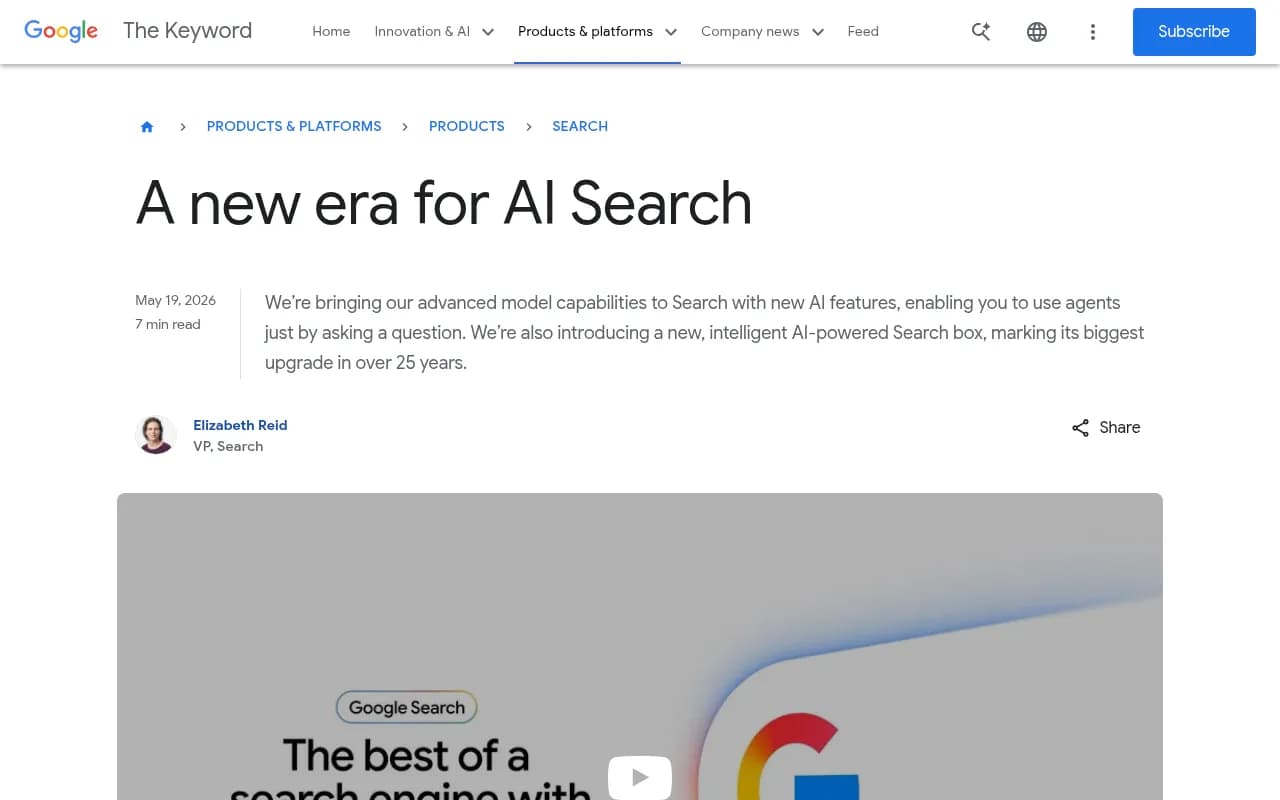
At Google I/O 2026, Elizabeth Reid (VP of Search) announced that AI agents are now embedded directly in the search interface -- not as a separate product, but as the default way Google handles complex queries. That's a meaningful shift. It means the gap between "appearing in traditional search results" and "being cited by AI" is no longer something you can defer.
A lot of marketing teams responded to this by grabbing the nearest AI visibility tool they could find -- often something lightweight like Searchable, Otterly.AI, or Peec.ai. Those tools are fine for getting started. They show you which prompts your brand appears in, which models cite you, and how your share of voice compares to competitors.
But here's the problem: monitoring is not optimization. Knowing you're invisible for a prompt doesn't tell you what to write, where to publish it, or whether your fix actually worked. And in 2026, with AI search behavior changing week to week, that gap between "I see the problem" and "I fixed the problem" is where brands fall behind.
The question this guide answers: how do you move from a monitoring-only setup to a full GEO optimization stack -- without throwing away the historical data you've already collected?
What "full GEO optimization" actually means
Before getting into the migration mechanics, it's worth being precise about what you're upgrading to.
A monitoring-only tool does one thing: it queries AI models on a schedule, records whether your brand appears, and shows you a dashboard. That's useful. But it's step one of a three-step process.
Full GEO optimization covers all three steps:
- Find the gaps -- which prompts are your competitors winning that you're not? What content is missing from your site that AI models want to cite?
- Create content that fills those gaps -- not generic blog posts, but articles engineered around the specific questions AI models are already answering (and not finding your brand in).
- Track whether it worked -- page-level citation tracking, crawler logs showing when AI bots visited your new content, and traffic attribution connecting AI citations to actual revenue.
Most tools on the market in 2026 do step one. A few do step one and a partial version of step two. Very few close the loop through step three.
Promptwatch is one of the platforms that covers all three. It's worth mentioning here because the rest of this guide is about migrating toward that kind of capability -- so it helps to have a concrete example of what the destination looks like.

Understanding what Searchable gives you (and what it doesn't)
Searchable is a reasonable entry point into AI visibility monitoring. It tracks brand mentions across several LLMs, gives you share-of-voice data, and surfaces some content recommendations.
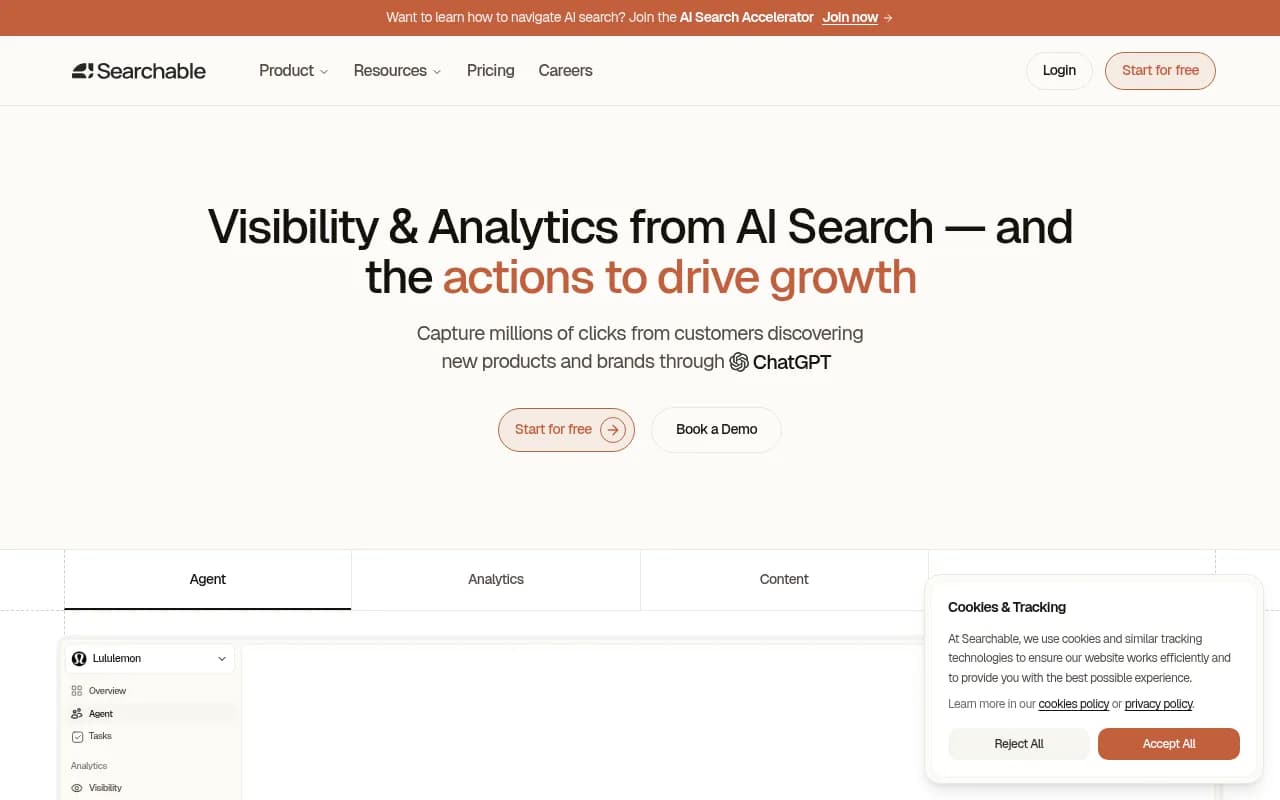
What it doesn't give you:
- AI crawler logs (you can't see when ChatGPT or Perplexity actually crawled your pages)
- Content generation grounded in real prompt data
- Page-level citation tracking (which specific URLs are being cited, and how often)
- Traffic attribution from AI citations to conversions
- Prompt volume and difficulty scoring to prioritize which gaps to fix first
- Reddit and YouTube tracking (both are major sources AI models draw from)
None of that is a knock on Searchable specifically -- most monitoring-only tools have the same limitations. The point is that if you've been using it for 6-12 months, you've built up a baseline of data that's genuinely valuable. The migration challenge is preserving that baseline while gaining the capabilities above.
The historical data problem (and why it's solvable)
Here's what people worry about when switching platforms: "I have 8 months of share-of-voice data. If I switch tools, I lose my trend lines. I can't show leadership that our AI visibility improved because I have no before/after comparison."
That fear is legitimate. But it's also solvable with a bit of planning.
The core issue is that different platforms measure AI visibility differently. They use different prompt sets, different query frequencies, different model versions, and different scoring methodologies. So even if you export your Searchable data perfectly, your Promptwatch (or any other platform's) numbers won't match it exactly. They're measuring slightly different things.
The right mental model: your historical Searchable data is a baseline snapshot, not a continuous time series you'll extend in the new platform. You're not migrating data -- you're preserving a reference point.
Here's how to do that properly.
The migration framework: five phases
Phase 1: Audit and document your current state
Before you touch anything, spend a week documenting what you have.
Export everything from Searchable:
- Your full prompt list (every query you're tracking)
- Share-of-voice scores by model, by month, for the last 6-12 months
- Top cited pages (if available)
- Competitor visibility data
- Any content recommendations the platform has surfaced
Save these as CSVs and a PDF summary. The PDF matters because it's a snapshot you can show stakeholders -- a "this is where we were in Q2 2026" reference that doesn't depend on any platform staying active.
Also document your methodology: how many prompts were you tracking? Which models? Which geographies? This context is what makes your historical data meaningful.
Phase 2: Set up your new platform in parallel
Don't cancel Searchable yet. Start your new platform (in this case, let's use Promptwatch as the example) and configure it to track the same prompts you were tracking in Searchable.
This parallel period is critical. Running both tools simultaneously for 4-6 weeks gives you:
- A cross-platform calibration period (you can see how the two tools' numbers relate to each other)
- Continuity of monitoring while you learn the new interface
- A safety net if the new platform has setup issues
During this phase, don't change your prompt list. You want the comparison to be as clean as possible.
Phase 3: Establish your new baseline
At the end of the parallel period, you'll have 4-6 weeks of data in both platforms covering the same prompts. Export both datasets for that period and document the relationship between them.
For example: "In Searchable, our share of voice for [prompt category] was 23%. In Promptwatch for the same period, it shows 31%. The difference is likely due to [methodology difference]. Going forward, our baseline in Promptwatch is 31%."
This calibration document is your bridge. It lets you say "we improved from X to Y" in a way that's honest about the platform change.
Phase 4: Migrate fully and start optimizing
Once you have your calibration document, you can cancel Searchable and go all-in on the new platform.
Now the real work starts. This is where monitoring-only tools leave you stranded and full GEO platforms earn their cost.
In Promptwatch, the workflow looks like this:
- Run Answer Gap Analysis to find prompts where competitors appear but you don't
- Use Content Agents to generate articles targeting those specific gaps, grounded in real prompt data and citation analysis
- Publish the content and watch the crawler logs to see when AI bots pick it up
- Track page-level citations to see which new articles get cited and by which models
- Connect to Google Search Console and your website analytics to attribute AI traffic to revenue
This is the loop that monitoring-only tools can't close. You're not just watching your visibility score -- you're actively moving it.
Phase 5: Validate and report
After 60-90 days on the new platform, you should have enough data to show meaningful movement. The report structure that works well for leadership:
- Where we were (Searchable baseline, Q[X] 2026)
- Platform migration and calibration (brief explanation of the methodology change)
- Where we are now (new platform data, with calibrated baseline)
- What drove the change (specific content published, specific prompts won)
- Revenue attribution (AI traffic to conversions, if your setup supports it)
The calibration step in phase 3 is what makes this report credible. Without it, you're asking leadership to trust a number that appeared out of nowhere.
Comparing the major platforms for this migration
If you're evaluating where to land after Searchable, here's an honest comparison of the main options in 2026:
| Platform | Monitoring | Content generation | Crawler logs | Traffic attribution | Prompt volume data | Reddit/YouTube tracking |
|---|---|---|---|---|---|---|
| Searchable | Yes | Basic | No | No | No | No |
| Otterly.AI | Yes | No | No | No | No | No |
| Peec.ai | Yes | No | No | No | No | No |
| AthenaHQ | Yes | No | No | No | No | No |
| Profound | Yes | Partial | No | No | No | No |
| Scrunch AI | Yes | No | No | No | No | No |
| Promptwatch | Yes | Yes | Yes | Yes | Yes | Yes |
The table makes the split obvious. Most platforms stop at monitoring. If you're migrating specifically to gain optimization capabilities, the shortlist gets short quickly.




What to do with your AI crawler log data going forward
One capability that Searchable and most monitoring tools lack entirely is AI crawler logs. This is worth spending a moment on because it changes how you think about content strategy.
When you publish a new article targeting an AI visibility gap, you want to know:
- Did ChatGPT's crawler actually visit the page?
- How long after publishing did it show up?
- Did it encounter any errors (blocked by robots.txt, slow load time, etc.)?
- Did the crawl eventually lead to a citation?
Without crawler logs, you're flying blind. You publish content, wait 4-6 weeks, and then check whether your citation count went up. With crawler logs, you can see the pipeline: publish → crawl → citation. If a page gets crawled but never cited, that's a content quality signal. If it never gets crawled, that's a technical issue.
Platforms like Promptwatch surface this data through integrations with Cloudflare, Vercel, Fastly, server logs, or a tracking snippet. Setting this up during your migration (phase 2 or 3) means you'll have crawler data from day one on the new platform -- something you can never retroactively add.
Common mistakes during GEO platform migrations
A few things that regularly go wrong:
Changing your prompt list at migration time. If you add 50 new prompts when you switch platforms, you can't compare your new numbers to your old ones. Keep the prompt list identical during the parallel period. Expand it after you've established your calibration baseline.
Canceling the old platform before exporting everything. Sounds obvious, but it happens. Some platforms delete your data within 30 days of cancellation. Export everything before you cancel, even data you think you won't need.
Expecting identical numbers across platforms. They won't match. Different tools query models differently, at different times, with different persona configurations. The calibration document in phase 3 is specifically designed to handle this -- but you have to accept that the numbers will differ and document why.
Treating migration as the end goal. The point of migrating to a full GEO platform isn't to have better dashboards. It's to start the optimization loop: find gaps, create content, track results. If you migrate and then use the new platform the same way you used Searchable (just watching the numbers), you've paid more for the same outcome.
Ignoring offsite citations. Your own website is only part of the picture. AI models cite Reddit threads, YouTube videos, industry publications, and third-party review sites heavily. A full GEO stack should track these too -- and surface which external sources are helping or hurting your AI visibility.
The state of AI search in 2026: why this upgrade is time-sensitive
Wix Studio and Statista ran a detailed analysis of AI search behavior heading into 2026, and the headline finding is that AI search isn't a niche behavior anymore -- it's how a growing share of users start their information discovery. That shift is happening faster in B2B than B2C, and faster in high-consideration categories (software, financial services, healthcare) than in commodity ones.
The practical implication: if your competitors are on optimization platforms and you're on a monitoring-only tool, they're compounding their advantage every week. They're finding gaps, publishing content, getting cited, and tracking what works. You're watching a dashboard.
The good news is that most brands are still in the early stages of GEO. The companies that get the optimization loop working in 2026 will have a meaningful head start by 2027, when the market gets more crowded.
A note on prompt intelligence and prioritization
One thing that changes significantly when you move from a monitoring tool to a full GEO platform is how you prioritize your work.
In Searchable, every prompt gap looks roughly equal. You know you're not appearing for certain queries, but you don't know which ones are worth fixing first.
In a platform with prompt intelligence (volume estimates, difficulty scores, query fan-outs), you can answer questions like:
- Which of these gaps gets the most actual user queries?
- Which gaps are winnable given my domain authority and existing content?
- Which prompt branches into 8 sub-queries that I could address with one comprehensive article?
That prioritization layer is what turns GEO from "publish more content and hope" into an actual strategy. It's also what makes the ROI case to leadership -- you're not just improving visibility scores, you're winning specific high-volume queries that drive measurable traffic.
Putting it together: your migration checklist
Here's the condensed version you can actually use:
Before you start:
- Export all historical data from Searchable (CSVs + PDF summary)
- Document your current prompt list, models tracked, and geographies
- Create a "baseline snapshot" document for leadership
During parallel operation (weeks 1-6):
- Set up new platform with identical prompt list
- Configure integrations (Google Search Console, website analytics, crawler logs)
- Run both platforms simultaneously, don't change anything
At end of parallel period:
- Export data from both platforms for the overlap period
- Create calibration document explaining the relationship between the two sets of numbers
- Cancel old platform (after confirming all exports are complete)
After migration:
- Run Answer Gap Analysis to find your first optimization targets
- Publish first batch of gap-targeting content
- Monitor crawler logs to confirm AI bots are picking up new content
- Set up 90-day review cadence to track citation improvements
- Connect AI traffic to revenue attribution
The migration itself is maybe 6-8 weeks of work. The optimization loop that follows is ongoing -- but that's the point. You're not migrating to a new dashboard. You're migrating to a new way of working.
Final thought
The brands that will look back on 2026 as a turning point are the ones that stopped treating AI visibility as a reporting metric and started treating it as an optimization channel. The tools exist to do this now. The migration path is clear. The main thing standing between most teams and a full GEO stack is the (understandable) fear of losing historical data -- and as this guide shows, that fear is manageable with a bit of planning.
Export your data, run the parallel period, build your calibration document, and then start optimizing. The historical data will still be there as a reference. What matters is what you do next.