Key takeaways
- No public evidence shows that running ChatGPT ads lowers your organic citations. OpenAI says ads run on separate systems and cannot alter answers.
- Ads are now common. Promptwatch Data found ads in an average of 20.1% of tracked ChatGPT responses from May 20 to Aug 17, 2026, and the past 7-day average was 32.4%.
- The scarier-sounding claim is the reverse: that ads lift organic traffic. The simplest explanation is attribution. Ad clicks and organic links can land in the same GA4 bucket.
- Organic citation swings in 2026 had other causes, such as the Reddit drop on August 14 and the site: operator change on August 8.
- You can answer this for your own brand with tagged ad URLs, multi-day visibility tracking, and a before/after test.
Why this question keeps coming up
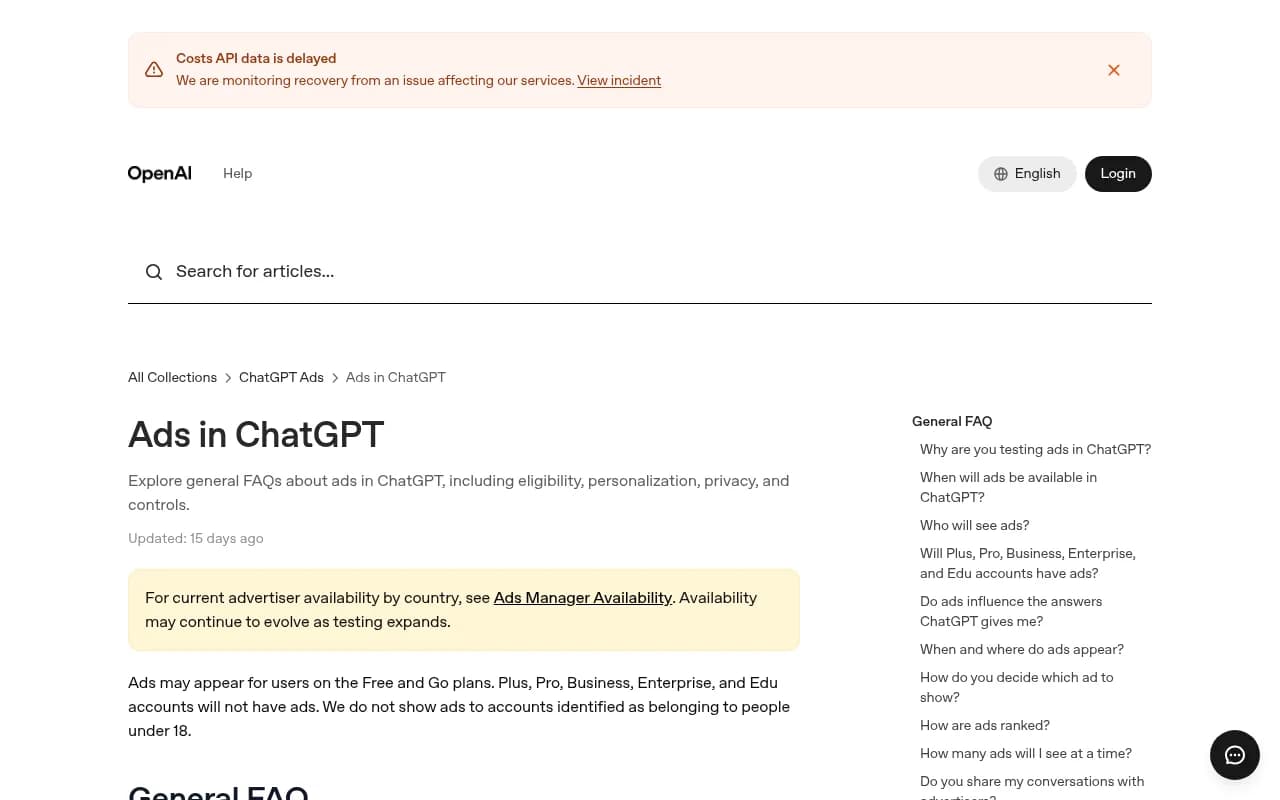
ChatGPT ads went from a rumor to a line item quickly. OpenAI's help center says ad testing began in the United States on February 9, 2026, and that ads appear for Free and Go users. Plus, Pro, Business, Enterprise and Edu accounts see none, and neither do users under 18.
Once a paid slot sits directly under an AI answer, marketers do what they did with Google in 2005. They squint at the organic results and ask whether the ad side of the house is quietly tilting the scales. Some ask whether paying for ads will cost them citations. Others ask whether not paying will.
Both fears deserve a look at the data before anyone changes budgets.
What OpenAI says, and what it cannot prove
The official position, from the OpenAI Help Center, is blunt. Ads do not influence ChatGPT's answers. They run on separate systems from the chat model. Advertisers have no ability to shape, rank, or alter responses. Ads appear below the response and are labeled. A Martech guide to running ChatGPT ads repeats the same point: running ads does not affect whether your brand is mentioned organically, and the reverse holds too.
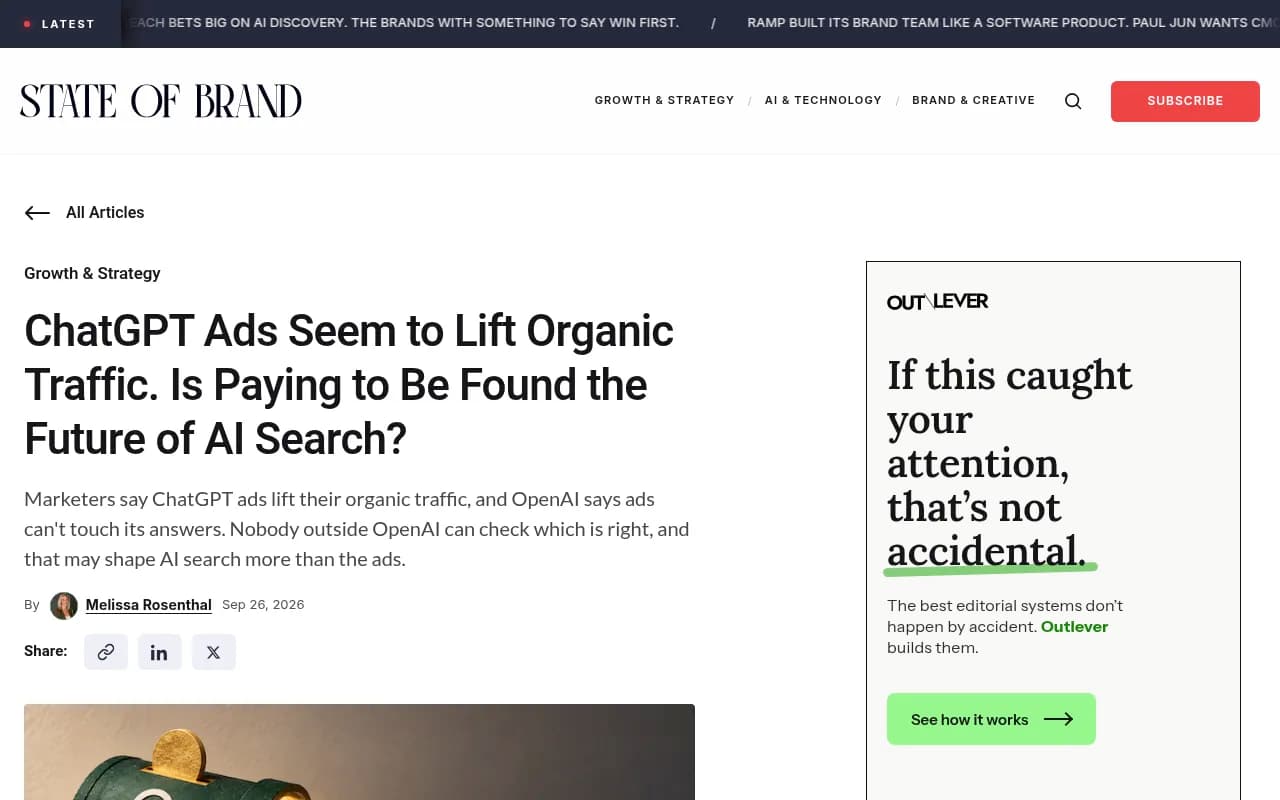
That is a clear statement. It is also unverifiable from the outside. State of Brand makes this point well: there is no evidence OpenAI is misrepresenting anything, but advertisers only see aggregated views and clicks, and nothing about the conversations their ads appeared in. So when numbers move together, people guess.
I think that is the honest position. You do not need to assume bad faith. You just need to recognize that nobody outside OpenAI can audit it, so your own measurement matters more than anyone's claim.
How common are ads in ChatGPT answers?
Before asking whether ads change organic results, it helps to know how often ads are even in the picture. Promptwatch Data's ChatGPT Ads Over Time report tracked this from May 20 to August 17, 2026. It only counts responses where ChatGPT searched the web, returned at least one citation, and completed ad extraction.
| Metric | Value |
|---|---|
| 90-day average share of responses with ads | 20.1% |
| First ads seen in sample | May 27 (1.69% of responses) |
| Jump past 30% | July 1 |
| Daily peak | 43.9% |
| Past 7-day average | 32.4% (+12.5% vs prior 7 days) |
| Past 30-day average | 29.6% (+22.6% vs prior 30 days) |
The mix of ad-bearing responses over the past 7 days was 73.3% organic prompts, 18.0% brand-specific, and 8.6% competitor comparison. One caveat from the report itself: that mix reflects prompt volume, not how likely each prompt type is to trigger an ad.
There is also a date mismatch worth flagging. OpenAI says testing began February 9, but the tracked sample showed no ads until May 27. Region, user plan, or monitoring setup likely explain it. That is an inference, not something verified.
The practical lesson: ads are now present in about a third of the responses Promptwatch tracks, so this question is not hypothetical. But presence is not causation.
The claim that ads lift organic traffic
Oddly, the loudest anecdotes point the other way. State of Brand reports that marketers running ChatGPT ads noticed "organic" ChatGPT traffic rising when ads were on and falling when they were off. One advertiser saw a fivefold jump, with a drop on the same day the campaign was paused.
If ads helped organic, then ads would not hurt it. But the article offers four possible explanations, and the best-fitting one is dull.
Ad clicks may be landing in the organic bucket
When ChatGPT links to a site in an answer, it adds utm_source=chatgpt.com, and GA4 records a chatgpt.com referral. That is the line most teams treat as organic AI traffic. Ad clicks do not arrive with their own channel label unless you tag them yourself. So if your ad URLs are untagged, paid clicks may be inflating the "organic" number. Switch the campaign off and the number drops. No mystery needed.
The ad can start an organic conversation
Users can open the menu on an ad and choose Ask ChatGPT, which shares the ad with the model. The follow-up conversation is about the advertiser, and any link ChatGPT includes carries the standard organic tag. You could argue that traffic is organic, since the model chose to link. Neither dashboard will sort it for you.
OpenAI also notes that if you share an ad via Ask ChatGPT and ask questions, that conversation can be referenced in future chats when the user has reference chat history enabled. That is a user-level memory effect, not an answer-ranking effect.
Ads could be changing answers
This is the scary one. State of Brand's counterpoint is practical: if ad spend bought organic mentions, the brands named would mostly be the ones paying. They mostly are not.
Nobody can audit the answer
Organic citations swing hard even with advertising out of the picture, which makes any simple before/after reading shaky.
Organic citations move for plenty of other reasons
Here is where I would slow down before blaming ads for any dip. Promptwatch Data has documented several large shifts in 2026 that had nothing to do with ad spend:
- ChatGPT started using the site: operator at scale on August 8, 2026. Site: queries jumped from about 0.4% to about 17% of fanout queries overnight, and searches per response nearly doubled.
- reddit.com's share of ChatGPT citations fell from roughly 4% to 0.5% on August 14, 2026.
- Average citations per response dropped around the GPT-5.3 rollout on March 4, 2026.
- Of pages ChatGPT cited on July 6, 2026, news lost half its pages within 36 days, while landing pages and docs stayed cited longest.
Note the timing. Ads began appearing more heavily around July 1, and the large citation shifts above landed in March and August. If ads were driving citation loss, you would expect a pattern tied to ad rollout. What the data shows instead is model and retrieval changes.
One honest limit: the Promptwatch report I reviewed does not compare citation rates for advertisers versus non-advertisers. So the data supports "no sign ads are the cause of these shifts," not "proven no effect."
The credibility-signal theory
There is a more interesting angle in Seer Interactive's piece. They saw a brand's organic CTR rise 156% when paid ads ranked alongside organic results in traditional search. When they paused the ads, organic did not cover the drop. Their hypothesis: the paid placement made the organic result feel more legitimate.
That is about click behavior in classic search, not about citations in ChatGPT. But it points to a different risk than the one most people panic about. The question is not "will ads reduce my citations?" It is "what does the answer sitting next to my ad say about me?"
Seer's worry is an ad that performs exactly as intended while the answer above it recommends a competitor or surfaces a negative review. In their words, you just paid to put a spotlight on the wrong message. In search you could see what ranked beside you. In ChatGPT the answer is generated live and personalized, so you may not know what it says.
How to test it for your own brand
You do not need to settle this debate in general. You need to know what is happening to you.
1. Tag every ad URL
State of Brand's top advice, and the cheapest fix. Use a distinct UTM scheme for ad clicks so they stop blending into chatgpt.com referrals. Without this, any organic-versus-paid comparison is noise.
2. Track brand visibility over several days
Promptwatch's own guidance applies here: check ad visibility and brand mentions across multiple days before concluding anything, because one run can land on an outlier day. Daily rates since July 1 have mostly sat between the low 20s and high 30s, so single-day readings vary a lot.
3. Run a controlled before/after
Pick a fixed set of prompts. Record your mention rate, citation rate, and position for 14 days with ads off. Turn ads on for 14 days. Compare. Keep content changes frozen so you are not measuring your own edits.
4. Watch the answer next to the ad
Read what ChatGPT actually says about you on prompts where your ad appears. Check sentiment and the claims being made, not just whether you are named.
5. Check who else is bidding on your prompts
Competitor ads appear on brand-specific prompts too. In the Promptwatch sample, 18.0% of ad-bearing responses in the past 7 days were brand-specific. Knowing which advertisers and landing pages show up on your prompts is part of the picture.
Tools that help you read the data
There are two jobs here: measuring AI visibility, and attributing the traffic. Different tools cover each.
Promptwatch tracks mentions, citations, sentiment and Ads Radar (which advertisers bid on your prompts, their ad copy, and landing pages) from the real ChatGPT interface, and it pairs that with visitor analytics so you can see what AI traffic converts. Ads Radar is on the Business plan and agency plans; see the ChatGPT ads page and pricing.

For visibility tracking alone, a few others are worth a look:



For the attribution half of the problem, a server-side or first-party attribution tool helps separate paid clicks from AI referrals:
| Need | Option | Why it fits |
|---|---|---|
| Mentions, citations, sentiment, ad monitoring | Promptwatch | Tracks real ChatGPT UI plus Ads Radar and visitor analytics |
| Visibility monitoring | Profound, Otterly.AI, Peec AI | Prompt-level tracking across AI engines |
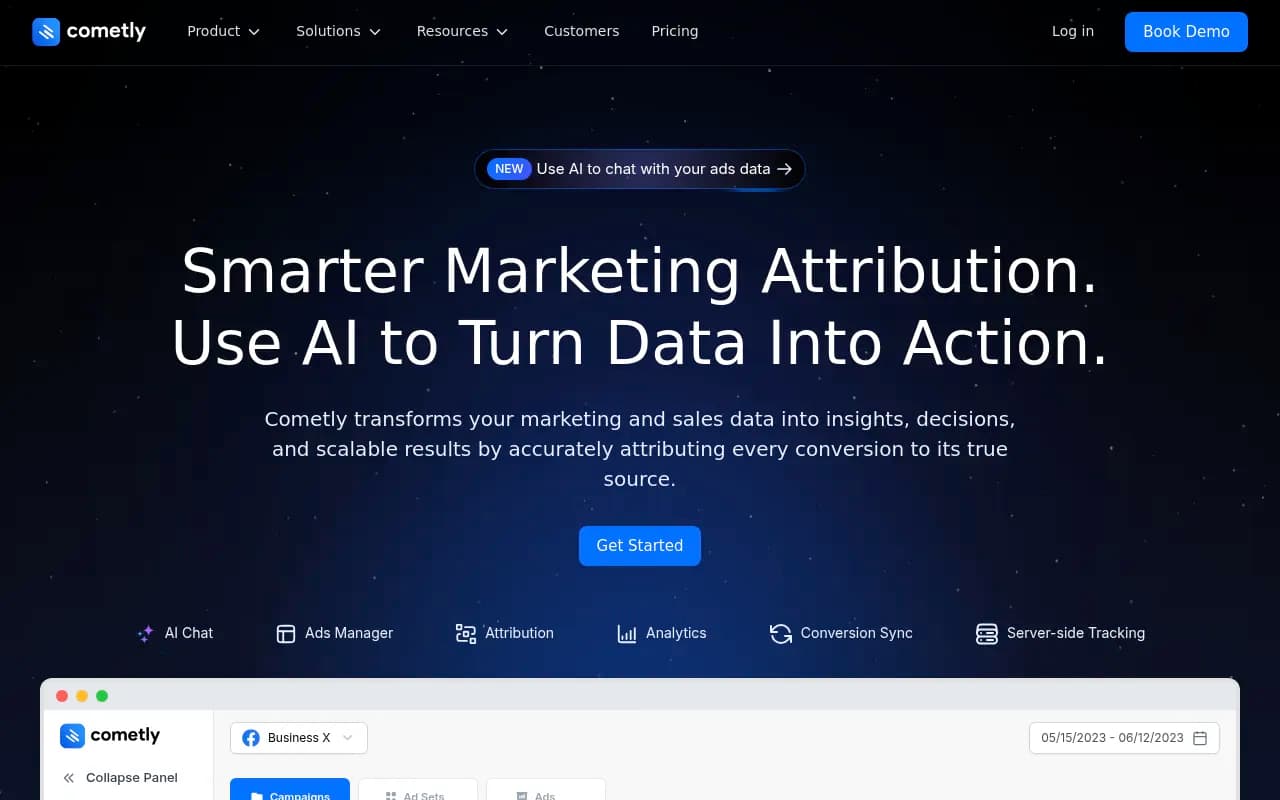
| Paid versus organic attribution | Northbeam, Cometly | First-party attribution to separate channels |
| Crawler and referral visibility | DarkVisitors | Shows AI agents and LLM referrals hitting your site |
If you want more options, the GEO software directory at bestgeosoftware.com lists dozens of trackers.
What to do if your citations dropped
Before you pause a campaign, rule out the boring causes.
- Check the date of the drop against known platform changes. March 4, August 8 and August 14 are all documented.
- Check your content type. News content decays fastest in ChatGPT citations; landing pages and docs last longest, per Promptwatch's half-life data.
- Check the sources ChatGPT favors for your industry. In software prompts, for example, GitHub, Microsoft docs and G2 led citations in the Sep 28 to Oct 4, 2026 sample.
- Check whether pages are being crawled at all. Crawler access problems look like citation loss.
- Only then test the ads variable.
So should you panic?
No. Here is where the evidence stands:
- OpenAI says ads and answers are separate. Nobody has shown otherwise, though nobody outside OpenAI can verify it.
- The loudest anecdote, ads lifting organic traffic, has a simple attribution explanation that costs nothing to test.
- The big 2026 citation swings trace to model and retrieval changes, not ad spend.
- The real risk is reputational: paying for attention next to an answer that describes your brand badly.
Fix your tagging this week, track visibility across at least 14 days, and read what the answer says before you decide whether to spend or stop.