Key takeaways
- Most GEO platforms stop at monitoring: they show you where you're invisible in AI search but don't help you fix it.
- The tools that drive real results combine visibility tracking, content gap analysis, and content generation in one loop.
- Coverage matters: the best platforms track 8-10+ AI engines (ChatGPT, Perplexity, Claude, Gemini, Grok, DeepSeek, and more), not just one or two.
- Prompt intelligence (volume, difficulty, query fan-outs) separates serious platforms from basic rank trackers.
- Promptwatch is the only platform in this comparison rated as a "Leader" across all evaluation categories, largely because it closes the loop from gap analysis to content creation to traffic attribution.
Why GEO platforms are not all the same
There's a version of GEO tool that's essentially a fancy alert system. It queries a few AI engines, checks whether your brand name shows up, and sends you a report. That's useful for a basic sanity check, but it doesn't move the needle.
Then there's a different kind of platform -- one that tells you which prompts your competitors are winning that you're not, generates content designed to close those gaps, and tracks whether that content actually starts getting cited. That's a fundamentally different product.
The market in 2026 has both, and a lot of tools in between. This guide ranks 12 of the most-discussed GEO platforms on a spectrum from monitoring-only to full optimization, so you can figure out which category you actually need.
A few things worth knowing before we get into the rankings:
- "AI visibility" is not the same as "brand mentions." A tool that counts how often your brand name appears in ChatGPT responses is not the same as one that tracks whether you're being cited as a source, which prompts trigger those citations, and how that translates to traffic.
- Prompt coverage varies wildly. Some tools run a handful of fixed prompts. Others let you define your own prompt library and track hundreds of custom queries across multiple AI engines simultaneously.
- Content generation is the dividing line. Tools that only monitor are useful for awareness. Tools that also help you create content optimized for AI citation are where the real ROI lives.
The spectrum: monitoring-only vs. full optimization
Before the rankings, here's a quick framework for how to think about GEO platform maturity:
| Tier | What it does | What it doesn't do |
|---|---|---|
| Monitoring-only | Tracks brand mentions in AI responses | No gap analysis, no content tools |
| Monitoring + insights | Tracks mentions + shows competitor visibility | Still no content creation |
| Monitoring + gap analysis | Shows which prompts you're missing | Stops before content generation |
| Full optimization | Tracks, identifies gaps, generates content, attributes traffic | Nothing left on the table |
Most tools on this list fall into tiers 1-3. A small number reach tier 4.
The 12 platforms ranked
1. Promptwatch -- full optimization platform
Promptwatch is the most complete GEO platform available right now. It monitors 10 AI engines (ChatGPT, Perplexity, Claude, Gemini, Grok, DeepSeek, Copilot, Mistral, Meta AI, and Google AI Overviews), but the monitoring is almost the least interesting part.
What separates it is the action loop. Answer Gap Analysis shows you the specific prompts where competitors are getting cited and you're not -- not as a vague "you have gaps" summary, but as a list of actual queries with prompt volume estimates and difficulty scores. From there, a built-in AI writing agent generates articles, listicles, and comparisons grounded in citation data from over 880 million citations analyzed. You publish the content, and page-level tracking shows you when AI models start citing it.
The traffic attribution piece is also worth calling out specifically. Most GEO tools have no idea whether their visibility improvements translate to actual website visits. Promptwatch closes that loop via a code snippet, Google Search Console integration, or server log analysis -- connecting AI citations to real traffic and, eventually, revenue.
Other features that don't get enough attention: real-time AI crawler logs (which pages ChatGPT, Claude, and Perplexity are actually reading on your site), Reddit and YouTube insights (which discussions are influencing AI recommendations), ChatGPT Shopping tracking, and competitor heatmaps that show who's winning for each prompt across each model.
It's used by 6,700+ brands and agencies including Booking.com and Center Parcs. Pricing starts at $99/month for the Essential plan (1 site, 50 prompts, 5 articles) and goes up to $579/month for Business (5 sites, 350 prompts, 30 articles).

2. Profound -- enterprise monitoring with strong data depth
Profound is a serious platform aimed at enterprises in regulated industries. It covers 10+ AI engines and has SOC 2 Type II and HIPAA compliance, which matters if you're in healthcare, pharma, or finance. The Conversation Explorer reportedly has access to 400M+ prompts, which gives it strong data depth for understanding what people are actually asking AI engines.
Where it falls short relative to Promptwatch is on the action side. Profound is primarily a monitoring and analytics platform -- it shows you what's happening but doesn't generate content to help you change it. Pricing starts at $499/month, which is a significant jump from most competitors.

3. AthenaHQ -- clean monitoring across 8+ engines
AthenaHQ tracks your brand visibility across 8+ AI search engines and presents the data in a clean, accessible interface. It's a solid monitoring tool, particularly for teams that want straightforward visibility dashboards without a lot of complexity.
The limitation is that it's monitoring-focused. There's no content gap analysis, no content generation, and no traffic attribution. If you want to know where you stand, AthenaHQ works. If you want to improve where you stand, you'll need to pair it with other tools.
4. Scrunch AI -- brand-focused AI visibility monitoring
Scrunch AI focuses on brand visibility monitoring across AI search engines. It's designed for marketing teams that want to track how their brand is being discussed and recommended in AI-generated responses.
Like most tools in this tier, it's primarily a monitoring product. The reporting is solid and the interface is approachable, but it doesn't extend into content optimization or gap analysis.
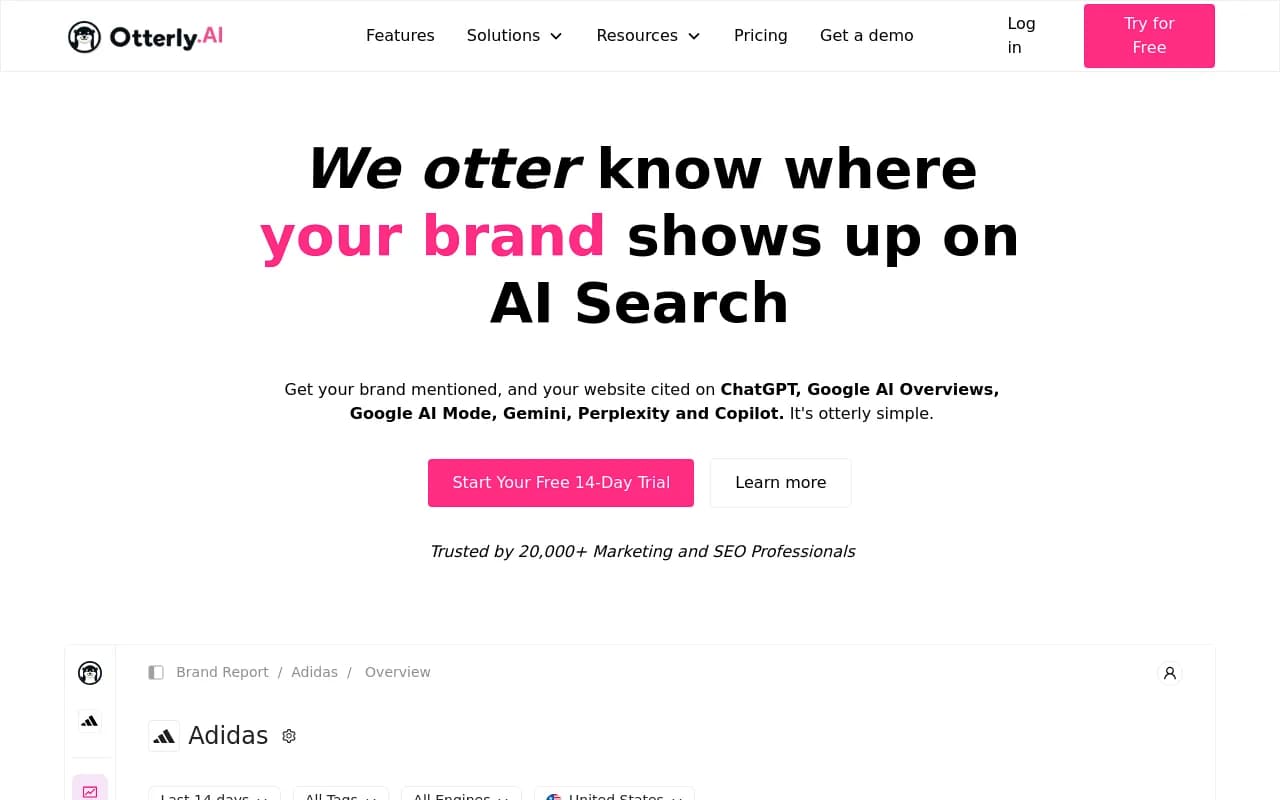
5. Otterly.AI -- affordable entry-level monitoring
Otterly.AI is one of the more accessible entry points into GEO monitoring. It tracks brand mentions across AI engines at a price point that works for smaller teams and individual marketers.
The trade-off is depth. Otterly.AI doesn't offer crawler logs, visitor analytics, content generation, or prompt volume data. It's a good starting point for teams that just want to know whether they're showing up in AI responses at all, but it won't help you understand why or how to improve.
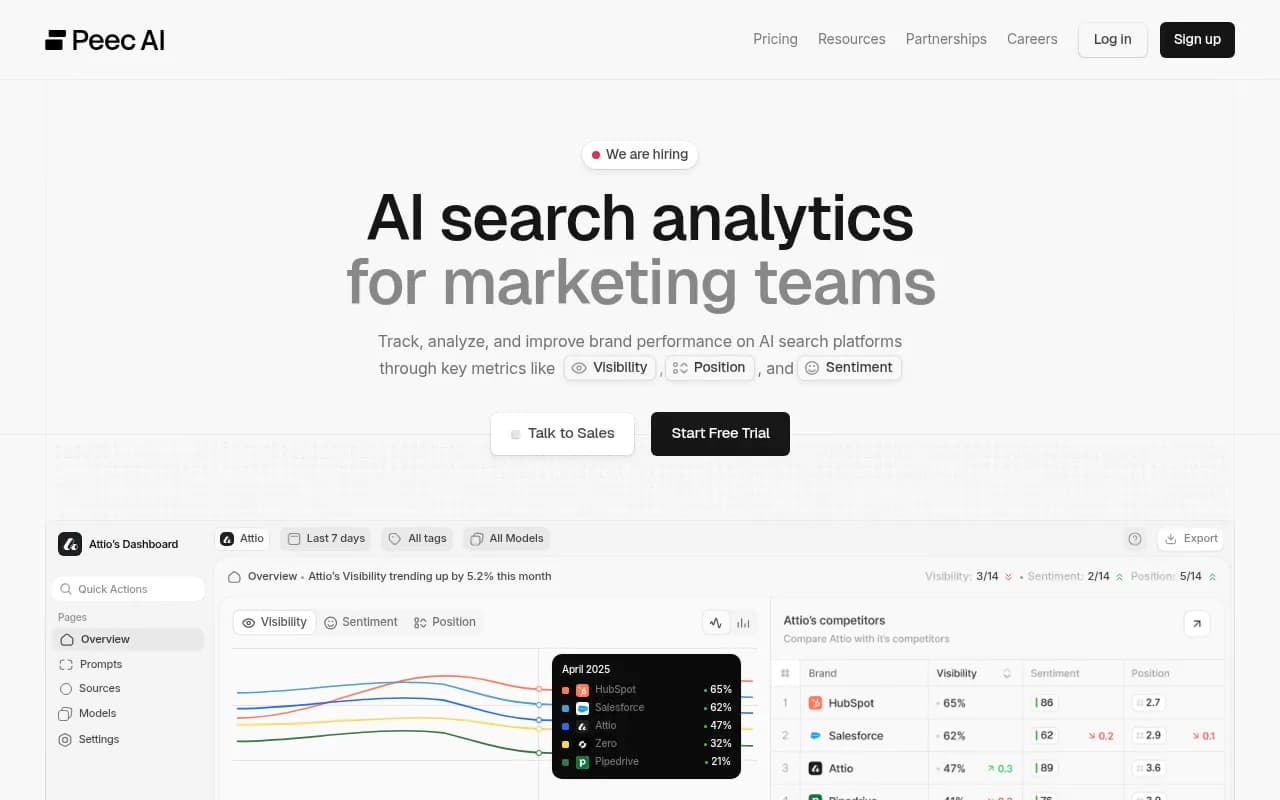
6. Peec AI -- multi-language tracking with citation focus
Peec AI has a clear focus: showing where AI models cite you and where they cite your competitors. The multi-language support is genuinely useful for brands operating across markets, and the citation-focused approach gives it more depth than pure mention-counting tools.
It doesn't extend into content creation or traffic attribution, but within the monitoring-and-insights tier, it's one of the more thoughtful options.
7. Search Party -- agency-oriented with limited prompt metrics
Search Party is positioned toward agencies and has a different model from most tools on this list -- it's more of an AI automation service than a self-serve platform. That can work well for agencies that want to outsource the GEO workflow entirely.
The limitation for in-house teams is that self-serve prompt metrics and content gap analysis are limited. It's also not the right fit if you want direct control over your prompt library or content strategy.
8. Semrush -- traditional SEO platform with AI visibility add-on
Semrush is one of the most widely used SEO platforms in the world, and it has added AI visibility tracking to its feature set. For teams already deep in the Semrush ecosystem, this is a convenient way to get some GEO data without adopting a new tool.
The catch is that Semrush's AI tracking uses fixed prompts rather than a custom prompt library, and there's no AI traffic attribution. It's a useful supplement for existing Semrush users, but it wasn't built from the ground up for GEO the way dedicated platforms were.
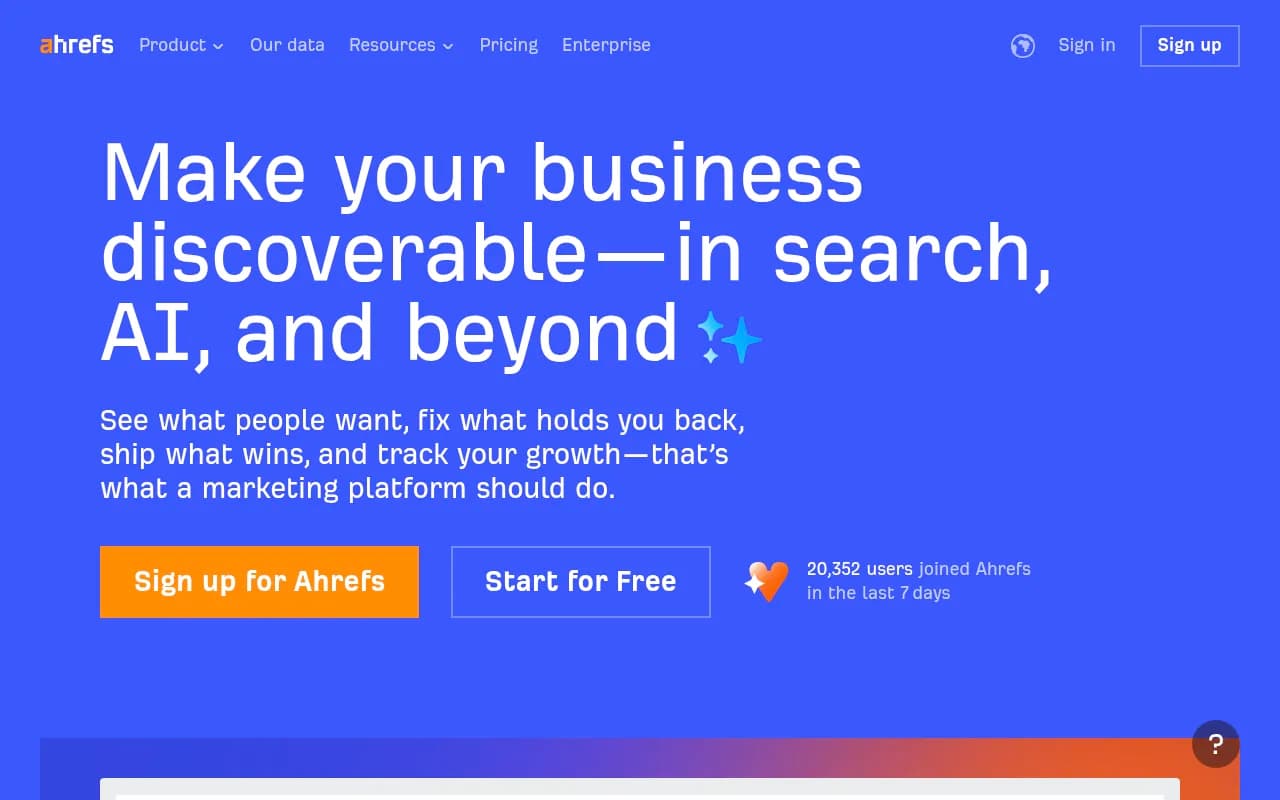
9. Ahrefs Brand Radar -- brand monitoring in AI results
Ahrefs Brand Radar is Ahrefs' answer to the GEO monitoring trend. It tracks brand appearances in AI search results and fits naturally into the Ahrefs workflow for teams already using it for traditional SEO.
Like Semrush, the AI tracking is built on fixed prompts, and there's no AI traffic attribution. It's a reasonable addition to an existing Ahrefs subscription, but not a standalone GEO solution.
10. Brandlight -- AI brand visibility tracking
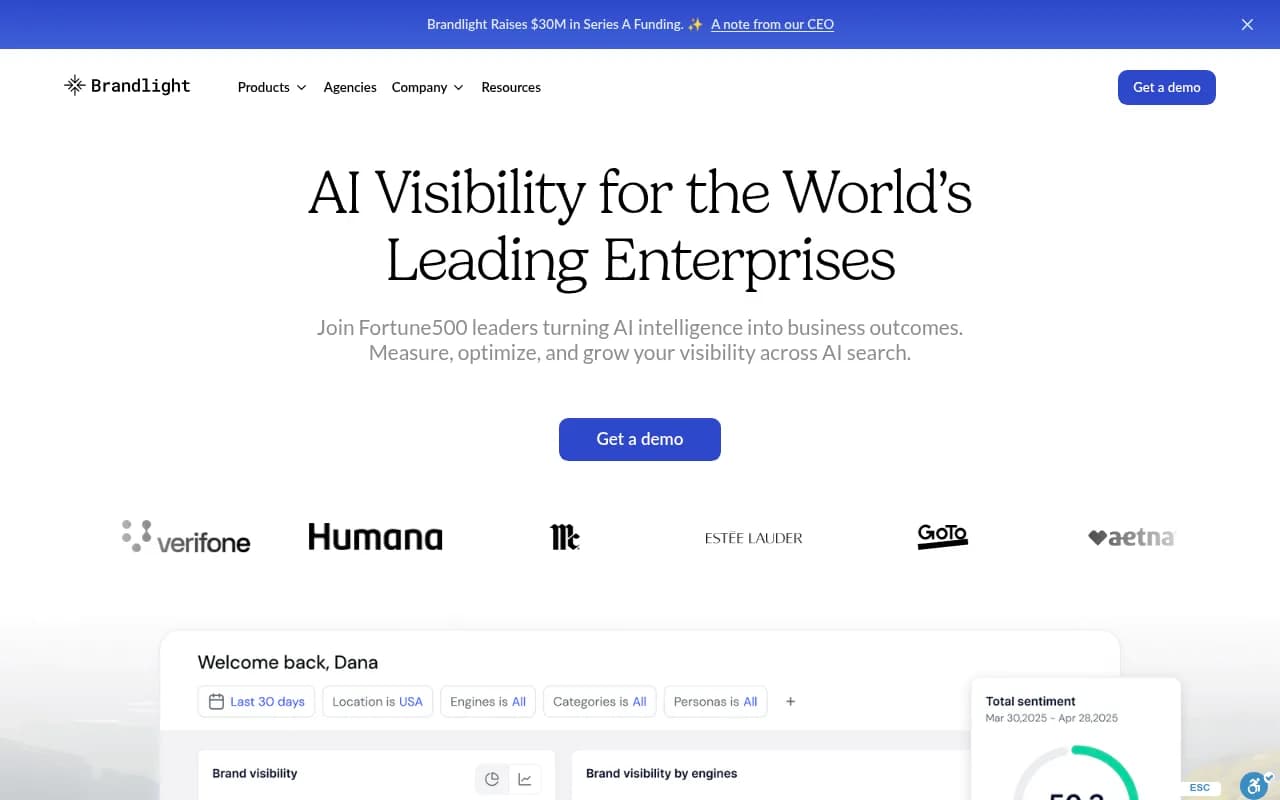
Brandlight focuses on AI-powered brand visibility tracking. It's a newer entrant in the space and covers the core use case of monitoring how your brand appears in AI-generated responses.
Feature depth is more limited compared to the platforms higher on this list -- no crawler logs, no content generation, no prompt volume data. It works as a lightweight monitoring option for teams with straightforward needs.
11. Rankscale -- AI search ranking and visibility
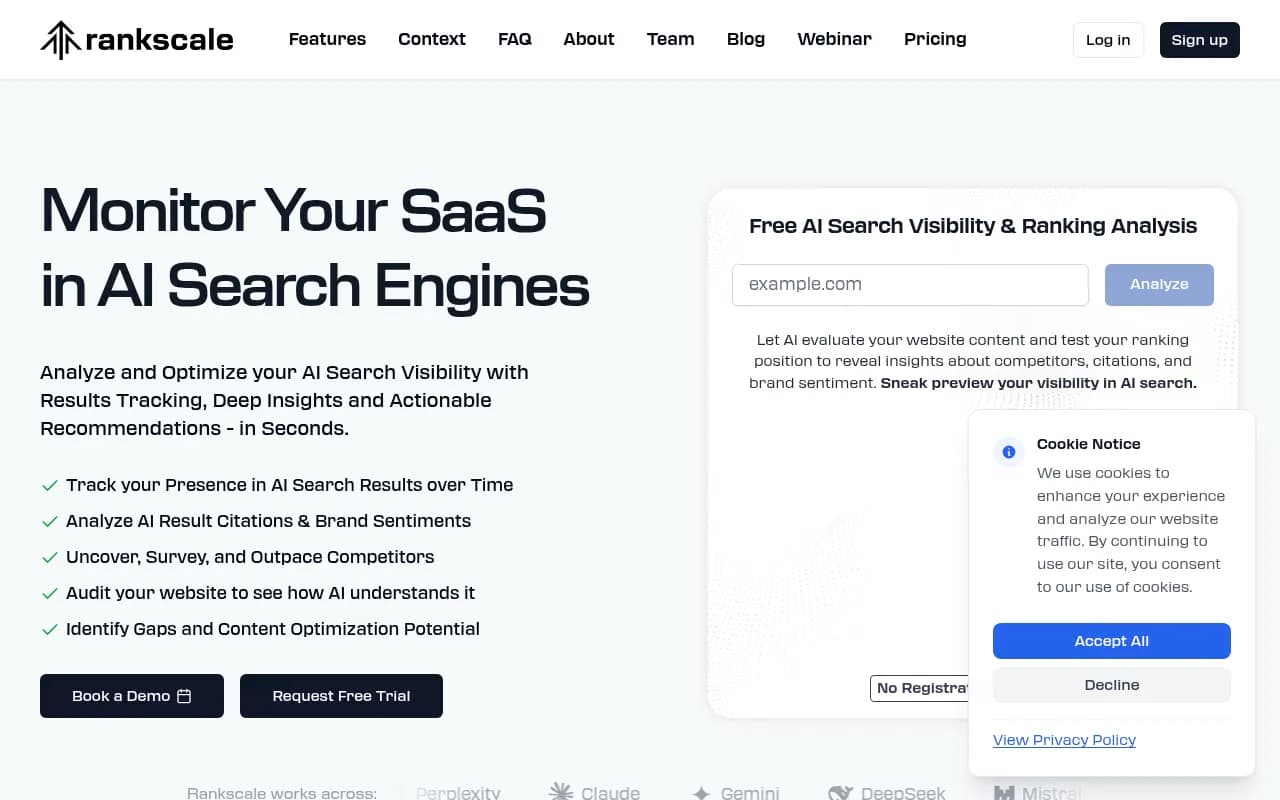
Rankscale tracks AI search rankings and visibility across multiple platforms. It's a functional monitoring tool with a focus on ranking data, which makes it useful for teams that think about GEO in terms similar to traditional rank tracking.
The platform doesn't extend into content optimization or gap analysis, keeping it firmly in the monitoring tier.
12. SE Visible -- user-friendly entry-level tracking
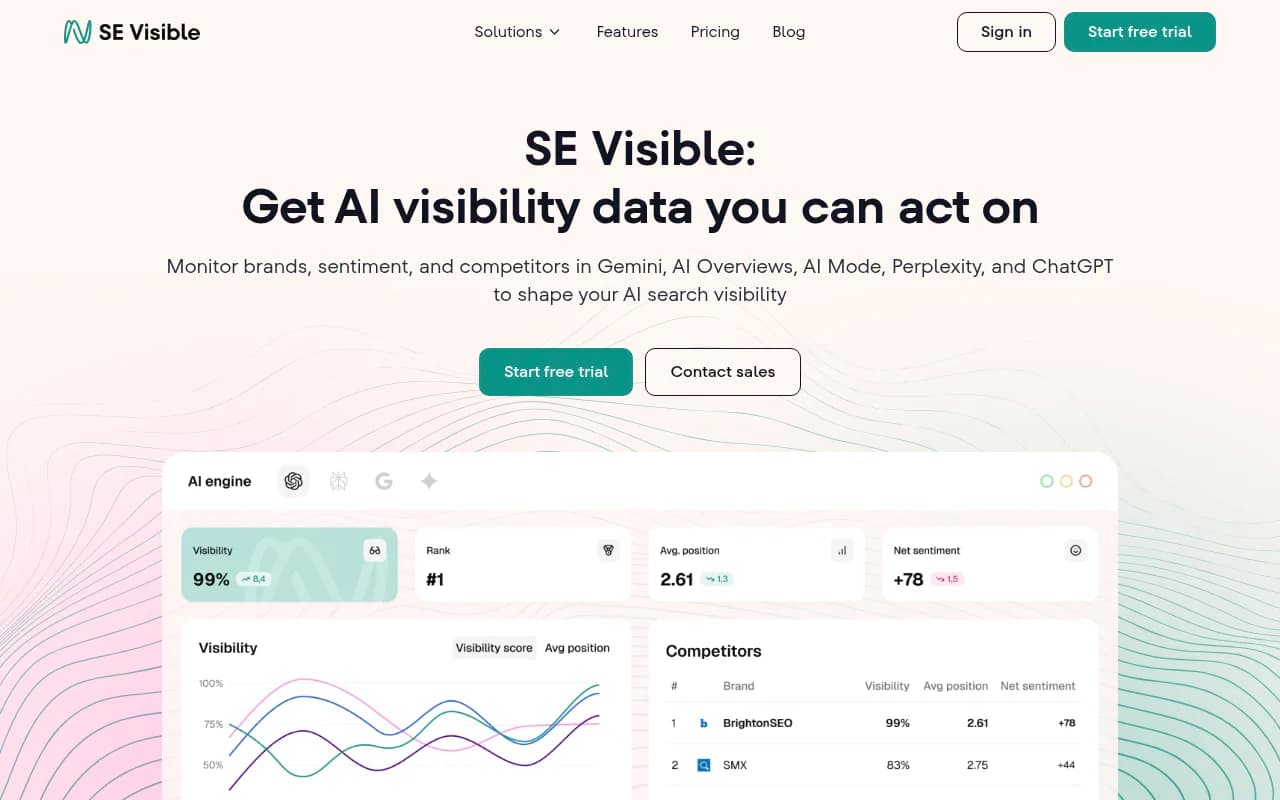
SE Visible (from SE Ranking) is one of the more accessible options for teams new to GEO. The interface is clean and the learning curve is low, which makes it a reasonable starting point.
It covers the basics of AI visibility monitoring but doesn't offer the depth of data or the optimization capabilities that more mature platforms provide. Good for dipping a toe in; not the right tool if you're serious about improving your AI search presence.
Head-to-head comparison
| Platform | AI engines tracked | Custom prompts | Content generation | Crawler logs | Traffic attribution | Starting price |
|---|---|---|---|---|---|---|
| Promptwatch | 10 | Yes | Yes | Yes | Yes | $99/mo |
| Profound | 10+ | Yes | No | No | No | $499/mo |
| AthenaHQ | 8+ | Yes | No | No | No | Custom |
| Scrunch AI | Multiple | Limited | No | No | No | Custom |
| Otterly.AI | Multiple | Limited | No | No | No | Low |
| Peec AI | Multiple | Yes | No | No | No | Custom |
| Search Party | Multiple | Limited | No | No | No | Custom |
| Semrush | Multiple | No (fixed) | No | No | No | $139/mo+ |
| Ahrefs Brand Radar | Multiple | No (fixed) | No | No | No | Included in Ahrefs |
| Brandlight | Multiple | Limited | No | No | No | Custom |
| Rankscale | Multiple | Yes | No | No | No | Custom |
| SE Visible | Multiple | Limited | No | No | No | Low |
The pattern is pretty clear. Most platforms handle monitoring. Only Promptwatch closes the full loop from tracking to content creation to traffic attribution.
How to choose the right platform for your situation
The right answer depends on what you're actually trying to accomplish.
If you just want to know whether your brand shows up in AI responses, almost any tool on this list will work. Otterly.AI or SE Visible are fine starting points at low cost.
If you want to understand the competitive landscape -- who's winning which prompts and why -- you need something with proper prompt intelligence and competitor analysis. Peec AI, AthenaHQ, and Profound all do this reasonably well, though at different price points.
If you want to actually improve your AI visibility and connect that improvement to business outcomes, you need a platform that goes beyond monitoring. That's where Promptwatch is in a different category from everything else on this list. The combination of Answer Gap Analysis, AI content generation grounded in citation data, and traffic attribution is what makes it an optimization platform rather than a dashboard.
One practical note: if you're at an enterprise with compliance requirements (healthcare, pharma, finance), Profound's SOC 2 Type II and HIPAA certifications may be a deciding factor regardless of feature depth. For everyone else, the monitoring-only platforms are hard to justify when a full optimization platform starts at $99/month.
What to look for beyond the feature list
A few things that don't show up in feature comparison tables but matter a lot in practice:
Prompt volume data is more valuable than it sounds. Knowing that a prompt gets asked 10,000 times a month vs. 100 times completely changes how you prioritize your content strategy. Most monitoring-only tools don't provide this.
Query fan-outs are underrated. When someone asks "what's the best CRM for small businesses," that prompt branches into dozens of sub-queries that AI models use to construct their answer. Understanding that structure helps you create content that addresses the full reasoning chain, not just the surface question.
Reddit and YouTube matter more than most brands realize. AI models cite Reddit threads and YouTube videos heavily in their responses. A GEO platform that surfaces which discussions are influencing AI recommendations gives you a channel most competitors aren't even thinking about.
Crawler logs tell you something monitoring can't. Knowing that Claude visited your pricing page three times last week but hasn't touched your blog tells you something important about how AI engines are actually discovering your content -- and where you might have indexing issues worth fixing.
The bottom line
The GEO platform market is maturing fast, but there's still a wide gap between tools that show you data and tools that help you act on it. Most of the 12 platforms in this guide are useful for understanding your current AI visibility. Very few help you improve it in a systematic, measurable way.
If you're evaluating GEO tools in 2026, start by asking: "After I see the data, what does this platform help me do next?" The answer to that question will tell you more about a platform's real value than any feature list.