Key takeaways
- Ecommerce needs SKU-level tracking, not just brand-mention monitoring. Most AI visibility tools were built for SaaS marketers and only report whether your brand name showed up, which tells you nothing about which product got recommended.
- Product pages are now the single most-cited content format in both ChatGPT Search and Google AI Overviews, per Promptwatch's citation-type data, though the share is volatile month to month.
- AI shopping features still trigger in only a low single-digit percentage of ChatGPT responses overall, concentrated on commercial-intent prompts, according to Promptwatch's shopping usage data. Test commercial prompts, not just brand prompts, or you'll underestimate your real exposure.
- Third-party marketplaces and review sites tend to out-cite brand-owned domains, based on Promptwatch's automotive vertical data, a pattern likely to hold for retail too. Off-site presence matters as much as your own product pages.
- Pricing for this category ranges from $29/month (Otterly.ai's entry tier) to $5,000+/month for enterprise suites. Match the spend to whether you actually need revenue attribution, or just directional monitoring.
Why ecommerce needs a different kind of AI visibility tool
I'll say the obvious part first: a shopper typing "best running shoes for flat feet" into ChatGPT is not the same use case as a marketer tracking whether "best CRM software" mentions their SaaS product. One is a single branded answer. The other is a catalog problem. If you sell 4,000 SKUs and a generic AI visibility tool tells you "your brand was mentioned 12 times this week," you still don't know which product got the nod, whether the price AI quoted was still accurate, or whether the product card even rendered with an image.
That gap is why most tools in this category started life as SEO or brand-monitoring platforms and bolted AI tracking on afterward. It shows. Ask a vendor whether they track SKU-level mentions and most go quiet, or point you to a manual CSV upload. Few connect that visibility to actual revenue.
So before you buy anything, decide which of these three questions you're actually trying to answer:
- Is my brand name showing up at all when AI assistants discuss my category?
- Which specific products get recommended, and how often?
- Does that visibility translate into clicks, sessions, and sales?
Most tools answer question one. A much smaller group answers question two. Almost none answer question three convincingly.
What's actually happening in AI shopping right now
A few data points worth knowing before you pick a tool, because they change what "good visibility" looks like.
Product pages have become the dominant citation format. In ChatGPT Search, product pages accounted for roughly 29% of citations through most of August 2026, though that share dropped from near 30% to around 25% in the back half of the month as how-to content and documentation regained ground, according to Promptwatch's ChatGPT citation-type data. Google AI Overviews told a similar story: product pages overtook listicles as the most-cited format for the first time in late July 2026, per Promptwatch's AI Overviews research.
The lesson isn't "just optimize product pages and you're done." It's that informational content (how-tos, comparisons, documentation) is clawing back share even as product pages lead. A visibility strategy that only covers PDPs is incomplete.
Shopping features in ChatGPT are still rare, but not evenly distributed. Product cards and price comparisons show up in only a low single-digit percentage of all ChatGPT web-search responses, but that rate concentrates heavily on commercial and transactional prompts, per Promptwatch's shopping feature data. If your benchmarking prompts are mostly informational ("what's the best material for hiking boots") you'll systematically underestimate how often AI shopping surfaces actually appear for your category.
Citation slots are scarce and contested. ChatGPT typically cites only around 5 sources per web-search answer, roughly half of what a traditional results page shows, while Google AI Overviews and Perplexity each cite closer to 10, per Promptwatch's average-sources-per-response data. That asymmetry matters: ChatGPT is a much harder room to get into, and Microsoft Copilot's source counts have swung wildly, from under 2 to nearly 17, making it genuinely hard to optimize against right now.
Off-site presence outweighs owned pages. In Promptwatch's automotive-vertical citation data, marketplaces and review sites captured over 14% combined citation share versus under 8% for manufacturer sites, with Reddit still ranking in the top ten despite declining overall. Retail brands should expect the same skew: third-party review and comparison sites often out-cite the brand's own domain.
Reddit's role is shrinking fast, at least in ChatGPT. Reddit's share of ChatGPT Search citations collapsed from roughly 4% to 0.5% in a single day, August 14, 2026, per Promptwatch's Reddit citation report. If your GEO plan leaned heavily on seeding Reddit threads, that channel just got a lot less reliable, at least for ChatGPT specifically.
What to actually check before buying
Every vendor in this space publishes a feature list. Fewer publish what they don't do. Here's the checklist I'd run through:
- SKU-level tracking. Does the tool report on individual products, or only the brand name? Most tools in independent comparisons stop at brand level.
- Revenue attribution. Does visibility data connect to actual GA4/Shopify sales, or does it stop at a mention count?
- Catalog sync. Is there a live feed connection (Shopify, WooCommerce, Salesforce Commerce, Magento), or are you uploading a spreadsheet every month?
- Engine coverage, weighted correctly. It's not enough to say "we track 10 engines" if half of them barely matter for shopping queries. Make sure ChatGPT Shopping, Google AI Overviews, AI Mode, Perplexity, and Gemini are all covered with real UI data, not just API pulls that can differ from what a shopper actually sees.
- Off-site and sentiment tracking. Given how much weight marketplaces and review sites carry, a tool that only watches your own domain is missing most of the picture.
The tools, compared
| Tool | Ecommerce-native? | SKU/product tracking | Revenue attribution | Catalog sync | Starting price |
|---|---|---|---|---|---|
| Promptwatch | Adapted, strong GEO stack | Page-level tracking, content gap analysis | Visitor analytics tied to AI traffic | CMS publishing (Webflow, Framer, WordPress) | $95/mo |
| Ranketta | Yes, built for agentic commerce | SKU-level, feed enrichment | Not fully documented | Google Merchant, Shopify, XML/JSON feeds | EUR 29/mo |
| AthenaHQ | Yes, Shopify-focused | Product-level view | Shopify + GA integration | Shopify sync | Free / $295/mo |
| Alhena AI | Yes | Native, documented | Yes, closed-loop | Live catalog sync | $199/mo |
| Profound | Adapted | Via add-on (Shopping Analysis) | Not documented | Not documented | $99/mo |
| Otterly.AI | Adapted | Not documented | Not documented | Not documented | $29/mo |
| Ahrefs Brand Radar | Adapted | Not documented | Not documented | Not documented | $199/mo per engine |
| Semrush AI Visibility Toolkit | Adapted | Not documented | Not documented | Not documented | $99/mo |
A caveat on this table: "not documented" means the vendor hasn't published evidence of the capability publicly, not that it's impossible. Roadmaps in this space move fast, and plenty of these tools ship new features monthly.
Where Promptwatch fits for retail brands
Promptwatch wasn't purpose-built as an ecommerce SKU tracker the way Ranketta or AthenaHQ were, but it's worth a serious look for retail teams because of what it does once it finds a visibility gap. Most tools in this category stop at monitoring: they tell you ChatGPT mentioned a competitor instead of you and leave you to fix it manually. Promptwatch's Content Agents can plan, write, and publish GEO-optimized content straight to your CMS, and its Content Gap Analysis scores how well your existing pages cover what AI engines are actually answering, then generates briefs with internal linking, screenshots, and competitor context built in.
For a retail brand, that matters because the fix for a visibility gap is rarely "write one blog post." It's closing gaps across dozens or hundreds of category and comparison pages, continuously, as model behavior shifts. Promptwatch also tracks Reddit and YouTube citations specifically, which matters given how fast Reddit's share is dropping in ChatGPT (and how differently it's holding up elsewhere), plus a dedicated ChatGPT Shopping and Ads Radar module that tracks product recommendations and sponsored placements, including which competitors are bidding on your category's prompts.

It's not SKU-level inventory tracking in the way Ranketta or Alhena document. If your single biggest question is "which exact product got recommended and what did it earn," a catalog-native tool will serve that specific need better out of the box. But if your question is broader, "where are we invisible across AI search, why, and how do we fix it at scale," Promptwatch's crawler logs, content agents, and citation analytics cover more of that loop than most monitoring-only tools do.
Other tools worth knowing about
Ranketta is explicitly built for agentic commerce. It monitors ChatGPT, Google AI Overviews, AI Mode, Gemini, Perplexity and Copilot while surfacing which SKUs, yours and competitors', get mentioned in shopping answers. It also pushes a cleaned-up catalog back out as Google Merchant, Shopify, or generic XML/JSON feeds, and it collects responses by interacting with the actual web interfaces rather than pulling sanitized API outputs. Its MCP server lets you query prompts and citations from Claude Desktop or Cursor directly.
AthenaHQ targets Shopify brands specifically, with a free Essential tier and a $295/month Starter plan that adds GA integration and autonomous agents.
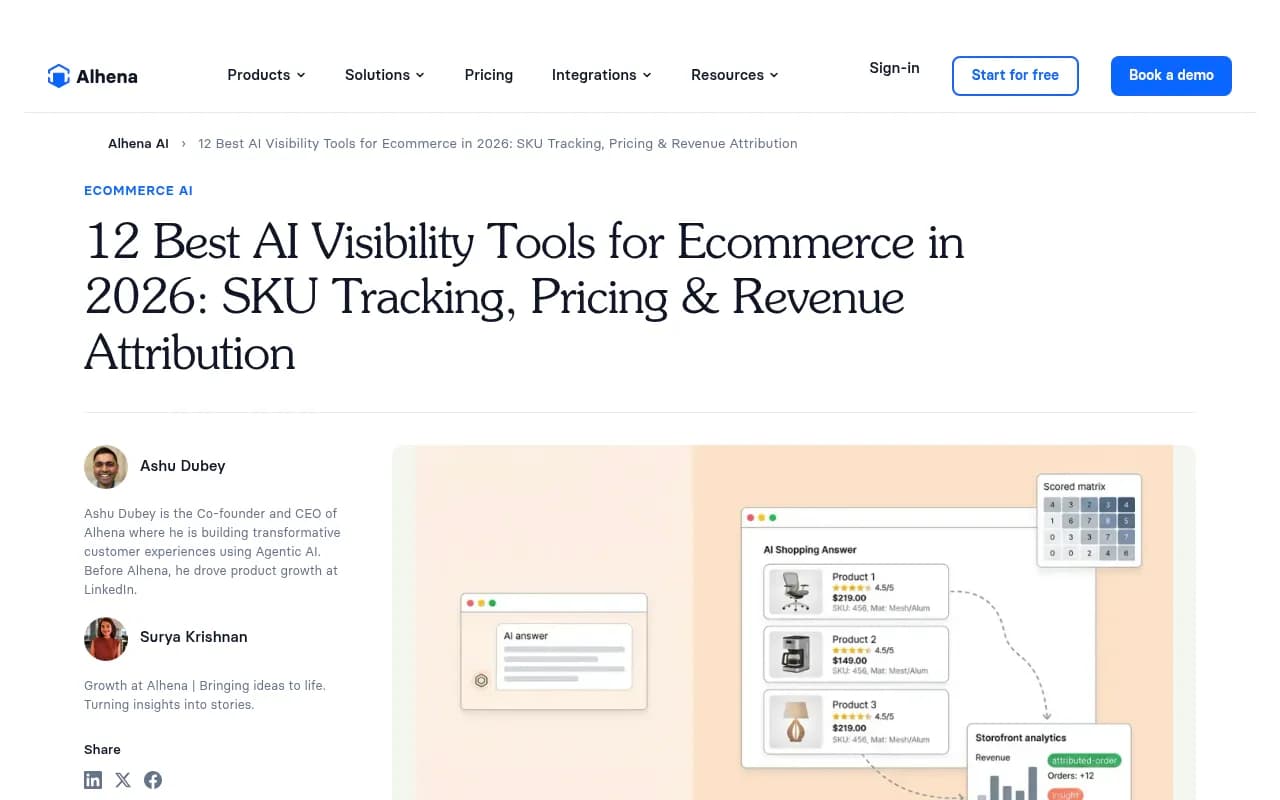
Alhena AI Visibility documents native SKU tracking, live catalog sync, and closed-loop revenue attribution together, which, per the comparison research cited above, none of the eleven other tools it was benchmarked against fully match.

Ahrefs Brand Radar and Semrush's AI Visibility Toolkit suit teams that already live inside those ecosystems and want AI tracking layered onto existing SEO workflows, rather than a dedicated ecommerce tool. Otterly.ai is the cheapest entry point at $29/month, but add-ons for Claude and Gemini tracking stack up quickly and can roughly double the effective price.
Structured data you need regardless of which tool you pick
No visibility tool compensates for broken product data. Google's I/O 2026 announcement introduced what it calls "Universal Cart," a feed-layer eligibility gate that schema.org Product markup alone doesn't unlock. You need structured data and a qualifying merchant feed together. Google also added category support to merchant listing markup in July 2026 and clarified sale-price date fields to match Merchant Center attributes.
Practically, that means every product page needs accurate JSON-LD with name, brand, price, availability, and GTIN at minimum, and ideally product Q&A markup and lifestyle attributes like primary_benefit and target_user, which several 2026 guides flag as increasingly relevant for conversational commerce queries. On multi-vendor marketplaces, this has to be true for every vendor's listings, not just the top sellers, or AI engines will quietly skip the ones with incomplete data.
Common mistakes retail teams make
A few patterns show up again and again in the research on this topic, and they're worth naming plainly rather than dressing up as "challenges."
Teams treat an AI visibility audit as a one-time project. Citation patterns shift weekly as models update; a snapshot from March tells you little about October.
Teams mass-rewrite product descriptions reactively after a bad audit, which is too slow relative to how fast model behavior changes, and generic AI-written copy increasingly gets filtered out anyway.
Teams ignore off-site signals entirely. If AI engines pull recommendations from third-party review sites and marketplaces more than from your own domain, which the data above suggests, optimizing only your own product pages won't close the gap.
Teams try to suppress negative reviews to keep ratings artificially high. AI models look for a natural spread of sentiment to judge authenticity; a suspiciously perfect rating can trigger distrust rather than confidence.
Teams let inventory and pricing data go stale. AI assistants increasingly deprioritize listings with outdated availability or pricing, which is a quiet way to lose visibility without any obvious error message.
How to choose
If you need closed-loop revenue attribution tied to a live catalog and nothing else matters more, start with Ranketta or Alhena AI, both of which document SKU-level tracking and catalog sync explicitly. If you're a Shopify-first DTC brand, AthenaHQ's free tier is a reasonable place to test the waters before committing spend. If your bigger problem is understanding why you're invisible across AI search broadly and actually fixing it at scale, not just watching a dashboard, Promptwatch's combination of crawler logs, content gap analysis, and automated publishing covers more of that loop than a monitoring-only tool will.
Whichever you pick, budget for structured data cleanup first. A great visibility tool pointed at a catalog with broken schema and stale pricing will just tell you, accurately, that you're invisible. For a broader look at GEO platforms beyond the retail-specific shortlist here, the directory at bestgeosoftware.com is worth browsing before you commit to a contract.