Summary
- Action beats monitoring: Platforms like Promptwatch, Searchable, and Relixir combine AI visibility tracking with content generation tools -- they show you where competitors rank, then help you create content that ranks too
- Content gap analysis is the unlock: The best platforms identify exactly which prompts you're missing citations for, then generate articles grounded in real citation data and prompt volumes
- Most competitors are dashboards only: Tools like Otterly.AI, Peec.ai, and AthenaHQ excel at monitoring but leave you stuck when it's time to actually fix visibility problems
- Pricing reflects capabilities: Monitoring-only tools start around $99/mo, while platforms with content generation typically run $250-600/mo for professional tiers
- Integration matters: Look for platforms that connect visibility tracking to content creation workflows -- crawler logs, Reddit insights, and prompt intelligence feed directly into what you write
Why content generation matters for AI visibility
Tracking your brand mentions in ChatGPT is table stakes now. Every AI visibility platform can tell you when Perplexity cites your competitor instead of you. The question is: what do you do about it?
Most tools stop at the dashboard. You see the problem -- your competitor ranks for 47 prompts where you're invisible -- but you're left guessing what content to create. Should you write a comparison page? A how-to guide? A product listicle? Which angle do AI models actually want?
Platforms with built-in content generation close this loop. They analyze 880M+ citations to understand what types of content get cited, then generate articles optimized for AI search. This isn't generic SEO filler -- it's content engineered around the specific prompts, personas, and citation patterns that drive AI visibility.
The difference is moving from "we're losing to competitors" to "here's the exact content we need to create, and here's a draft ready to publish."
What to look for in a content-enabled platform
Not all content generation features are equal. Here's what separates real optimization platforms from monitoring tools with a ChatGPT wrapper bolted on:
Content gap analysis: The platform should show you exactly which prompts competitors rank for but you don't. Not just "they're ahead" -- the specific queries, the missing topics, the angles AI models want but can't find on your site.
Citation-grounded generation: Content should be based on real data about what gets cited, not generic SEO best practices. The platform needs to analyze which page structures, content types, and formats AI models prefer when answering specific prompts.
Prompt intelligence: Volume estimates and difficulty scores for each prompt. You need to know which gaps are worth filling -- high-value prompts with winnable competition, not impossible queries or zero-volume long-tail.
Multi-model optimization: Content that ranks in ChatGPT might not rank in Perplexity or Claude. The best platforms generate content optimized across multiple AI models, not just one.
Workflow integration: Content generation should connect directly to visibility tracking. You identify a gap, generate content, publish it, then track whether your visibility score improves. The loop needs to close.
The platforms that actually deliver
Promptwatch: The action-first platform
Promptwatch is the only platform rated as a "Leader" across all categories in a 2026 comparison of 12 GEO tools. The reason: it's built around taking action, not just monitoring.

The core workflow is simple. Answer Gap Analysis shows you exactly which prompts competitors are visible for but you're not -- the specific content your website is missing. Then the built-in AI writing agent generates articles, listicles, and comparisons grounded in 880M+ citations analyzed, prompt volumes, persona targeting, and competitor analysis.
This isn't a ChatGPT wrapper. The content is engineered to get cited by AI models based on real data about what works. You see citation patterns, understand which page structures rank, then generate content that matches those patterns.
What makes Promptwatch different from competitors:
- AI Crawler Logs: Real-time logs of ChatGPT, Claude, and Perplexity crawlers hitting your site -- which pages they read, errors they encounter, indexing issues to fix. Most competitors lack this entirely.
- Prompt Intelligence: Volume estimates and difficulty scores for each prompt, plus query fan-outs showing how one prompt branches into sub-queries. Prioritize high-value, winnable prompts.
- Citation & Source Analysis: See exactly which pages, Reddit threads, YouTube videos, and domains AI models cite. Know where to publish and what to optimize.
- Reddit & YouTube Insights: Surface discussions that directly influence AI recommendations -- a channel most monitoring-only tools ignore.
- ChatGPT Shopping Tracking: Monitor when your brand appears in ChatGPT's product recommendations and shopping carousels.
Pricing: Essential $99/mo (1 site, 50 prompts, 5 articles), Professional $249/mo (2 sites, 150 prompts, 15 articles, crawler logs), Business $579/mo (5 sites, 350 prompts, 30 articles). Free trial available.
Monitors: ChatGPT, Perplexity, Google AI Overviews, Google AI Mode, Claude, Gemini, Meta AI, DeepSeek, Grok, Mistral, Copilot.
Searchable: Content tools for agencies
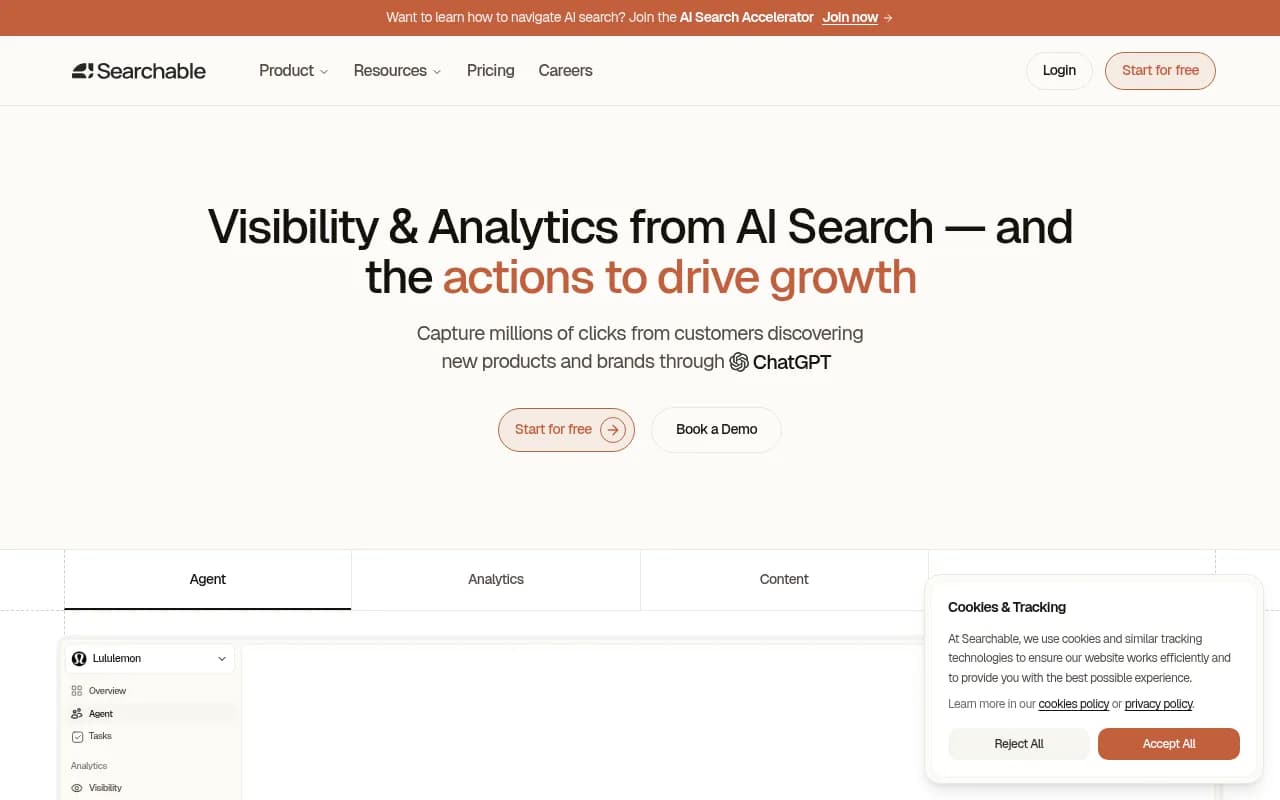
Searchable combines AI visibility monitoring with content optimization tools aimed at agencies managing multiple clients. The platform tracks brand mentions across major AI models, then provides content recommendations and generation capabilities.
The content workflow focuses on identifying underperforming pages and suggesting optimizations. You see which pages AI models cite for competitors but not for you, then get recommendations on how to improve those pages -- new sections to add, schema markup, internal linking changes.
Searchable also includes a content brief generator that creates outlines based on AI citation patterns. The briefs specify which topics to cover, how to structure the page, and which sources to reference to maximize citation probability.
What's missing compared to Promptwatch: no AI crawler logs, limited prompt intelligence (no volume estimates or difficulty scores), and no Reddit/YouTube tracking. The content generation is more template-based than citation-grounded.
Best for: Agencies that need white-label reporting and client management features alongside content tools.
Relixir: AI-native CMS with GEO optimization
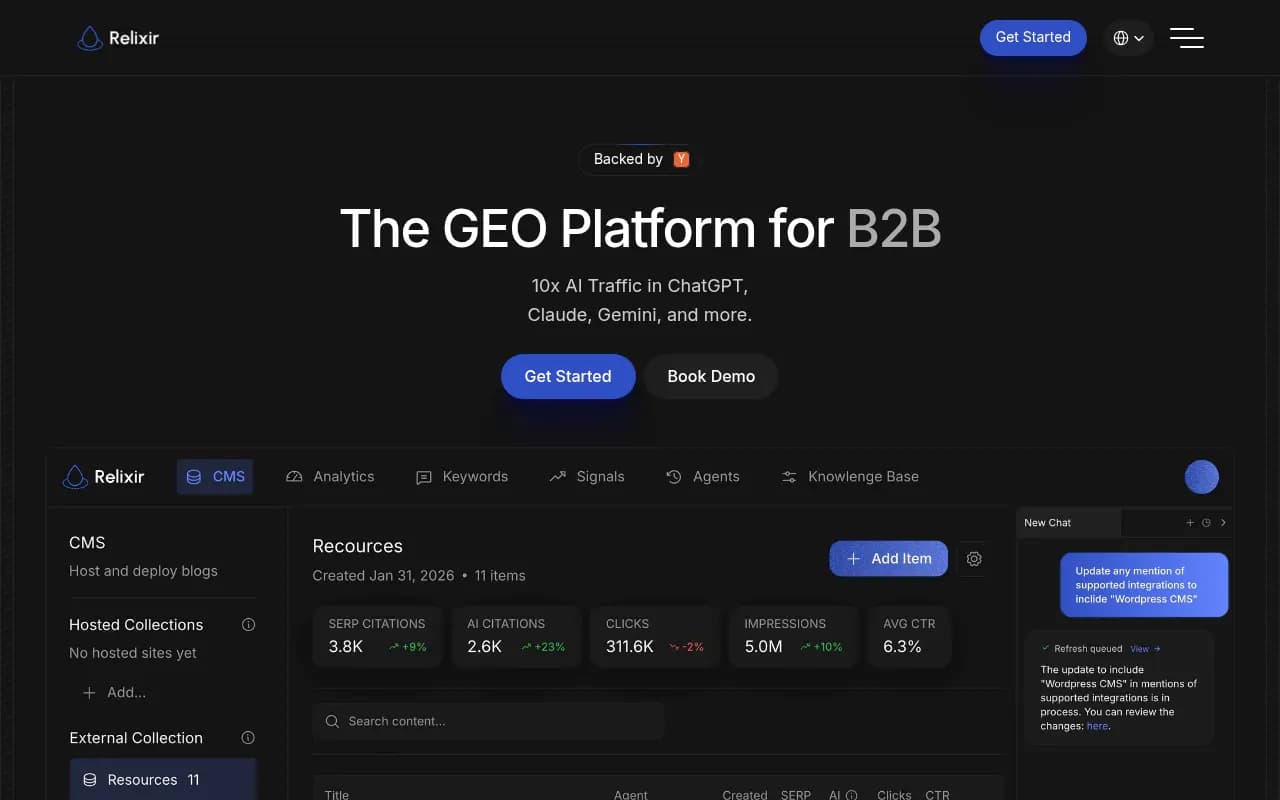
Relixir takes a different approach -- it's an AI-native CMS that combines content creation with GEO optimization. Instead of bolting content generation onto a monitoring platform, Relixir starts with content management and adds AI visibility tracking.
The platform includes an autonomous content co-pilot that generates articles optimized for both traditional SEO and AI search. You define your target prompts and personas, and the co-pilot creates content structured to maximize citations across ChatGPT, Perplexity, and other models.
Relixir also tracks how your published content performs in AI search -- which pages get cited, by which models, for which prompts. The feedback loop helps you refine your content strategy over time.
The trade-off: Relixir is a full CMS, not just a monitoring tool. You're committing to their content management system, which might not fit if you already have a WordPress or headless CMS setup you're happy with.
Best for: Teams building new content properties from scratch who want AI visibility baked into the CMS from day one.
Qwairy: GEO strategy and optimization
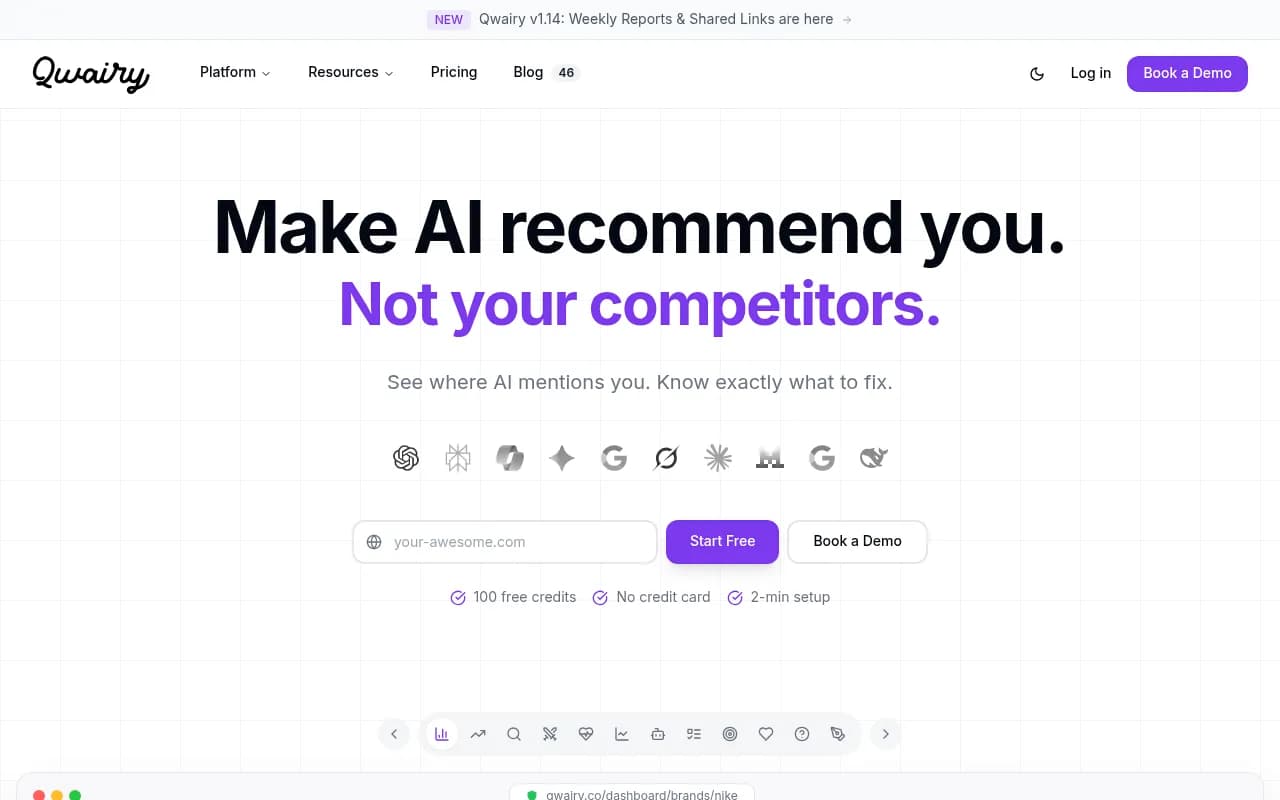
Qwairy positions itself as the "ultimate GEO strategy and optimization platform." The focus is on strategic planning -- understanding which prompts to target, which content types to create, and how to structure your site for maximum AI visibility.
The platform includes content optimization recommendations based on AI citation analysis. You upload existing pages, and Qwairy suggests improvements: sections to add, questions to answer, schema markup to implement. The recommendations are specific, not generic -- "add a comparison table of X vs Y" rather than "improve content quality."
Qwairy also offers content brief generation similar to Searchable, but with more emphasis on competitive analysis. The briefs show you what competitors include that you don't, which angles they cover, and how to differentiate your content while still hitting the citation triggers AI models look for.
What's missing: no built-in content generation. Qwairy gives you the strategy and the brief, but you still need to write the content yourself or hand the brief to a writer.
Best for: SEO teams that want strategic guidance and optimization recommendations but prefer to handle content creation in-house.
SnowSEO: Auto-generated content for AI visibility
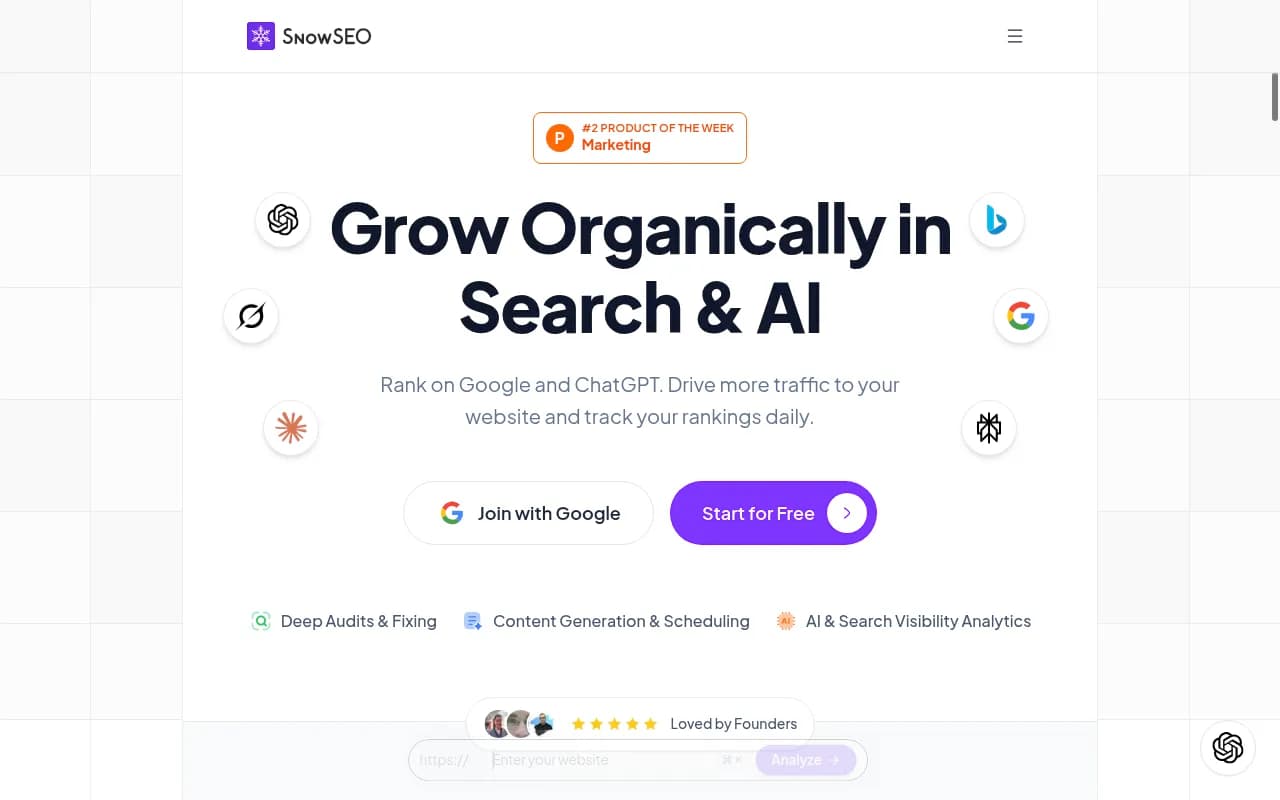
SnowSEO takes the most aggressive approach to content generation -- it auto-generates entire articles optimized for AI visibility. You input your target keywords and prompts, and SnowSEO creates full drafts ready to publish.
The platform analyzes top-ranking content in both traditional search and AI search, then generates articles that combine elements from both. The output includes proper heading structure, internal links, schema markup, and content sections designed to trigger AI citations.
The quality is hit-or-miss. SnowSEO works well for straightforward informational content -- how-to guides, product comparisons, FAQ pages. It struggles with nuanced topics that require expertise or original research. You'll need to review and edit everything before publishing.
What's missing: limited visibility tracking. SnowSEO focuses heavily on content generation but provides minimal monitoring of how that content actually performs in AI search. You're generating content blind, without feedback on what's working.
Best for: Content teams that need volume and are willing to trade some quality for speed. Works for programmatic SEO approaches where you're creating hundreds of similar pages.
Comparison: Content generation capabilities
| Platform | Content gap analysis | Citation-grounded generation | Prompt intelligence | Multi-model optimization | Workflow integration |
|---|---|---|---|---|---|
| Promptwatch | Yes | Yes (880M+ citations) | Yes (volume + difficulty) | 10 models | Full loop (track → generate → publish → track) |
| Searchable | Limited | Template-based | No | 6+ models | Partial (recommendations only) |
| Relixir | Yes | Yes (AI-native CMS) | Limited | Multiple models | Full (CMS-integrated) |
| Qwairy | Yes | No (briefs only) | Limited | Multiple models | Strategy-focused |
| SnowSEO | No | Generic SEO focus | No | Limited | Content-only (minimal tracking) |
What about monitoring-only platforms?
Most AI visibility tools don't include content generation at all. They excel at tracking and reporting but leave you stuck when it's time to actually improve your visibility.
Otterly.AI is the most affordable monitoring option at $99/mo, tracking six major AI platforms with clean dashboards and sentiment analysis. Great for validating whether AI visibility is even a problem for you. No content tools.

Peec.ai offers multi-language tracking and smart suggestions for which prompts to target. The suggestions are helpful, but you still need to figure out what content to create and write it yourself.

AthenaHQ brings enterprise-grade brand monitoring with exceptional crisis management features. Tracks 8+ AI engines with real-time alerts. Zero content generation capabilities.

ZipTie provides deep analysis and reporting with detailed citation breakdowns. The data is excellent for understanding what's happening, but the platform doesn't help you act on it.
These platforms work well if you have a content team that just needs direction on what to create. They identify the gaps and provide the data -- your team handles the actual content creation.
The problem: the gap between "here's what's missing" and "here's a draft ready to publish" is where most AI visibility initiatives stall. Content teams are already stretched thin. Handing them a list of 50 prompts to target doesn't magically create capacity.
The enterprise options
If you're managing AI visibility at scale across multiple brands or regions, a few platforms stand out:
Profound is the highest-rated platform with a 92/100 AEO score, tracking 10+ AI engines with 400M+ prompt insights and SOC 2 Type II compliance. The enterprise tier includes content optimization recommendations, but not full generation. Pricing starts around $500/mo and scales up quickly.

BrightEdge is an enterprise SEO platform that added AI visibility tracking and content optimization. The AI capabilities are solid but feel bolted onto a traditional SEO platform rather than built from the ground up for AI search. Expect $1,000+/mo pricing.
Bluefish targets Fortune 500 brands with an enterprise AI marketing platform. Includes content strategy and optimization tools, though not full generation. The focus is on brand safety and compliance -- making sure AI models don't say anything damaging about your brand.
These platforms make sense if you're a large enterprise with complex requirements around security, compliance, and multi-brand management. For most teams, they're overkill.
How to choose the right platform
Start with your content creation capacity. If you have a strong content team that just needs direction, a monitoring-only platform like Otterly.AI or Peec.ai might be enough. You get the data, they create the content.
If your content team is already maxed out, you need a platform that helps with creation. Promptwatch is the most complete option -- it identifies gaps, generates content, and tracks results in one workflow. The content quality is high because it's grounded in real citation data, not generic templates.
If you're building a new content property from scratch, Relixir's AI-native CMS approach makes sense. You're not retrofitting AI visibility onto an existing site -- you're building with GEO in mind from day one.
If you want strategic guidance but prefer to handle content in-house, Qwairy provides detailed briefs and optimization recommendations without forcing you into their content generation workflow.
Avoid SnowSEO unless you're doing programmatic SEO at scale and have editors to review everything. The auto-generated content needs work before it's publishable.
The monitoring-only trap
Here's the pattern I see repeatedly: teams sign up for a monitoring-only platform, get excited about the data, then stall when it's time to actually improve their visibility.
The dashboard shows you're invisible for 200 high-value prompts. Your competitor ranks for all of them. You know you need to create content. But which content? What angle? What structure? How do you prioritize?
You export a CSV of prompts and hand it to your content team. They're already working on Q1 priorities. The AI visibility project gets pushed to Q2. Then Q3. The monitoring platform renews, but nothing changes.
This is why platforms with built-in content generation matter. They remove the friction between insight and action. You see the gap, generate the content, publish it, track the results. The loop closes.
Monitoring-only platforms work if you have dedicated resources to act on the data. For most teams, that's not realistic. You need the platform to help with execution, not just analysis.
What's coming in 2026
The AI visibility market is moving fast. A few trends to watch:
Deeper AI model integration: Expect platforms to move beyond just tracking citations to actually understanding how AI models make decisions. Which content formats do they prefer? Which sources do they trust? How do they handle conflicting information?
Automated content optimization: Platforms will start automatically rewriting your existing pages to improve AI visibility -- not just suggesting changes, but implementing them. This is already happening with schema markup and meta descriptions.
Multi-channel content generation: The best platforms will generate content optimized for multiple channels simultaneously -- your website, Reddit discussions, YouTube descriptions, social posts. AI models pull from all these sources, so your content strategy needs to span them.
Real-time feedback loops: Instead of publishing content and waiting days to see if it improves your visibility, platforms will provide near-real-time feedback. Publish a page, see within hours whether AI models are citing it.
Persona-based generation: Content will be generated for specific personas and use cases. A B2B buyer researching solutions gets different content than a consumer looking for product recommendations. Platforms will create variants optimized for each.
The platforms investing in these capabilities now will dominate in 2026. Those stuck on monitoring-only dashboards will struggle to keep up.
Final thoughts
AI visibility is no longer optional. ChatGPT usage is soaring, Google's AI answers appear in nearly half of all searches, and consumers increasingly trust AI recommendations over traditional search results.
But tracking your visibility isn't enough. You need to improve it. That requires content -- the right content, optimized for AI search, targeting the prompts that actually matter.
Platforms with built-in content generation close the gap between insight and action. They show you where you're invisible, then help you fix it. Promptwatch leads this category with citation-grounded generation, crawler logs, and prompt intelligence that feed directly into what you create.
Monitoring-only platforms like Otterly.AI and Peec.ai work if you have content resources to spare. For most teams, you need the platform to help with execution, not just analysis.
The question isn't whether to invest in AI visibility. It's whether you'll choose a platform that helps you actually improve it, or one that just shows you the problem.