Key takeaways
- AthenaHQ Starter costs $295/month for 3,600 credits (1 credit = 1 AI response). Promptwatch starts at $95/month for 6,000 responses and $245/month for 18,000, but responses may be counted differently, so check before you compare per-response cost.
- Your history does not transfer. Only the prompt list moves (paste or upload up to 1,000 at a time), so export a CSV from AthenaHQ before you cancel.
- Switching makes most sense if you want flat, predictable pricing, AI crawler logs, and content that gets written and published for you. Staying makes sense if native GA4 and Shopify revenue attribution is central to your workflow.
- Check prompt caps. Promptwatch plans cap prompts at 50, 150 or 350, while AthenaHQ allows unlimited prompts bounded by credits.
- Some claims in vendor comparison posts are stale. Verify seats and free-tier details on both pricing pages before deciding.
Why people are looking at this at all
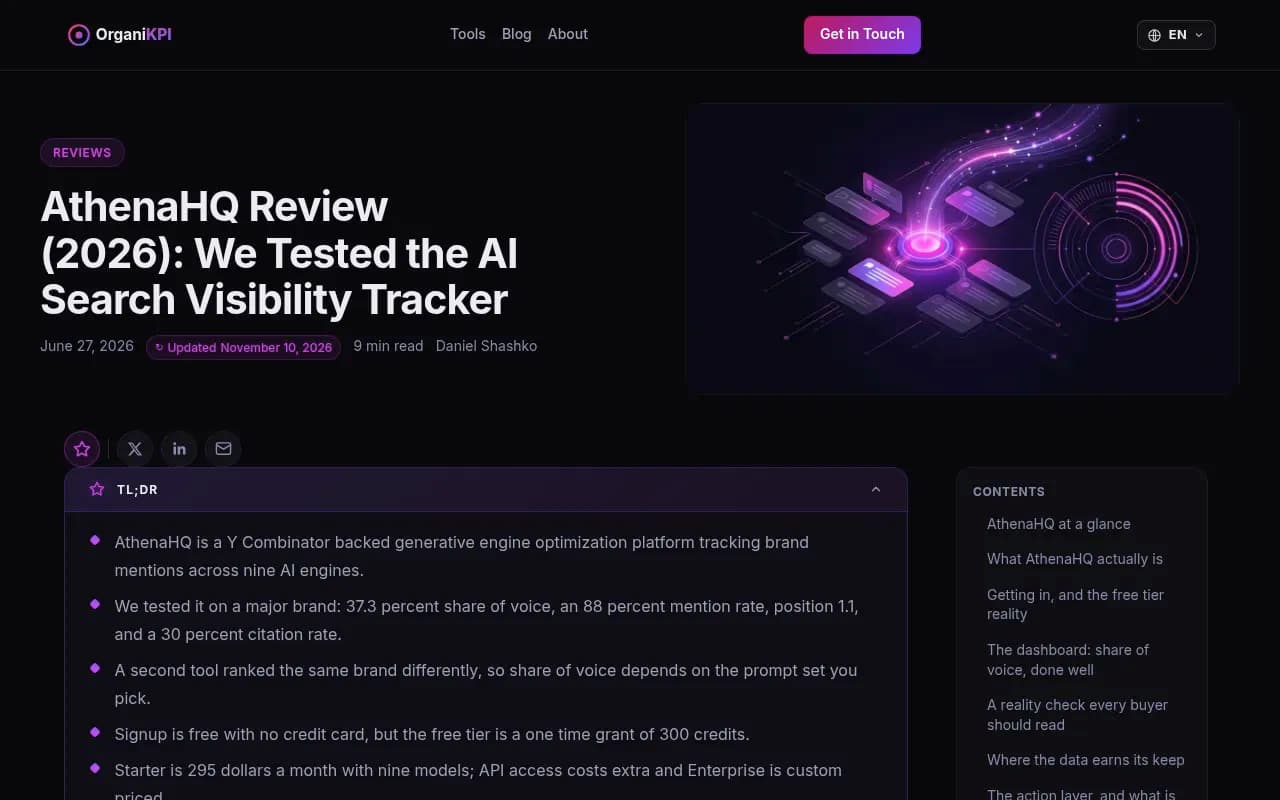
AthenaHQ is a Y Combinator backed GEO platform, and it is a good product. OrganiKPI rated it 4 out of 5 after testing it on a major brand, praising the onboarding, auditable AI answers and the action layer. Their summary line stuck with me: AthenaHQ "costs less and actually gets used" compared with some rivals.
So why switch? Mostly money and mechanics. The Starter plan is $295/month, there is no middle tier between the free grant and that price, and the credit model makes monthly spend scale with prompts x models x frequency. If you track daily across many models, credits drain fast. Some teams also want things AthenaHQ does not obviously offer, like IP-verified crawler logs and an agent that publishes to a CMS.
This guide is for people already on AthenaHQ (or just off it) who are weighing the move. I'll be honest about where each tool wins, and I'll flag that I'm publishing on a network that uses Promptwatch, so weigh my opinions accordingly.


Pricing, side by side
Both vendors publish pricing, which helps. Here is what the official pages show.
| AthenaHQ | Promptwatch | |
|---|---|---|
| Free starting point | Essential: one-time 300 credits ($25), 5 models | 7-day free trial on monthly billing, plus a free AI visibility report |
| Entry paid plan | Starter $295/mo (17% off annual) | Essential $95/mo |
| Mid plan | None | Professional $245/mo |
| Higher plan | Enterprise (custom) | Business $579/mo, Enterprise (custom) |
| Volume | 3,600 credits/mo on Starter | 6,000 / 18,000 / 42,000 responses by plan |
| Prompts | Unlimited, limited by credits | 50 / 150 / 350 by plan |
| Seats | Unlimited | Unlimited on all plans |
| Extras | API access and extra credits cost more | Agent Credits included, add-ons available |
A warning on the volume row. AthenaHQ's 3,600 credits equal 3,600 responses a month. Promptwatch's Professional plan gives 18,000 responses. That looks like a 5x gap for a lower price, but a response is not guaranteed to be defined identically on both platforms (models, locations and frequency all multiply the count). Run your own prompt list through both calculators before you trust a per-response number.
Promptwatch also runs a Black Friday promotion (30% off, ending Nov 30), but confirm current pricing at promptwatch.com/pricing.
The stale claims worth ignoring
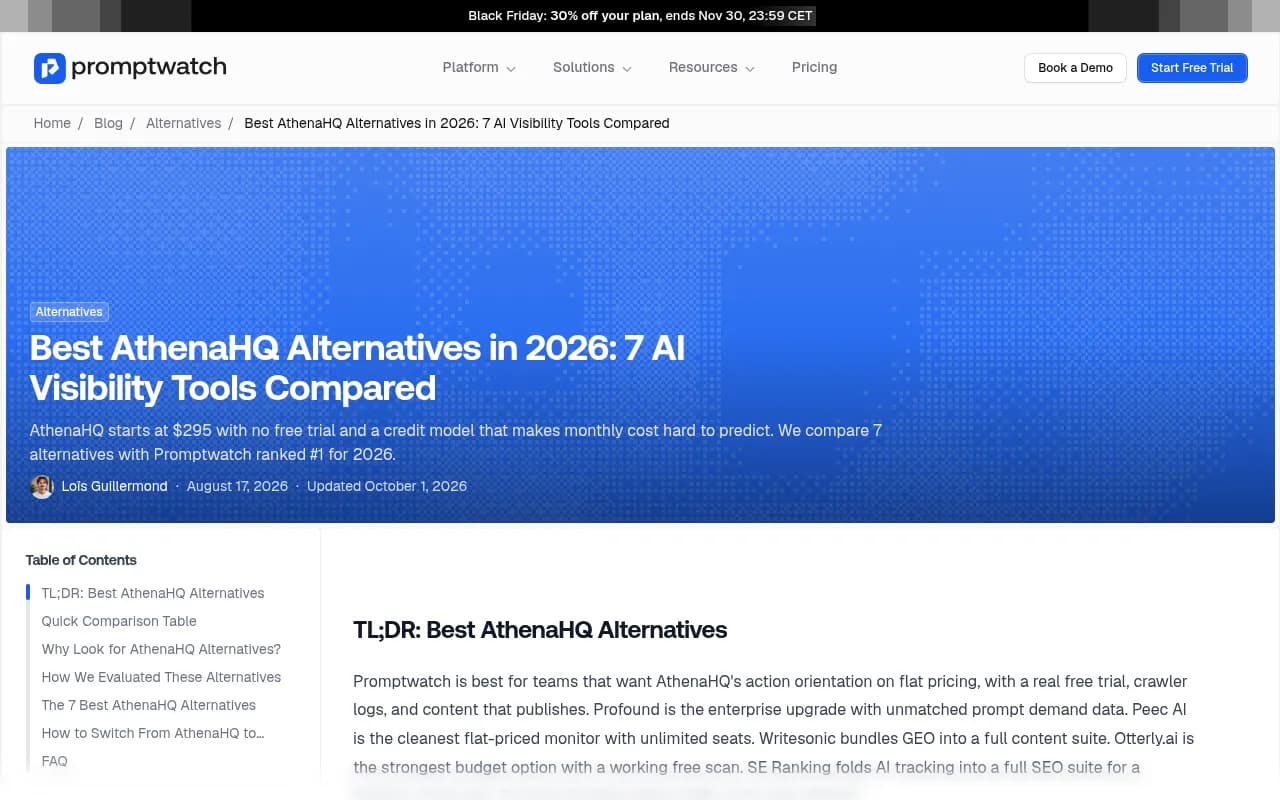
Promptwatch's own migration post says AthenaHQ has no real free trial and that Promptwatch meters seats. Both look out of date. AthenaHQ now lists a free Essential tier with 300 credits, and Promptwatch's pricing page shows unlimited seats on every plan. When a vendor writes a comparison, double-check the details that favor them. Competitor posts do the same: Profound's AthenaHQ review is a year old and written by a rival.
Where AthenaHQ is genuinely strong
I'd rather not pretend AthenaHQ is a weak product.
- Onboarding. OrganiKPI called it the cleanest they tested.
- Revenue attribution. Even Promptwatch's own post concedes that AthenaHQ's native GA4 and Shopify attribution is more turnkey for e-commerce. I could not verify whether that is still unique, so test it if it matters to you.
- Model coverage on Starter. Eleven models, including AI Mode, Claude, Grok, DeepSeek, Meta AI and Mistral.
- Unlimited prompts, topics and competitors. If you run thousands of prompts at low frequency, the credit model can pay off. Alexandrya.AI's review makes the same point for weekly tracking.
- An agency pitch workspace.
The weak spots are also consistent across reviews. The price floor is high, the best optimization features (the Advanced Content Optimization Agent, multiple countries, the Athena Citation Engine and a GEO specialist) sit in Enterprise, and credits drain quickly with daily runs. OrganiKPI's review lays all of that out well.
Where Promptwatch is different
The core difference is scope. Promptwatch is built as a loop: monitor what AI says, trace where it gets answers, act on gaps, then measure whether the fix worked.
Crawler logs and traffic
AI crawler logs show whether bots like GPTBot, ClaudeBot and PerplexityBot actually read your pages, and where they hit errors. That tells you whether a missing citation is an access problem or a content problem. Promptwatch Data's AI crawler traffic report is a useful benchmark here: OpenAI accounted for 79.8% of IP-verified AI crawler requests in the week of Aug 31 to Sept 6, 2026, down from 94.8% in mid-June. If a provider is big in that mix but near zero in your logs, you are probably blocking it. I could not confirm that AthenaHQ offers an equivalent log view; it has a Google Analytics connection for AI bot analytics instead.
See the AI crawler logs feature for how setup works through Cloudflare, Vercel, Fastly, the WordPress plugin and others.
Content that gets written and published
On Professional, you get content writing and refresh plus a knowledge base. Business adds the automated Content Agent, which plans, writes and publishes to WordPress, Webflow or Framer on a schedule with a review inbox. AthenaHQ has a content optimization agent on Starter and an advanced one on Enterprise, so this is a difference of degree, not a total gap. Where Promptwatch goes further is tracking each published page afterwards through crawls, citations and AI traffic.
Query fan-outs and prompt data
AI engines often run several searches behind one answer. Promptwatch tracks these fan-outs and shows prompt volumes and difficulty. Promptwatch Data's ChatGPT query fanout report found average fanouts fell from about 2.15 searches per response in early December to about 1.84 by early March, and average query length dropped from roughly 117 to 53 characters once fanouts returned in April. Its practical advice, writing headings that read like search queries and covering sub-questions like pricing and alternatives, applies whichever tool you use.
Features that matter at higher tiers
Business adds hourly tracking, state and city tracking, Shopping insights, Ads Radar and Fact Check. Country-level tracking is included from the $95 plan, whereas AthenaHQ lists multiple countries as an Enterprise feature.
Head-to-head comparison
| Area | AthenaHQ | Promptwatch |
|---|---|---|
| Price predictability | Credits scale with prompts x models x frequency | Fixed plans with response allowances |
| Countries | Single country on Starter, multiple on Enterprise | Country tracking on every plan |
| Crawler logs | Not confirmed in research (GA4-based AI bot analytics) | IP-verified logs, plan limits vary |
| Content publishing | Optimization agent, advanced version on Enterprise | Content writing from Professional, automated agent on Business |
| GA4 / Shopify revenue attribution | Native, reportedly turnkey | Conversion tracking and visitor analytics; GA4/Shopify support not confirmed |
| Prompt limits | Unlimited, credit-bound | Capped by plan |
| Seats | Unlimited | Unlimited |
| Agency options | Pitch workspace | Agency plans from $199/mo with unlimited projects and prompts |
Should you switch? A decision guide
Switch if
- Your credits run out before the month ends and you cannot predict the bill.
- You want crawler logs or fan-out data next to your visibility numbers.
- You want content published to your CMS, with tracking afterwards.
- You need multi-country tracking without moving to Enterprise.
- You are a price-sensitive team that only needs monitoring, and $95/month beats $295.
Stay if
- Native revenue attribution through GA4 and Shopify is how you justify the budget.
- You run very large prompt sets. A 350-prompt cap on Business is a real ceiling.
- Your team already lives in AthenaHQ and the work is getting done. A tool people use beats a better tool they ignore.
Consider neither
If your needs are simpler or the budget is tight, the GEO software directory at bestgeosoftware.com lists many lower-cost trackers. Peec AI and Otterly.AI are common flat-priced options for pure monitoring, and Profound targets enterprises.



How to switch without losing your baseline
The honest limitation first: there is no connector between the platforms. Nothing historical moves.
- Export everything from AthenaHQ. Download CSVs of prompts, responses, citations and visibility metrics before cancelling. This is your only record of the baseline.
- Copy your prompt list. Promptwatch accepts a paste or file upload of up to 1,000 prompts at a time. Trim to your plan's cap (50, 150 or 350), prioritizing prompts tied to revenue.
- Recreate your setup. Set countries, languages, competitors and personas. Language and location are fixed per monitor, so plan your monitors before creating them.
- Run both tools in parallel for 2 to 4 weeks. Share of voice depends on the prompt set (OrganiKPI saw a second tool rank the same brand differently), so expect numbers to differ. Compare trends, not absolute values.
- Connect your site. Add crawler logs via your CDN or the WordPress plugin, install the visitor script, and link Google Search Console.
- Cancel AthenaHQ once your new baseline has a few weeks of data. Note that Starter credits roll over for one month only.
Before you commit, run the free AI visibility report or the 7-day trial with your real prompt list. For detailed head-to-head specifics, see Promptwatch vs AthenaHQ.
What I could not verify
Two gaps are worth stating. I found no independent evidence on how closely the two tools' data agree, so accuracy claims from either side are unproven. And I could not confirm whether GA4 or Shopify attribution exists in Promptwatch, so if it is a dealbreaker, ask in a demo.
Bottom line
For most former AthenaHQ users who felt the credit meter was the problem, Promptwatch is worth a trial: lower entry price, country tracking included, and crawler logs plus publishing tools in the same product. For e-commerce teams that depend on native revenue attribution, or teams running huge prompt lists, AthenaHQ may still be the better fit. Test with your own prompts, compare for a month, and decide on what your data shows.