Key takeaways
- AI slop is not defined by whether AI touched the keyboard. It's defined by the absence of specificity, evidence, and original judgment in the finished piece. AI-generated and AI-assisted are production methods; slop is a quality label.
- Merriam-Webster made "slop" its 2025 Word of the Year, defined as low-quality digital content produced in quantity with AI. That's now the mainstream definition you're working against.
- Google's spam policy targets "scaled content abuse," not AI use itself. Volume without proportional value is what gets sites hit, and the March 2026 core update enforced this hard.
- AI detectors are unreliable for policing your own team's output. Light editing defeats most of them, and false-positive rates on ESL writers run absurdly high. Track process, not detector scores.
- Promptwatch's own citation data shows AI search engines are rewarding specific, how-to and documentation-style content over generic listicles, which lines up almost exactly with what separates assisted writing from slop.
Why the slop debate keeps going in circles
Every few weeks someone posts a hot take about AI slop, and every time, the comments split into two camps that are both a little right. One camp says "AI writing is inherently hollow, stop pretending otherwise." The other says "AI is just a tool, the output is only as good as the person directing it." A Reddit thread in r/WritingWithAI put it well: if you read a lot, the tell with AI writing usually isn't the sentences themselves, it's that the cost of producing something that actually says anything new got driven to zero, and a lot of people stopped paying it.
I think both camps are missing the more useful question, which is one an editor at a content marketing firm phrased cleanly: does the finished writing give the reader meaningful information they couldn't get from a generic explanation? That's it. Everything else is downstream of that.
So let's separate two things people constantly conflate.
AI-generated vs. AI slop are not the same axis
AI-generated content describes how something was produced: a model drafted some or all of it. AI slop describes the quality of what came out the other end. You can have AI-generated content that's accurate, well-sourced, and genuinely useful after a competent editor works it over. You can also have 100% human-written content that's repetitive, vague, and says nothing. The production method and the quality of the result are two separate variables, and the slop conversation gets muddled every time someone treats them as one.
| AI-generated content | AI slop | |
|---|---|---|
| What it describes | How the piece was produced | The quality of the finished piece |
| Can it be good | Yes, with real editing and added expertise | No, by definition it's thin |
| Editing required | Ranges from light touch to heavy rewrite | Usually none was applied |
| Who's responsible | A team decision about workflow | An editorial failure |
An AI writing tool industry site made basically this same point, framing it as a table of "AI-generated content" vs. "AI slop" that maps how it was made against how good it ended up. The distinction matters because a lot of content policies aimed at "banning AI" are actually aimed at banning laziness, and they'd be more effective if they said so.
The slop spectrum: a five-level way to audit your own output
The most actionable framework I've seen for this comes from a content agency's internal model, which splits AI output into levels. It's worth adapting for any content team:
Level 1-2: Raw prompt output. Someone typed a prompt, copied the answer, hit publish. This is slop by definition, no argument needed.
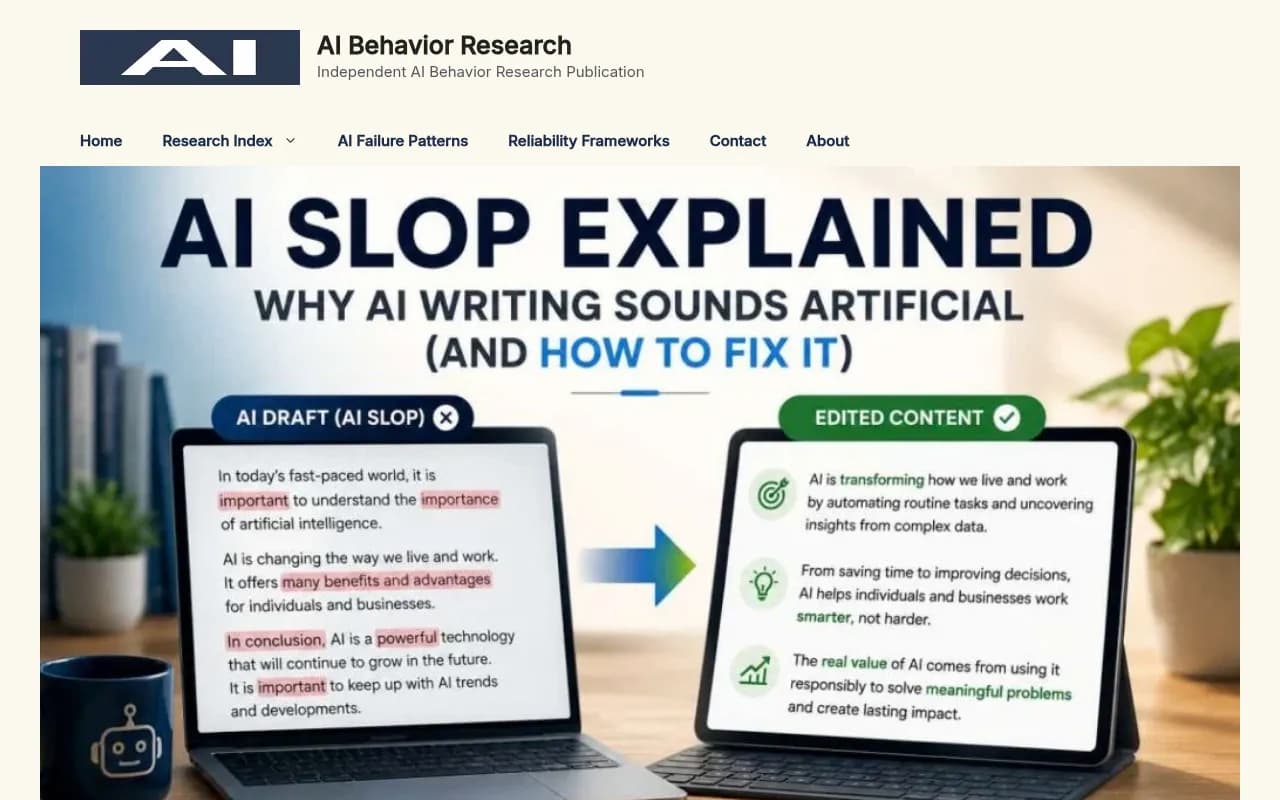
Level 3: Edited output. A human cleaned up grammar, smoothed the tone, removed the obvious AI phrasing. This is the dangerous level, because it looks like effort was applied, and most teams stop here and call it done. The agency's framing nails it: editing for tone and flow removes the surface-level tells while leaving the structural emptiness completely intact. It's polished slop. Still zero information gain for the reader.
Level 4: Augmented output. A human injects something the model couldn't generate on its own: proprietary data, a named example from an actual customer, a genuine disagreement with the conventional wisdom, a first-person account of trying the thing. AI supplies structure and drafting speed; the human supplies the reason anyone should read it. This is what "AI-assisted writing" should mean.
Level 5: Expert-directed output. The human comes up with the argument and gathers the evidence first; AI is used mainly to speed up drafting mechanics. This is the gold standard, and honestly it's how a lot of skilled writers already worked pre-AI, just faster now.
The test the agency proposes for auditing your own drafts is blunt and useful: does this page contain any claim or perspective that couldn't appear on a competitor's site? If the honest answer is no, you're at level 3 at best, no matter how clean the prose reads.
What actually gives away slop (and what doesn't)
There's a lot of folk wisdom about "AI tells" that's worth being skeptical of. A widely cited field guide on this splits the signals into two buckets, and it's a useful gut check before you go rewriting a perfectly good sentence out of paranoia.
Unreliable signals, things people point to that don't actually prove anything: sophisticated vocabulary like "delve" or "multifaceted," the absence of typos, the absence of contractions. None of that is proof. A careful human writer running spellcheck produces the same surface pattern.
More reliable signals are structural repetition. A 2026 ICLR research paper on this (Dekoninck et al.) found that certain lexical and structural patterns occur over 1,000 times more frequently in raw LLM output than in human writing. Rule-of-three groupings, em-dash saturation, the reflexive "it's not just X, it's Y" construction. Individually these aren't damning, a human can use an em dash too, but when a piece is built almost entirely out of these tics, that's a structural signature, not a style choice.
Here's the thing though: none of that structural stuff is actually the problem. You can strip every em dash and rule-of-three out of a slop piece and it's still slop, just slop with better punctuation. The tics are symptoms. The disease is the absence of a claim that couldn't appear on a competitor's site.
What Google actually penalizes (it's not "using AI")
A lot of content teams operate under a myth that Google bans AI-written content. It doesn't, and never has. Google's spam policy defines "scaled content abuse" as pages generated for the primary purpose of manipulating rankings without helping users, and it's explicit that this applies "regardless of whether automation, human effort, or a combination is used." A human churning out 40 near-identical city-name-swapped pages a day is exactly as much a violation as a script doing it.
The March 2024 core update introduced this language formally, and Google moved from purely algorithmic enforcement to manual actions on scaled content abuse starting in June 2025. The March 2026 core update leaned on it again, and one analysis of sites hit by that update found a consistent pattern: sites publishing 50-500 AI articles a day with no human review, templated pages swapping out a location or product name at thin-value scale, and AI-translated content multiplied across dozens of language variants with zero original value added anywhere.
The pattern across all of it: volume isn't the trigger. Volume without proportional value is. That's the exact same line Google has held since March 2024, and it's the same line that separates level 3 slop from level 4 augmented content in the framework above.
Why this matters even more for AI search visibility
If you're optimizing for how AI search engines like ChatGPT, Perplexity, and Google's AI Overviews cite sources, the slop problem gets a second, more immediate consequence: thin content just doesn't get cited as much. Data from Promptwatch on what ChatGPT cites shows product pages and listicles losing share to how-to and documentation-style content over the course of a single month in 2026, with how-to citations more than doubling from roughly 4% to over 9%. That's a direct signal that AI search is rewarding the kind of specificity that slop, by definition, doesn't have.

There's also a persistent myth in content-ops circles that publishing raw markdown files somehow helps AI models find and cite your content faster. Promptwatch's data on this is stark: across ChatGPT, Claude, Perplexity, and Google AI Overviews, HTML pages account for 99.94% of citations versus 0.05% for markdown files, a roughly 2,000-to-1 ratio. Markdown matters for coding agents like Claude Code, not for consumer AI search visibility. If your team has been dumping AI drafts straight into a .md file thinking that's the optimization move, it isn't.
For teams that want to track this systematically rather than guess, platforms like Promptwatch break citations down by content type and show which of your own pages are actually getting pulled into AI answers versus which ones are just sitting there. That's useful feedback for figuring out whether your "AI-assisted" content is landing at level 4 or quietly sliding back to level 3.
Readers can tell, even when they can't always say why
A Bynder study that put 2,000 US and UK consumers through a blind test found 50% could correctly identify AI-generated copy against a human copywriter's version, with US readers about 10 points better at spotting it than UK readers. Interestingly, 56% said they actually preferred the AI-written piece in that same blind test. But the study's more important number is this: 52% of people said they become less engaged once they suspect content is AI-generated, regardless of whether their suspicion is accurate. Suspicion, not detection accuracy, is what kills engagement.
A separate content marketing analysis put a number on the downstream effect: content built from generic third-party stats with no first-party insight sees roughly 5.44x less traffic than content built on real expertise, named tools, and specific examples. Whether or not that exact multiplier holds up everywhere, the direction matches everything else in this piece.
A practical editorial checklist
Borrowing from a human-in-the-loop checklist that's been circulating in editorial teams, here's a version worth pinning above your CMS:
- The opening two paragraphs answer the reader's actual question, not a restated version of the headline.
- Every statistic links to a sourced, dated citation, not a vague "studies show."
- At least one claim, example, or data point in the piece could not appear verbatim on a competitor's site.
- Vague references ("a recent study," "many experts") are replaced with named tools, organizations, people, or methods.
- Headings map to questions a real reader would type into a search box or ask a colleague, not generic section labels.
- Examples have enough detail that a reader could actually evaluate them, not just nod along.
- A named human editor owns final accuracy and approval before it ships.
If a piece fails more than one or two of these, it's level 3 at best, no matter how good the sentences sound.
Don't rely on AI detectors to police this
It's tempting to think you can just run drafts through a detector and call it a policy. Don't. Pangram Labs is independently rated by NBER research as the most accurate detector currently available, and even it, along with Copyleaks, GPTZero, and Originality.ai, sees accuracy collapse once text has been lightly edited. One December 2025 comparison found all four major detectors dropped to single-digit accuracy percentages on human-edited AI text. Worse, Stanford HAI research found a 61% false-positive rate on TOEFL essays written by non-native English speakers, meaning detectors disproportionately flag good writers as AI cheats simply because their sentence patterns differ from a native-speaker baseline.
The practical lesson: build a process (draft history, source records, named editor sign-off) rather than leaning on a single tool's percentage score. A detector telling you a piece is "12% likely AI" tells you almost nothing about whether it's actually good.
Where this is heading
The Organization Science journal study covered by Forbes in April 2026 is a useful preview of what happens when an entire industry ignores this distinction. Researchers scored nearly 7,000 submissions using Pangram and found the fastest-growing category was manuscripts scoring 70%+ AI-generated, while genuinely human-only submissions actually declined. The AI-heavy papers were measurably harder to read, scored worse on standard readability tests, and were more likely to get rejected. Over 30% of peer reviews now show detectable AI use too, and editors describe those reviews as essentially uninformative. That's what an industry publishing at level 3 scale looks like from the outside, and it's a preview of what happens to any content vertical that treats output volume as the goal instead of a byproduct.
For content teams trying to avoid that fate while still using AI to move faster, the tools worth looking at aren't detectors, they're the ones that help you see whether your content is actually landing with real audiences and AI systems, not just getting published. The directory of GEO software at bestgeosoftware.com is a reasonable place to start comparing platforms built for that specific job, and the broader software directory at surferstack.com covers content optimization tools more generally if you're building out an editorial stack from scratch.
The framework, stripped down to one sentence: it was never about whether AI wrote the first draft. It's about whether a specific, verifiable, non-interchangeable idea made it into the final piece before anyone hit publish.