Key takeaways
- Peec.ai tracks brand visibility across AI engines like ChatGPT, Perplexity, and Gemini, but teams frequently outgrow it due to cost, limited model coverage, and a lack of content optimization tools.
- The best alternatives go beyond monitoring to help you actually fix visibility gaps -- through content generation, competitor analysis, and citation tracking.
- Promptwatch is the only platform in this space rated as a "Leader" across all GEO categories, covering 10+ AI models with built-in content gap analysis and an AI writing agent.
- Most alternatives covered here fall into two camps: monitoring-focused tools (good for tracking) and full optimization platforms (good for tracking and fixing).
- Pricing across the category ranges from free tiers to $300+/month -- so there's a fit for most team sizes.
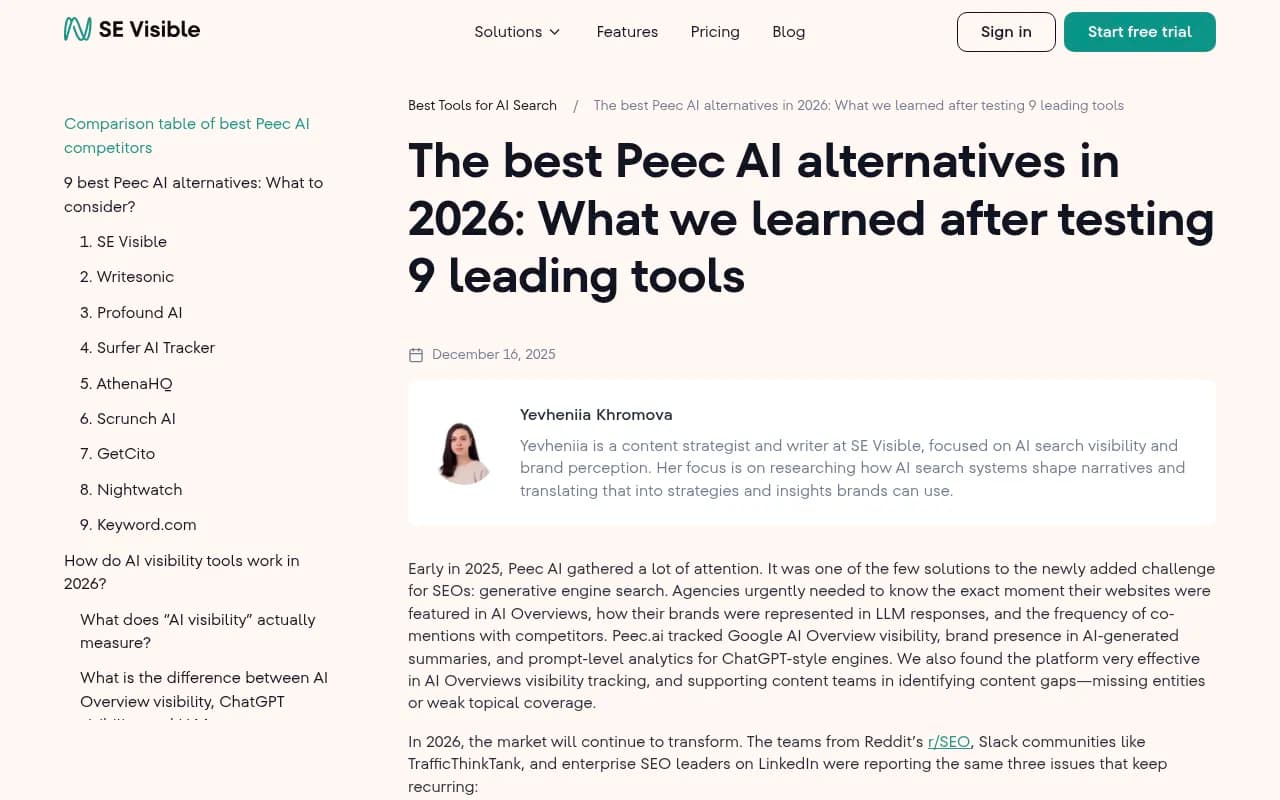
Peec.ai had a good run as an early mover in AI visibility tracking. When generative search started eating into organic traffic in 2024 and 2025, it was one of the few tools that let you see how your brand appeared in ChatGPT, Perplexity, and Gemini responses. For a lot of teams, it was the first time they had any data at all on this.
But the complaints started piling up. Costs scaled poorly for large prompt sets. Model coverage felt narrow as the AI search landscape expanded to include Claude, Grok, DeepSeek, Meta AI, and Google AI Mode. And critically, most teams found themselves staring at dashboards with no clear path to improving what they were seeing.
This guide covers 9 alternatives worth considering in 2026 -- tools that either cover more AI models, offer better pricing, or actually help you do something with the data.
What to look for in a Peec.ai alternative
Before jumping into the list, it's worth being clear about what "better" actually means here. The right tool depends on what you're trying to do.
A few questions worth asking:
- How many AI models does it track? ChatGPT and Perplexity are table stakes. But what about Claude, Gemini, Grok, DeepSeek, Copilot, and Google AI Overviews?
- Does it show you why you're not being cited, or just that you're not?
- Can it help you create content that gets cited, or does it just report the gap?
- Does it track at the page level, so you know which URLs are actually driving AI visibility?
- What does it cost at scale -- when you have 150+ prompts across multiple sites?
With that in mind, here's how the main alternatives stack up.
Quick comparison table
| Tool | AI models covered | Content generation | Crawler logs | Starting price |
|---|---|---|---|---|
| Promptwatch | 10+ (ChatGPT, Claude, Perplexity, Gemini, Grok, DeepSeek, Copilot, Meta AI, Google AIO, Google AI Mode) | Yes (built-in AI writing agent) | Yes | $99/mo |
| Profound | ChatGPT, Perplexity, Gemini, Claude, Google AIO | No | No | $99/mo |
| AthenaHQ | Google AIO, Perplexity, ChatGPT, Claude | No | No | $295/mo |
| Scrunch AI | ChatGPT, Perplexity, Gemini, Claude | No | No | Custom |
| Otterly.AI | ChatGPT, Perplexity, Gemini, Bing | No | No | ~$49/mo |
| SE Visible | ChatGPT, Perplexity, Google AIO, Gemini | No | No | $189/mo |
| Rankscale | ChatGPT, Perplexity, Gemini | No | No | Custom |
| LLM Pulse | ChatGPT, Gemini, Google AI Mode | No | No | Free tier |
| Writesonic | ChatGPT, Perplexity, Gemini, Claude, Google AI Mode | Yes (content workflows) | No | $199/mo |
1. Promptwatch -- best overall for AI visibility and optimization
Promptwatch is the most complete platform in this category. Where Peec.ai and most alternatives stop at monitoring, Promptwatch runs a full loop: find the gaps, generate content to fill them, and track whether it worked.

The Answer Gap Analysis is the standout feature. It shows you exactly which prompts your competitors are appearing for that you're not -- not just "you're missing," but the specific topics and questions AI models want answered that your site doesn't cover. From there, the built-in AI writing agent generates articles and listicles grounded in citation data from 880M+ analyzed citations, not generic SEO filler.
Model coverage is the widest in the category: ChatGPT, Claude, Perplexity, Gemini, Grok, DeepSeek, Copilot, Meta AI, Google AI Overviews, and Google AI Mode. That's 10 models tracked simultaneously.
A few things that genuinely set it apart from Peec.ai:
- AI Crawler Logs show you which pages ChatGPT, Claude, and Perplexity are actually crawling -- and where they're hitting errors. Most competitors don't have this at all.
- Prompt Intelligence gives you volume estimates and difficulty scores per prompt, so you can prioritize instead of guessing.
- Reddit and YouTube tracking surfaces discussions that directly influence AI recommendations -- a channel Peec.ai ignores entirely.
- ChatGPT Shopping tracking monitors when your brand appears in product recommendation carousels.
Pricing starts at $99/month (1 site, 50 prompts, 5 articles). The Professional plan at $249/month adds crawler logs, city/state tracking, and 150 prompts across 2 sites. Used by 6,700+ brands and agencies including Booking.com and Center Parcs.
If you're evaluating one tool seriously, this is the one to start with.
2. Profound -- best for entity-driven AI visibility
Profound has built a strong reputation for precise AI Overview tracking and entity extraction. If your SEO strategy is entity-focused -- you care about which named entities appear in AI responses and how they're connected -- Profound does this better than most.

It maps attribution at a granular level: which source URLs are being cited, how often, and in what context. The competitor presence monitoring is solid too. Where it falls short is on the action side -- there's no content generation, no crawler logs, and the model coverage is narrower than Promptwatch's. But at $99/month as a starting point, it's a reasonable option for teams that already have content workflows and just need better visibility data.
3. AthenaHQ -- best for multi-engine brand monitoring
AthenaHQ covers Google AI Overviews, Perplexity, ChatGPT, and Claude, with a focus on brand narrative analysis -- how AI engines describe your brand, what language they use, and whether that narrative is accurate or drifting.

It's genuinely useful for brands that have a reputation management concern alongside a visibility concern. The sentiment analysis is more developed than Peec.ai's. The downside: at $295/month, it's expensive for what's still primarily a monitoring tool. There's no content generation, no crawler logs, and no Reddit/YouTube tracking. You'll get good data, but you'll need to act on it elsewhere.
4. Scrunch AI -- best for brand narrative analysis at scale
Scrunch AI takes a different angle than most tools here. Rather than just tracking whether your brand appears in AI responses, it analyzes how your brand is described -- the descriptors, associations, and narrative framing that AI models apply to you.
For enterprise brands with complex positioning, this is valuable. If ChatGPT consistently describes your product in a way that's outdated or inaccurate, Scrunch helps you identify that systematically. Coverage includes ChatGPT, Perplexity, Gemini, and Claude. Pricing is custom (enterprise-focused), which means it's probably not the right fit for smaller teams.
5. Otterly.AI -- best budget entry point
If you're just getting started with AI visibility tracking and want to spend as little as possible, Otterly.AI is the most accessible option. It covers ChatGPT, Perplexity, Gemini, and Bing, with a clean interface and straightforward prompt tracking.

The limitations are real: no content generation, no crawler logs, no Reddit tracking, no visitor analytics. It's a monitoring-only tool. But for a small team that just wants to know whether their brand is showing up in AI responses before committing to a larger platform, it does the job at a price that doesn't require budget approval.
6. SE Visible -- best for marketing leaders who need strategic context
SE Visible (from SE Ranking) positions itself for CMOs and marketing leaders rather than technical SEO practitioners. The dashboards are built around strategic decisions -- competitor benchmarking, share of voice trends, sentiment analysis -- rather than raw data exports.
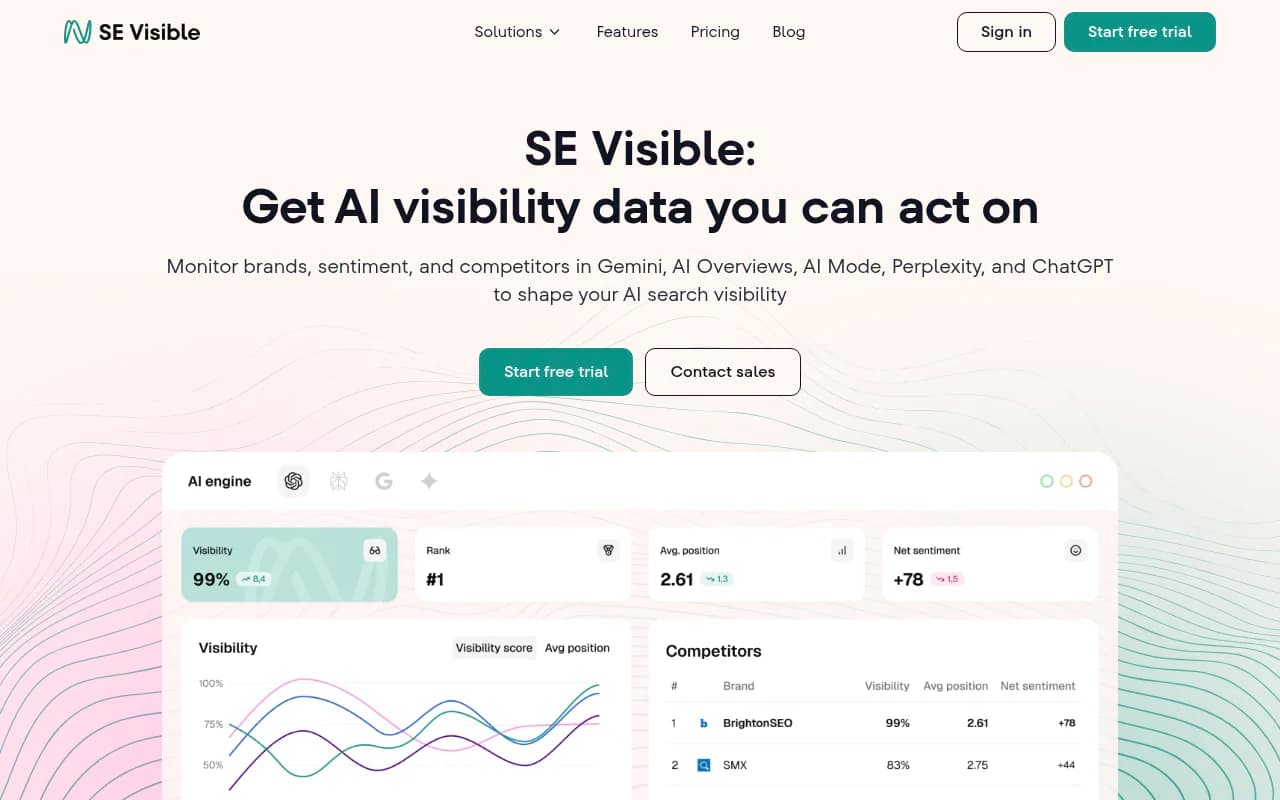
It covers ChatGPT, Perplexity, Google AI Overviews, and Gemini. The reporting is polished and the competitor benchmarking is genuinely useful for presenting to leadership. At $189/month, it's mid-range for the category. The gap is the same as most tools here: no content optimization, no crawler logs, no way to act on what you're seeing beyond exporting the data.
7. Rankscale -- best for competitive AI visibility benchmarking
Rankscale focuses specifically on competitive benchmarking -- how your AI visibility compares to specific competitors across prompts and models. If you're in a category where you know exactly who you're competing against and want to track the gap systematically, it's well-suited to that workflow.
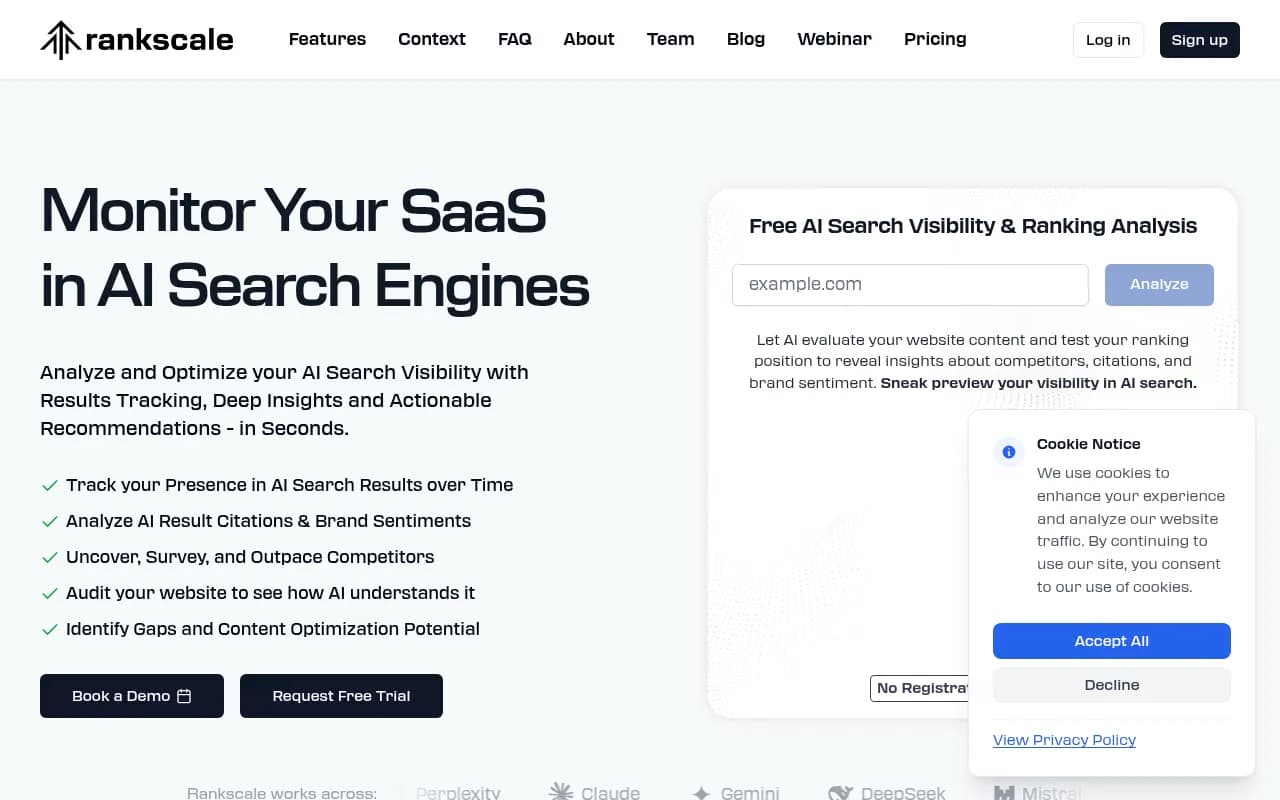
Coverage includes ChatGPT, Perplexity, and Gemini. Pricing is custom, which suggests it's aimed at mid-market and enterprise teams. The competitive heatmap view is one of the cleaner implementations of this feature in the category.
8. LLM Pulse -- best free option for AI search visibility
LLM Pulse tracks brand mentions and citations across ChatGPT, Gemini, and Google AI Mode, with a free tier that makes it accessible for individuals and small teams testing the waters.
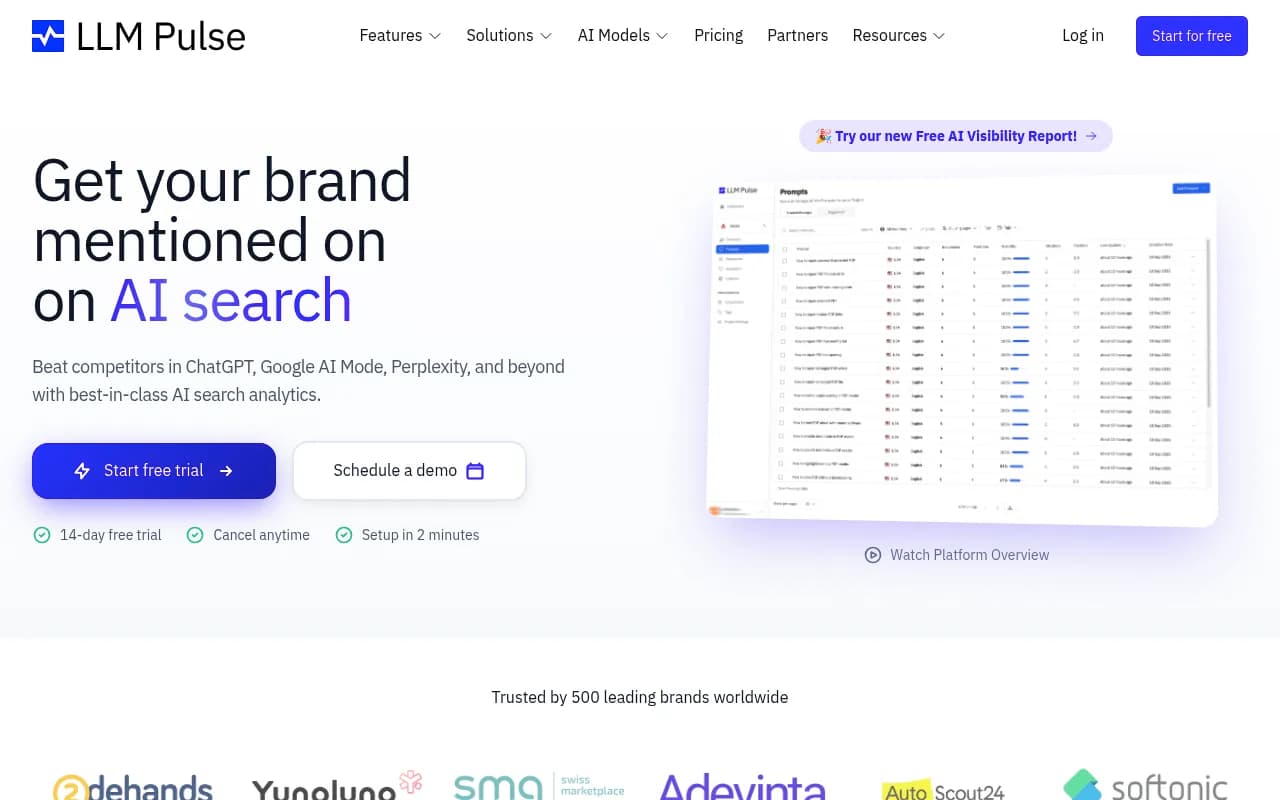
The data export options and API/BI connectors are a genuine differentiator at this price point -- most tools in the free/budget tier don't offer this. It won't replace a full platform for a serious SEO team, but for someone who wants to understand AI visibility basics without spending anything, it's a reasonable starting point.
9. Writesonic -- best for teams that want monitoring and content creation together
Writesonic has expanded well beyond its original AI writing roots into a GEO platform that tracks visibility across ChatGPT, Perplexity, Gemini, Claude, and Google AI Mode, while also offering content optimization workflows.
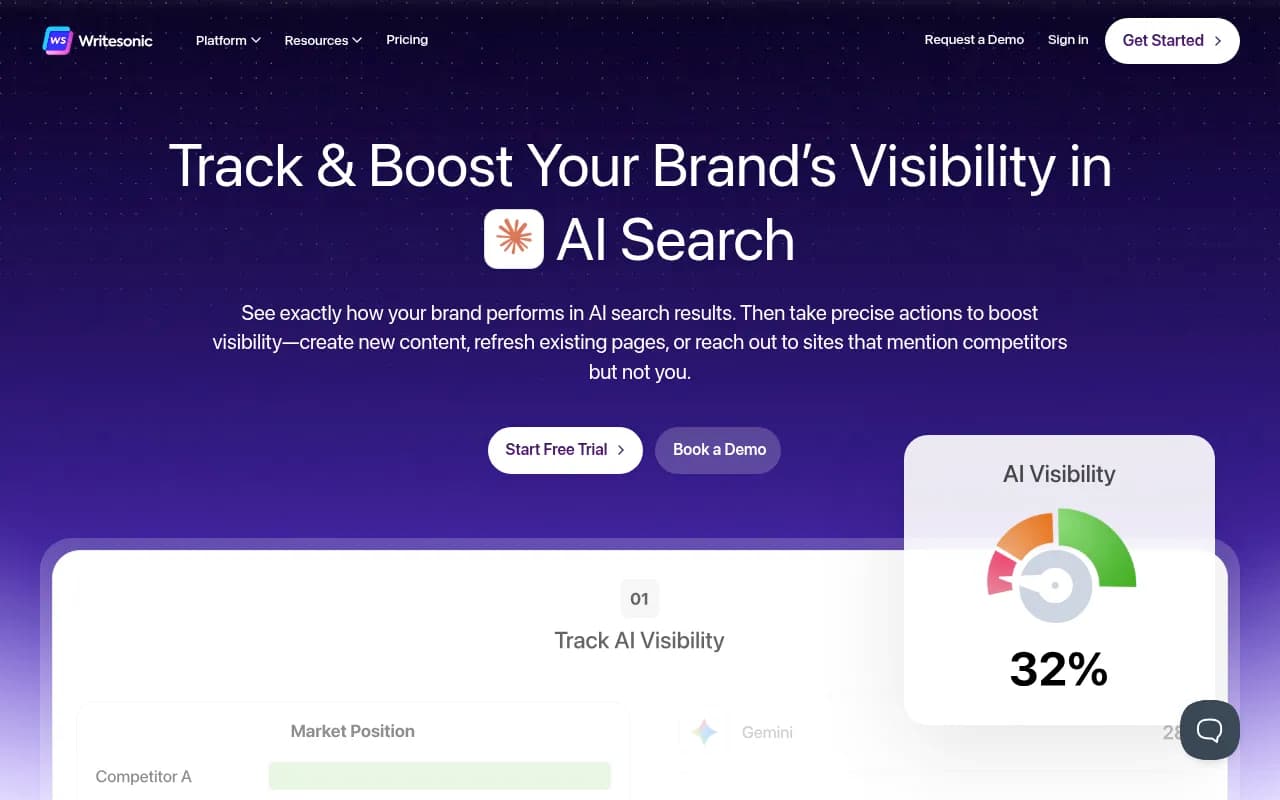
The combination of tracking and content creation in one tool is the appeal here. You can see where you're not appearing and generate content to address it without switching platforms. At $199/month, it's priced similarly to Promptwatch's Professional plan, though Promptwatch's model coverage (10 models vs. 5) and crawler log capabilities give it an edge for teams that need the full picture.
Why most alternatives still leave you stuck
Looking at this list honestly, there's a pattern worth naming. Most of these tools -- Profound, AthenaHQ, Otterly.AI, SE Visible, Rankscale, LLM Pulse -- are monitoring platforms. They show you data. They tell you where you're invisible. Then they stop.
That's not nothing. Knowing you're invisible is better than not knowing. But the teams that are actually improving their AI search visibility aren't just watching dashboards -- they're publishing content that gets cited, fixing crawl errors that prevent AI bots from reading their pages, and systematically targeting prompts where they can win.
The tools that close this loop -- Promptwatch and to a lesser extent Writesonic -- are the ones worth prioritizing if your goal is actually moving the needle, not just reporting on where you stand.
How to choose
A few practical scenarios:
- You're a solo SEO or small team on a tight budget: Start with LLM Pulse (free) or Otterly.AI (~$49/month) to get baseline data. Upgrade when you need to act on it.
- You're at an agency managing multiple client sites: Promptwatch's Professional or Business plan gives you multi-site tracking, content generation, and the crawler logs you need to diagnose issues across accounts.
- You're an enterprise brand worried about narrative accuracy: AthenaHQ or Scrunch AI are worth evaluating for their sentiment and descriptor analysis.
- You want to actually improve visibility, not just measure it: Promptwatch is the clear choice. The combination of Answer Gap Analysis, AI content generation grounded in citation data, and crawler logs is the most complete action loop in the category.
- You're coming from a traditional SEO background and want AI visibility inside a familiar suite: SE Visible (SE Ranking) or Writesonic both offer this kind of integration.
The honest answer is that Peec.ai was a reasonable choice when the category was new and options were limited. In 2026, the bar is higher -- and several of these tools clear it by a significant margin.