Key takeaways
- Promptwatch is the strongest all-round alternative -- it goes beyond monitoring to help you find content gaps, generate AI-optimized content, and track traffic attribution. Best for teams that want to actually improve their AI visibility, not just measure it.
- AthenaHQ and Profound are solid enterprise-grade options with strong monitoring and some content features, but both come at higher price points and lack certain capabilities like Reddit tracking or ChatGPT Shopping monitoring.
- Otterly.AI and Peec AI are the budget-friendly picks -- good for basic brand monitoring across AI models, but don't expect content generation or deep crawler analytics.
- Semrush makes sense if you're already paying for their SEO suite and want AI visibility bolted on -- but the AI Visibility Toolkit is an add-on, and the prompts are fixed rather than customizable.
- Amplitude and Mixpanel are product analytics tools, not AI visibility platforms -- they overlap with GrowthOS's growth analytics side but don't touch LLM monitoring at all.
- HubSpot Marketing Hub is worth considering if you want AI visibility bundled into a broader marketing platform, especially if you're already in the HubSpot ecosystem.
GrowthOS pitches itself as a growth analytics platform that includes AI search visibility tracking -- a hybrid that sounds appealing on paper. The idea is that marketing teams can monitor brand presence across LLMs like ChatGPT, Claude, and Gemini while also keeping tabs on broader performance metrics, all from one place.
In practice, though, that dual focus can be a limitation. Teams that need serious AI visibility work often find that GrowthOS's LLM tracking is less deep than dedicated GEO platforms. And teams that need serious product analytics often find that tools like Amplitude or Mixpanel go much further on that side. The freemium model (200 credits/month free, then $99-$999/month) is attractive, but the credit-based system can feel restrictive as you scale up prompt tracking.
So who should look elsewhere? Teams that want to move beyond monitoring and actually fix their AI visibility gaps. Teams that need crawler log analysis, prompt volume data, or content generation. Teams that want to track 10+ AI models with granular per-page citation data. Or teams that want a more established platform with a larger customer base and deeper feature set.
Here are the best alternatives worth considering in 2026.
Dedicated AI visibility and GEO platforms
Promptwatch

Promptwatch is the most complete AI search visibility platform available right now, and the clearest upgrade from GrowthOS if AI visibility is your primary concern.
The core difference is what happens after you see the data. GrowthOS (and most other tools) show you where you're visible and where you're not. Promptwatch shows you that too, but then it tells you exactly what to do about it -- and helps you do it.
The Answer Gap Analysis identifies specific prompts where competitors are getting cited but you aren't. You can see the exact content your site is missing: the topics, angles, and question formats that AI models want to answer but can't find on your pages. Then the built-in content agent generates articles, listicles, and comparison pages grounded in real citation data from over 880 million citations analyzed. This isn't generic content -- it's built to get cited by ChatGPT, Claude, Perplexity, and others.
On the monitoring side, Promptwatch tracks 10 AI models (ChatGPT, Perplexity, Google AI Overviews, Google AI Mode, Claude, Gemini, Meta/Llama, DeepSeek, Grok, Mistral, Copilot) with page-level citation tracking, prompt volume estimates, difficulty scores, and query fan-outs that show how one prompt branches into sub-queries. The AI Crawler Logs feature is something most competitors don't have at all -- real-time logs showing when ChatGPT, Claude, Perplexity, and others crawl your pages, which pages they read, and what errors they hit.
A few things Promptwatch does that GrowthOS doesn't: Reddit and YouTube tracking (surfacing discussions that directly influence AI recommendations), ChatGPT Shopping monitoring, competitor heatmaps across LLMs, multi-language and multi-region support, and traffic attribution that connects AI visibility to actual revenue via a code snippet, GSC integration, or server log analysis.
Pricing starts at $99/month (Essential: 1 site, 50 prompts, 5 articles), $249/month (Professional: 2 sites, 150 prompts, 15 articles, crawler logs), and $579/month (Business: 5 sites, 350 prompts, 30 articles). There's a 7-day free trial. Compared to GrowthOS's $99/month Growth tier, you get significantly more depth at the same entry price -- and the content generation alone can justify the cost if you're actively trying to improve rankings.
Best for: Marketing teams, SEO teams, and agencies that want to understand their AI visibility and actually improve it -- not just track it.
AthenaHQ

AthenaHQ is a well-built GEO platform that's been getting attention since coming out of stealth backed by Y Combinator. It covers 8+ AI search engines, has a clean command center interface, and is used by recognizable brands like Coinbase, SoFi, and PagerDuty.
Compared to GrowthOS, AthenaHQ goes deeper on the monitoring and analysis side. You get cross-platform AI visibility tracking, citation source analysis, automated content optimization recommendations, and an executive dashboard for reporting up the chain. The "AEO/GEO Manager Command Center" framing is accurate -- it's built for teams that own AI search optimization as a dedicated function.
Where it falls short relative to Promptwatch: no Reddit or YouTube tracking, no ChatGPT Shopping monitoring, and the content optimization is recommendations-based rather than a full content generation agent. The platform is monitoring-heavy, which is great for understanding your position but leaves the actual content work to your team.
Pricing is $295/month self-serve (or $95/month on annual billing), with custom enterprise pricing above that. No free trial, which is a notable friction point compared to GrowthOS's free tier or Promptwatch's trial.
Best for: Enterprise marketing teams and AEO specialists who want a structured command center for AI visibility management and don't mind doing the content work themselves.
Profound
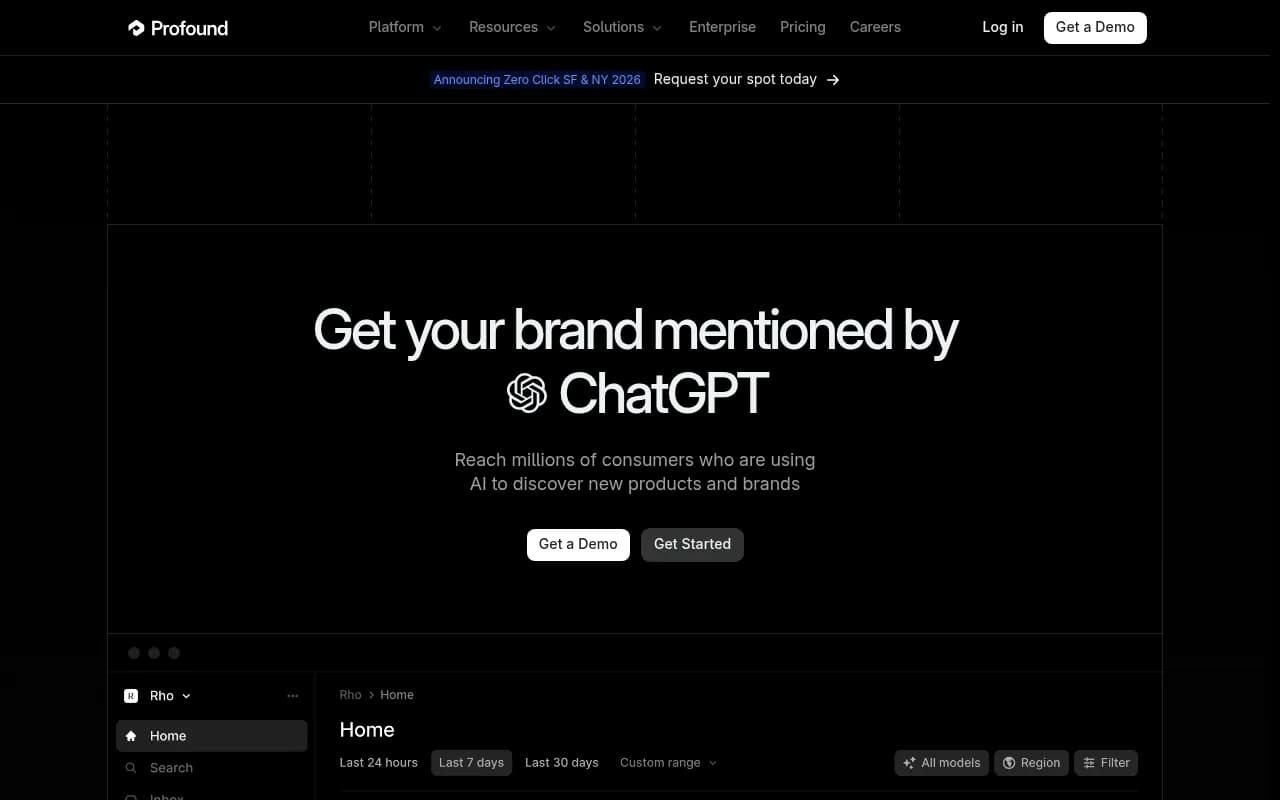
Profound is the enterprise-grade option in this space. Used by MongoDB, Ramp, and Zapier, it covers the full stack: answer engine insights, agent analytics (AI crawler logs), prompt volume data, shopping tracking, and automated content agents. It's one of the few platforms that matches Promptwatch feature-for-feature on the monitoring side.
The content agents are genuinely useful -- Profound can generate AEO-optimized FAQs and other content formats grounded in what AI models are actually asking. Prompt volume data is a standout feature, giving you a sense of how many people are asking a given question across AI platforms.
The catch is pricing. Profound doesn't publish tiers -- you need to book a demo, and estimates put it at $1,000-$3,000+/month for most enterprise customers. That's a significant jump from GrowthOS's $99-$999 range, and it means Profound is realistically only accessible to larger marketing teams with dedicated budgets.
Compared to GrowthOS, Profound is more powerful but far more expensive and less accessible. Compared to Promptwatch, it's comparable on features but typically costs more and lacks Reddit/YouTube tracking.
Best for: Enterprise brands with serious AI visibility budgets that need the most comprehensive monitoring and content toolset available.
Scrunch AI
Scrunch AI is a focused AI search visibility platform that tracks brand presence across ChatGPT, Perplexity, Gemini, and other LLMs. It's built for marketing teams and agencies that want clean, actionable visibility data without the complexity of an enterprise platform.
Compared to GrowthOS, Scrunch AI is more focused -- it doesn't try to be a growth analytics platform, just an AI visibility tool. That focus shows in the interface and the quality of the monitoring data. The $250/month starting price (350 prompts, 3 personas) is competitive for what you get.
What it doesn't have: content generation, crawler logs, Reddit/YouTube tracking, or the traffic attribution features you'd find in Promptwatch. It's a solid monitoring tool, but if you want to move from "seeing the problem" to "fixing the problem," you'll hit a ceiling.
Best for: Marketing teams and agencies that want clean AI visibility monitoring without the overhead of a larger platform, and are comfortable handling content optimization separately.
Otterly.AI

Otterly.AI is the most affordable dedicated AI visibility tool on this list, and it's earned a user base of 25,000+ marketing professionals. The $29/month Lite tier (15 prompts) makes it accessible for small teams or individuals just getting started with AI search monitoring.
The platform tracks brand mentions across ChatGPT, Perplexity, and Google AI Overviews, shows competitor coverage over time, and includes basic GEO audit features. The UI is clean and the setup is fast -- you can get a brand report running in minutes.
The limitations are real, though. No crawler logs, no content generation, no traffic attribution, no Reddit or YouTube tracking. It's a monitoring dashboard, full stop. For teams that just want to know "are we showing up in AI search?" it works well. For teams that want to do something about it, you'll need to supplement it with other tools.
Compared to GrowthOS, Otterly.AI is cheaper and more focused on AI visibility specifically, but it lacks the growth analytics side. Compared to Promptwatch, it's significantly less capable but also significantly cheaper.
Best for: Small teams, startups, and individual marketers who want basic AI visibility monitoring without a large budget commitment.
Peec AI

Peec AI is a clean, well-designed AI search analytics platform with a particular strength in multi-language support. If you're monitoring AI visibility across multiple countries or languages, Peec AI handles that better than most tools at its price point.
The platform tracks visibility, position, and sentiment across ChatGPT, Perplexity, and Gemini. The interface is intuitive, and the competitor benchmarking is solid. Starting at €89/month (roughly $95/month), it's priced between Otterly.AI's entry tier and GrowthOS's Growth plan.
Like Otterly.AI, Peec AI is monitoring-focused. There's no content generation, no crawler logs, and no traffic attribution. The "smart suggestions" feature gives you some optimization direction, but it's not the same as a full content gap analysis or AI writing agent.
Best for: Marketing teams with international audiences who need multi-language AI visibility tracking at a reasonable price.
Broader platforms with AI visibility features
Semrush
Semrush is now an Adobe company, and its AI Visibility Toolkit is a genuine attempt to address the GEO space -- but it's an add-on to an existing SEO platform, not a purpose-built tool.
The AI Visibility Toolkit ($99/month add-on on top of Semrush One at $165/month+) tracks brand mentions across AI search engines and provides visibility scoring. The integration with Semrush's existing SEO data is the main selling point -- if you're already using Semrush for keyword research, backlink analysis, and site audits, having AI visibility data in the same platform has real workflow value.
The limitations: prompts are fixed rather than fully customizable, there's no AI traffic attribution, no crawler logs, and no content generation agent. It's a monitoring layer on top of an SEO tool, not a dedicated GEO platform.
Compared to GrowthOS, Semrush is more expensive overall (you're paying for the full SEO suite whether you want it or not) but offers much more on the traditional SEO side. If you need both SEO and AI visibility, Semrush is worth considering. If you only need AI visibility, it's overkill.
Best for: Teams already using Semrush for SEO who want to add AI visibility monitoring without switching platforms.
HubSpot Marketing Hub
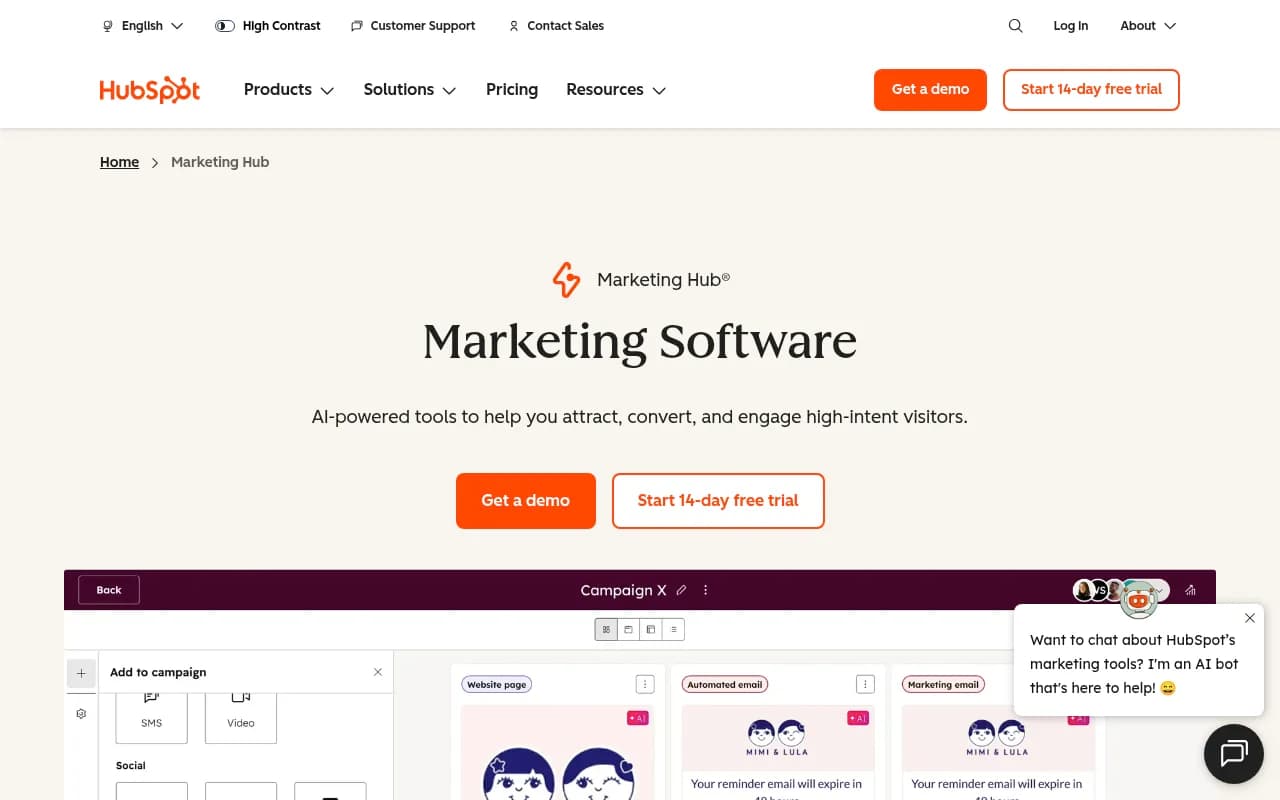
HubSpot's Marketing Hub recently added AEO (Answer Engine Optimization) features, which is a notable development given HubSpot's scale and the size of its existing customer base.
The HubSpot AEO feature tracks where your brand stands in AI search, provides recommendations to improve it, and connects those recommendations to HubSpot's marketing tools -- email, content, social, and so on. The CRM integration is the real differentiator: if you're already running your marketing in HubSpot, having AI visibility data connected to your lead and customer data is genuinely useful.
The AEO features are relatively new and not as deep as dedicated platforms. You won't get crawler logs, prompt volume data, or a content generation agent tuned for AI citation. But for teams that live in HubSpot and want a starting point for AI visibility without adding another tool, it's a reasonable option.
Pricing is freemium at the base level, with Professional at $890/month and Enterprise at $3,600/month -- though the AEO features are available across tiers.
Best for: Teams already invested in the HubSpot ecosystem who want AI visibility as part of their existing marketing stack rather than a standalone tool.
Product analytics tools (different category, worth understanding)
GrowthOS positions itself partly as a growth analytics platform, which is why Amplitude and Mixpanel appear in comparisons. It's worth being clear: these are product analytics tools, not AI visibility platforms. They don't track LLM citations, brand mentions in ChatGPT, or AI search presence at all.
Amplitude
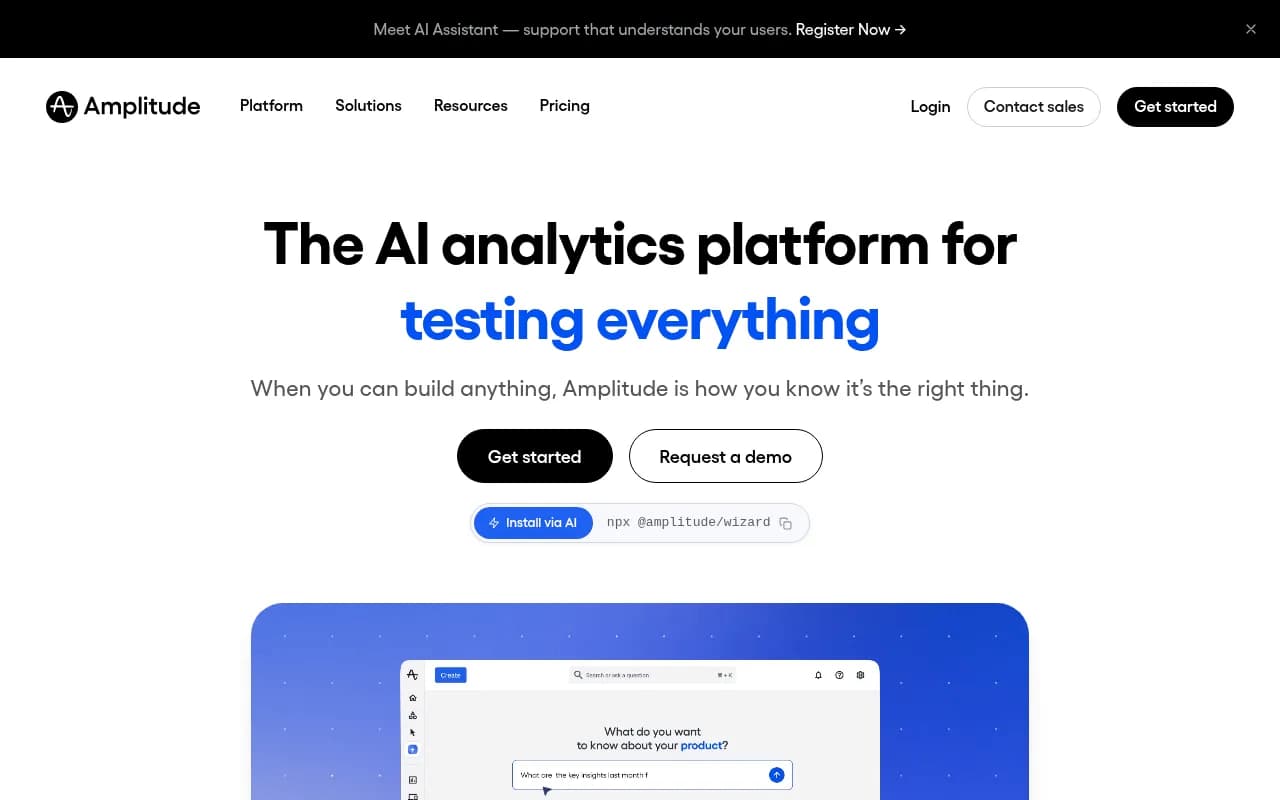
Amplitude is a product analytics platform for understanding user behavior inside your product. It covers event tracking, funnels, retention analysis, A/B experimentation, and session replay. It's excellent at what it does -- the free tier (up to 10K monthly tracked users) is genuinely useful, and the paid tiers scale well for growth-stage companies.
If you're using GrowthOS primarily for growth analytics (conversion tracking, user behavior, funnel analysis) rather than AI visibility, Amplitude is a more powerful replacement. If you're using GrowthOS for AI visibility, Amplitude doesn't help at all.
Best for: Product and growth teams at digital-native companies that need deep behavioral analytics and experimentation capabilities.
Mixpanel
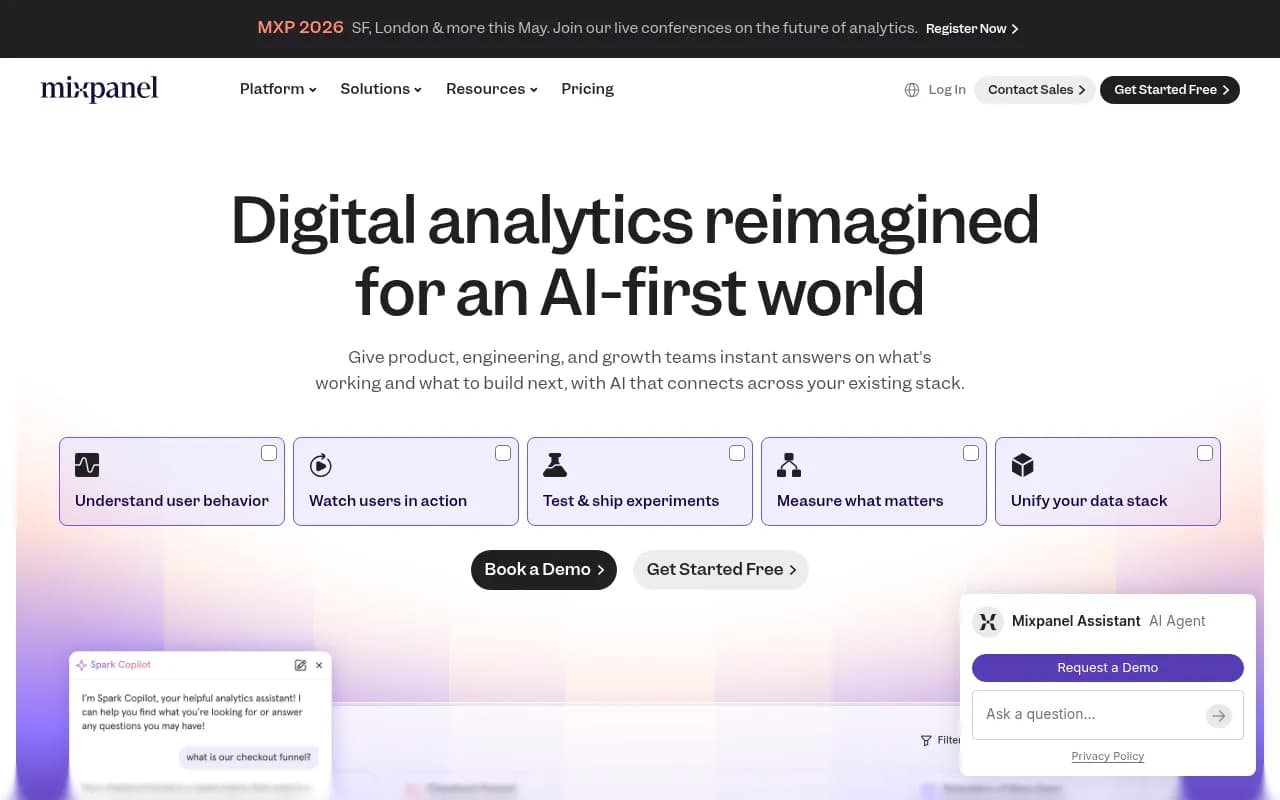
Mixpanel is Amplitude's main competitor in the product analytics space. It's fast, the query interface is intuitive, and the free tier is generous (20 million events per month). The AI-powered "Spark" assistant can surface insights automatically, which reduces the time spent building manual reports.
Same caveat as Amplitude: Mixpanel has nothing to do with AI search visibility. It's a behavioral analytics tool for understanding what users do inside your product or website.
If GrowthOS's appeal to you was the growth analytics side, Mixpanel is worth evaluating alongside Amplitude. If it was the AI visibility side, look at Promptwatch, AthenaHQ, or Profound instead.
Best for: Product, engineering, and growth teams that want fast, flexible behavioral analytics with a strong free tier.
How to choose
The right choice depends on what you actually need from GrowthOS.
If AI visibility is your main goal and you want to improve it (not just track it), Promptwatch is the strongest option. It's the only platform that closes the full loop: find gaps, generate content, track results. The pricing is comparable to GrowthOS at the entry level, and the depth is significantly greater.
If you want enterprise-grade monitoring with a strong brand and recognizable client list, AthenaHQ or Profound are worth evaluating -- just be prepared for higher price points and no free trials.
If budget is the primary constraint and you just need basic AI visibility monitoring, Otterly.AI at $29/month or Peec AI at €89/month are reasonable starting points.
If you're already in the Semrush or HubSpot ecosystem and want AI visibility without adding a new tool, both platforms now have features worth exploring -- though neither is as deep as a dedicated GEO platform.
If what you actually need is product analytics (funnels, retention, user behavior), GrowthOS isn't really the right tool to begin with -- and neither are any of the AI visibility platforms. Amplitude and Mixpanel are the right category entirely.