Key takeaways
- Searchable is a monitoring-focused AI visibility tool -- it shows you where your brand appears (or doesn't) in AI search engines, but stops there
- Mid-market teams need more than dashboards: they need to identify content gaps, generate optimized content, and track whether it's working
- The monitoring-only model is a real bottleneck at scale -- you end up with data you can't act on without additional tools and manual effort
- Several alternatives in 2026 cover the full loop: gap analysis, content creation, and citation tracking in one platform
- If AI search isn't part of your strategy yet, Gartner projects a 25% drop in traditional search volume by end of 2026 -- the urgency is real
Searchable raised £3M in 2024, led by Freestyle Ventures, and positioned itself as the go-to AI search visibility platform for mid-market brands. The pitch made sense at the time: AI search was exploding, most companies had no idea whether ChatGPT or Perplexity was even mentioning them, and any monitoring tool felt like progress.
But it's 2026 now. The market has moved. And mid-market teams -- the ones with real budgets, real content operations, and real pressure to show ROI -- are running into the same ceiling with Searchable: it tells you what's happening, but it doesn't help you change it.
This guide breaks down exactly where Searchable falls short for mid-market use cases, and which tools are actually built for teams that need to act on AI visibility data, not just observe it.
What Searchable actually does (and doesn't do)
Searchable monitors how your brand appears across AI search engines. You set up prompts, it tracks whether you're cited, and you get a dashboard showing your visibility score over time. For a solo founder or a small team just getting started with GEO, that's a reasonable starting point.
The problem is that monitoring is only the first step. Here's where mid-market teams consistently hit walls:
No content gap analysis. Searchable can tell you that you're not appearing for a given prompt. It can't tell you why -- which specific topics, angles, or questions your site is missing that competitors are answering. That analysis has to happen manually, which means your SEO team is spending hours in spreadsheets instead of creating content.
No content generation. Even if you identify the gaps yourself, Searchable doesn't help you close them. You're back to your existing content workflow, which may or may not be optimized for AI citation.
Limited prompt intelligence. Mid-market teams need to prioritize. Not every prompt is worth chasing -- some have high AI search volume, some are easier to win than others. Searchable's prompt data doesn't give you the depth to make those calls confidently.
No crawler log visibility. One of the most underrated problems in AI visibility is that you don't know whether AI crawlers are even reading your pages correctly. If ChatGPT's crawler hits a 404 or gets blocked by your CDN, you'll never appear in its responses -- and you won't know why. Searchable doesn't surface this.
No traffic attribution. At the end of the day, mid-market teams need to connect AI visibility to revenue. Searchable's monitoring dashboard doesn't close that loop.
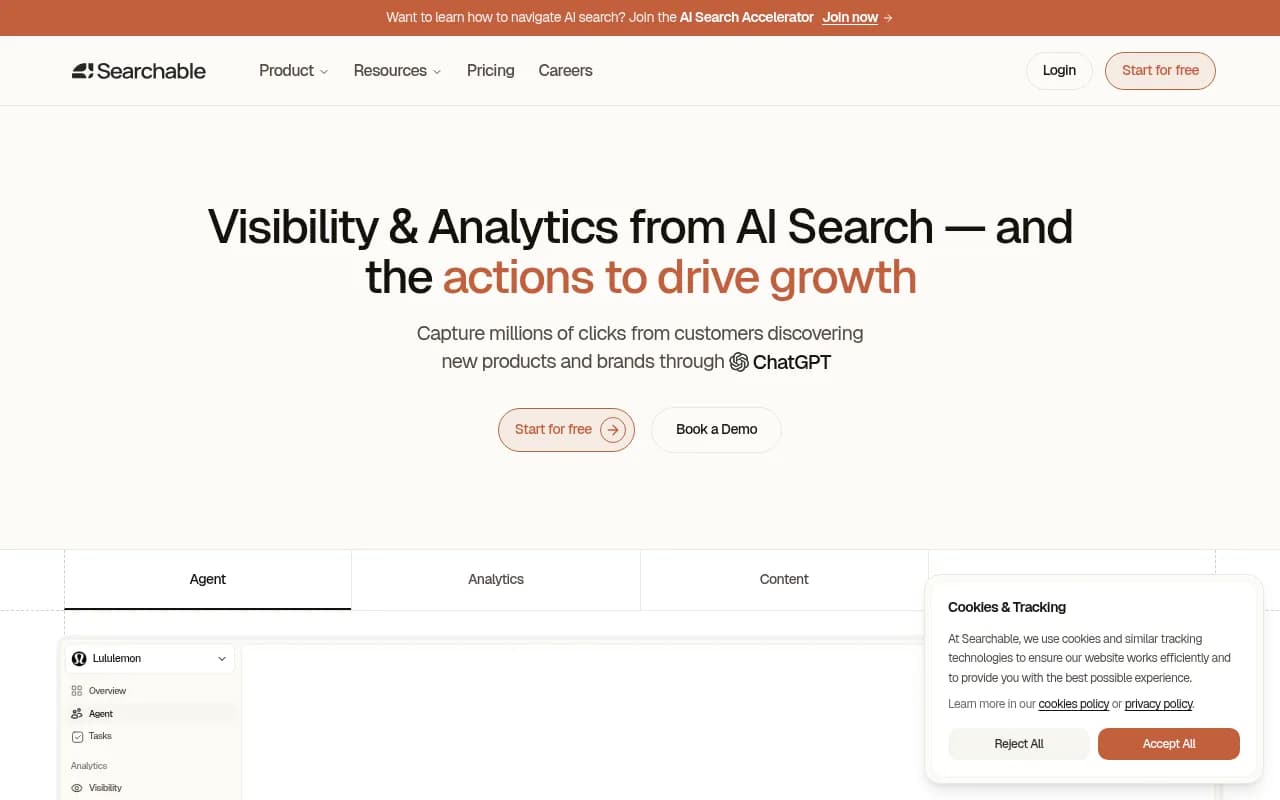
None of this makes Searchable a bad product. It's a decent entry-level monitoring tool. But "entry-level" is the problem -- mid-market teams have outgrown entry-level.
The mid-market gap in AI visibility tools
There's a real bifurcation in the GEO tool market right now. On one end, you have lightweight monitoring tools (Searchable, Otterly.AI, Peec.ai) that are cheap and easy to set up but thin on capabilities. On the other end, you have enterprise platforms (Bluefish, BrightEdge) that are built for Fortune 500 budgets and require significant onboarding.
Mid-market teams -- say, a 50-500 person company with a 3-8 person marketing team -- sit in an awkward middle. They need more than a dashboard, but they don't need (or want to pay for) an enterprise contract with a six-month implementation.
What they actually need is a platform that runs the full loop:
- Find the gaps -- which prompts are competitors winning that you're not?
- Create content that closes those gaps -- grounded in real AI search data, not generic SEO templates
- Track whether it worked -- page-level citation tracking, crawler logs, and traffic attribution
Most monitoring-only tools handle step one poorly and skip steps two and three entirely.
What to use instead in 2026
Here's an honest look at the alternatives worth considering, depending on your team's specific situation.
Promptwatch: the full-loop option
Promptwatch is the most complete option for mid-market teams that want to go beyond monitoring. The core difference from Searchable is that it's built around action, not just observation.
The Answer Gap Analysis shows you exactly which prompts competitors are being cited for that you're not -- not just "you're missing," but the specific content your site needs to answer those questions. From there, Content Agents generate articles, listicles, and comparison pieces grounded in real prompt data, citation patterns, and competitor analysis. Then page-level tracking and crawler logs show you whether the new content is getting crawled, cited, and driving traffic.
It also covers things Searchable doesn't touch: AI crawler logs (so you can see when ChatGPT or Perplexity hits your site and whether they're encountering errors), Reddit and YouTube citation tracking, ChatGPT Shopping monitoring, and prompt volume/difficulty scoring so you can prioritize intelligently.
Pricing starts at $99/month for the Essential tier (1 site, 50 prompts, 5 articles) and $249/month for Professional (2 sites, 150 prompts, 15 articles, crawler logs). For a mid-market team that's serious about AI visibility, Professional is the realistic entry point.

Profound: strong monitoring, limited action
Profound has a solid feature set and is genuinely good at tracking brand visibility across AI engines. The reporting is clean and the prompt coverage is broad. Where it falls short for mid-market teams is the same place Searchable does: it's primarily a monitoring tool. There's no content generation, no crawler logs, and no Reddit/YouTube tracking. It's also priced at the higher end, which makes the monitoring-only limitation harder to justify.

AthenaHQ: monitoring-focused with good UX
AthenaHQ tracks visibility across 8+ AI search engines and has a clean interface that non-technical marketers can use without much onboarding. It's a reasonable step up from Searchable in terms of polish. But it's still monitoring-focused -- no content optimization, no gap analysis that tells you what to create, no crawler visibility. Good for teams that just want cleaner dashboards; not enough for teams that want to move the needle.

Otterly.AI: budget monitoring
Otterly.AI is cheaper than Searchable and covers the basics of AI mention tracking. It's fine for very small teams or individuals who want a low-cost way to see whether they're appearing in AI responses. For mid-market teams, it's not a serious option -- the feature depth isn't there.

Scrunch AI: niche use cases
Scrunch AI has some interesting angles on AI visibility monitoring, particularly for content-heavy brands. But it's missing several capabilities that mid-market teams need: no content generation, limited prompt intelligence, no crawler logs. Worth a look if you have a specific use case it fits, but not a general-purpose replacement for Searchable.
Side-by-side comparison
| Feature | Searchable | Promptwatch | Profound | AthenaHQ | Otterly.AI |
|---|---|---|---|---|---|
| AI mention monitoring | Yes | Yes | Yes | Yes | Yes |
| Answer gap analysis | No | Yes | No | No | No |
| Content generation | No | Yes | No | No | No |
| Crawler logs / agent analytics | No | Yes | No | No | No |
| Prompt volume + difficulty | Limited | Yes | Limited | No | No |
| Reddit + YouTube tracking | No | Yes | No | No | No |
| ChatGPT Shopping tracking | No | Yes | No | No | No |
| Traffic attribution | No | Yes | No | No | No |
| Multi-model coverage | Yes | Yes (10 models) | Yes | Yes | Limited |
| Starting price | ~£99+/mo | $99/mo | Higher | Mid-range | Low |
| Best for | Entry-level monitoring | Full-loop optimization | Monitoring + reporting | Clean monitoring UX | Budget monitoring |
The pattern is clear. If you're evaluating tools purely on monitoring capabilities, the differences between Searchable, Profound, and AthenaHQ are mostly about UX and price. If you need to actually improve your AI visibility -- not just measure it -- Promptwatch is the only option in this group that covers the full loop.
The "monitoring trap" and why it matters now
Here's the thing about monitoring-only tools: they create a false sense of progress. You set up your prompts, you watch your visibility score, you see competitors outranking you, and you feel informed. But informed isn't the same as improving.
Gartner projects a 25% drop in traditional search engine volume by end of 2026 as AI chatbots absorb more queries. That's not a distant trend -- it's happening now, and the brands that are building AI visibility today are the ones that will be cited by default when the shift accelerates.
Mid-market teams that spend 2026 watching dashboards will be behind the brands that spent 2026 creating content that AI models actually cite. The monitoring tools got you to the starting line. They're not going to win the race.
How to evaluate your current setup
If you're using Searchable (or any monitoring-only tool) right now, here are the questions worth asking:
Can you see which specific content gaps are causing your competitors to outrank you? Not just "you're missing for this prompt" but the actual topics and angles your site needs to cover. If not, you're guessing at what to create.
Do you know whether AI crawlers are successfully reading your pages? If ChatGPT's crawler is hitting errors on your site, no amount of content optimization will help. Crawler log visibility is table stakes for serious AI visibility work.
Can you connect AI citations to actual traffic and revenue? If your visibility score goes up but you can't tie it to business outcomes, you'll struggle to justify the investment internally.
Are you tracking offsite citations? Reddit threads, YouTube videos, and third-party listicles often drive more AI citations than your own site. If you're only monitoring your own domain, you're missing half the picture.
If the answer to most of these is no, you've outgrown your current tool.
The bottom line
Searchable made sense as an early-mover product in 2024. In 2026, with AI search eating a meaningful share of traditional search traffic and the GEO tool market maturing fast, it's not built for what mid-market teams actually need.
The teams winning in AI search right now aren't just monitoring their visibility -- they're systematically finding gaps, creating content that closes them, and tracking the results at the page level. That requires a platform built around the full optimization loop, not just a dashboard.
For most mid-market teams, Promptwatch is the most direct path to that. It's not the cheapest option, but it's the only one in this category that handles discovery, creation, and measurement in one place -- without requiring an enterprise contract or a six-month implementation.
If you're still on a monitoring-only tool, the question isn't whether to switch. It's how quickly you can make the move before competitors who already have the full loop in place get further ahead.