Key takeaways
- AI search visibility is now a separate discipline from traditional SEO — your rankings in Google don't tell you whether ChatGPT or Perplexity recommends your brand
- Most tools in this space are monitoring dashboards only; a smaller number help you actually fix the gaps they find
- The best platform for you depends on whether you need monitoring, content optimization, agency reporting, or a full end-to-end workflow
- Gartner projects search engine volume will drop 25% by 2026 as users shift to AI chatbots — brands without an AI visibility strategy are flying blind
- For teams that want to move from tracking to actually improving their AI presence, Promptwatch is the only platform in this comparison rated as a "Leader" across all categories in a 2026 review of 12 GEO tools
Something shifted in 2024 and most brands didn't notice until 2025. Their Google rankings held steady. Their traffic dropped anyway. The culprit? A growing share of their potential customers stopped Googling and started asking ChatGPT, Perplexity, or Gemini instead.
If you're not cited in those answers, you don't exist for those users. It's that simple.
The good news: a new category of tools has emerged specifically to track and improve AI search visibility. The bad news: the market is crowded, the feature sets vary wildly, and most tools are monitoring-only dashboards that show you a problem without helping you solve it.
This guide cuts through that. Below are 10 platforms worth serious consideration in 2026, with honest takes on what each one actually does well and who it's built for.
What "AI search visibility" actually means
Before diving into tools, it's worth being precise about what we're measuring. AI search visibility refers to how often your brand, product, or content appears in AI-generated responses when users ask relevant questions. This includes:
- Direct brand mentions in ChatGPT, Claude, Gemini, Perplexity, Grok, and similar tools
- Citations where AI models link to or reference your content as a source
- Share of voice across a set of tracked prompts compared to competitors
- Sentiment and framing when your brand is mentioned
Traditional SEO tools track keyword rankings in Google's blue-link results. That's a different thing. A page can rank #1 in Google and never appear in an AI-generated answer. Conversely, a page that barely registers in traditional rankings can become a heavily cited source for AI models if it's structured and written in the right way.
That gap is what this tool category exists to close.
The 10 best AI search visibility platforms in 2026
1. Promptwatch — best for end-to-end optimization
Promptwatch is the most complete platform in this list. Where most tools stop at showing you data, Promptwatch is built around a three-step loop: find the gaps, create content to fill them, then track the results.

The Answer Gap Analysis is genuinely useful. It shows you the specific prompts where competitors are getting cited but you aren't, along with the content your site is missing. That's not just a monitoring feature — it's a prioritized to-do list.
The built-in AI writing agent then generates articles, listicles, and comparisons grounded in real citation data (over 880 million citations analyzed). This isn't generic content generation. It's engineered around what AI models actually cite, which makes a real difference in whether the output performs.
Promptwatch also has AI crawler logs — real-time visibility into when ChatGPT, Claude, Perplexity, and other crawlers visit your site, which pages they read, and what errors they hit. Most competitors don't have this at all.
Other capabilities worth noting: prompt volume and difficulty scoring, query fan-outs, Reddit and YouTube citation tracking, ChatGPT Shopping monitoring, and multi-language/multi-region support.
Pricing starts at $99/month (Essential, 1 site, 50 prompts) and goes to $249/month (Professional) and $579/month (Business). A free trial is available.
Best for: Marketing and SEO teams that want to move beyond monitoring and actually improve their AI visibility. Also strong for agencies managing multiple brands.
2. Profound — best for enterprise teams
Profound is one of the more mature platforms in the space and has built a strong reputation with enterprise and agency teams. It covers the major AI engines (ChatGPT, Perplexity, Gemini, Claude, Grok) and gives solid share-of-voice metrics across them.

The reporting is clean and the data is reliable. Where Profound falls short is on the optimization side — it's primarily a monitoring and analytics tool. You get good visibility into what's happening, but less guidance on what to do about it. No Reddit tracking, no ChatGPT Shopping monitoring, and no built-in content generation. For teams with dedicated content resources who just need solid data, that's fine. For teams that want a full workflow, it's a gap.
Pricing is on the higher end compared to most tools in this category.
Best for: Enterprise marketing teams and agencies that need reliable, comprehensive monitoring data and have separate content teams to act on it.
3. Otterly.AI — best for budget-conscious teams
Otterly.AI is one of the more affordable options in the market and has a clean, accessible interface. It tracks brand mentions and citations across the main AI engines and gives you a reasonable view of your share of voice.

The trade-off for the lower price point is feature depth. Otterly.AI doesn't have crawler logs, visitor analytics, or content generation. It's a monitoring tool, full stop. For small teams or solo marketers who just want to start tracking their AI visibility without a big investment, it's a reasonable starting point. For teams that need to actually move the needle, you'll hit its ceiling quickly.
Best for: Small businesses and solo marketers who want basic AI visibility monitoring at a low cost.
4. Peec AI — best for multi-language tracking
Peec AI has carved out a useful niche with strong multi-language support, which matters more than you'd think. AI search behavior varies significantly by language and region — a brand that dominates English-language AI responses might be nearly invisible in French or German.

The platform covers the major AI engines and gives solid citation and share-of-voice data. Like Otterly.AI, it's primarily a monitoring tool without content generation or deep optimization features. But if your brand operates across multiple languages and regions, Peec AI's coverage here is genuinely better than most competitors.
Best for: International brands that need multi-language AI visibility tracking.
5. AthenaHQ — best for structured monitoring workflows
AthenaHQ tracks visibility across 8+ AI search engines and has a well-structured interface that makes it easy to set up monitoring workflows and track changes over time.

It's a solid monitoring platform. The gap is on the optimization side — AthenaHQ is focused on tracking and reporting rather than helping you fix what you find. No content generation, no crawler logs. For teams that have a clear monitoring use case and handle optimization separately, it works well.
Best for: Teams that want structured, reliable monitoring across a wide range of AI engines.
6. Scrunch AI — best for brand-focused monitoring
Scrunch AI focuses on brand visibility and sentiment tracking across AI search engines. It's particularly useful for brands that care about how they're being described in AI responses, not just whether they appear.
The sentiment analysis is a genuine differentiator — knowing that ChatGPT mentions your brand but frames it negatively is more actionable than just knowing you were mentioned. Scrunch AI surfaces this kind of nuance better than most tools.
Feature depth is more limited on the technical side (no crawler logs, limited prompt intelligence), and pricing is on the higher end for what you get. But for brand and communications teams focused on reputation, it's worth a look.
Best for: Brand and communications teams focused on how their brand is portrayed in AI responses, not just whether it appears.
7. SE Ranking — best for teams already using traditional SEO tools
SE Ranking is primarily an all-in-one SEO platform that has added an AI visibility toolkit. If you're already using SE Ranking for keyword tracking, site audits, and backlink analysis, the AI visibility features are a natural extension.
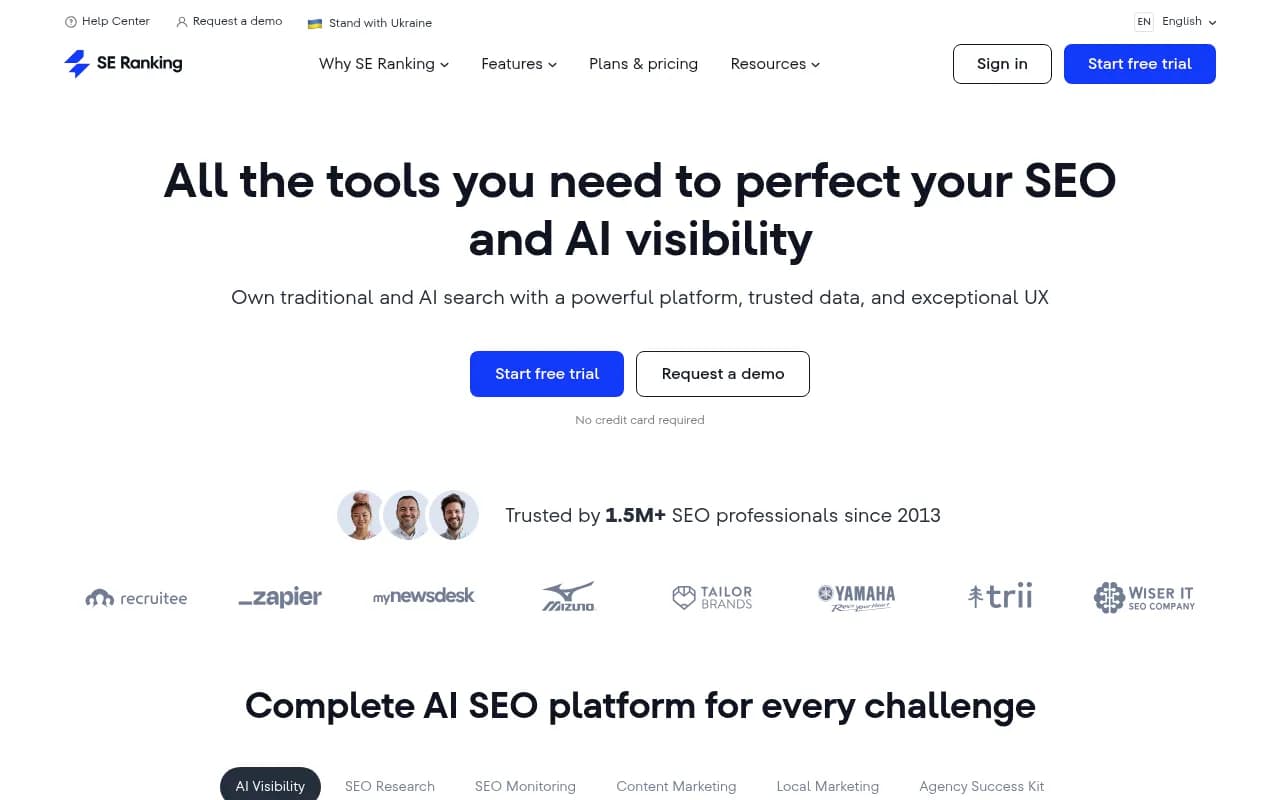
The integration with traditional SEO data is the main selling point. You can see your Google rankings and your AI visibility in one place, which helps teams understand how the two channels relate. The AI visibility features are less deep than dedicated GEO tools, but for teams that don't want to manage another separate platform, it's a reasonable compromise.
Best for: SEO teams already using SE Ranking who want to add AI visibility tracking without switching platforms.
8. Semrush — best for teams in the Semrush ecosystem
Semrush has added AI visibility features to its platform, and for the 10 million+ marketers already using it, that's genuinely convenient. The brand monitoring and AI overview tracking features are solid, though the approach uses fixed prompts rather than custom prompt sets.
The limitation worth knowing: Semrush's AI visibility features don't include traffic attribution from AI sources, and the fixed-prompt approach means you can't fully customize what you're tracking. For teams that need deep GEO analytics, a dedicated tool will outperform it. But as a starting point for Semrush users, it's a low-friction way to get some AI visibility data.
Best for: Existing Semrush users who want a basic view of AI visibility without adding a new tool.
9. Rankability — best for agencies focused on reporting
Rankability has built a strong offering for agencies, with clean reporting interfaces and good competitive intelligence features. The price-to-value ratio is solid, and the platform is designed with client reporting in mind.
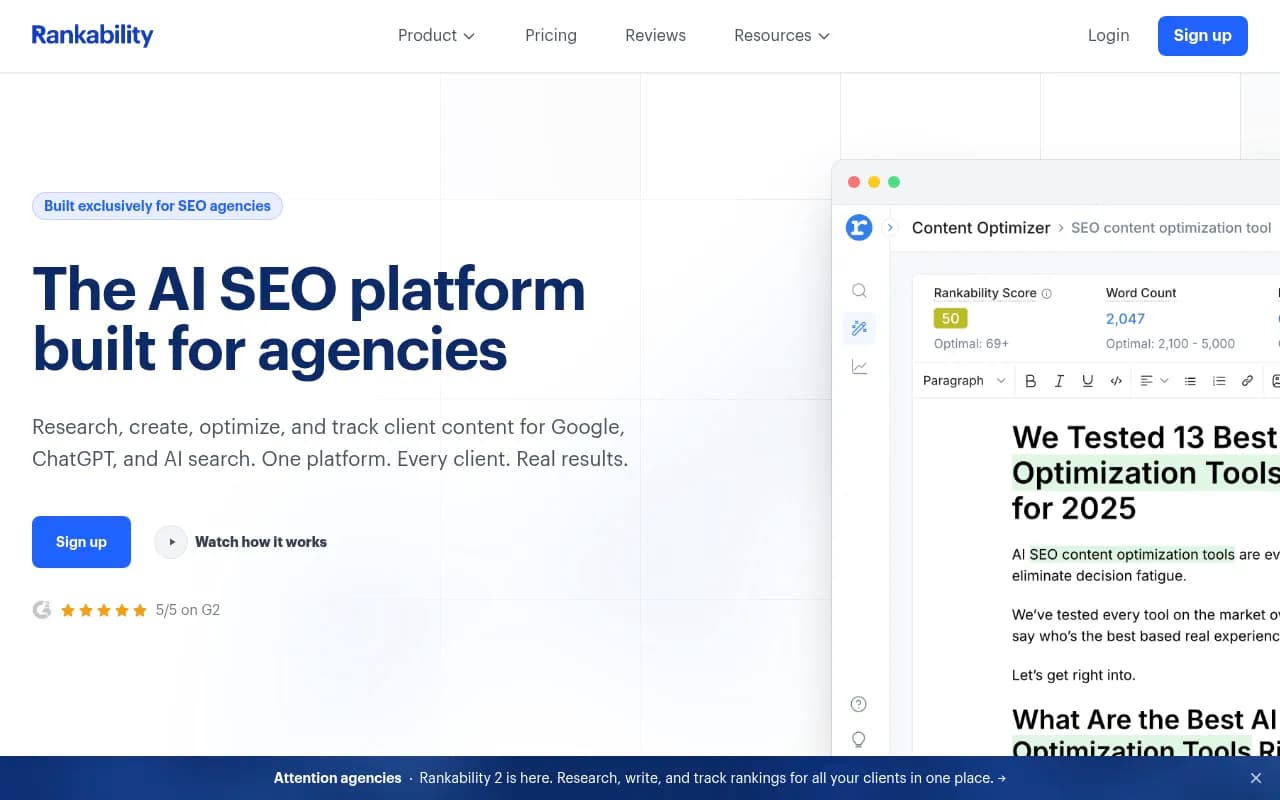
The monitoring features are reliable. Like most tools in this list, Rankability is primarily a tracking and reporting platform rather than an optimization tool. No content generation, no crawler logs. But for agencies that need to show clients clear data on AI visibility performance, the reporting capabilities are well-designed.
Best for: Digital agencies that need clean, client-ready AI visibility reporting.
10. LLMrefs — best for keyword-centric teams
LLMrefs takes an interesting approach: instead of building workflows around custom prompts, it centers on the keywords you already track. It automatically generates conversational prompts from those keywords, collects AI responses, and aggregates the results into share-of-voice and citation metrics.
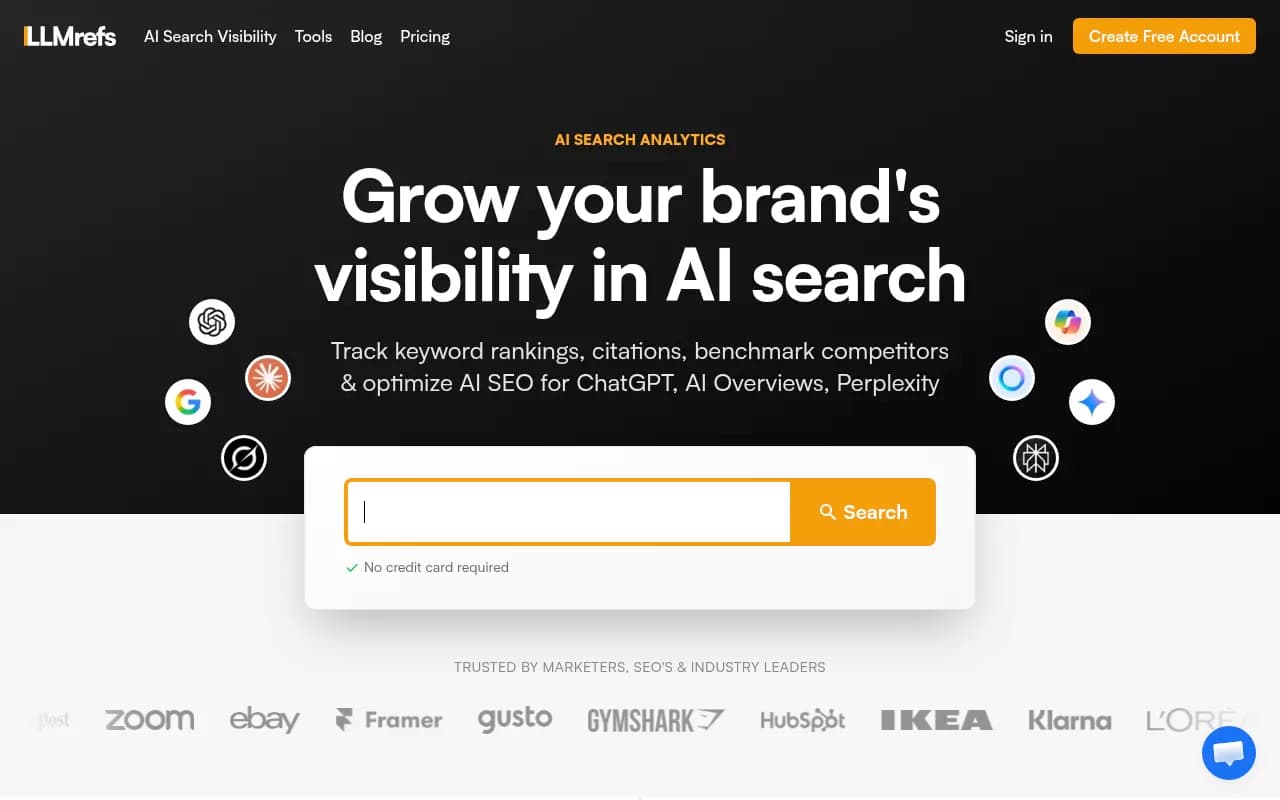
For SEO teams that think in terms of keywords rather than prompts, this framing makes the tool feel familiar and accessible. The coverage includes ChatGPT, Google AI Overviews, Perplexity, and Gemini. It's a monitoring-focused tool, but the keyword-centric workflow is genuinely useful for teams transitioning from traditional SEO to GEO.
Best for: SEO teams who want to extend their existing keyword strategy into AI search tracking.
How these tools compare
Here's a direct comparison across the dimensions that matter most for growing brands:
| Tool | AI engines covered | Content generation | Crawler logs | Reddit/YouTube tracking | Traffic attribution | Starting price |
|---|---|---|---|---|---|---|
| Promptwatch | 10+ | Yes | Yes | Yes | Yes | $99/mo |
| Profound | 5+ | No | No | No | Limited | Higher |
| Otterly.AI | 4+ | No | No | No | No | Low |
| Peec AI | 5+ | No | No | No | No | Mid |
| AthenaHQ | 8+ | No | No | No | No | Mid |
| Scrunch AI | 5+ | No | No | No | No | Higher |
| SE Ranking | 3+ | No | No | No | No | Mid (add-on) |
| Semrush | 3+ | No | No | No | No | Add-on to existing |
| Rankability | 4+ | No | No | No | No | Mid |
| LLMrefs | 4+ | No | No | No | No | Mid |
The pattern is clear. Most platforms in this category are monitoring tools. Promptwatch is the outlier that covers the full workflow from gap identification through content creation to traffic attribution.
The monitoring-only problem
It's worth being direct about something: knowing you're invisible in AI search is not the same as fixing it.
Most tools in this market will tell you that ChatGPT doesn't mention your brand when users ask about your product category. That's useful information. But then what? You still need to figure out which content to create, how to structure it so AI models will cite it, and whether your changes are actually working.
That's the gap most tools leave open. They show you the problem and leave you to solve it yourself.
The tools that go further — specifically Promptwatch with its Answer Gap Analysis and AI writing agent — are more valuable for teams that want to actually move the needle rather than just measure it. The monitoring data is only as useful as the action it drives.
What to look for when choosing a platform
A few questions worth asking before you commit to a tool:
How many AI engines does it cover? The market has fragmented. ChatGPT, Perplexity, Gemini, Claude, Grok, and DeepSeek all have meaningfully different user bases. A tool that only monitors two or three of them is giving you an incomplete picture.
Does it track prompts that match how your customers actually search? Fixed-prompt tools are easier to set up but less accurate. Custom prompt sets that reflect real customer queries give you more actionable data.
Can you connect visibility to revenue? Traffic attribution — knowing that a citation in Perplexity drove X visits and Y conversions — is what makes AI visibility a business metric rather than a vanity metric. Most tools don't have this.
Does it help you fix what it finds? If the answer is no, you're paying for a dashboard. That might be fine depending on your team's resources, but go in with clear eyes about what you're getting.
Does it cover Reddit and YouTube? These platforms disproportionately influence what AI models cite. A tool that ignores them is missing a significant part of the picture.
The bottom line
The brands that will win in AI search over the next two years are the ones that treat it as an optimization problem, not just a monitoring problem. That means tracking where you're invisible, understanding why, creating content that fills those gaps, and measuring whether it works.
Most tools in this market handle the first step reasonably well. Promptwatch handles all four. For growing brands that want to move from invisible to cited, that end-to-end capability is what separates a tool that shows you the problem from one that helps you solve it.