Key takeaways
- Demos run on the vendor's data, so the only useful demo is one where you bring your own brand, prompts and competitors.
- Ask whether answers come from the real user interface of each AI engine or from API simulations. They can differ.
- Blended numbers hide the truth. Test whether the tool splits citations by engine, country and date.
- Monitoring alone is not the finish line. Check whether the platform tells you what to fix and whether the fix worked.
- Use the 12-test scorecard below, and walk out of any demo that refuses to run a live prompt.
Why the demo is where you win or lose the purchase
Finding out whether ChatGPT mentions your brand takes about five minutes. That is the problem. Dozens of platforms now do it, new ones show up almost weekly, and their demos look nearly identical: every engine covered, a sentiment gauge, a dashboard that seems to have done your job already.
I have sat through enough of these to have a strong view. The slide deck is a sales asset. The live session is the only place a vendor can't hide behind a pre-loaded sample brand. So treat it like a test, not a presentation.
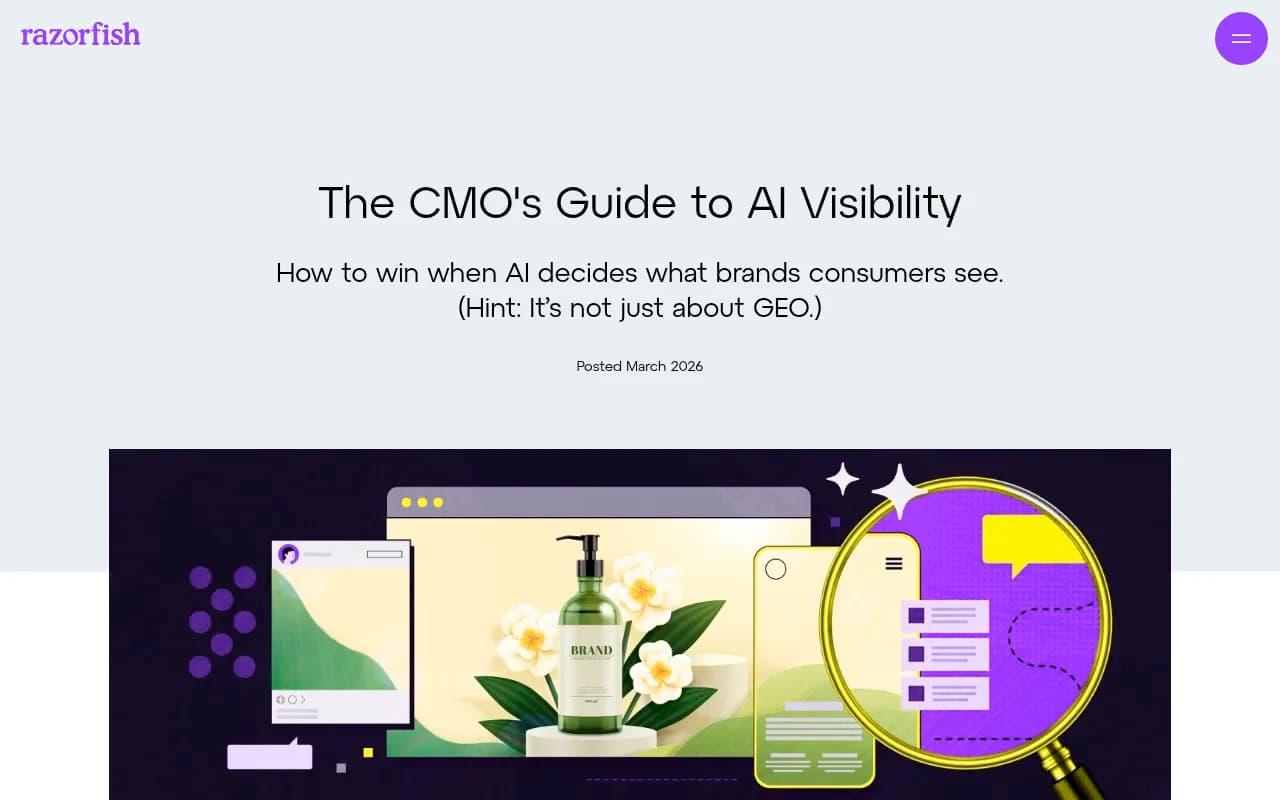
The stakes are real for brand teams in particular. Razorfish's CMO guide to AI visibility makes the point that in AI answers you are competing for the recommendation, not for a ranking position, which looks a lot more like brand work than like technical SEO. It also cites Pew: when an AI summary appears in Google results, users click a traditional result 8% of the time versus 15% without one. If your platform can't tell you how you are being recommended, you are budgeting blind.
Before the call: prepare your own test kit
Show up with a short document. Without it, the vendor controls the session.
- 15 to 25 prompts you actually care about: category prompts, brand prompts, and at least three competitor comparisons.
- Your three closest competitors, plus one you suspect is overrated by the tool.
- Two countries or languages if you sell in more than one market.
- One known fact, for example a page you know ChatGPT cites, or a competitor you know it recommends. You need ground truth to catch fabricated or stale data.
- Your real constraints: seats, number of brands or clients, budget ceiling, reporting needs.
Then run the same prompts by hand in ChatGPT, Gemini and Perplexity before the call and screenshot the answers. That is your reference.
The 12 live tests
1. Real interface or API simulation?
Ask directly where the answers come from. User-facing answers, citations and shopping recommendations in the actual ChatGPT or Google AI Overviews interface can differ from what the API returns. A platform that only calls APIs is measuring a model, not what your customers see.
Live test: pick one of your reference prompts and compare the vendor's captured answer against your manual screenshot. Similar sources and brand mentions are a good sign. A totally different answer deserves a hard question.
Promptwatch, for one, monitors the real interfaces of ChatGPT, Google AI Overviews, AI Mode, Gemini, Perplexity and others, then tracks API models alongside to show training-data beliefs. Whatever vendor you choose, get the answer in writing.
2. Run a brand-new prompt live
Demo accounts are often seeded with prompts that were tuned to look good. Ask them to add one of your prompts and show the result. If it takes a day to appear, fine, but you should know that. If they refuse, that tells you something.
3. Check how many runs sit behind each score
AI answers vary. Ask the same question twice and you may get different brands. A visibility score from one run per day on three prompts is noise. Ask how many prompts and runs support a number, how often they run, and whether you can see the individual responses behind it.
Live test: click a score and drill to raw responses. If you can't get from the number to the answer text in two clicks, the score is a black box.
4. Split by engine, not one blended number
Promptwatch Data for Sep 28 to Oct 4, 2026 shows how misleading a blended number can be. Social platforms made up 0.46% of ChatGPT citations but 12.2% of Google AI Overviews citations, about 26 times more. Perplexity sat at 2.7%. A single "social visibility" or "Reddit share" figure averages away all of that.
Live test: ask for citation share by engine for a source type you care about. If the tool can only show a total, you can't decide where to put effort.
5. Look for the break in history
Good history tells you when the world changed, not just when your numbers did. On August 14, 2026, reddit.com's share of ChatGPT citations fell from roughly 4% to 0.5%, while AI Overviews and AI Mode declined more gradually. Likewise, average citations per ChatGPT response dropped around the GPT-5.3 rollout on March 4, 2026.
Live test: scroll the vendor's timeline back to those dates for a Reddit-heavy category. Does the break show up? Does the platform annotate model changes, or will you blame your content team for a drop that happened to everyone?
6. Citations per response and domain depth
Source counts differ by engine. Promptwatch Data on average sources per response (a 2025 dataset, so treat figures as directional) found ChatGPT citing about 5 sources on web-search answers, AI Overviews about 10, and Perplexity almost exactly 10. More recently, almost half of ChatGPT responses cite 10 or more unique domains in the Sep 28 to Oct 4, 2026 window.
Live test: ask the vendor to show citations per response by engine. A tool that treats every engine as one citation pool is not looking closely.
7. Query fan-outs
When an AI answers, it often runs several web searches behind the scenes. Those queries tell you what to write. Promptwatch's fan-out data shows average ChatGPT fan-outs per response drifting from 2.15 in December 2025 to about 1.84 by early March 2026, and the behavior keeps changing. On August 8, 2026, ChatGPT began using the site: operator at scale, jumping from about 0.4% to about 17% of fan-out queries.
Live test: open one response and ask to see the underlying search queries. Then ask whether the platform tracks how those queries change over time. If fan-outs aren't there, the tool is guessing at intent.
8. Source types and content formats
You need to know what kind of page wins, not just which domain. Product pages were the most cited ChatGPT content type at 22.4% in the Sep 28 to Oct 4, 2026 window, and DR 46-75 sites earned almost half of citations in August 2026, with DR 91-100 near 3%. Content also ages differently: news lost half its cited pages within 36 days, while landing pages and docs lasted longest.
Live test: ask for citations classified by content type and source type, with first-cited and decay dates. If the answer is "top cited domains" and nothing else, you get a leaderboard, not a plan.
9. Crawler logs and real traffic
A mention without a click is a vanity metric. Ask whether the platform shows IP-verified AI crawler activity on your site (which bots hit which pages, which errors they saw) and AI-referred visits and conversions. Meta-WebIndexer, for example, grew from about 2% to nearly 38% of tracked AI crawler requests between mid-July and August 9, 2026. A tool with no crawler data would never have told you.
Live test: ask for the crawl-to-citation path for one of your pages. Also ask how spoofed bots are filtered.
10. Sentiment, with receipts
Sentiment scores are easy to fake and hard to audit. Ask how it is calculated, whether it sits beside the visibility score, and whether you can read the sentences it scored. A brand marketer cares about this most: being named in an answer as the cheap, outdated option is worse than not being named.
Live test: pull up a response scored negative and read it. Does the score match your reading?
11. Does it help you fix anything?
This is where the category splits. Prompt trackers answer "was my brand mentioned?" Fuller platforms try to answer "what do I do about it, and did it work?" Look for content gap analysis, a prioritized action list, content drafting tied to the data, publishing into your CMS, and a loop that tracks the published page through crawls, citations and traffic.
Live test: pick one gap the tool finds, and ask them to take it from detection to a draft brief in the session. Time it.
12. Reporting, seats and the real price
Check the boring parts last, but check them. Do exports work? Can you white-label? Are seats, projects, countries and models included or add-ons? Compare plan limits per response, not per month: Peec AI's plans, for instance, run $95, $245 and $495 a month with three engines of your choice, while others include all models from their entry tier. Ask for the price at your actual prompt count, in your actual countries.
Scorecard you can bring to the call
| # | Test | What good looks like | Red flag |
|---|---|---|---|
| 1 | Data source | Real UI capture, API models labeled | Vague "we query the models" |
| 2 | Live prompt | Your prompt added and run in session | Only pre-loaded prompts |
| 3 | Run depth | Raw responses behind every score | One number, no drill-down |
| 4 | Engine split | Citations per engine and country | Blended totals |
| 5 | History | Shows Aug 14 and Mar 4 shifts | Flat, unexplained lines |
| 6 | Citations/response | Shown by engine | One pooled figure |
| 7 | Fan-outs | Queries visible per response | Not available |
| 8 | Content types | Source and content-type breakdown | Domain leaderboard only |
| 9 | Crawlers and traffic | IP-verified logs, AI visits | Mentions only |
| 10 | Sentiment | Readable scored text | Opaque gauge |
| 11 | Action loop | Gap to draft to tracked result | Insights, no next step |
| 12 | Price | All-in cost at your volume | Surprise add-ons |
Who to put in the room, and which vendors to shortlist
Bring someone from brand, someone from SEO or content, and someone who owns reporting. Brand people will push on sentiment and positioning, SEO people on crawlers and fan-outs, and the reporting owner on exports. Disagreements in the debrief are useful.
On shortlisting, I'd group the field loosely.
| Type | Examples | Typical strength | Watch for |
|---|---|---|---|
| End-to-end platforms | Promptwatch, Profound | Monitoring plus content and attribution | Price and learning curve |
| Lighter trackers | Peec AI, Otterly.AI, Rankscale | Quick setup, clean interface | No crawler logs or content workflow |
| Suite add-ons | Semrush, Ahrefs Brand Radar, SE Visible | Fits an existing stack | Fixed prompt sets, shallower AI data |
| Enterprise suites | Adobe Brand Visibility, BrightEdge | Governance and scale | Cost, deployment time |
Promptwatch is the one I'd run through all 12 tests first, because it covers most of them in one product: real-UI tracking, fan-outs, citation trends by content type, IP-verified crawler logs, visitor analytics, and a Content Agent plus Action Board that close the loop. It is also ISO/IEC 27001 certified, which matters if procurement gets involved.

Profound is the other platform most agencies and enterprises will meet, with an agency mode and content creation. Its own comparison, 18 best AI visibility tools for marketing agencies, is worth reading, though remember it is written by a vendor.

For small teams who want a simple interface, Peec AI and Otterly.AI are common picks, and SE Visible is worth a look if you already live in SE Ranking.


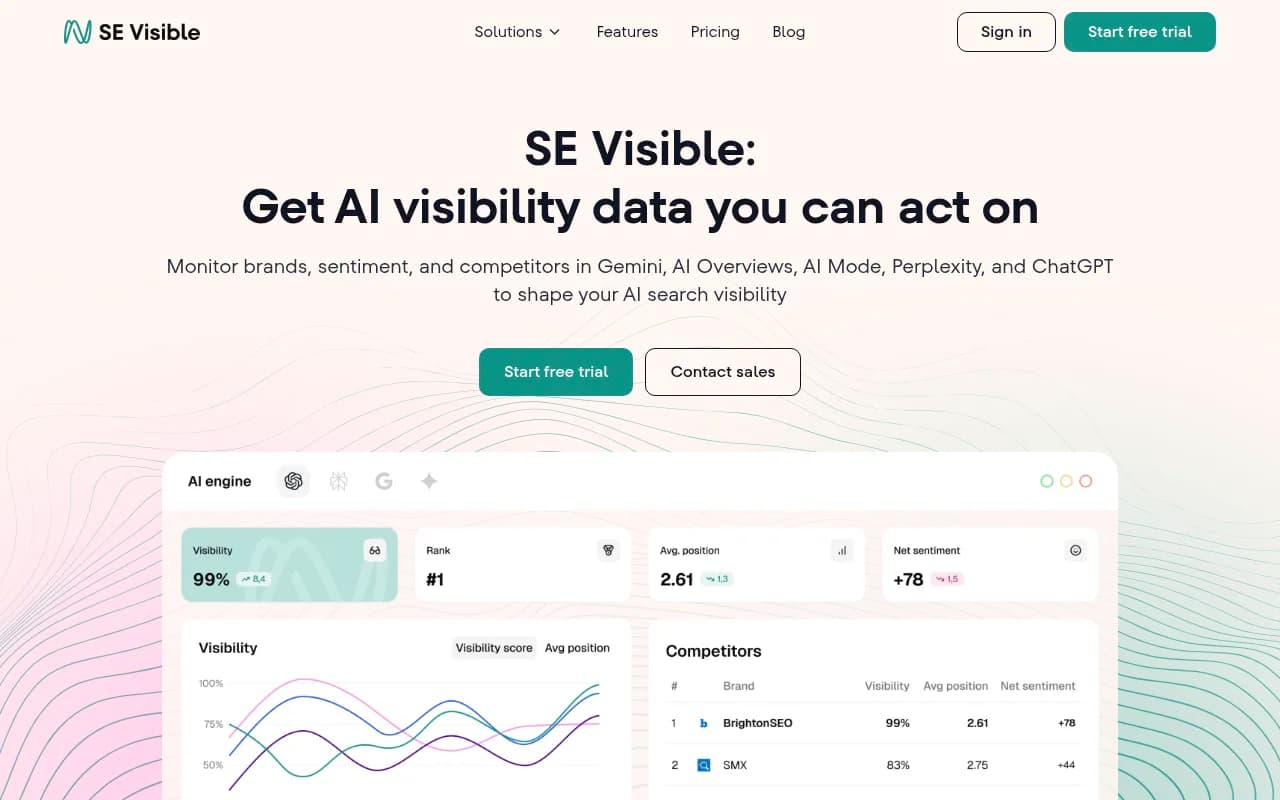
If you want one more voice, Omnia publishes a 26-tool comparison that is helpful for a longlist, with the same vendor caveat.
To browse wider, the GEO software directory at bestgeosoftware.com lists many more options.
After the demo: a short trial plan
A demo proves little. A trial with your data proves more.
- Load the same prompts you tested by hand and compare 10 responses against your screenshots.
- Let it run for at least a week so you see variance, not a snapshot.
- Pick one content gap and ship a fix. Watch whether the tool shows the crawl, the citation and the traffic.
- Ask support one hard question and time the answer.
- Rebuild the price quote with your final prompt, market and seat counts.
Most platforms offer a free tier or a trial of about a week or two. Promptwatch has a free Explore tier and a 7-day trial on monthly paid plans, and its pricing page has current numbers. Confirm any vendor's limits before you commit to an annual contract.
One last opinion
The best demo question I know is the simplest: "Show me something in my data that is bad news." A platform that only finds flattering numbers is selling you comfort. One that surfaces a competitor out-citing you on your best prompt, then shows the page to fix, is doing the job.