Key takeaways
- A citation is a URL an AI engine surfaces when building an answer. Measure it per engine, because ChatGPT, Perplexity, Gemini and Claude behave differently.
- Build a fixed set of 15-30 buyer prompts, run them on a schedule, and log which outlets and URLs get cited. One-off checks miss decay.
- Press coverage is short-lived in ChatGPT. Promptwatch's data shows half of cited news pages drop out within 36 days, so report trends, not snapshots.
- Compare the outlets AI cites for your category against the outlets you pitch. Muck Rack's analysis, as relayed by Carly Martinetti, found only about 2% journalist overlap.
- Spot-check tool output by hand every couple of weeks, and ask customers and sales how they heard about you.
Why clips and reach no longer answer the question
For years PR teams have reported coverage volume, reach, share of voice in the press, and referral traffic. Those numbers still matter. They just stop at the click, and a growing share of buyers never click. Notified cites Pew Research (June 2026) saying 60% of Americans now read AI-generated summaries at the top of search results.
So the question changes. Not just "did we get coverage?" but "did the AI engines read it, use it, and name us because of it?"
Muck Rack's analysis of more than 25 million AI-cited links found that earned media accounts for about 84% of AI citations, and paid or advertorial content for about 0.3%. That is good news for PR. It is also a trap: the same report says the measurement gap, not the content gap, is what most PR teams need to close. Muck Rack's own survey data says 73% of PR professionals see GEO as at least somewhat important, yet 39% are not measuring it at all.
What counts as a citation (and what doesn't)
An AI citation is a source URL or reference an engine surfaces while constructing an answer. In ChatGPT it appears as inline links and a sources panel. In Perplexity it is a numbered footnote on nearly every answer. Different formats, same signal: the model is naming where the information came from.
There is a second thing worth separating out, which is a mention. An engine can name your brand with no link at all, or link to your coverage without naming you in the answer text. Track three states per prompt:
- Mentioned in the answer text
- Cited as a source URL (yours, or a third party writing about you)
- Absorbed, meaning the answer paraphrases your coverage even if the footnote is thin
Shadow's guidance on earned media makes the same point: check whether coverage is absorbed into the answer or merely listed in citation footnotes.
Engines behave differently
Per Muck Rack's report, ChatGPT cites sources in 96% of responses, Gemini in 82% and Claude in 55%. Keep in mind those figures are based on a different method from Promptwatch's, which counts only responses where web search was triggered. Don't merge the two.
Source counts differ too. Promptwatch's average sources per response data (a page dated September 2025, so check freshness) shows ChatGPT citing about 5 sources per web-search answer, Google AI Overviews about 10, and Perplexity almost exactly 10 every day. With only five slots in ChatGPT, each citation is contested. Perplexity's steadier ten makes it a decent test bench.
Perplexity also leans on community sources. Muck Rack puts Reddit and forums at 16.9% of Perplexity's citations, a higher share than any other major engine, which means a pure journalist-pitching strategy won't capture all of it.
Step 1: Build a prompt set that reflects how buyers ask
Shadow recommends 15-30 target queries that represent how buyers discover and evaluate brands in your category. That is a sensible size. Fewer and you get noise. More and nobody reviews the output.
Split them into types:
- Category discovery: "best [category] vendors for [segment]"
- Comparison: "[your brand] vs [competitor]"
- Branded: "is [your brand] any good?" or "what does [your brand] do?"
- Expert sourcing: "which [specialty] expert should I talk to about [topic]?"
The last one is easy to forget and PR-specific. Martinetti describes a client trademark attorney whose reporters keep saying they found him by asking ChatGPT who to talk to. If journalists use AI to find sources, your spokesperson prompts are a measurable PR outcome.
One honest caveat from the Spin Sucks conversation: visibility tools generate prompts to estimate what people ask, they don't see real customer prompts. Treat the set as a proxy, and refine it with sales calls and customer interviews.
Step 2: Run it across engines on a schedule
Run every prompt on ChatGPT, Perplexity, and ideally Google AI Overviews, Gemini and Claude, weekly. Responses vary by model, location, context and even repeat runs, so one manual check proves very little. Use several runs per prompt and report averages.
For each response, log:
| Field | Why it matters |
|---|---|
| Prompt and prompt type | Lets you segment branded vs category results |
| Engine and country | Citations differ per engine and per location |
| Brand mentioned (yes/no, position) | Presence and prominence |
| Cited URLs and domains | Which outlets feed the answer |
| Your coverage cited (yes/no) | The core PR metric |
| Absorbed into answer text | Distinguishes real influence from footnotes |
| Sentiment | Mentions can hurt as easily as help |
You can do this in a spreadsheet or Airtable for a pilot. It gets painful past a couple of engines and a few dozen prompts, which is when a dedicated tracker earns its fee.
Step 3: Pick metrics PR leaders will actually accept
Add these to the standard report next to coverage volume and reach:
- AI citation share: the percentage of tracked responses where your brand or your coverage is cited
- Share of media: of all domains cited for your category prompts, how much comes from outlets that covered you
- Outlet overlap: how many of the outlets AI cites are on your media list
- Time to first citation: days from publication to first appearance in a tracked response
- Absorption rate: share of citations where the answer text reflects your messaging
- Sentiment of the answer
Outlet overlap is the most useful diagnostic. Muck Rack's research, via Martinetti's thread, says only 2% of journalists pitched by PR teams overlap with the journalists AI is citing, that most of a brand's AI visibility comes from about 20 outlets, and that models mix high-trust names with niche vertical outlets. For B2B queries, Muck Rack finds niche trade outlets often drive more citations than national press. Pull the outlets AI cites for your category, set them next to your pitch list, and the gaps are your plan.
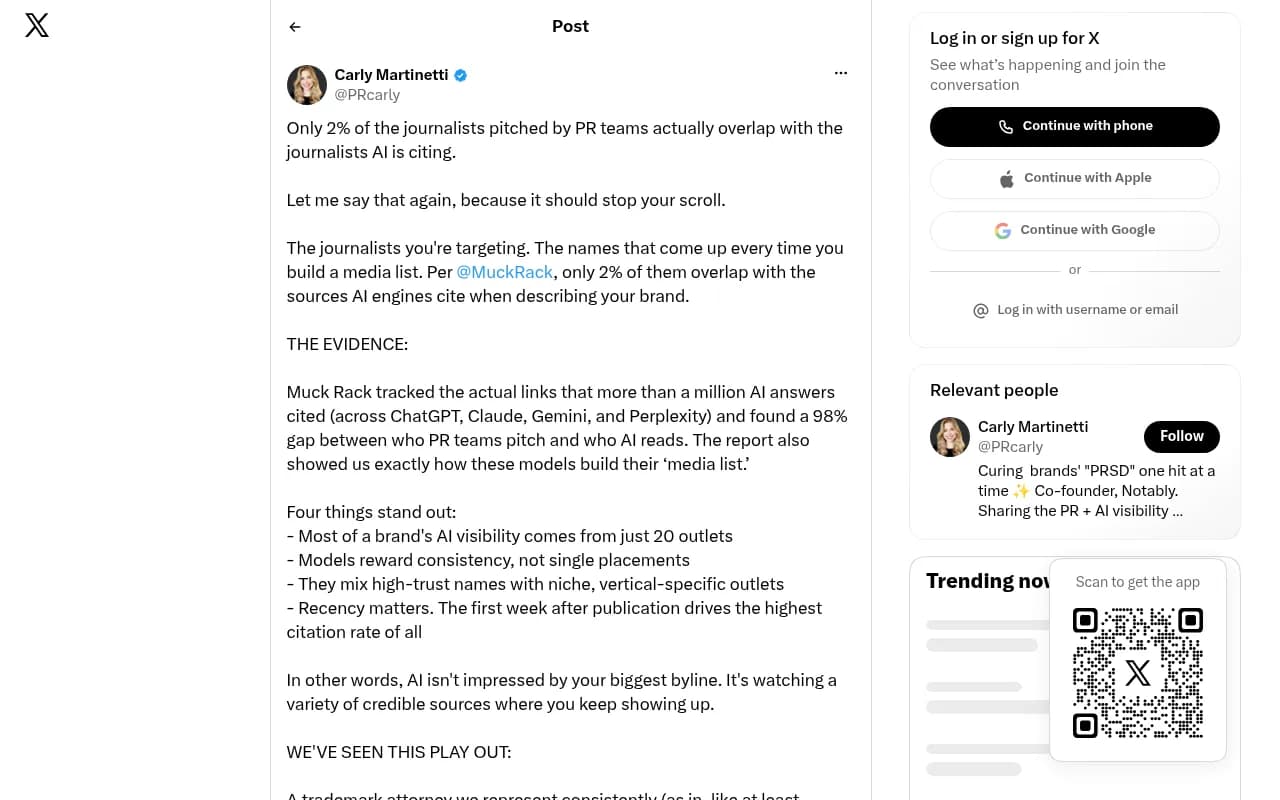
Treat that overlap figure as a claim from a vendor report relayed on social media, not a settled benchmark. The direction is plausible. The exact number I'd verify against the original Muck Rack report before putting it in a board deck.
Step 4: Account for decay, because news doesn't last
This is where PR reporting usually goes wrong. A citation in week one is not a citation in week ten.
Promptwatch's half-life of content in ChatGPT study tracked every page ChatGPT cited on July 6, 2026 for 90 days (to October 4). News pages decayed fastest: almost a quarter were never cited again after day 0, half were gone after 36 days, and 41% were still cited at day 60. Compare that with landing pages (78% still cited at 30 days, 69% at 60) and docs (76% and 67%).
Two implications for PR:
- Use press coverage for short bursts of visibility, and report it on a rolling basis.
- Pair coverage with durable owned pages so there is something long-lived to cite.
There is an opposing data point. Notified's June 2026 study of 8,000+ GlobeNewswire releases found 99.3% were cited by ChatGPT or Claude, with a first citation after about eight hours on average, 25% of citations by day seven and 50% by day 18. Muck Rack's research as relayed by Martinetti also says the first week after publication gets the highest citation rate. Different samples and definitions, but they agree on one thing: the early window matters, so check your prompts within days of a launch, not at quarter end.
Where press releases and news sit in the mix
In Promptwatch's ChatGPT citation share by content type data (Sep 28 to Oct 4, 2026), news is 5.7% of classified citations. Product pages are 22.4% and landing pages 16.8%. Press releases don't appear in the overall list, but earn 2.1% of citations for branded prompts, more than their share across all prompts. Reviews are 5.6% of branded citations.
This does not contradict Muck Rack's 84% earned-media figure. Muck Rack classifies by media type (earned versus paid and owned) and Promptwatch classifies by content format. Both can be true. The practical reading: coverage shapes what AI says about you, but for branded and commercial prompts the pages ChatGPT cites are often the ones describing what you sell. Your own product and landing pages need to carry the same facts your coverage does.
Step 5: Choose tools for the job
You have roughly four tool types in play, and a PR team rarely needs all of them.
| Need | Tool type | Examples from our catalog |
|---|---|---|
| Track prompts, citations and mentions across engines | AI visibility platforms | Promptwatch, Profound, Otterly.AI, Peec AI |
| Track classic coverage and mentions | Media monitoring | Meltwater, Cision, Mention |
| Link AI visits to actual traffic | Analytics / crawler logs | Promptwatch, DarkVisitors |
| Manual log or pilot | Spreadsheet or database | Airtable |
AI visibility platforms
Promptwatch is the one I'd shortlist first for a PR team that wants more than a mention counter. It runs your prompts daily against the real ChatGPT and Perplexity interfaces, shows which URLs and domains get cited, and has dedicated reports for the Reddit, YouTube and LinkedIn sources that matter so much for Perplexity. Its crawler logs show whether AI bots are actually reading your coverage-linked pages, and visitor analytics show whether any of this turns into traffic. Content gap analysis then tells you what to publish next.

Profound is a strong monitoring option if enterprise reporting is the priority.

Otterly.AI and Peec AI are lighter prompt trackers. They answer "were we mentioned?" at a lower price, but won't tell you why or what to do next.


For a wider shortlist, the GEO software directory at bestgeosoftware.com compares many more trackers.
Traditional media monitoring
Keep your existing coverage tracker. It tells you what was published. The AI tool tells you what got used.
The join between the two is the useful part: export the outlets that covered you, then check which of them appear in AI citation reports for your prompts.
Step 6: Build the monthly PR report
A workable one-page report:
- Prompt set summary, with number of prompts by type and engine.
- Citation share and mention rate, per engine, with a 4-8 week trend line.
- Top cited outlets for your category versus outlets that covered you.
- Coverage placed this month and whether each placement was cited, and how many days it took.
- Decay watch: placements from 30-60 days ago and whether they are still cited.
- Sentiment and any wrong claims AI is repeating.
- Actions: outlets to pitch, owned pages to update, community channels to join.
Keep it to trends. Spin Sucks' summary of the discussion says it well: the goal is not to chase individual citations, but to understand whether efforts are improving visibility, credibility and eventually business outcomes.
Measurement pitfalls to watch
Treating one check as proof
AI answers are non-deterministic. Run each prompt multiple times and look at trends. Promptwatch also advises judging noisy engines like Copilot on monthly trends rather than weekly snapshots, since its source counts have swung widely.
Trusting generated prompts blindly
Even good tools estimate what users ask. Spot-check findings by hand every couple of weeks, as the Spin Sucks participants recommend.
Chasing Tier 1 only
Spin Sucks cites Featured's analysis: the top 100 cited domains account for about 25% of citations, 76% of cited domains appear exactly once, and about 34% of citations come from sites with domain authority below 40. Tier 1 press still matters a lot, and a publication ChatGPT cites often may show up less in Perplexity or Claude. But there is a long tail you can work. Promptwatch's own data on ChatGPT citations by domain rank points the same way: mid-authority sites (DR 46-75) earned almost half of citations in August 2026, while DR 91-100 sites fell to about 3%.
Ignoring Reddit and social
This is engine-specific. In Promptwatch's social citations by AI model data (Sep 28 to Oct 4, 2026), ChatGPT got just 0.46% of its citations from social platforms, while Google AI Overviews got 12.2%. And reddit.com's share of ChatGPT citations fell from about 4% to 0.5% on August 14, 2026. So for ChatGPT, don't spend heavily on Reddit. For Perplexity and AI Overviews, community presence is still worth tracking.
Skipping the human signal
Add "how did you hear about us?" to forms and sales calls, with ChatGPT and Perplexity as explicit options. It is low-tech, and it catches what no tool will. The hard part is getting sales to ask consistently.
A simple 30-day starting plan
- Week 1: Draft 20 prompts from sales calls, search data and competitor comparisons. Run them manually on ChatGPT and Perplexity to get a baseline.
- Week 2: List every cited domain. Compare with your pitch list and recent coverage.
- Week 3: Move the prompt set into a tracker so it runs daily, and log citations from your latest placements.
- Week 4: Produce the first report, pick three outlets to add to your pitch list, and update two owned pages so they repeat the facts your coverage states.
Then repeat monthly. The compounding benefit comes from having a baseline: after a quarter you can say which campaigns got cited, how fast, and how long it lasted.
Where an agency fits
If your team lacks the bandwidth to run this, an agency that combines digital PR with AI search work can take it on. 1001 SEO Media does digital PR, GEO and content under one roof, which suits this kind of coverage-to-citation measurement. For most in-house teams, though, starting with the spreadsheet and a tracker is enough to learn what moves.
Bottom line
Measure citations per engine, on a fixed prompt set, repeatedly, and tie them back to the specific placements that earned them. Expect news-driven citations to fade within weeks, and plan your owned content and outlet mix accordingly.