Key takeaways
- Most AI visibility platforms are monitoring-only dashboards -- they show you where you're invisible but don't help you fix it, which makes ROI conversations with finance teams awkward.
- Searchable, Profound, and Peec AI all sit in the "track and report" category to varying degrees; Promptwatch is the only one of the four with a full content generation and optimization loop built in.
- Profound is the most feature-rich monitoring platform but starts at $499/month, making it hard to justify for teams that aren't already running a mature GEO program.
- Peec AI is the most accessible entry point (from ~€89/month) but has the thinnest feature set of the four.
- The CFO question isn't "which tool tracks the most models?" -- it's "which tool can show a line from spend to revenue?" Only one of these four answers that clearly.
Why this comparison matters right now
Your CFO doesn't care about citation share. They care about pipeline.
That's the uncomfortable truth sitting underneath every AI visibility platform evaluation in 2026. The category has exploded -- there are now dozens of tools claiming to track your brand across ChatGPT, Perplexity, Gemini, and the rest -- but most of them produce dashboards, not outcomes. When budget review comes around, "our AI mention rate went from 12% to 18%" is a hard sell if you can't connect it to anything downstream.
This guide compares four platforms that come up most often in real buying conversations: Searchable, Promptwatch, Profound, and Peec AI. The goal isn't to crown a winner on feature counts. It's to figure out which one you can actually defend to someone who controls the budget.
What each platform actually does
Before getting into pricing and ROI, it's worth being honest about what each tool is at its core.
Searchable
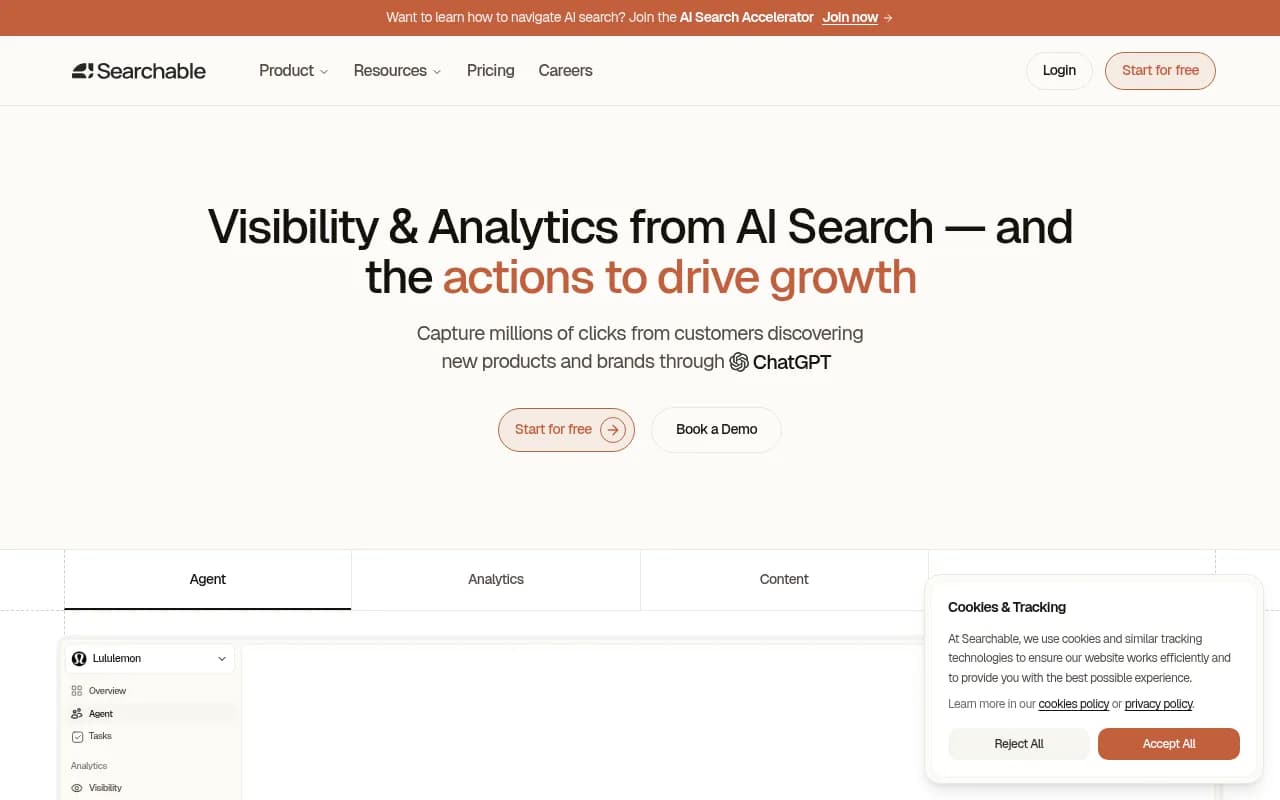
Searchable is an AI search visibility platform with monitoring and some content tooling. It tracks brand mentions across major AI engines and provides visibility scoring. It's positioned as a mid-market option, sitting between the simplicity of Peec AI and the depth of Profound.
Profound
Profound is the closest thing the category has to an enterprise standard. It tracks AI visibility across multiple models, provides prompt volume data, and has built out agent analytics and shopping tracking. The research from Profound's own team is worth noting: they've found that 40-60% of cited domains change monthly across answer engines, which is a compelling argument for continuous monitoring.
Where Profound falls short is the content creation side. Multiple independent reviews in 2026 describe it as monitoring-only -- it shows you the gaps but leaves the fixing to your team. At $499/month as an entry point, that's a significant spend for a tool that hands you a problem without a solution.

Peec AI
Peec AI is the speed-and-simplicity play. It starts around €89/month, has a clean interface, and gets you up and running quickly. If you need to show a stakeholder that you're doing something about AI visibility without a major budget commitment, Peec AI is the easiest first step.
The trade-off is depth. Peec AI tells you where you stand. It doesn't tell you much about why, and it certainly doesn't help you change it. One way to think about it: Peec AI is a thermometer, not a thermostat.

Promptwatch
Promptwatch is built around a different premise than the other three. Rather than treating visibility tracking as the end product, it treats tracking as step one of a three-step loop: find the gaps, create content to fill them, then track whether that content is getting cited.
The Answer Gap Analysis shows exactly which prompts competitors appear in that you don't. Content Agents then generate articles, comparisons, and briefs grounded in that gap data -- not generic SEO content, but material engineered around the specific questions AI models are already answering without citing you. Then page-level tracking shows whether those pages are getting picked up and by which models.
That loop is what makes the CFO conversation different. You're not reporting a visibility metric -- you're reporting a content investment with a measurable citation outcome.

Feature comparison
Here's how the four platforms stack up across the dimensions that matter most for a business case:
| Feature | Searchable | Promptwatch | Profound | Peec AI |
|---|---|---|---|---|
| AI model coverage | Multiple | 10+ models | Multiple | Multiple |
| Prompt tracking | Yes | Yes (with volume + difficulty scores) | Yes (with volume data) | Basic |
| Content gap analysis | Limited | Yes (Answer Gap Analysis) | No | No |
| Content generation | Some | Yes (Content Agents) | No | No |
| AI crawler logs | Unknown | Yes | Yes (Agent Analytics) | No |
| Traffic attribution | Limited | Yes | Limited | No |
| Reddit/YouTube tracking | No | Yes | No | No |
| ChatGPT Shopping tracking | No | Yes | Yes | No |
| Offsite citation analysis | Limited | Yes | Limited | No |
| Multi-language/region | Limited | Yes | Yes | Yes |
| Starting price | Not public | $99/mo | ~$499/mo | ~€89/mo |
| Free trial | Unknown | Yes | Demo only | Yes |
The gap that stands out isn't between Profound and Peec AI -- it's between all three monitoring tools and Promptwatch's action loop.
The CFO question, answered for each platform
"What does Profound get us for $499/month?"
Profound's strongest argument is data quality and depth. If your team is already running a GEO program and needs reliable, enterprise-grade visibility data to inform strategy, Profound delivers that. The prompt volume data and agent analytics are genuinely useful for prioritization.
The problem is that $499/month for monitoring alone is a tough sell when the output is a report that says "you're invisible for these 40 prompts." Finance will ask: "And then what?" If your team has the bandwidth and expertise to act on that data independently, Profound is defensible. Most teams don't.
"What does Peec AI get us for €89/month?"
Peec AI is the easiest to get approved because the number is small. But small budget, small return. It's a reasonable starting point for teams that need to demonstrate they're paying attention to AI visibility, but it won't generate the kind of insight that drives meaningful action. You'll likely outgrow it within six months and face a harder conversation about upgrading.
"What does Searchable get us?"
Searchable sits in an awkward middle position. It's not as cheap as Peec AI or as deep as Profound, and its content tooling isn't as developed as Promptwatch's. It's worth evaluating if you want something between the two extremes, but the business case is harder to articulate precisely because it doesn't own a clear position.
"What does Promptwatch get us for $99-$579/month?"
This is the easiest conversation to have with a CFO, and not because the price is lowest (though the entry point is competitive). It's because you can describe a complete workflow:
- We identify which prompts our competitors are winning that we're not.
- We generate content specifically designed to answer those prompts.
- We track whether that content gets cited, and by which AI models.
- We connect citation growth to actual traffic and revenue.
That's a capital allocation story, not a monitoring story. You're describing an investment with expected returns, not a subscription to a dashboard.
Pricing breakdown
| Platform | Entry price | Mid tier | Notes |
|---|---|---|---|
| Peec AI | ~€89/mo | Higher tiers available | Cheapest entry point |
| Promptwatch | $99/mo (Essential) | $249/mo (Professional), $579/mo (Business) | Free trial available |
| Searchable | Not publicly listed | -- | Contact for pricing |
| Profound | ~$499/mo | Enterprise pricing | Demo-only, no self-serve trial |
Promptwatch's pricing structure is worth noting because it scales with what you actually need. The Essential plan at $99/month covers one site and 50 prompts -- enough to prove the concept before committing to a larger investment. Profound requires a demo conversation before you can even see the platform, which adds friction to the evaluation process and signals that it's built for larger enterprise budgets.
Who should use what
This isn't a one-size-fits-all category. Here's a practical breakdown:
Use Peec AI if: You're just starting to think about AI visibility, have a tight budget, and need something to show stakeholders you're tracking the space. Treat it as a temporary first step.
Use Profound if: You're at an enterprise with a dedicated GEO team, you need the deepest available monitoring data, and you have internal content resources to act on what you find. The price is justifiable when it's one input into a larger program.
Use Searchable if: You want a mid-market option and have evaluated both Peec AI and Profound and found them too simple or too expensive respectively. Worth a trial to see if the feature set fits your workflow.
Use Promptwatch if: You want to close the loop between visibility data and content output, need to show ROI to a finance team, or don't have a large internal team to translate monitoring data into action. The content generation capability is what separates it from the rest of the field.
The monitoring-only problem
It's worth dwelling on this for a moment because it's the central issue with most of the category.
Knowing you're invisible in AI search is not the same as becoming visible. Every platform in this comparison can tell you that ChatGPT isn't citing your brand when someone asks about your product category. Only one of them helps you do something about it.
The research backs this up. Profound's own data shows that 40-60% of cited domains change monthly. That's not a reason to panic -- it's a reason to have a systematic way to create and publish content that earns citations. A monitoring tool shows you the problem repeating. An optimization platform gives you a way to interrupt the cycle.
This is the core argument for Promptwatch over the monitoring-only alternatives. The AI crawler logs show you which pages are being read by AI agents and which are being ignored. The Answer Gap Analysis shows you the specific prompts you're losing. The Content Agents generate material to fill those gaps. And the attribution layer connects the dots back to traffic and revenue.
Most competitors stop at step one. That's fine if you have a team that can execute steps two and three independently. If you don't, you're paying for a problem statement without a solution.
What to ask during a trial or demo
Regardless of which platform you evaluate, these are the questions worth pressing on:
- Can you show me a specific prompt where a competitor is cited and I'm not, and explain why?
- What does the platform recommend I do about it?
- How do I track whether my content changes lead to citation improvements?
- Can you show me how AI traffic from this platform connects to actual conversions?
- Which AI models are you tracking, and are you querying them through the user interface or just the API? (This matters because user-facing answers can differ from API outputs.)
The last question is more technical than it sounds. Some platforms query AI models through APIs for cost efficiency, but the answers users actually see in ChatGPT or Perplexity can differ from what the API returns. Platforms that track real user-interface behavior give you more accurate data.
The bottom line
If you have to pick one platform and defend it to a CFO, Promptwatch makes the strongest case -- not because it has the most impressive brand name or the longest feature list, but because it's the only one of the four that completes the loop from "here's where you're invisible" to "here's the content we created" to "here's the citation growth we measured."
Profound is excellent if you're already running a sophisticated GEO operation and need enterprise-grade monitoring data. Peec AI is a reasonable starting point if budget is the primary constraint. Searchable sits in the middle without a clear differentiated story.
The category is maturing fast. In 2026, "we track your AI visibility" is table stakes. The question is what happens after the tracking.