Key takeaways
- All four tools track brand visibility across AI search engines like ChatGPT, Perplexity, and Gemini -- but they diverge sharply on what you can do with that data afterward.
- Otterly.AI and Peec AI are solid monitoring tools, but they largely stop at showing you the numbers. No content generation, no crawler logs, no gap analysis.
- Searchable adds some content tooling on top of monitoring, making it a step up for teams that want a bit more than a dashboard.
- Promptwatch is the only one of the four with a full optimization loop: find gaps, generate content, track results. It's built for teams that want to actually improve their AI visibility, not just measure it.
The AI search monitoring space has gotten crowded fast. Two years ago, barely anyone was asking "how do we rank in ChatGPT?" Now there are dozens of tools claiming to answer that question, and the differences between them are genuinely hard to see from a features page.
So let's cut through it. This guide focuses on four specific tools -- Searchable, Otterly.AI, Peec AI, and Promptwatch -- and ranks them on a single, practical question: once you have the data, what can you actually do with it?
Because monitoring is table stakes now. The real differentiator is actionability.
What "actionable" actually means in this context
Before diving into the tools, it's worth being precise about what we mean by actionable.
A monitoring dashboard that shows your brand mention rate across ChatGPT and Perplexity is useful. But if you look at that number and your next step is "I guess we need to create more content" -- with no guidance on what content, for which prompts, targeting which AI models -- then the tool has done half the job.
Truly actionable AI visibility tools do three things:
- Show you where you're invisible (and where competitors aren't)
- Tell you specifically what to create or fix to close those gaps
- Track whether the changes you made actually improved your visibility
Most tools in this space do step one reasonably well. Very few do all three. That's the lens we're using here.
The four tools at a glance
Otterly.AI
Otterly.AI was one of the first purpose-built AI visibility monitoring tools to gain real traction. It's designed specifically for the AI search era -- not a traditional SEO tool with AI features bolted on.

What it does well: Otterly tracks brand mentions, citations, and sentiment across the major AI platforms (ChatGPT, Perplexity, Google AI Overviews, Gemini, Claude). The interface is clean, setup is fast, and the data updates regularly. For a team that wants to get a quick read on how their brand is appearing in AI-generated answers, it works.
Where it falls short: Otterly is fundamentally a monitoring dashboard. It shows you what's happening but doesn't help you change it. There's no content generation, no gap analysis that maps your content against what AI models are actually citing, and no crawler logs to understand how AI engines are discovering (or ignoring) your pages. If your visibility score is low, Otterly tells you that. It doesn't tell you why or what to do next.
Pricing sits at the more affordable end of the market, which makes it appealing for smaller teams or those just getting started with AI visibility tracking.
Peec AI
Peec AI takes a similar monitoring-first approach, with a particular strength in multi-language tracking. If you're a brand operating across multiple markets and languages, Peec's localization support is genuinely useful -- it's one area where it differentiates from the pack.

The tool tracks share of voice, brand mentions, and citation frequency across the main AI platforms. It produces clean reports and handles international queries better than most.
But like Otterly, Peec is primarily a tracker. The data is solid; the "now what?" is left to you. There's no content brief generation, no answer gap analysis, and no way to see which specific pages on your site are being cited (or not). You get the scoreboard without the playbook.
For multilingual brands that need basic monitoring across regions, Peec is a reasonable pick. For teams that want to actually move the needle, it's a starting point, not a complete solution.
Searchable
Searchable sits a notch above the pure monitoring tools. It combines visibility tracking with some content tooling, which puts it in a more interesting position for marketing teams that want a single platform rather than stitching together multiple tools.
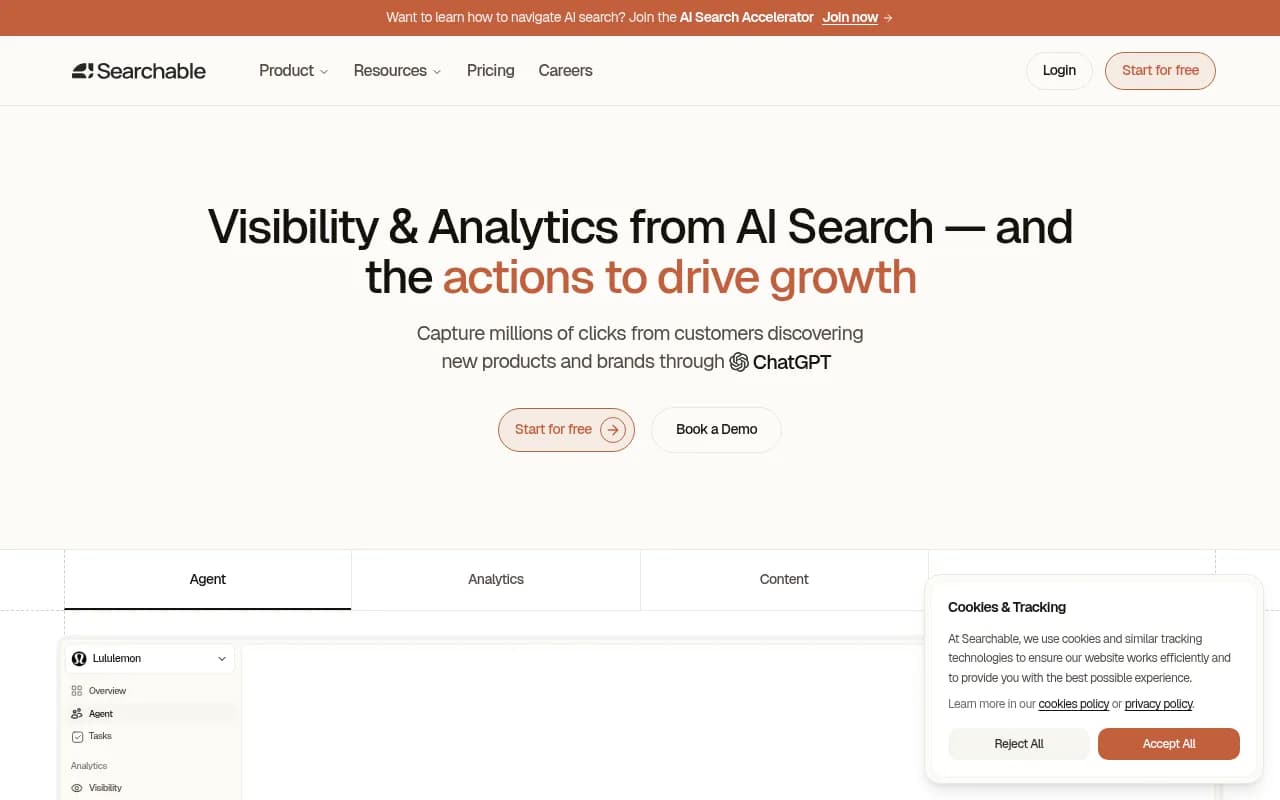
The monitoring side covers the expected platforms and provides brand mention tracking, citation analysis, and competitive benchmarking. The content side adds the ability to generate or brief content based on visibility data -- which is a meaningful step toward closing the gap between "here's where you're invisible" and "here's what to create."
That said, Searchable's content capabilities are more limited than they appear at first glance. The gap analysis isn't as granular as what you'd get from a purpose-built optimization platform, and the content generation leans more toward briefs than fully developed articles grounded in real prompt data. It's a better tool than Otterly or Peec for teams that want some optimization capability, but it doesn't complete the full loop.
Promptwatch
Promptwatch is the most complete of the four, and the gap between it and the others is larger than the marketing copy suggests.

The monitoring layer covers 10 AI models -- ChatGPT, Perplexity, Google AI Overviews, Google AI Mode, Claude, Gemini, Meta/Llama, DeepSeek, Grok, Mistral, and Copilot -- with real user-interface tracking rather than just API queries. That distinction matters because what AI models say in their actual interfaces can differ from what they return via API.
But the monitoring is almost secondary to what comes after. Promptwatch's Answer Gap Analysis shows you exactly which prompts competitors are visible for that you're not -- with specifics on the topics, angles, and questions AI models want to answer but can't find on your site. That's a content brief in everything but name.
From there, Content Agents generate articles, listicles, comparisons, and briefs grounded in real prompt data, citation volumes, persona targeting, and competitor analysis. This isn't generic content generation -- it's built around the specific gaps AI models are exposing.
Then the tracking layer closes the loop: page-level citation tracking shows which of your pages are being cited, by which models, and how often. Agent Analytics logs show the timeline from publish to crawl to citation, so you can see whether your new content is actually getting picked up.
The AI Crawler Logs feature is worth calling out separately because most competitors don't have anything like it. Real-time logs of AI crawlers hitting your site -- which pages they read, errors they encounter, how often they return -- give you a technical view of AI discoverability that's genuinely hard to get elsewhere.
Pricing starts at $99/month for the Essential plan (1 site, 50 prompts, 5 articles), $249/month for Professional (crawler logs, 150 prompts, 15 articles), and $579/month for Business (5 sites, 350 prompts, 30 articles). There's a free trial available.
Feature-by-feature comparison
| Feature | Searchable | Otterly.AI | Peec AI | Promptwatch |
|---|---|---|---|---|
| Brand mention tracking | Yes | Yes | Yes | Yes |
| Citation analysis | Yes | Yes | Yes | Yes |
| Competitive benchmarking | Yes | Yes | Yes | Yes |
| Multi-language support | Limited | Limited | Strong | Yes |
| AI models covered | 5-6 | 5 | 5-6 | 10 |
| Real UI tracking (not just API) | No | No | No | Yes |
| Answer gap analysis | Basic | No | No | Yes |
| Content generation | Basic | No | No | Yes (full articles) |
| AI crawler logs | No | No | No | Yes |
| Page-level citation tracking | No | No | No | Yes |
| Traffic attribution | No | No | No | Yes |
| Reddit/YouTube insights | No | No | No | Yes |
| ChatGPT Shopping tracking | No | No | No | Yes |
| Prompt volume/difficulty data | No | No | No | Yes |
| Starting price | ~$99/mo | ~$49/mo | ~$49/mo | $99/mo |
How they rank on actionability
Here's the honest ranking, using the three-step framework from earlier:
1. Promptwatch
Does all three steps. Find gaps (Answer Gap Analysis), create content (Content Agents), track results (page-level tracking, crawler logs, traffic attribution). The only tool of the four that completes the full loop. Used by 1,480+ brands including Booking.com and Center Parcs, which gives some signal about enterprise confidence in the platform.
2. Searchable
Does step one well, makes a reasonable attempt at step two, doesn't really do step three. If you want some content tooling alongside your monitoring and don't need the depth of Promptwatch's optimization features, Searchable is a fair middle-ground option.
3. Otterly.AI
Does step one well. Clean interface, good platform coverage, reasonable pricing. But the journey ends at the dashboard. Good for teams that are just starting to track AI visibility and don't yet have a workflow for acting on the data.
4. Peec AI
Does step one well, with a specific advantage in multi-language tracking. If your primary need is monitoring brand visibility across international markets in multiple languages, Peec is worth a look. For everything else, it's behind the others.
Who should use which tool
The right choice depends less on feature lists and more on where your team is in the AI visibility journey.
If you're just starting out and want to understand whether your brand is even showing up in AI search results, Otterly.AI is a low-cost, low-friction way to get a baseline. It won't tell you what to do, but it'll tell you where you stand.
If you're operating across multiple languages and regions and monitoring is your primary need, Peec AI's localization support makes it the better choice over Otterly for that specific use case.
If you want monitoring plus some content tooling in one place and aren't ready to invest in a full optimization platform, Searchable is a reasonable step up.
If you're a marketing or SEO team that's past the "let's see if this matters" phase and wants to actually improve your AI visibility -- not just measure it -- Promptwatch is the only tool here that's built for that. The gap analysis, content generation, and crawler logs together form a workflow that the others simply don't offer.
A note on what the market is missing
One thing worth saying plainly: the AI visibility tool market is full of dashboards that show you numbers and leave you to figure out what to do with them. That's not a knock on any specific tool -- it reflects where the market was 18 months ago, when just tracking AI mentions was novel enough to be valuable.
But the bar has moved. Brands that have been monitoring their AI visibility for a year now have the baseline data. What they need next is a way to act on it. The tools that will matter in 2026 and beyond are the ones that close the loop between data and action.
Of the four tools in this comparison, only one does that completely. The others are useful -- some more than others -- but they're monitoring tools in a world that increasingly needs optimization tools.
If you're evaluating AI visibility platforms right now, the most important question to ask any vendor is: "After I see the data, what does your platform help me do next?" The answer will tell you more than any feature comparison table.