Key takeaways
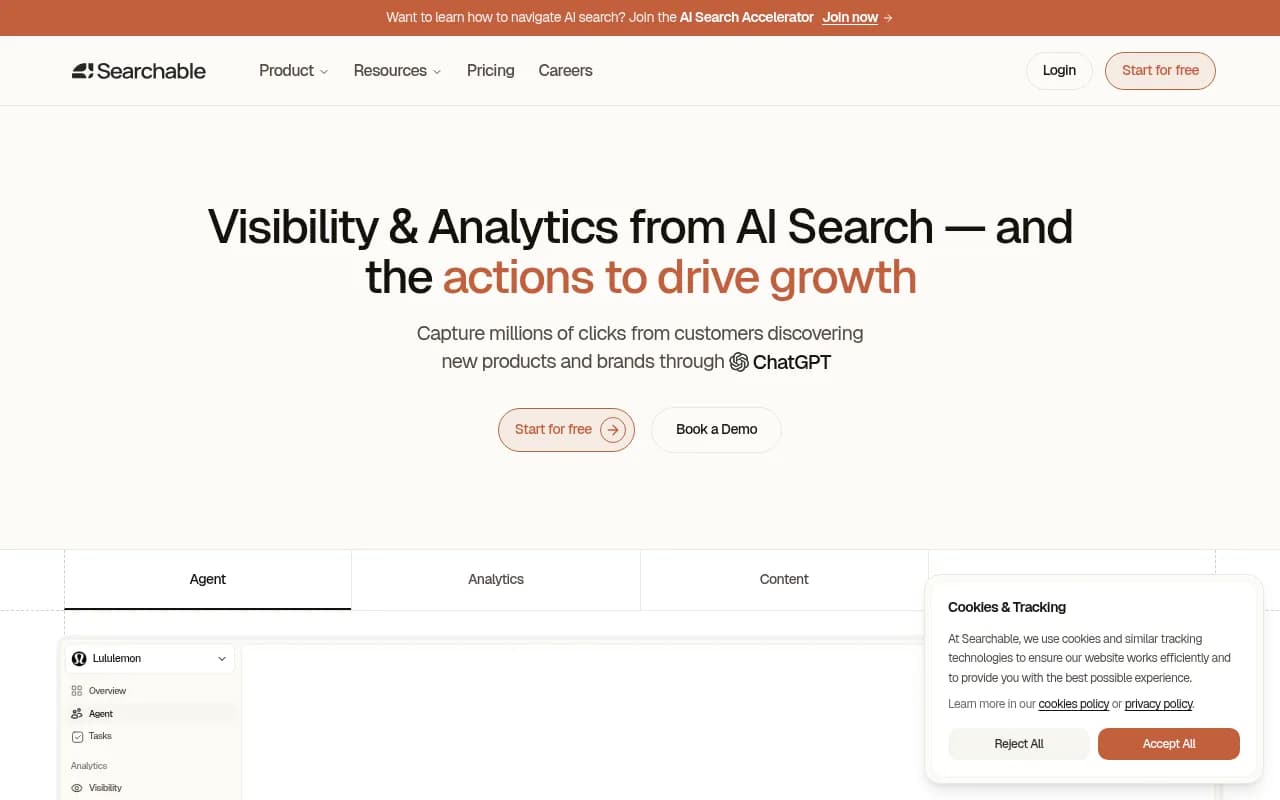
- Searchable is a legitimate AI visibility platform, but several structural limitations make it a poor fit for mid-market teams that need to act on data, not just read it.
- The biggest red flag isn't any single missing feature -- it's the pattern: monitoring-heavy, optimization-light.
- Mid-market teams need content generation, crawler logs, prompt intelligence, and traffic attribution. Most platforms in this space, including Searchable, don't deliver all four.
- If you're evaluating alternatives, look for platforms that close the loop between "you're invisible here" and "here's how to fix it."
- This guide covers 8 specific warning signs to watch for during a trial or sales process.
Mid-market marketing teams have a particular problem with AI visibility tools: they're big enough to care about the data, but lean enough that they can't afford a platform that just shows dashboards without helping them do anything about it.
Searchable has been on a lot of shortlists in 2026. It's a real product with real monitoring capabilities. But after talking to teams who've evaluated it -- and looking at what it does and doesn't do compared to the broader market -- there are some consistent patterns worth flagging before you sign anything.
These aren't hypothetical concerns. They're the kinds of things that show up three months into a contract when your team is staring at a visibility score that hasn't moved and nobody can explain why.
Red flag 1: The platform shows you where you're invisible but doesn't tell you why
This is the most common complaint about monitoring-only tools, and it applies to a lot of platforms in this space. You get a score. You get a list of prompts where competitors appear and you don't. What you don't get is a clear answer to the question that actually matters: what content is missing from my site that would change this?
Answer gap analysis -- the kind that maps your existing content against what AI models are actually citing -- is not a standard feature across this category. If a platform can't show you the specific topics, angles, and questions your site fails to answer, you're left guessing. For a mid-market team without a dedicated GEO strategist, guessing is expensive.
During any trial or demo, ask directly: "Can you show me which prompts my competitors rank for that I don't, and what content I'd need to create to close that gap?" If the answer involves exporting a CSV and figuring it out yourself, that's a problem.
Red flag 2: No content generation tied to the gap data
Even if a platform surfaces gaps, there's a meaningful difference between "here are the gaps" and "here's a draft article that addresses those gaps, grounded in real prompt data and citation patterns."
Mid-market teams are usually running lean content operations. A tool that hands you a brief and says "good luck" is only half useful. The platforms that actually move the needle in 2026 are the ones where you can go from gap identification to publishable content without leaving the platform -- or at least without starting from scratch.
If Searchable's content workflow requires you to copy insights into a separate writing tool, brief a freelancer, and then manually track whether the resulting article ever gets cited, you've added process without removing work.
Red flag 3: Crawler log access is missing or limited
This one is surprisingly underappreciated. AI crawler logs -- real-time records of when ChatGPT, Claude, Perplexity, and other AI agents visit your site, which pages they read, and what errors they encounter -- are one of the most actionable data sources in GEO.
Without crawler logs, you're flying blind on a fundamental question: does the AI even know my content exists? You might have a great article that answers a high-volume prompt perfectly, but if the AI crawler hit a 404 on that page last month and hasn't been back, your visibility score will never reflect it.
Ask any platform you're evaluating: "Can I see which AI crawlers visited my site yesterday, which pages they accessed, and whether they encountered any errors?" If the answer is no, or if this requires a separate integration that's buried in an enterprise tier, take note.

Promptwatch includes real-time AI crawler logs as a core feature on its Professional plan -- not an add-on. You can see exactly which pages each AI agent read, how often they return, and when a page moves from "crawled" to "cited."
Red flag 4: Prompt data is thin or static
Not all prompt tracking is equal. There's a real difference between a platform that monitors a fixed list of prompts you set up manually and one that gives you volume estimates, difficulty scores, and query fan-outs that show how one prompt branches into related sub-queries.
If Searchable's prompt intelligence is limited to "we checked these prompts you gave us," you're missing the discovery layer entirely. The most valuable prompts for your business might be ones you haven't thought to track yet. A platform that only monitors what you already know about isn't helping you find new opportunities.
During evaluation, ask: "How does the platform help me find prompts I'm not currently tracking? What data do you have on prompt volume and difficulty?" Vague answers here are a warning sign.
Red flag 5: No traffic attribution connecting AI visibility to revenue
Visibility scores are interesting. Revenue impact is what gets budget approved.
If a platform can't connect AI citations to actual site traffic -- and ideally to conversions or pipeline -- you'll always be in the position of defending GEO spend with soft metrics. "We improved our AI visibility score by 12 points" is a hard sell to a CFO.
The platforms that are winning mid-market deals in 2026 are the ones that can show: this prompt drove this citation, which drove this traffic, which contributed to this conversion. That requires integration with your analytics stack, not just a standalone visibility dashboard.
Ask whether the platform integrates with Google Search Console, your CMS, or your analytics tools. Ask whether it can show you which specific pages are being cited and how often that citation translates to a click. If the answer is "we're working on attribution," that's a current gap, not a future feature.
Red flag 6: Coverage is limited to one or two AI models
In 2026, your customers are using ChatGPT, Perplexity, Google AI Overviews, Google AI Mode, Gemini, Claude, Grok, and others. The distribution of AI search traffic across models varies by industry, persona, and query type. A platform that only monitors two or three models is giving you an incomplete picture.
More importantly, different AI models have different citation behaviors. A page that gets cited frequently in Perplexity might be invisible in Google AI Overviews. If your platform doesn't break this down by model, you can't prioritize your optimization efforts intelligently.
Check the model coverage list carefully. "We support the major AI search engines" is not the same as a specific list of 10+ models with per-model visibility data.
| Feature | What to look for | Red flag |
|---|---|---|
| Model coverage | 8+ AI models tracked separately | "We cover the major ones" |
| Prompt intelligence | Volume scores, difficulty, fan-outs | Fixed prompt list only |
| Content generation | AI-grounded drafts from gap data | Export to CSV, write elsewhere |
| Crawler logs | Real-time, per-page, per-model | Not available or enterprise-only |
| Traffic attribution | Citations linked to clicks and revenue | Visibility score only |
| Answer gap analysis | Specific content gaps with context | Competitor comparison only |
| Reddit/YouTube tracking | Offsite citation sources | Web-only monitoring |
| Multi-region/language | Country and language-level data | English/US only |
Red flag 7: No visibility into offsite citations
A significant portion of AI citations don't come from your own website. They come from Reddit threads, YouTube videos, third-party review sites, industry publications, and listicles that mention your brand. If a platform only monitors what happens on your domain, it's missing a large chunk of the picture.
This matters for mid-market teams because offsite citations are often easier to influence than on-site rankings. Getting mentioned in the right Reddit thread or industry comparison article can move your AI visibility faster than publishing new content. But you can only act on this if you know which external sources AI models are currently citing in your category.
Ask whether the platform tracks offsite citations. Ask whether it surfaces Reddit discussions or YouTube content that's influencing AI recommendations in your space. Most monitoring tools don't touch this at all.
Red flag 8: The pricing structure punishes growth
This one is easy to miss during initial evaluation. Some platforms price by the number of prompts you track, and the tiers jump sharply. If you start with 50 prompts and discover you actually need 200 to cover your competitive landscape properly, the cost difference might be 3-4x.
For mid-market teams, this creates a perverse incentive: you track fewer prompts than you should because adding more is expensive. That means you're making optimization decisions based on incomplete data.
Before signing, map out what your realistic prompt coverage looks like. Include branded prompts, category prompts, competitor comparison prompts, and use-case-specific prompts. Then check whether the platform's pricing at that volume is still reasonable. Also check whether content generation (articles, briefs) is included or metered separately -- some platforms charge for both tracking and content creation independently, which adds up fast.
What a better fit looks like
The pattern across these eight red flags is the same: Searchable, like most platforms in this category, is built around monitoring. It shows you data. What mid-market teams actually need is a platform that closes the loop -- from "here's where you're invisible" to "here's what to create" to "here's proof it worked."
A few platforms are worth evaluating as alternatives:
Promptwatch covers all 10 major AI models, includes real-time crawler logs, runs answer gap analysis that maps your content against what AI models actually want, and generates content directly from that gap data. The Professional plan at $249/month includes crawler logs, 150 prompts, and 15 articles per month -- which is a realistic starting point for a mid-market team.

Profound has a strong feature set for enterprise teams and does well on prompt tracking and competitive analysis. It's worth a look if you're at the higher end of mid-market.

AthenaHQ is monitoring-focused but covers multiple models well. If your primary need is visibility tracking and you have a separate content workflow, it's a reasonable option -- just go in knowing it won't help you create content.
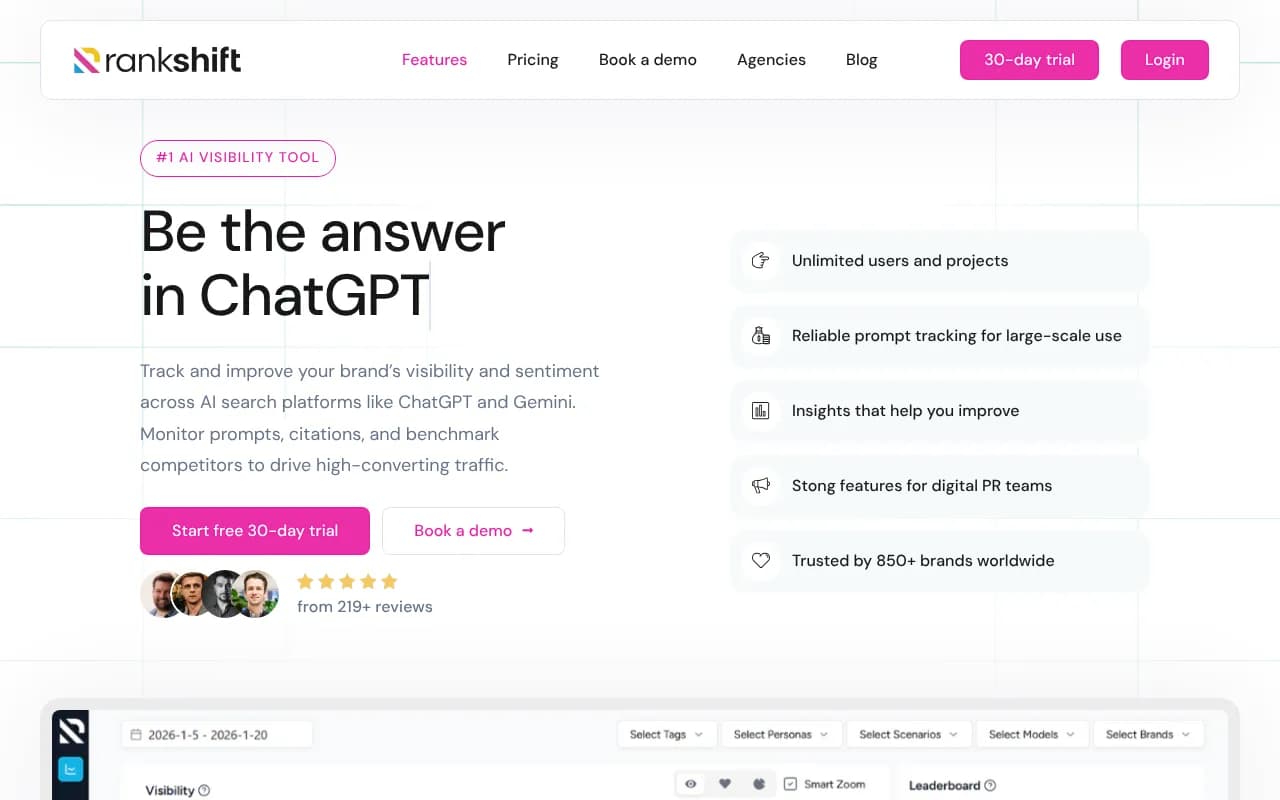
Rankshift is worth evaluating if your team is primarily focused on LLM tracking and GEO. It's lighter on content generation but solid on the monitoring side.
How to run a proper evaluation
If you're still considering Searchable -- or any platform in this space -- here's a practical checklist for your trial period:
- Set up 20-30 prompts that represent real buying intent in your category, not just branded queries
- Check whether the platform surfaces prompts you haven't thought of, or only monitors the ones you provide
- Ask for a walkthrough of the content workflow: how do you go from a gap to a published article?
- Request access to crawler log data and verify it's showing real AI agent activity on your site
- Try to connect visibility data to a traffic metric -- even a simple one
- Check model coverage by asking to see your visibility score broken down by ChatGPT vs. Perplexity vs. Google AI Overviews separately
- Price out what the platform costs at 2x your current prompt volume
None of these are trick questions. A platform that's genuinely right for your team will answer all of them cleanly. The ones that hedge, defer, or route you to an enterprise upgrade for basic functionality are telling you something important.
The AI search landscape is moving fast enough in 2026 that picking the wrong monitoring tool isn't just a wasted budget line -- it's six months of your team watching a dashboard while competitors build visibility you'll have to fight to recover.