Key takeaways
- Promptwatch is the only platform in this comparison that closes the full loop: find visibility gaps, generate content to fix them, then track results. The others are primarily monitoring tools.
- Omnia is a solid monitoring-first choice for teams that want clean dashboards and share-of-voice data without needing built-in content creation.
- Gauge positions itself as an agency-focused platform, connecting tracking and content execution in one workflow.
- BrandRank.AI focuses on brand sentiment and answer-engine tracking, useful for reputation-heavy use cases.
- If competitive intelligence is your primary goal, the key question isn't just "who mentions me?" -- it's "what do I do about the gaps?" That's where the tools diverge most sharply.
Why competitive intelligence in AI search is different from traditional SEO
A few years ago, competitive intelligence meant checking who ranked above you on page one of Google. You'd look at their backlinks, their keyword density, maybe their domain authority. The playbook was well-worn.
AI search breaks that playbook. When someone asks ChatGPT "what's the best project management tool for remote teams?" there's no page one. There's just a response -- and either your brand is in it or it isn't. The AI model has already synthesized information from dozens of sources, made judgment calls about which brands to mention, and delivered an answer that most users will accept without clicking through.
That's a fundamentally different competitive problem. You're not competing for a ranking position. You're competing to be part of the AI's mental model of your category.
The tools in this comparison all try to solve that problem, but they approach it very differently. Let me walk through each one.
The four tools at a glance
| Feature | Promptwatch | Omnia | Gauge | BrandRank.AI |
|---|---|---|---|---|
| AI models monitored | 10+ (ChatGPT, Claude, Gemini, Perplexity, Grok, DeepSeek, Copilot, Mistral, Meta AI, Google AI Overviews) | Multiple LLMs | Multiple LLMs | Multiple LLMs |
| Competitor visibility tracking | Yes | Yes | Yes | Yes |
| Answer gap analysis | Yes | Limited | Yes | Limited |
| Built-in content generation | Yes (AI writing agent) | No | Yes | No |
| AI crawler logs | Yes | No | No | No |
| Reddit/YouTube tracking | Yes | No | No | No |
| ChatGPT Shopping tracking | Yes | No | No | No |
| Prompt volume + difficulty scores | Yes | No | No | No |
| Traffic attribution | Yes (GSC, snippet, server logs) | No | No | No |
| Starting price | $99/mo | Custom | Custom | Custom |
| Free trial | Yes | Yes | Yes | Yes |
Promptwatch: the full action loop
Promptwatch is the platform I'd point most teams toward first, and the reason is specific: it's the only tool here that doesn't stop at showing you data.

Most AI visibility platforms are dashboards. They show you your share of voice, which prompts competitors appear in, and maybe a sentiment score. That's genuinely useful -- but it leaves you staring at a gap without a clear path to closing it. Promptwatch is built around what happens after you see the gap.
The workflow looks like this. Answer Gap Analysis identifies the exact prompts where competitors are visible and you're not. You can see the specific topics, questions, and angles that AI models are drawing on -- content that exists somewhere on the web but not on your site. From there, the built-in AI writing agent generates articles, listicles, and comparisons grounded in citation data from over 880 million analyzed citations. This isn't generic content; it's engineered around what AI models actually cite. Then you track whether your new pages start getting cited, at the page level, across each AI model.
That loop -- find gaps, create content, measure results -- is what makes this an optimization platform rather than a monitoring tool.
A few other things worth calling out for competitive intelligence specifically:
Promptwatch's competitor heatmaps let you compare your AI visibility against specific rivals across all monitored LLMs. You can see who's winning for each prompt and get a clear picture of where you're losing ground. Combined with prompt volume and difficulty scores, you can prioritize the gaps that actually matter -- high-traffic prompts where you have a realistic shot at visibility -- rather than chasing every gap equally.
The AI crawler logs are something most competitors don't offer at all. You get real-time data on when ChatGPT, Claude, Perplexity, and other AI crawlers visit your site, which pages they read, and any errors they hit. For competitive intelligence, this is interesting: if a competitor's pages are getting crawled more frequently, that's a signal worth investigating.
Reddit and YouTube tracking is another differentiator. AI models frequently cite Reddit threads and YouTube videos in their responses, and Promptwatch surfaces the discussions that are directly influencing AI recommendations in your category. If a Reddit thread is shaping how ChatGPT talks about your competitors, you probably want to know about it.
Pricing starts at $99/month for the Essential plan (1 site, 50 prompts, 5 articles). The Professional plan at $249/month adds crawler logs, city/state tracking, and 150 prompts across 2 sites. Business at $579/month covers 5 sites and 350 prompts. There's a free trial, and annual billing brings the price down further.
Omnia: clean monitoring with strong share-of-voice data
Omnia is a well-regarded monitoring platform that does what it promises: it tracks your brand's visibility across AI search engines and gives you share-of-voice data that's genuinely useful for competitive benchmarking.
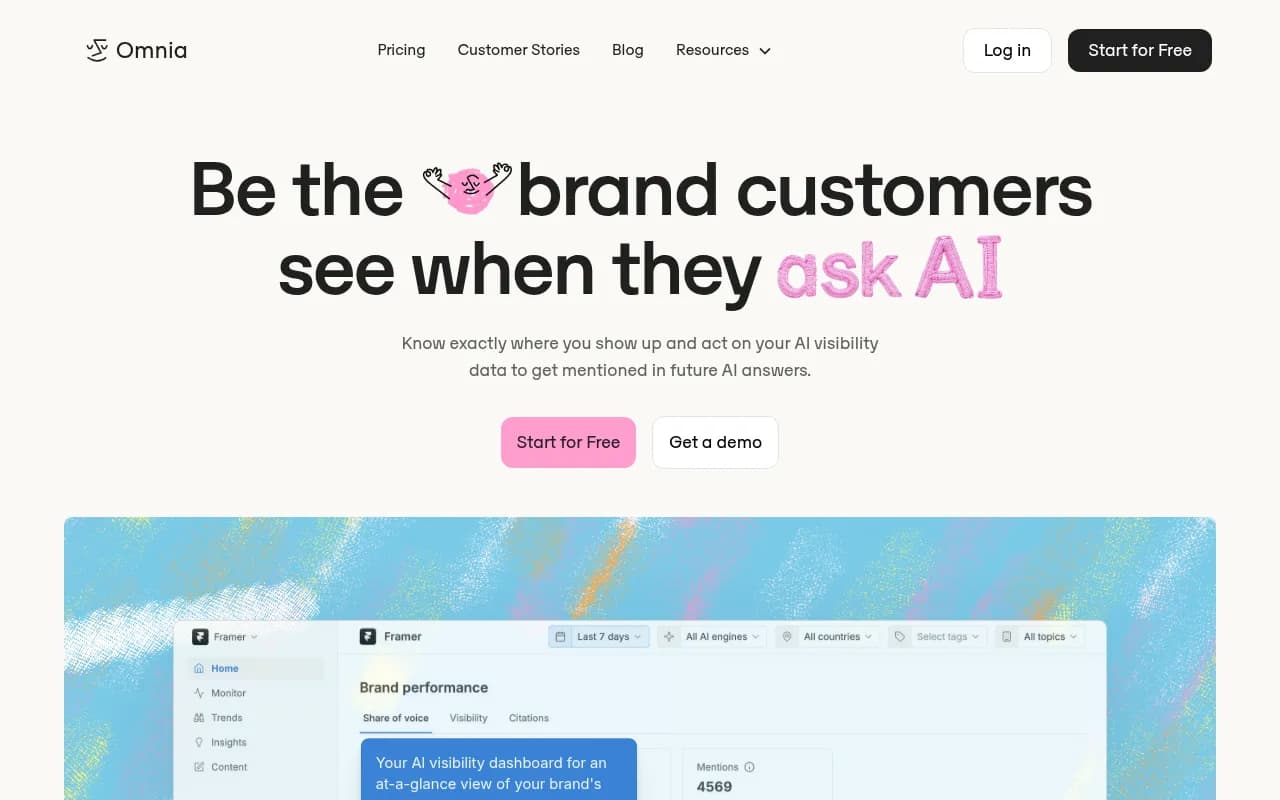
The interface is clean, and the reporting is solid. If you're a marketing team that needs to show stakeholders how your AI visibility compares to competitors over time, Omnia's dashboards are easy to work with. The platform covers multiple LLMs and gives you a clear picture of which prompts competitors are winning.
Where Omnia falls short for competitive intelligence is in the "so what?" layer. The platform shows you the data but doesn't help you act on it. There's no built-in content generation, no answer gap analysis that surfaces specific content opportunities, and no crawler log visibility. You'll know you're losing -- you just won't get much help figuring out how to stop.
That's not a knock on Omnia as a product. It's a monitoring tool, and it's a good one. But if your competitive intelligence goal is to actually close the gaps you find, you'll need to pair it with other tools.
Omnia is worth considering if your team is primarily focused on reporting and benchmarking, and you have a separate content workflow already in place. It's also a reasonable starting point if you're newer to AI visibility tracking and want something approachable before investing in a more complex platform.
Gauge: agency-focused with content execution built in
Gauge positions itself as the AI visibility tool built specifically for marketing agencies, and that focus shows in the product. The platform connects tracking, analysis, and content execution in a single workflow, which is a meaningful advantage for agencies managing multiple client accounts.
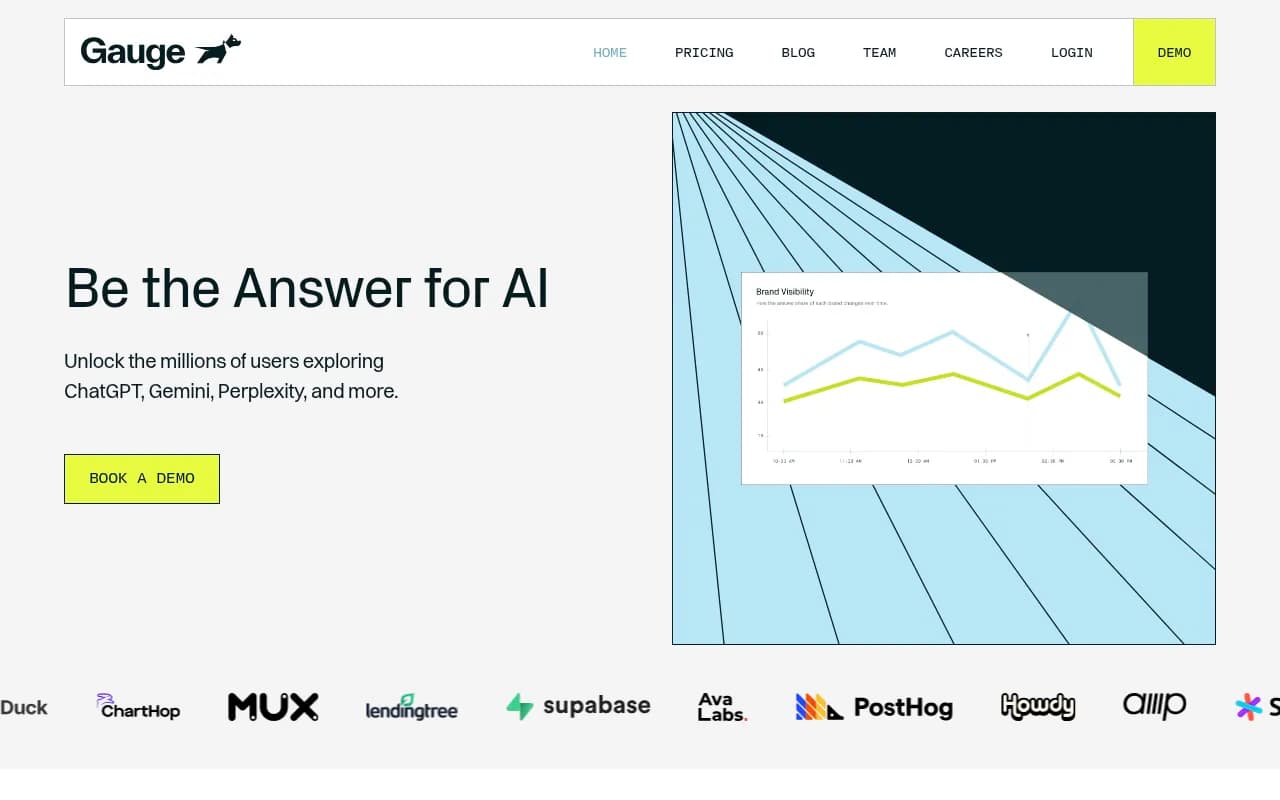
The competitive intelligence features include visibility tracking across AI models, competitor benchmarking, and gap analysis. The content execution side lets agencies move from identifying a gap to producing content without switching tools. For agencies that bill on deliverables, that tight loop has real operational value.
Where Gauge is more limited: the depth of competitive intelligence data doesn't quite match what Promptwatch offers. Prompt volume and difficulty scoring, AI crawler logs, Reddit/YouTube citation tracking, and ChatGPT Shopping monitoring aren't part of the picture. For an agency doing deep competitive analysis for a client, those gaps can matter.
Gauge is a solid choice for agencies that want a streamlined, client-ready workflow and don't need the most granular competitive data available. If you're running a lean agency operation and want one tool that handles both tracking and content production, it's worth evaluating.
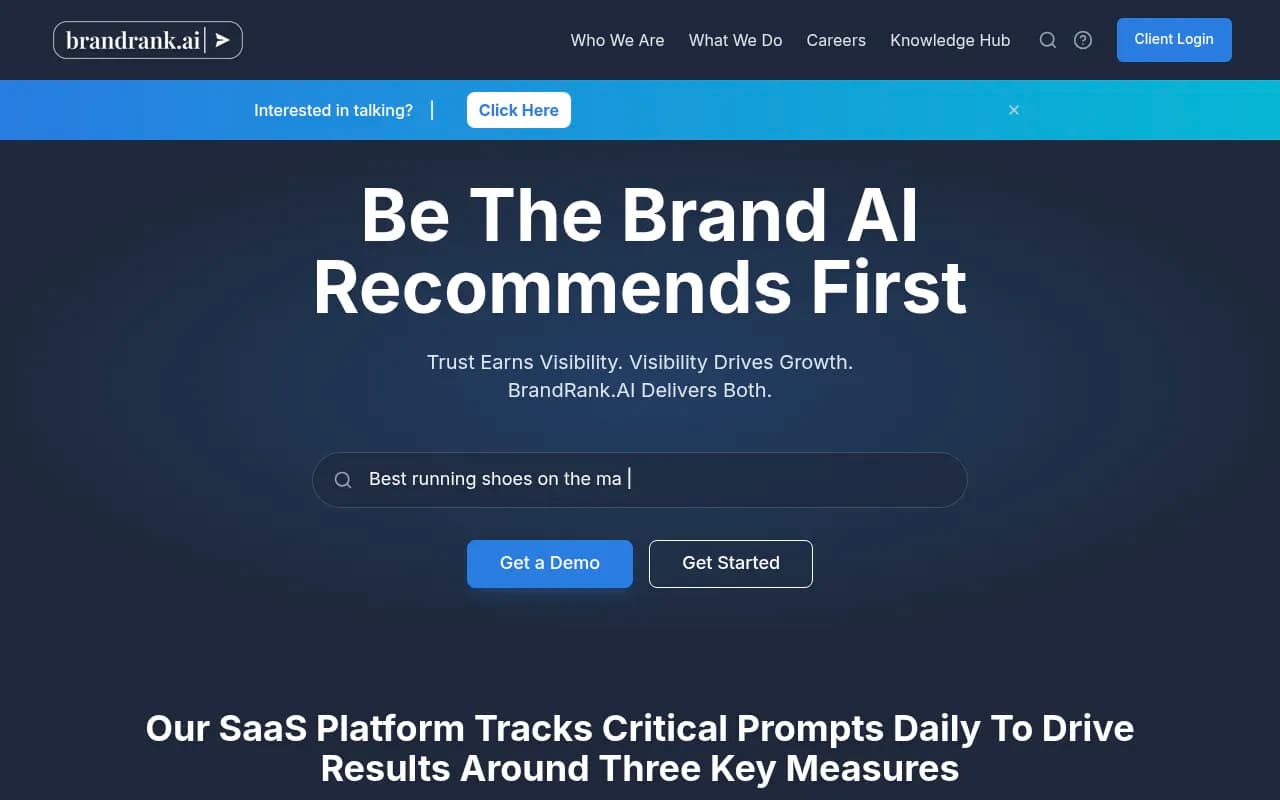
BrandRank.AI: brand sentiment and answer-engine focus
BrandRank.AI takes a slightly different angle than the other tools here. The platform is built around tracking how AI answer engines talk about your brand -- not just whether you appear, but how you're described, what sentiment is attached to your brand, and how that compares to competitors.
For brands where reputation is a primary concern -- think financial services, healthcare, or any category where negative AI-generated characterizations could do real damage -- BrandRank.AI's sentiment focus is genuinely useful. The platform surfaces how different AI models characterize your brand and flags when the narrative shifts.
The competitive intelligence angle is more limited than Promptwatch or even Gauge. BrandRank.AI is strong on the "how are we being talked about?" question but less equipped to answer "what content do we need to create to change that?" There's no built-in content generation, and the gap analysis capabilities are narrower.
It's a tool that fits well alongside a broader AI visibility stack rather than as a standalone competitive intelligence solution. If brand sentiment monitoring in AI responses is your primary concern, it's worth a look. If you need the full competitive picture -- gaps, content, attribution -- you'll want something more comprehensive.
How to choose between them
The honest answer is that these tools aren't really competing for the same buyer in every case. Here's a rough guide:
If you need the full competitive intelligence loop -- find gaps, create content, track results, attribute traffic -- Promptwatch is the clear choice. The combination of answer gap analysis, AI content generation grounded in citation data, crawler logs, and traffic attribution is unique in this market. No other tool here does all of that.
If you're primarily a reporting-focused team that needs clean share-of-voice dashboards and competitor benchmarks, Omnia is a solid option. It's a monitoring tool that does monitoring well.
If you're a marketing agency that wants a single tool covering both tracking and content execution for multiple clients, Gauge is worth evaluating. The agency-specific workflow design is a real advantage.
If brand sentiment and reputation monitoring in AI responses is your primary concern, BrandRank.AI has a specific strength there that the others don't match.
For most marketing and SEO teams, though, the question that matters most is: what happens after you see the data? If the answer is "we need to create content and track whether it works," then a monitoring-only tool will leave you frustrated. The gap between knowing you're invisible and actually fixing it is where most teams get stuck.
A note on the broader market
These four tools exist in a market that's moving fast. Zapier's roundup of AI visibility tools, published in late 2025, noted that the category had expanded to dozens of platforms in under two years. Most of them are monitoring dashboards.
The tools that will matter most in 2026 are the ones that help teams take action, not just collect data. That's the direction the market is moving, and it's the lens worth applying when you evaluate any platform in this space.
A few other tools worth knowing about as you explore this category:




Each has its own strengths, but the same question applies to all of them: does the tool help you close the gaps it finds, or does it just show them to you?
Bottom line
Competitive intelligence in AI search is genuinely new territory, and the tooling is still maturing. But the core problem is clear: AI models are making recommendations in your category every day, and either your brand is part of those recommendations or it isn't.
The tools that will help you most are the ones that go beyond showing you the problem and actually help you solve it. On that measure, Promptwatch leads this comparison by a meaningful margin -- not because the other tools are bad, but because they stop at a step that Promptwatch treats as the starting point.
Start with a free trial, run your answer gap analysis, and see what you're actually missing. The data tends to be more specific -- and more actionable -- than most teams expect.