Key takeaways
- Persona-based prompt tracking lets you simulate how different buyer types (roles, regions, intent stages) experience AI search results -- and all three platforms approach it differently.
- Promptwatch tracks prompts across 9 AI models on every plan starting at $99/mo, with customizable personas, crawler logs, and content generation built into the same workflow.
- Profound has strong persona and segmentation features, but comes at a higher price point and is more focused on enterprise teams.
- Peec AI is the simplest of the three -- solid for monitoring and reporting, but limited when it comes to acting on what you find.
- If your goal is to close the loop between "where am I invisible" and "what do I publish to fix it," Promptwatch is the only one of the three that handles both ends.
Persona-based prompt tracking sounds like a niche feature. It isn't. It's actually the difference between knowing your brand shows up in AI answers and knowing whether it shows up for the right people asking the right questions.
A CFO searching for "best AP automation software" gets a different AI response than a finance analyst searching the same thing. A buyer in Germany gets different citations than one in the US. A user asking Perplexity gets different results than one asking ChatGPT. If your tracking doesn't account for these differences, you're looking at an average that doesn't represent any real customer.
That's the problem persona-based prompt tracking solves. And it's where Peec AI, Promptwatch, and Profound diverge quite sharply.
This guide breaks down how each platform handles it -- and which one actually helps you do something with the data.
What persona-based prompt tracking actually means
Before comparing tools, it's worth being precise about what this feature involves. Persona-based prompt tracking means you can configure the context in which prompts are evaluated:
- Who is asking (job title, industry, buyer stage)
- Where they're asking from (country, region, city)
- Which AI model they're using (ChatGPT, Perplexity, Gemini, etc.)
- What device or interface they're on
Without this, you get a single visibility score that averages across all users and contexts. With it, you can see that your brand appears 65% of the time when a "marketing manager in the US" asks about your category on ChatGPT -- but only 18% when a "CMO in Germany" asks the same thing on Perplexity.
That's actionable. The average isn't.
Peec AI: clean monitoring, limited persona depth
Peec AI is a well-designed monitoring platform. Its interface is clean, onboarding is fast, and the core visibility metrics are easy to read. For teams that need to report on AI visibility without a lot of setup complexity, it's genuinely good.
On persona tracking specifically, Peec supports some customization -- you can configure queries and track visibility across different AI models. But the depth is limited compared to the other two platforms here.

A few things worth knowing:
- Peec's Starter and Pro plans limit you to 3 AI platforms. You only get full model coverage at Enterprise tier. That's a real constraint if you want to compare persona behavior across ChatGPT vs. Perplexity vs. Gemini simultaneously.
- Sentiment tracking exists but is reported as an overall score rather than broken down by persona, platform, or prompt type.
- There's no content gap analysis or content generation. Peec tells you where you stand -- it doesn't help you change it.
- No crawler logs. You can't see which AI agents are hitting your site, which pages they're reading, or why some content gets cited and some doesn't.
The Profound vs. Peec comparison on Profound's own site puts it plainly: "Peec AI tells you where you stand, while Profound tells you where you stand and gives you the tools to change it." That's a fair summary of the monitoring-only limitation.
For teams that just need clean reporting to share with stakeholders, Peec works well. For teams trying to optimize, it runs out of road quickly.
Profound: strong segmentation, enterprise pricing
Profound is one of the better-funded platforms in this space ($58.5M raised as of mid-2026) and it shows in the feature set. The platform has genuine depth on the monitoring side -- answer engine insights, prompt volume data, agent analytics, and shopping tracking are all present.
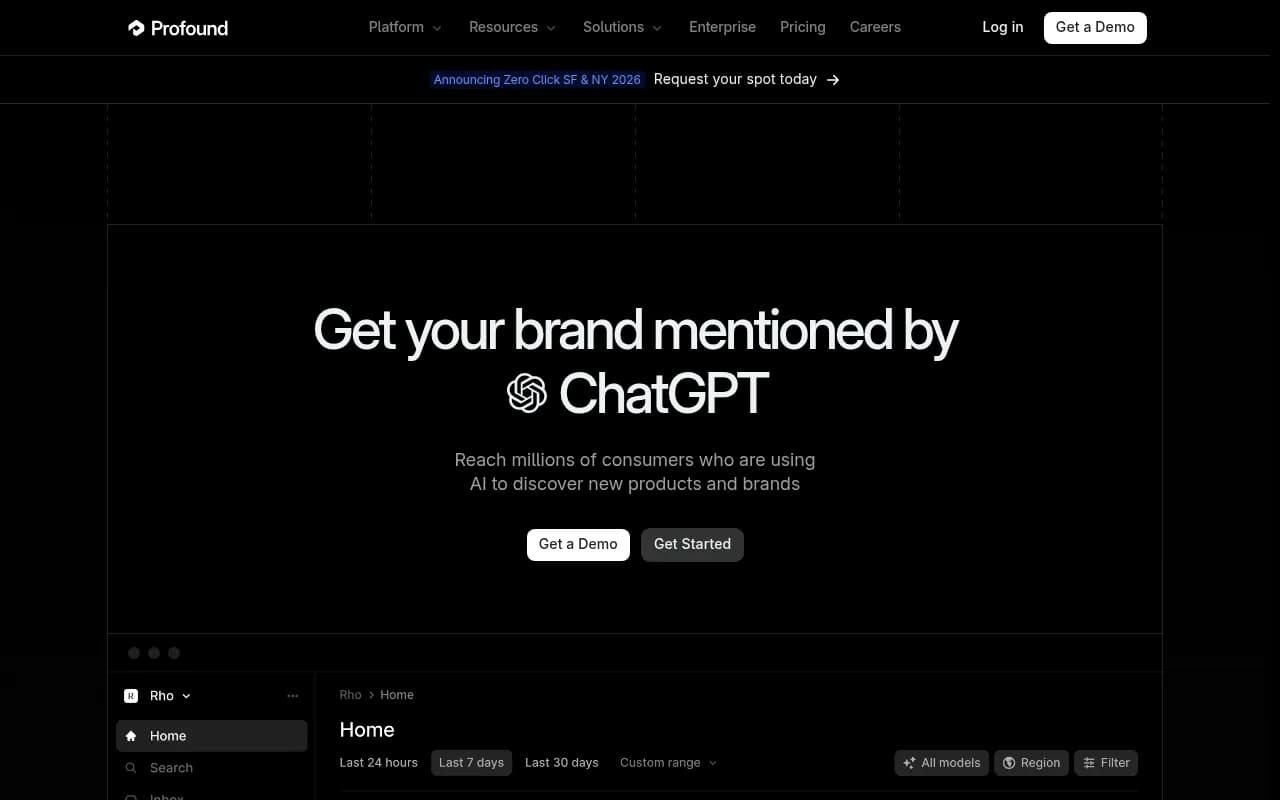
On persona-based tracking, Profound is solid. You can segment visibility by buyer type, region, and model, and the platform surfaces meaningful differences across those segments. It's built for teams that want to understand why their visibility looks the way it does, not just what the numbers are.
Where Profound gets complicated:
- Pricing is higher than both Peec and Promptwatch. The entry plan is more expensive and limits you to ChatGPT-only monitoring without multi-platform coverage, which is an odd restriction for a platform at this price point.
- The platform is clearly built for larger marketing and content teams. If you're a smaller brand or agency managing multiple clients, the cost-to-value ratio gets harder to justify.
- Content generation exists through Profound's "Agents" feature, but the workflow between monitoring insights and content output is less integrated than Promptwatch's approach.
Profound is a genuinely capable platform. If you're an enterprise team with budget and a dedicated AEO function, it's worth evaluating seriously. But for mid-market teams or agencies, the price point and complexity can be friction.
Promptwatch: persona tracking built into the optimization loop
Promptwatch approaches persona-based tracking differently from the other two. It's not just a configuration option -- it's woven into how the platform is designed to work.

Here's what that looks like in practice. When you set up prompt tracking in Promptwatch, you define the persona context: who's asking, from where, on which model. The platform then tracks your visibility for that specific combination across all 9 AI models it monitors (ChatGPT, Perplexity, Google AI Overviews, Google AI Mode, Claude, Gemini, Meta/Llama, DeepSeek, Grok, Mistral, Copilot).
That multi-model coverage is available on every plan, starting at $99/mo. You're not waiting for an Enterprise tier to see how your brand performs across different AI surfaces.
What makes the persona tracking genuinely useful is what happens next. Promptwatch's Answer Gap Analysis shows you exactly which prompts competitors are visible for in your target persona's context -- but you're not. You see the specific content gap, not just the visibility gap. Then Content Agents can generate articles, comparisons, or briefs built around those specific gaps, grounded in real prompt data, citation analysis, and competitor research.
So the workflow is:
- Set up a persona (e.g., "Head of Procurement, US, ChatGPT")
- Track which prompts that persona triggers
- See where competitors appear but you don't
- Generate content targeting those specific gaps
- Watch your visibility improve as AI models start citing the new content
Most platforms stop at step 2. Promptwatch runs through step 5.
A few other things that matter for persona-based work:
- State and city-level tracking is available from the Professional plan ($249/mo), which matters if your buyers are geographically concentrated
- Crawler logs show which AI agents are reading your site and which pages they return to -- useful for understanding why certain content gets cited for certain persona queries
- Sentiment is tracked by platform and prompt type, not just as an aggregate score
- Reddit and YouTube insights surface discussions that influence AI recommendations for specific personas -- a channel most competitors ignore
Head-to-head comparison
| Feature | Peec AI | Profound | Promptwatch |
|---|---|---|---|
| AI models tracked | 3 (Starter/Pro), all (Enterprise) | Multiple (varies by plan) | 9 (all plans) |
| Persona customization | Basic | Strong | Strong |
| Regional/city tracking | Limited | Yes | Yes (Professional+) |
| Sentiment by persona/platform | Aggregate only | Yes | Yes |
| Content gap analysis | No | Limited | Yes |
| Content generation | No | Yes (Agents) | Yes (Content Agents) |
| Crawler logs | No | Yes (Agent Analytics) | Yes (Professional+) |
| Reddit/YouTube insights | No | No | Yes |
| ChatGPT Shopping tracking | No | Yes | Yes |
| Entry price | ~$95/mo | Higher (demo required) | $99/mo |
| Best for | Monitoring and reporting | Enterprise AEO teams | Teams optimizing AI visibility |
Which platform should you use?
The honest answer depends on what you're actually trying to do.
If you need clean, simple AI visibility reporting to share with leadership or clients, and you don't need to act on the data yourself, Peec AI does that job well. The interface is straightforward, onboarding is fast, and the core metrics are easy to communicate.
If you're an enterprise marketing team with a dedicated AEO function and budget to match, Profound is worth a serious look. The segmentation and monitoring depth are real, and the platform is built for teams that treat AI search as a strategic priority.
If you want to track persona-based visibility and actually do something about the gaps you find, Promptwatch is the only one of the three that closes the loop. The combination of persona-level tracking across 9 models, answer gap analysis, content generation, and crawler logs in a single workflow -- starting at $99/mo -- is hard to match.
The Reddit thread on r/GrowthHacking comparing these three platforms captures the practical reality: teams that tried Profound found it capable but expensive; Peec was praised for simplicity but hit a wall when it came to optimization; Promptwatch was the one people stuck with when they needed to actually move their visibility numbers.
That tracks with how the platforms are designed. Monitoring tells you what's happening. Optimization changes it. Only one of these three is built to do both.
A note on prompt volume and difficulty scoring
One underrated aspect of persona-based tracking is prompt prioritization. Not every prompt your target persona asks is worth chasing. Some have high volume but brutal competition; others are winnable with a single well-targeted piece of content.
Promptwatch includes prompt volume estimates and difficulty scores for each tracked prompt, plus query fan-outs that show how one prompt branches into sub-queries. That lets you prioritize which persona-prompt combinations to go after first -- instead of treating all gaps as equally important.
Profound has prompt volume data as well. Peec's prompt-level metrics are thinner, which makes prioritization harder.
If you're managing a content calendar around AI visibility, this matters a lot. Writing content for a high-volume, low-difficulty prompt in your target persona's context is a very different decision than writing for a low-volume, high-competition one.
Bottom line
Persona-based prompt tracking is only as useful as what you do with it. All three platforms let you configure some version of persona context. The difference is what happens after you see the data.
Peec AI stops at the data. Profound goes further but costs more and is built for larger teams. Promptwatch connects the data to content creation and tracks the results -- in a single platform, at a price point that works for mid-market teams and agencies.
If you're evaluating these platforms, start with what you actually need to accomplish. If the answer is "understand and improve our AI visibility for specific buyer personas," that narrows the field considerably.