Key takeaways
- A page-level tracker answers a narrower question than a prompt tracker: for this one URL, which prompts cite it, and how often?
- Watching a competitor's page shows you the prompts where they win and you don't, which is a ready-made content brief.
- Page type matters. Per Promptwatch Data, landing pages, docs and comparisons stay cited for months, while news pages fade in weeks.
- Prompts cite pages through short fan-out queries, not the user's full question, so read the matched prompts with that in mind.
- Page-change monitors and AI citation trackers do different jobs. You probably want both, but don't confuse them.
What a page tracker actually does
Most AI visibility tools start from prompts. You enter a list of questions, the tool runs them daily across ChatGPT, Perplexity, Google AI Overviews and others, and you see whether your brand showed up. That is useful, but it is prompt-first.
A page tracker flips it around. You paste in a URL and the tool tells you which tracked prompts cited that URL, on which models, and how that has moved over time. It is URL-first.
The flip matters because competitor research rarely starts with a prompt. It starts with a thought like "their comparison page keeps beating ours, why?" or "what is that pricing page getting cited for?" A page tracker answers that directly.
Promptwatch has this as its Page Tracker: watch any URL, yours or a competitor's, and see the prompts that cite it. I couldn't find a standalone public doc page for it while researching this guide, so check Promptwatch's own product documentation for the current setup steps. The concept and the workflow below apply either way.

Page tracking vs prompt tracking vs page-change monitoring
Three different things get called "tracking" and they are easy to mix up.
| Type | Question it answers | Example tools |
|---|---|---|
| Prompt tracking | Is my brand mentioned for this prompt? | Promptwatch, Otterly.AI, Peec AI, Profound |
| Page tracking | Which prompts cite this specific URL? | Promptwatch Page Tracker, Semrush "Pages" view |
| Page-change monitoring | Did this URL's content change? | PageCrawl.io, Visualping |
PageCrawl.io is a classic change monitor. You paste a competitor URL such as a pricing page or blog and it notifies you when something on the page changes. It knows nothing about AI citations. A citation-focused page tracker knows nothing about what text changed. They complement each other.
Why watch a competitor URL at all
Citations are scarce. According to Otterly's guide to tracking AI citations, LLMs typically cite only 2 to 7 sources per response. Promptwatch Data on unique domains per ChatGPT response shows almost half of responses cite 10 or more domains (Sep 28 to Oct 4, 2026), so the number varies by prompt type, but each slot is still contested.
When a competitor URL holds one of those slots across dozens of prompts, that is a concrete asset you can study. You can see its format, structure, headings and claims, and ask why the model preferred it.
Three situations where this pays off:
- You lose a prompt you expected to win and want to know which page took your place.
- You are planning content and want to see which competitor pages already own the topic.
- You are auditing a competitor's strategy to see which page types drive their AI visibility.
How the matching works, and why it surprises people
Here is the part most people get wrong. You might assume a page is cited because it answers the user's prompt. Often it is cited because it answers a query the model generated itself.
Promptwatch Data on ChatGPT query fanouts shows average fanout queries per response of 2.15 in early December 2025 and about 1.84 by early March 2026. Average query length dropped from about 117 characters in early December to the high 80s in February and March, then to around 53 characters from April. Those are short, keyword-like searches, not the full question a user typed.
So when your page tracker lists the prompts citing a competitor URL, remember that the page may have matched a fanout like "crm for small business pricing" rather than the long prompt. Promptwatch's own advice from that report is that content has to match one of the generated queries, not the user's prompt, with headings that read like search queries and the entity and category up front.
Also worth knowing: ChatGPT changed behavior again on August 8, 2026, when it started using the site: operator at scale. Promptwatch Data shows site: queries jumping from about 0.4% to about 17% of fanouts overnight. That means a model may be searching inside a specific domain, which favors pages on sites it already trusts for a topic.
A step-by-step workflow
Step 1: Pick the right competitor URLs
Don't watch homepages. Watch the pages that win citations. Good candidates:
- Comparison and alternatives pages
- Pricing pages (Promptwatch classifies these as landing or product pages)
- Docs and help center articles
- Listicles where they rank themselves first
- Original research or data pages
If you don't know which URLs to pick, start with whichever competitor URLs already show up in the sources of your tracked prompts.
Step 2: Make sure your prompt set is representative
A page tracker can only report on prompts it is tracking. If your monitor has 20 prompts, the competitor page will look like it has 20 prompts' worth of reach at most. Add prompts from search console data, People Also Ask, and the long-tail questions your sales team hears. SE Ranking's guide on choosing prompts makes a similar point: tracked prompts determine what the citation data can show you.
Step 3: Read the matched prompts as a cluster
Don't read prompts one at a time. Group them. Ten prompts that all cite the same competitor page usually share one intent, and that intent is your content gap. If those prompts also cite a different page from your site, you have a coverage problem. If they cite nothing of yours, you have a missing page.
Step 4: Check the page type and its half-life
This step changes what you do next. Promptwatch Data on the half-life of content in ChatGPT tracked every page ChatGPT cited on July 6, 2026 through early October. The findings:
| Content type | Still cited after 30 days | Still cited after 60 days | Notes |
|---|---|---|---|
| Landing pages | 78% | 69% | Likely half-life beyond 90 days |
| Docs | 76% | 67% | 93% were cited again later |
| Comparisons | 72% | 63% | Durable |
| Listicles | n/a | 60% | |
| Product pages, reviews, how-tos | n/a | about 55% | Half-life 74 to 77 days |
| News | n/a | 41% | Half gone after 36 days |
The takeaway for competitor watching is simple. A rival's landing, docs and comparison pages are durable citation assets, worth studying and worth beating. Their news and press pages are short bursts. Don't spend a week reverse-engineering a press release.
One caveat from the report: landing pages, docs, comparisons and listicles only cross 50% in the last week of the window because the window ends. Their real half-life is probably longer than 90 days.
Step 5: Compare the page against yours
Open the competitor URL next to your closest equivalent and look at:
- How the headings read. Do they look like search queries?
- Whether they state the entity and category in the first lines
- Original data, tables or specifics you don't have
- Freshness, meaning last updated date and recent facts
- Whether the page is even crawlable and fast
Promptwatch's content-type data shows product pages are the most cited type at 22.4% of ChatGPT citations (Sep 28 to Oct 4, 2026), followed by landing pages and listicles. If the competitor page is a product page and yours is a blog post, the format may be the gap, not the writing.
Step 6: Act, then track your own page
Add your replacement or updated page to the tracker as well. Watch whether it picks up the same prompts over the next few weeks. Promptwatch's Content Refresh and content gap analysis are designed around this loop, and its crawler logs show whether AI bots actually fetched your new page. Without that last check you are guessing.
What the data cannot tell you
Be honest about the limits.
- Citation is not traffic. A page can be cited constantly and send few clicks. Pair page data with visitor analytics.
- Models differ. Searchable reports that of 80,525 prompt-and-domain pairs cited by AI Overviews, only 25.2% were also cited by ChatGPT. Profound claims about 12% overlap between ChatGPT and Google, but that is vendor data from a company that sells these tools. Either way, don't generalize from one model.
- Citations shift fast. The ChatGPT citation behavior changed noticeably around GPT-5.3 on March 4, 2026, per Promptwatch's citation drop report. A page that drops out may reflect a model change, not your content.
- Your prompt set biases everything you see.
Who offers page-level citation views
Page-level views are showing up across the category. I have not verified current pricing on vendor sites, and the prices below come from a June 2026 roundup written by someone who works at Profound, so treat the ranking as biased and confirm on each pricing page.
| Tool | Page-level view | Notes |
|---|---|---|
| Promptwatch | Page Tracker for any URL, yours or a competitor's | Also has crawler logs, content gap analysis, Content Agent |
| Semrush | "Pages" view lists the most-cited URLs across tracked prompts | Part of a broader SEO suite |
| SE Ranking | Sources tab lists domains and pages AI cites, sortable by Domain Trust | 14-day free trial; covers AI Overviews, AI Mode, Gemini, ChatGPT, Perplexity |
| Otterly.AI | Citation source tracking and competitive benchmarking | Listed from $29/mo in the June 2026 roundup |
| Profound | Citation and prompt-level visibility | Listed from $99/mo |
| Peec AI | Source and citation reporting | Listed from EUR 89/mo |




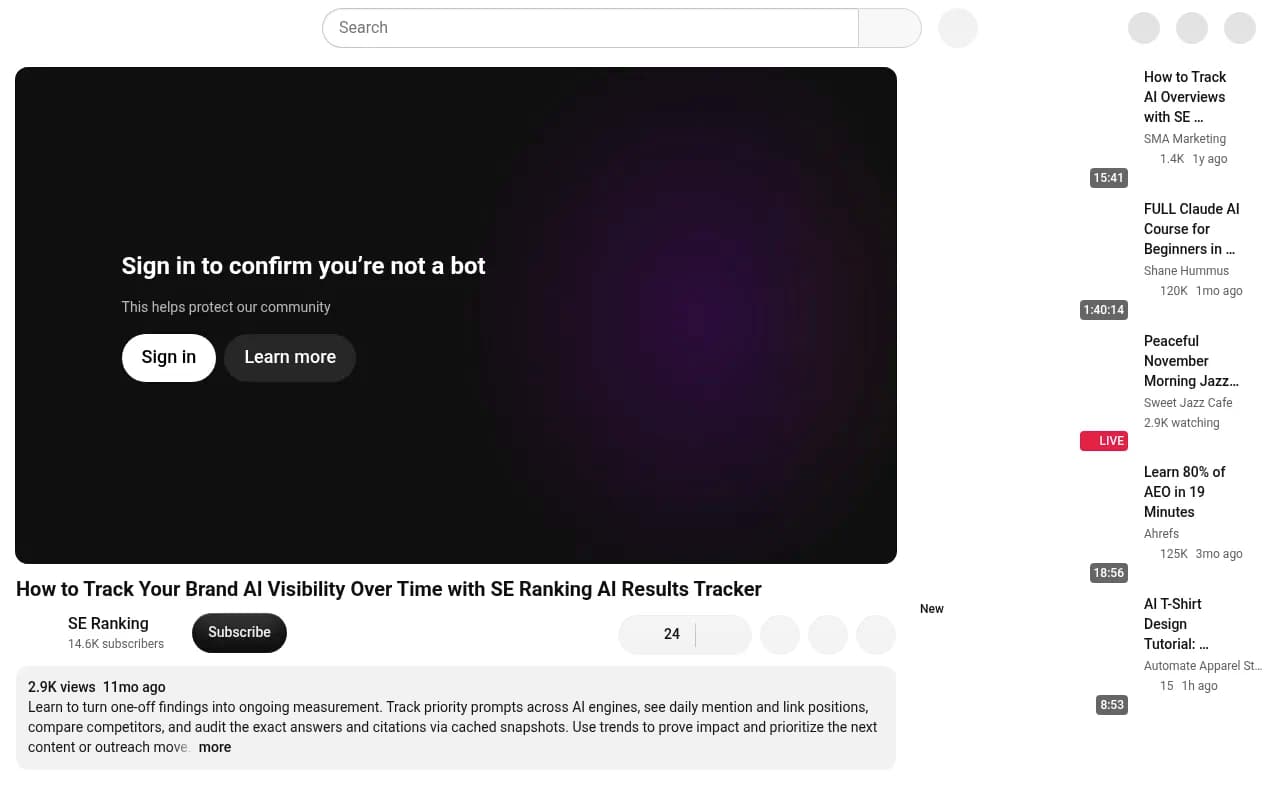
The SE Ranking tool is organized into Rankings, Competitors and Sources subtabs and keeps cached snapshots of the exact answers and citations, which helps when you need to audit why a page was cited.
Otterly's guide is also worth reading for the distinction between brand mentions (no link) and citations (linked), because a page tracker only sees the second kind.
If you are comparing options more broadly, the GEO software directory at bestgeosoftware.com lists many more platforms.
Pairing it with a change monitor
Citation tracking tells you that a competitor page is winning. It doesn't tell you the page was rewritten last Tuesday. A cheap change monitor like PageCrawl.io or Visualping (listed at $14/mo in the June 2026 roundup) fills that gap. When a tracked competitor page suddenly gains prompts, check whether it changed. If so, you have found a tactic worth copying. If not, the model changed, and you should look at the wider data instead.
A simple weekly routine
- Monday: review which competitor URLs gained or lost prompts.
- Check the page type and age of anything that moved sharply.
- Pick one durable page type (landing, docs, comparison) where a competitor is ahead and write or refresh your version.
- Add the new URL to your own tracking and check crawler logs after a few days.
- Repeat. Leave news pages alone unless you are newsjacking.
Bottom line
A page tracker turns competitor research from guesswork into a list. Pick five competitor URLs that are durable page types, read the prompts that cite them as clusters, and build or refresh the page you are missing. Then watch your own URL the same way. For broader context on what AI engines cite, the Promptwatch Data hub has the underlying research.