Key takeaways
- Total marketing budgets average 7.8% of revenue in Gartner's 2026 CMO Spend Survey (401 leaders), basically flat for four years. AI spend comes out of the same pot.
- CMOs put 15.3% of marketing budget toward AI initiatives, and the most AI-ready organizations put 21.3%. That number covers all AI work, not AI visibility or GEO specifically.
- There is no rigorous survey of GEO spend by company size. The best numbers are agency estimates, such as Evergreen Media's range of roughly EUR 30k a year for small firms up to EUR 3-8M for corporations.
- Software is the cheap part. Tracking tools run from about $10 a month to a few hundred, while the real cost is content, technical fixes and the people who act on the data.
- A sensible starting point is to carve 5-15% of your existing SEO and content budget for AI visibility, then expand only when AI-referred traffic shows up in your analytics.
Why this benchmark is hard to pin down
I went looking for a clean table of what companies spend on AI visibility, sorted by size. It does not exist. What exists is a mix of three different things that get conflated constantly:
- Total marketing spend as a percentage of revenue (solid survey data).
- Spend on AI in general, covering content generation, personalization, analytics and more (decent survey data).
- Spend on AI visibility or GEO specifically (mostly agency estimates).
Most articles blur these together. The figure that gets quoted most, 15.3% of marketing budget going to AI, tells you almost nothing about how much to spend on getting cited in ChatGPT or Google AI Overviews. Keep the three layers separate and the numbers start to make sense.
Layer one: total marketing budgets by company size
Start with the envelope everything else fits inside. Gartner's 2026 CMO Spend Survey puts the average at 7.8% of revenue, up a tenth of a point from 7.7% in 2025. Some write-ups still quote 7.7%, which is last year's number. B2B product companies sit at 7.0%, B2B services at 10.1%, and B2C product companies at 12.0%.
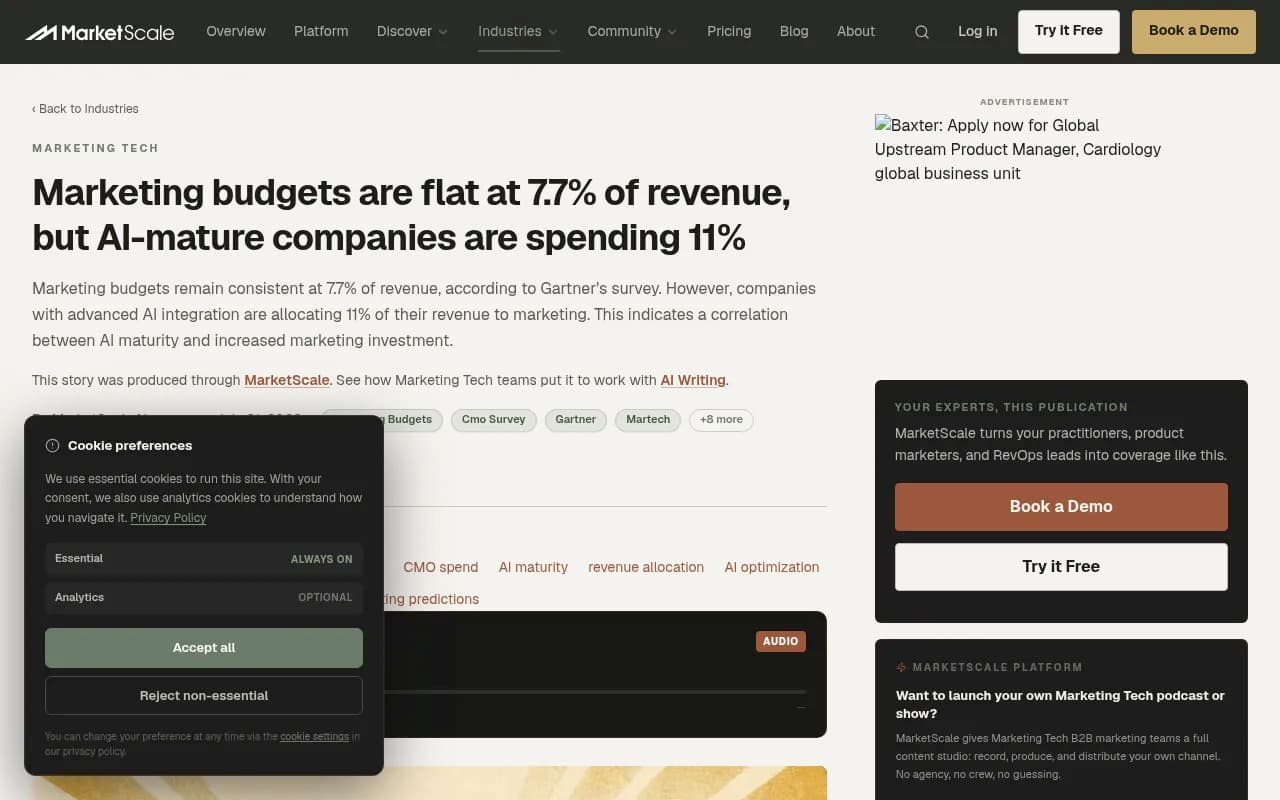
The more interesting finding: Gartner's "AI strategists," meaning firms with fully optimized internal AI processes, spend about 11% of revenue on marketing. On a $500 million revenue base, MarketScale notes that gap is the difference between roughly a $39 million and a $55 million budget. Correlation, not proof that AI causes bigger budgets, but it points the same way.
By company size, a B2B synthesis from GreyMatter looks like this:
| Annual revenue | Typical marketing spend | Example midpoint budget |
|---|---|---|
| Under $10M | 10% to 15% | $1.25M on $10M |
| $10M to $50M | 7% to 12% | $1.9M on $20M |
| $50M to $250M | 6% to 10% | $12M on $150M |
| Over $250M | 3% to 6% | $18M on $400M |
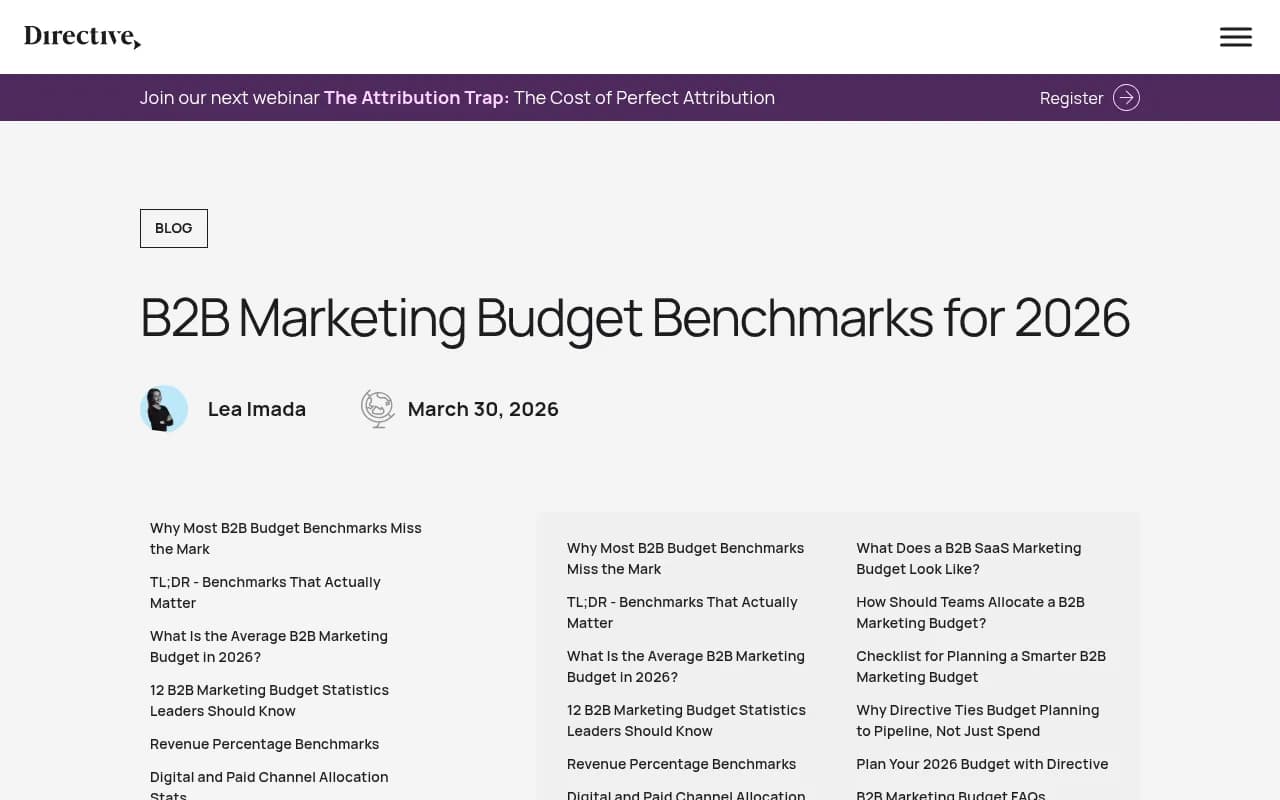
Directive Consulting publishes a similar ladder, with startups at 15% to 30%+ of ARR and enterprises at 5% to 8%. The exact ranges differ by source, but the shape is consistent: smaller companies spend a bigger share, larger ones spend more dollars.
Industry matters as much as size. Boomcycle's synthesis has consumer packaged goods near 18% of revenue and energy near 3%, with tech and software at 11% to 15%.
Layer two: what goes to AI in general
Gartner's survey says CMOs allocate 15.3% of marketing budget to AI initiatives, rising to 21.3% for the most AI-ready organizations. Only 30% say their organization is ready to scale AI capabilities. So a lot of money is going into AI before teams know what to do with it.
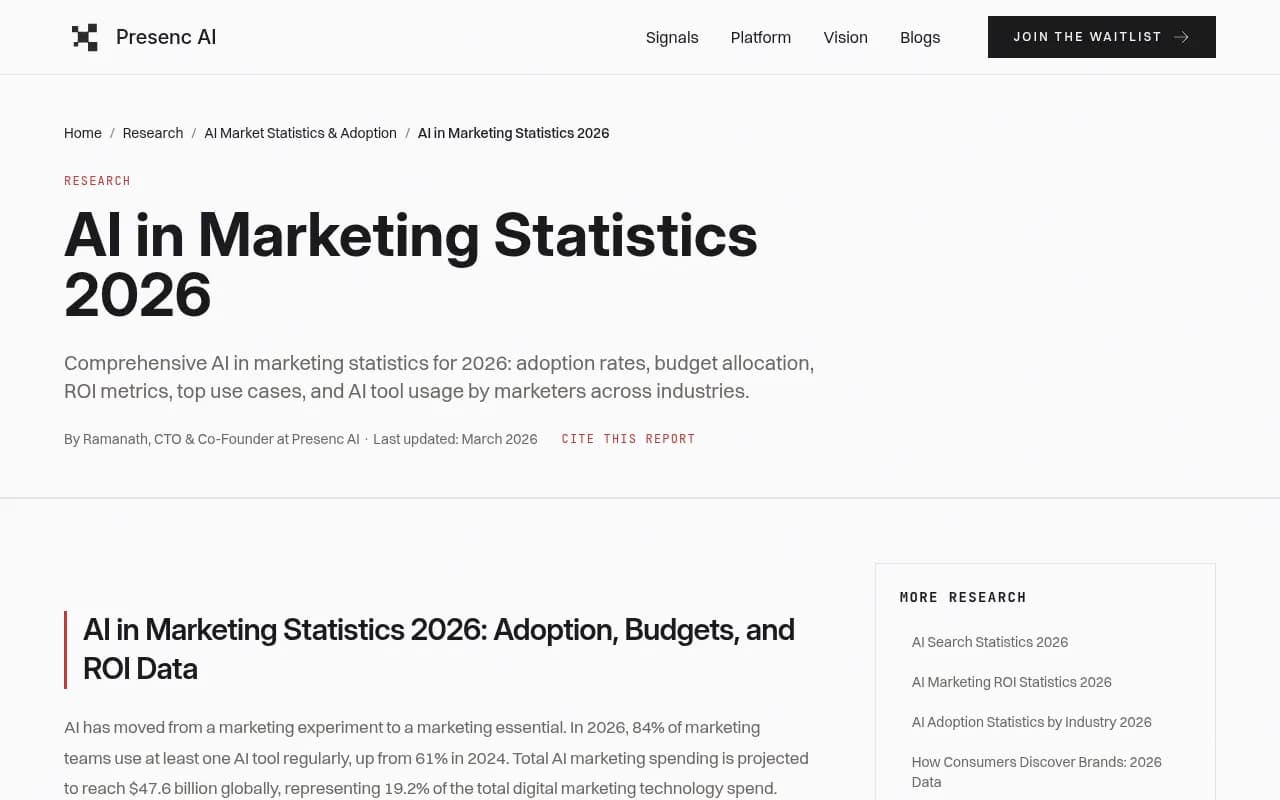
Presenc AI's compilation (a vendor source, so treat it as directional) reports a slightly different average of 14.8%, and splits it by size: 18.4% for enterprises above $500M revenue versus 9.6% for SMBs under $10M. It also reports that 84% of marketing teams use at least one AI tool regularly, and that AI visibility monitoring was the fastest-growing AI marketing category, from 4% of teams in 2024 to 41% in 2026.
What does 15.3% mean in dollars? A mid-market B2B company with $50M revenue spending 8% on marketing has a $4M budget. Fifteen percent of that is $600k for all AI work. Most of it goes to content production, analytics and automation. Visibility is a slice of that slice.
Layer three: dedicated AI visibility and GEO spend
This is where the data thins out. I'd treat everything below as agency estimates, not survey results.
Evergreen Media's annual budget ranges
Evergreen Media publishes annual GEO/SEO budgets that exclude internal personnel costs:
| Annual revenue | Annual GEO/SEO budget |
|---|---|
| Under EUR 5M | EUR 30k to 100k |
| EUR 5M to 10M | EUR 100k to 200k |
| EUR 10M to 25M | EUR 200k to 400k |
| EUR 25M to 100M | EUR 400k to 1M |
| EUR 100M to 500M | EUR 1M to 3M |
| Over EUR 500M | EUR 3M to 8M |
Note this is GEO and SEO together, and one agency's view of reasonable. Evergreen itself stresses that how you distribute the money matters more than the total. I agree. A EUR 200k budget wasted on thin content beats nothing, but not by much.
WebFX's three pricing models
WebFX describes three ways companies buy GEO:
| Model | Typical monthly cost |
|---|---|
| Software only | $10 to $1,000+ |
| Service with software included | $1,500 to $50,000+ |
| Service plus separate software | Service fee plus $50 to $1,000+ for software |
WebFX also cites Similarweb for the claim that U.S. enterprises put an average of 12% of digital marketing budgets toward GEO. I could not verify the underlying study, so use it as a rough anchor, not a target.
Adoption is ahead of spend
Secondary sources compiled by Omnibound suggest 92% of marketers plan to optimize for AI search, but only 40.6% are implementing GEO, and about 23% invest in GEO measurement. Intent is high and budgets are still catching up. That gap is why benchmarks are so fuzzy: many companies are paying for AI visibility out of existing SEO or content lines without a dedicated code.
A practical budget by company size
Here is how I would translate the above into something usable. These are my planning heuristics built on the sources, not published benchmarks.
| Company profile | Suggested AI visibility budget | Where it should go |
|---|---|---|
| Startup or small business (under $10M) | $1k to $8k per month | One tracking tool, 2 to 4 pieces of content a month, technical fixes |
| Mid-market ($10M to $100M) | $8k to $35k per month | Tracking plus content production, schema and crawl fixes, part of a specialist's time |
| Enterprise ($100M+) | $35k to $300k+ per month | Platform contract, dedicated team or agency, multi-region and multi-model coverage |
The small-business row lines up with Evergreen's EUR 30k to 100k a year. The mid-market row sits in the middle of Evergreen's EUR 100k to 1M span. Enterprise spend is wide because scope varies so much: a company tracking 10 markets in 8 languages is a different animal from one tracking a single product line.
How to split it
WebFX's category list is a useful checklist: visibility tracking, content optimization, technical improvements (schema, crawlability), competitor monitoring, reporting and internal execution time. A reasonable starting split:
- Content creation and refresh: 45% to 55%
- Technical work and site fixes: 10% to 15%
- Tracking and analytics software: 10% to 20%
- Reporting, competitor monitoring and other: 5% to 10%
- Internal or agency time to act on findings: whatever is left
The pitfall WebFX flags is real: a software-only budget with nobody to act on the insights is money spent on a dashboard. I've seen teams buy tracking in January and still have no content changes in June.
What the software costs
Tools in this category range from budget trackers to enterprise platforms. I didn't pull full price lists for every vendor, so check each pricing page before committing.
For teams that want monitoring plus action, Promptwatch is the one I'd start with. Plans run from a free tier (10 prompts, ChatGPT only) to Essential at $95 a month, Professional at $245, and Business at $579, with agency plans from $199. It goes past tracking: crawler logs, AI-referred traffic analytics, content gap analysis and a Content Agent that publishes to your CMS, so the spend ties back to pages and visits. Confirm current pricing at promptwatch.com/pricing.

Other tools worth pricing out:
Otterly.AI and Peec AI sit at the affordable monitoring end.


Profound targets larger brands with deeper monitoring and higher price points.

If you already pay for an SEO suite, Semrush and Ahrefs Brand Radar add AI tracking to what you have.

For a wider scan of the category, the GEO software directory at bestgeosoftware.com lists many more options, and ai-rank-tools.com focuses on AI rank trackers.
| Budget tier | Software cost | Typical choice |
|---|---|---|
| Testing | Free to ~$100/month | Free tiers, Otterly.AI, Peec AI, Promptwatch Essential |
| Growing team | $245 to $600/month | Promptwatch Professional or Business |
| Agency or multi-brand | $200 to $800/month | Agency plans with multiple projects |
| Enterprise | Custom | Platform contracts with SSO, audit logs, managed services |
Prompt volume affects cost more than you'd think
Promptwatch's data on average sources per response (published September 2025, so treat the numbers as approximate) shows ChatGPT citing about 5 sources per web-search answer, while Google AI Overviews and Perplexity cite about 10. Fewer slots means each ChatGPT citation is more contested. AI Overviews is the more forgiving place for mid-authority sites to start, and Perplexity's steady count makes it a stable place to test changes. For budgeting, that suggests weighting early effort toward the surfaces where you have a realistic shot, not spreading evenly across every model.
The wider citation picture is shifting too. Promptwatch Data shows that for ChatGPT, product pages are the most cited content type at 22.4% of citations (Sep 28 to Oct 4, 2026), and that landing pages and docs stay cited longest while news loses half its pages within 36 days. That matters for budget: evergreen pages repay investment, while news-style content needs constant refreshing and costs more over time. For more, see the Promptwatch Data hub.
Justifying the spend: measure revenue, not mentions
Budget approvals get easier when you can point to traffic and revenue. A few data points help, with caveats:
- WebFX reports GenAI visitors converted about 1.2x higher than organic search visitors in 2025, based on 2.3B sessions.
- Adobe reported AI referral traffic up 693% year over year during the 2025 holiday season, converting 31% better than non-AI traffic.
- Older figures, such as the Seer Interactive comparison of ChatGPT referrals at 15.9% conversion versus 1.76% for Google organic, date from June 2025 and may be stale.
Industry numbers are a starting argument. Your own analytics are the proof. Tag AI referrals, track conversions, and report leads from AI traffic alongside mention counts. If you can't connect spend to pipeline within two quarters, cut scope.
Mistakes that waste AI visibility budgets
- Treating the 15.3% AI figure as a GEO benchmark. It covers all AI initiatives.
- Buying software with no one assigned to act on it.
- Tracking hundreds of prompts before fixing the content you already have.
- Ignoring crawler access. If AI bots can't read your pages, no content spend will help.
- Spreading effort evenly across every AI model instead of prioritizing where your buyers actually search.
- Chasing consistency that doesn't exist. AirOps reports brand visibility stays consistent across AI sessions only 30% of the time, so judge trends over weeks, not single runs.
Building your own number in five steps
- Start with total marketing budget: revenue times your category rate (roughly 7% to 12% for most B2B).
- Identify your current SEO and content lines. AI visibility will mostly overlap with these.
- Carve out 5% to 15% for AI visibility work as a pilot, which sits near the 12% WebFX figure.
- Split it using the category list above, weighting content and technical fixes over software.
- Review after 90 days. Expand if AI-referred sessions and conversions are growing, hold if not.
If you'd rather hand it off, an agency can run the whole thing. 1001 SEO Media is one option that covers GEO alongside technical SEO and content.
The bottom line
The honest benchmark is a range with a lot of uncertainty. Total marketing spend averages 7.8% of revenue. AI initiatives take about 15.3% of that. A dedicated AI visibility line is commonly somewhere between 5% and 15% of the search and content budget, or roughly EUR 30k a year for small companies up to several million for global enterprises, per one agency's estimates. Start small, tie spend to AI-referred revenue, and let your own data tell you when to scale.