Key takeaways
- Searchable is a monitoring-focused AI visibility platform -- useful for tracking brand mentions across LLMs, but limited when it comes to acting on what you find.
- The ROI case for any AI visibility tool in 2026 depends heavily on whether it helps you close gaps, not just identify them.
- Only 21% of marketers can accurately measure content ROI, which makes choosing the right tool even more consequential.
- Compared to more complete platforms, Searchable lacks content generation, crawler log analysis, and deep prompt intelligence -- capabilities that directly drive measurable outcomes.
- If your team needs to move from "we know we're invisible" to "we fixed it," you'll likely outgrow Searchable quickly.
AI search is no longer a future trend you can safely ignore. ChatGPT, Perplexity, Gemini, and Claude are actively routing purchase decisions, vendor comparisons, and product recommendations -- and most marketing teams have no idea whether their brand shows up in those answers or not.
That's the gap tools like Searchable are trying to fill. The pitch is straightforward: monitor how AI models talk about your brand, see where competitors appear, and use that data to improve your visibility. It sounds like a clean value proposition. But whether it's worth the price tag depends on a question most vendors don't want you to ask: what happens after you see the data?
This guide works through that question honestly. We'll look at what Searchable actually does, how to think about ROI for AI visibility tools in 2026, and where the platform falls short for teams that need more than a dashboard.
What Searchable actually does
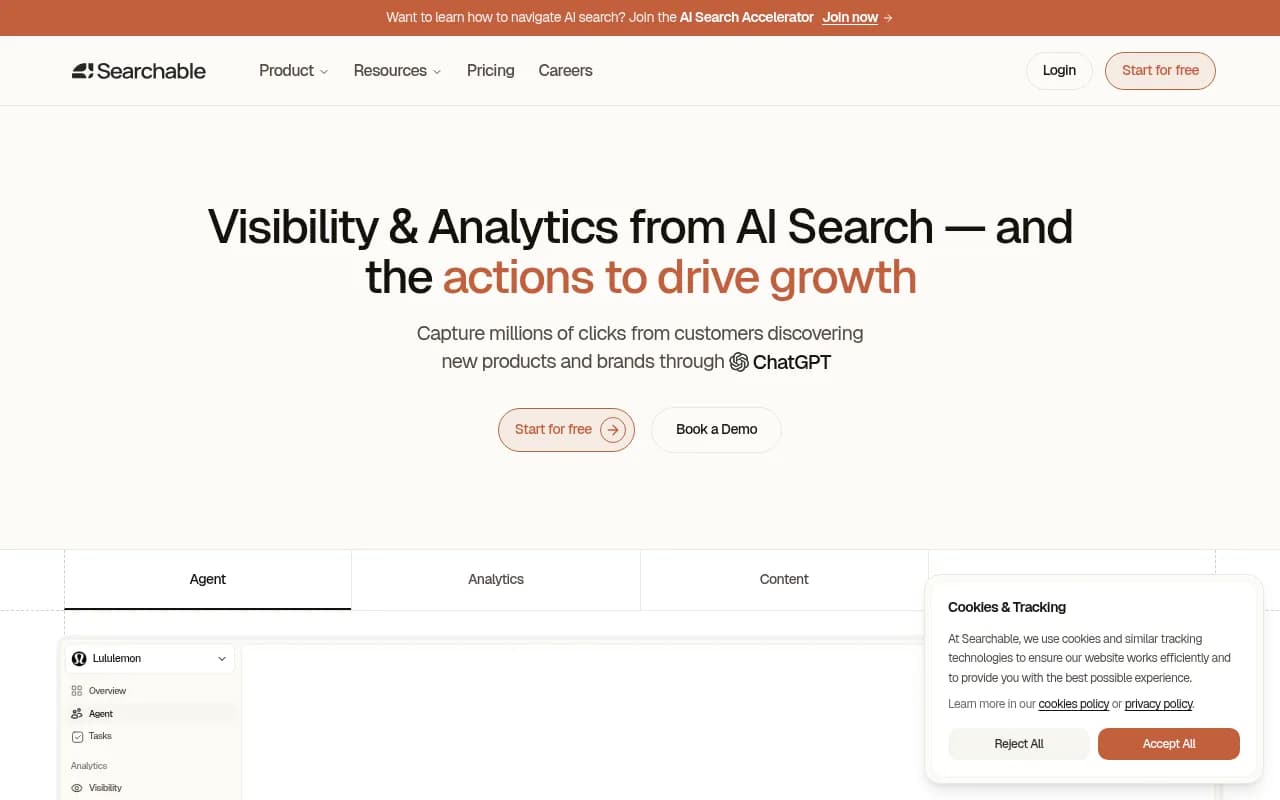
Searchable positions itself as an AI search visibility platform. At its core, it tracks how your brand appears in responses from major LLMs -- which prompts trigger mentions, which competitors get cited instead of you, and how that changes over time.
That's genuinely useful information. If you've never measured your AI visibility before, seeing the data for the first time can be eye-opening. You might discover that ChatGPT consistently recommends three competitors when users ask about your category, or that Perplexity cites a two-year-old blog post from a site you've never heard of.
The problem is what comes next. Searchable shows you the gap. It doesn't help you close it.
For teams that are just starting to think about AI search, a monitoring-only tool might be enough to justify the cost in the short term -- you're paying for awareness. But for teams with real revenue targets attached to their AI visibility work, awareness without action is a slow burn.
The real ROI question for AI visibility tools
Before evaluating any specific platform, it's worth being honest about how ROI gets calculated for this category of tool.
Marketing ROI in 2026 is genuinely hard to measure. According to research from Digital Applied, only 21% of marketers can accurately measure content ROI -- and AI-driven discovery makes attribution even fuzzier. When a user asks ChatGPT for a software recommendation and then visits your site three days later through a branded search, which channel gets credit?
The standard ROI formula -- (revenue generated minus cost of investment) divided by cost of investment -- works fine in theory. In practice, the numerator is the hard part. AI visibility tools sit at the top of the funnel, influencing discovery before a user ever clicks anything. That makes direct revenue attribution difficult.
So the more useful question isn't "how much revenue did this tool generate?" It's: "did this tool help us change something that plausibly drives revenue?"
For AI visibility specifically, that means:
- Did we identify prompts where competitors appear and we don't?
- Did we create content that addressed those gaps?
- Did our citation rate improve after publishing that content?
- Did AI-referred traffic increase?
A tool that only answers the first question has limited ROI potential. A tool that supports all four has a much stronger case.
Where Searchable fits in the market
The AI visibility tool market in 2026 has split into two camps: monitoring dashboards and optimization platforms.
Monitoring dashboards (Searchable, Otterly.AI, Peec.ai, some features of AthenaHQ) show you what's happening. They track brand mentions, sentiment, share of voice, and competitor citations across LLMs. They're useful for reporting and for building awareness of the problem.
Optimization platforms go further. They help you understand why you're invisible, generate content to fix it, track whether that content gets crawled and cited, and connect the whole loop back to traffic and revenue.

Promptwatch is the clearest example of the second category. It combines answer gap analysis (showing you exactly which prompts competitors rank for that you don't), AI content agents that generate articles and briefs grounded in real prompt data, and page-level tracking that shows when your new content moves from crawl to citation. That's a complete loop -- find the gap, fix it, measure the result.
Searchable doesn't offer that loop. It's a monitoring tool with content tools that feel bolted on rather than integrated.
Comparing Searchable to the alternatives
Here's how Searchable stacks up against the main alternatives across the capabilities that actually drive ROI:
| Feature | Searchable | Otterly.AI | Peec.ai | AthenaHQ | Promptwatch |
|---|---|---|---|---|---|
| Brand mention tracking | Yes | Yes | Yes | Yes | Yes |
| Competitor visibility comparison | Yes | Basic | Yes | Yes | Yes |
| Prompt volume / difficulty scoring | No | No | No | Limited | Yes |
| Answer gap analysis | Limited | No | No | Limited | Yes |
| AI content generation | Limited | No | No | No | Yes |
| Crawler log analysis | No | No | No | No | Yes |
| Page-level citation tracking | No | No | No | No | Yes |
| Reddit / YouTube insights | No | No | No | No | Yes |
| ChatGPT Shopping tracking | No | No | No | No | Yes |
| Traffic attribution to AI | No | No | No | No | Yes |
| Multi-language / multi-region | Limited | No | Yes | Limited | Yes |
The pattern is clear. Searchable does the basics well enough, but stops well short of the capabilities that let a marketing team actually improve their numbers.



The hidden costs most teams don't account for
When evaluating whether Searchable is worth the price, the subscription cost is only part of the picture. There are three hidden costs that often tip the ROI calculation negative.
Time spent on manual gap analysis
If your tool shows you that a competitor appears in 40% of prompts in your category and you don't, someone on your team has to figure out what content to create. That's a research process -- reading competitor pages, analyzing AI responses, identifying angles. Without tooling that automates this, you're paying a senior marketer to do work that could be systematized.
Content production without direction
Knowing you need more content is not the same as knowing what content to create. Teams that use monitoring-only tools often end up producing content based on intuition rather than prompt data. Some of it works. A lot of it doesn't. The cost of that misdirected effort is real.
Delayed feedback loops
If you publish a piece of content and have no way to know whether AI crawlers have indexed it, whether it's being cited, or whether your visibility score has moved, you're flying blind. Delayed feedback means delayed course correction. In a category moving as fast as AI search, that matters.
Who Searchable actually makes sense for
To be fair: Searchable isn't the wrong tool for every team. There are situations where it's a reasonable choice.
If you're a small team that has never measured AI visibility before and just needs a starting point, Searchable gives you a baseline. You'll see where you stand, which is more than most teams have right now.
If your organization has a separate content team that can act on monitoring data independently, the gap between "we see the problem" and "we fix the problem" is smaller. Searchable's data can feed into a workflow that exists elsewhere.
If your primary goal is executive reporting -- showing leadership that AI visibility is a real channel worth investing in -- a monitoring dashboard is often enough to make that case.
But if you're a marketing team with actual KPIs attached to AI search visibility, and you need to show measurable improvement over a 6-12 month period, Searchable's limitations will become apparent quickly.
How to calculate whether any AI visibility tool is worth it
Here's a framework for running the numbers before you commit to a subscription.
Step 1: Estimate the revenue at stake
How much of your current organic traffic comes from informational queries where AI search is starting to compete? If you're in a category where users frequently ask AI assistants for recommendations (software, financial products, travel, health), the percentage is probably higher than you think. Estimate what 10-20% of that traffic is worth in revenue terms.
Step 2: Estimate your current AI visibility gap
Without a tool, this is hard to know. But you can do a manual audit: ask ChatGPT, Perplexity, and Gemini 10-15 prompts relevant to your category and see how often your brand appears. If competitors appear consistently and you don't, you have a gap. That gap has a revenue cost.
Step 3: Model what improvement looks like
If closing 30% of your visibility gap over 12 months would recover X in revenue, and the tool costs Y per year, the math is straightforward. The question is whether the tool actually helps you close the gap -- or just measure it.
Step 4: Factor in the action capability
A monitoring tool that costs $200/month but requires $5,000/month in additional content production resources to act on its data is more expensive than it looks. An optimization platform that costs $500/month but reduces the manual research and content direction burden is cheaper than it looks.
What the data says about content ROI in 2026
The broader content marketing ROI picture is relevant here. Research from OmniBound's 2026 content marketing statistics shows that content marketing consistently outperforms paid channels on a cost-per-lead basis over 12+ month horizons. But the measurement challenge is real -- most teams can't connect content to revenue with confidence.
AI visibility tools that include traffic attribution and page-level citation tracking directly address this measurement problem. They let you say: "This article was published in March, crawled by Perplexity in April, started appearing in citations in May, and we can see AI-referred traffic to that page increasing from June onward." That's the kind of evidence that justifies budget.
Searchable doesn't give you that evidence chain. You can see that your brand mentions increased, but connecting that to revenue requires additional tooling and manual work.
The verdict
Searchable is a competent monitoring tool in a market that increasingly needs optimization platforms. If you're evaluating it purely on "does it show me my AI visibility," the answer is yes. If you're evaluating it on "does it help me improve my AI visibility in a way I can measure and report," the answer is more complicated.
For most marketing teams with real performance targets in 2026, the ROI case for a monitoring-only tool is weak. The cost of knowing you have a problem -- without the tooling to fix it efficiently -- adds up fast in wasted research time, misdirected content production, and slow feedback loops.
The platforms that deliver the strongest ROI are the ones that close the loop: find the gap, generate content to address it, track whether that content gets cited, and connect citations to traffic and revenue. That's a higher bar, and not many tools clear it.
If you're serious about AI search visibility as a revenue channel, it's worth evaluating whether the tool you're paying for actually moves the needle -- or just tells you how far you are from moving it.