Summary
- AI search engines (ChatGPT, Perplexity, Google AI Overviews) now serve billions of users monthly, and Gartner predicts traditional search volume will drop 25% in 2026 as users shift to AI-powered answers
- Ranking in AI search requires a different approach than traditional SEO: you need to be the source AI engines cite when generating answers, not just rank on Page 1
- The core strategy involves four phases: assess your current AI visibility, optimize content for citation, measure performance across AI platforms, and iterate based on what works
- Tools like Promptwatch help you track where you're invisible, identify content gaps, generate AI-optimized content, and measure results across 10+ AI models
- Success in AI search comes from creating content that directly answers questions, uses clear structure, includes citations and data, and addresses the specific ways people prompt AI engines
Why AI search visibility matters in 2026
Google's AI Overviews reach over 2 billion users each month. ChatGPT serves 800 million users weekly. Perplexity processes hundreds of millions of queries. These aren't fringe platforms -- they're where your customers are looking for answers right now.
The shift is measurable. Gartner predicted traditional search volume would drop 25% this year as users move to AI-powered answer engines. That's not a future problem. It's happening.
Getting found online used to mean ranking on Page 1 of Google. Now it means being the source AI engines cite when they generate an answer. If your brand isn't showing up in ChatGPT responses, Perplexity citations, or Google AI Overviews, you're invisible to a massive and growing audience.
This is generative engine optimization (GEO) -- and in 2026, it's no longer optional.
How AI search engines decide what to cite
AI models don't rank websites the way Google does. They synthesize answers from multiple sources and cite the ones that best support their response. Understanding this difference is the first step to improving your visibility.
When someone asks ChatGPT or Perplexity a question, the model:
- Interprets the query and determines what kind of answer is needed
- Searches its training data and real-time web access for relevant information
- Synthesizes an answer that directly addresses the question
- Cites sources that provide evidence, data, or authoritative backing
You get cited when your content provides clear, direct answers backed by evidence. Generic marketing copy doesn't cut it. Neither does content optimized purely for keyword density.
AI engines favor content that:
- Answers questions directly in the first paragraph
- Uses clear headings that match how people ask questions
- Includes specific data, examples, and citations
- Demonstrates expertise through depth and accuracy
- Structures information in scannable formats (lists, tables, comparisons)
Phase 1: Assess your current AI search visibility
You can't improve what you don't measure. Start by understanding where you currently show up (or don't) in AI search results.
Track your brand across AI platforms
Manually searching ChatGPT, Perplexity, Claude, and Google AI Overviews for every relevant query is impossible at scale. You need a systematic way to monitor visibility.
Promptwatch tracks your brand across 10 AI models including ChatGPT, Perplexity, Google AI Overviews, Claude, Gemini, and others. It shows exactly which prompts trigger citations, which competitors are being cited instead, and where you're completely invisible.

Other tools that help with AI visibility tracking:



Identify content gaps
The most valuable insight isn't where you're visible -- it's where you're not. Answer Gap Analysis shows exactly which prompts your competitors are being cited for but you aren't.
This tells you what content your website is missing. Not vague topics, but specific questions and angles that AI models want answers to but can't find on your site.
For example, if you sell project management software and competitors are being cited for "how to run async standups" but you're not, that's a content gap. You need a page that directly answers that question.
Audit your existing content
Look at your highest-traffic pages and ask:
- Does the first paragraph directly answer a question?
- Are headings structured as questions people actually ask?
- Is there specific data, examples, or evidence AI models can cite?
- Does the page demonstrate expertise or just repeat generic advice?
Most existing content was written for traditional SEO. It needs to be restructured for AI citation.
Phase 2: Optimize content for AI engines
Once you know where the gaps are, you need to create content that AI engines will cite. This isn't about gaming the system -- it's about providing better answers.
Structure content for direct answers
AI models favor content that gets to the point immediately. Lead with the answer, then provide supporting detail.
Bad structure:
Introduction about the topic
Background and context
Explanation of why it matters
Finally, the actual answer
Good structure:
Direct answer in the first paragraph
Supporting evidence and examples
Step-by-step details
Edge cases and alternatives
Use headings that match how people ask questions. Instead of "Benefits of X", use "Why should you use X?" or "What are the benefits of X?"
Include citations and data
AI models are more likely to cite content that itself cites authoritative sources. When you make a claim, back it up with:
- Specific numbers and statistics
- Links to research or authoritative sources
- Real examples and case studies
- Direct quotes from experts
This isn't just about AI visibility -- it makes your content more credible to human readers too.
Create comparison and listicle content
AI engines frequently cite comparison articles and listicles because they provide structured, scannable information.
Comparison tables are especially valuable:
| Feature | Tool A | Tool B | Tool C |
|---|---|---|---|
| Free tier | Yes | No | Yes |
| AI features | Basic | Advanced | None |
| Best for | Small teams | Enterprise | Solo users |
| Price | $10/mo | $50/mo | Free |
When someone asks "what's the best X for Y", AI models pull from these structured comparisons.
Use AI writing tools strategically
The built-in AI writing agent in Promptwatch generates content grounded in real citation data from 880M+ analyzed citations. It knows what AI models are looking for because it's trained on what they actually cite.
This isn't generic SEO filler. It's content engineered to get cited by ChatGPT, Claude, Perplexity, and other AI models.
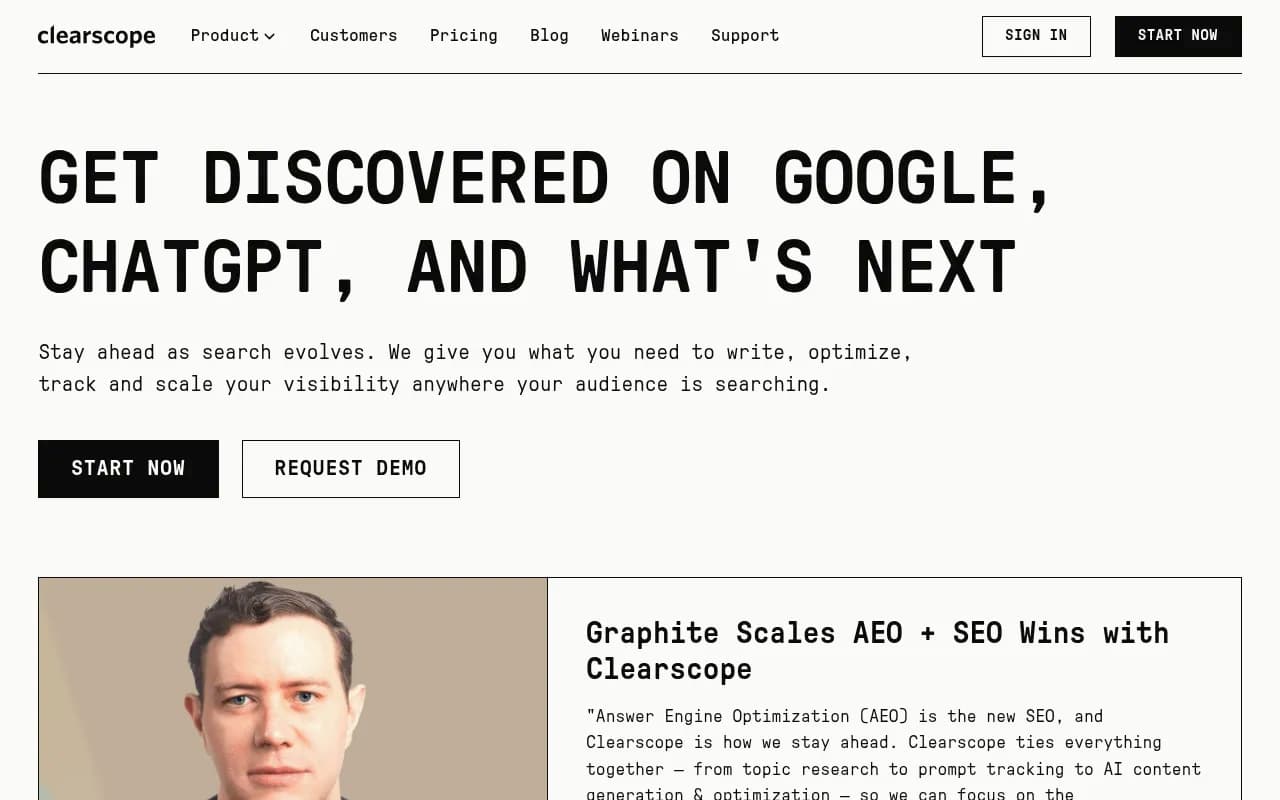
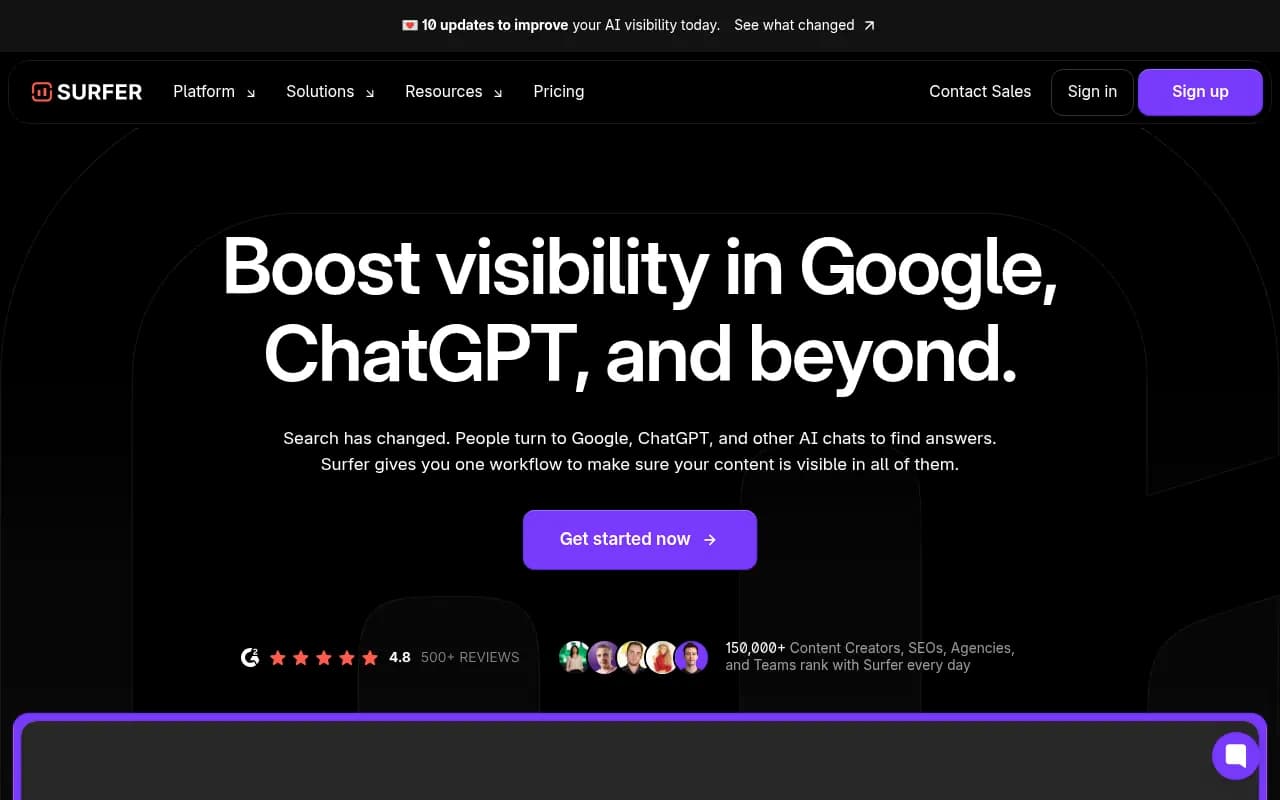
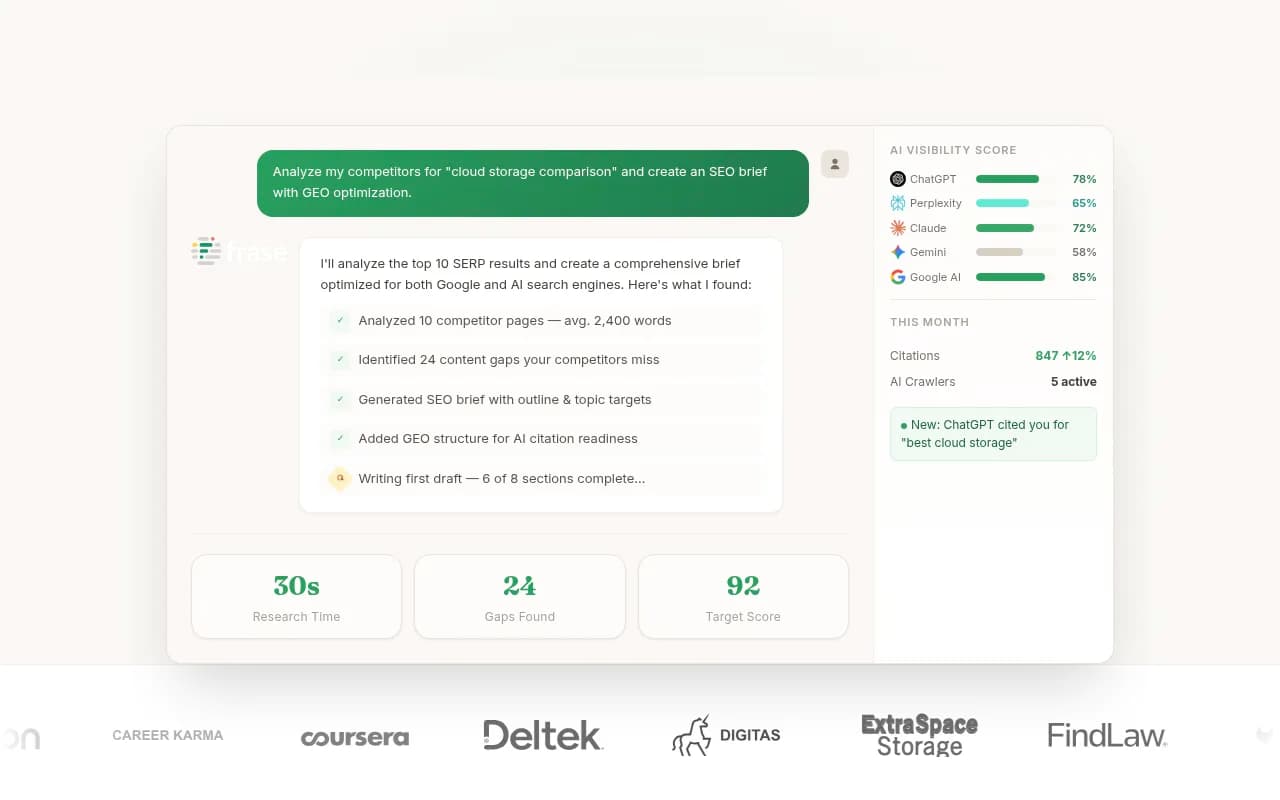
Other content optimization tools:
Optimize for different query types
People prompt AI engines differently than they search Google. Understanding these patterns helps you create content that matches.
Common AI query patterns:
- Comparison queries: "Compare X vs Y for Z use case"
- Recommendation queries: "What's the best X for Y"
- How-to queries: "How do I do X when Y happens"
- Explanation queries: "Why does X happen" or "What causes Y"
- List queries: "Give me 5 examples of X"
Create content that directly addresses these query patterns.
Phase 3: Measure your AI search performance
Publishing optimized content is only half the battle. You need to track what's working and what isn't.
Monitor citation frequency
Track how often your pages are being cited across different AI platforms. Page-level tracking shows exactly which pages are getting cited, how often, and by which models.
Promptwatch provides this visibility across ChatGPT, Perplexity, Google AI Overviews, Claude, Gemini, Meta AI, DeepSeek, Grok, Mistral, and Copilot. You see which specific pages are working and which need improvement.
Track AI crawler activity
AI models need to discover and read your content before they can cite it. AI Crawler Logs show real-time activity from ChatGPT, Claude, Perplexity, and other AI crawlers hitting your website.
You see:
- Which pages AI crawlers are reading
- How often they return
- Errors they encounter
- Indexing issues that need fixing
Most competitors lack this capability entirely. If AI crawlers can't access your content, you won't get cited.
Connect visibility to revenue
Visibility metrics are useful, but what matters is whether AI search drives actual traffic and conversions.
Track AI referral traffic using:
- Code snippet integration
- Google Search Console data
- Server log analysis
This closes the loop: you see which AI citations drive visitors, which visitors convert, and what the actual ROI of your AI visibility efforts is.
Compare against competitors
Competitor heatmaps show how your AI visibility stacks up against competitors across different LLMs. You see who's winning for each prompt and why.
This isn't vanity metrics -- it tells you where to focus your efforts. If a competitor dominates ChatGPT citations for a specific topic, you know you need better content on that topic.
Phase 4: Iterate and scale
AI search optimization isn't a one-time project. It's a continuous cycle of finding gaps, creating content, measuring results, and improving.
Prioritize high-value prompts
Not all prompts are equally valuable. Prompt Intelligence shows volume estimates and difficulty scores for each prompt, plus query fan-outs that reveal how one prompt branches into sub-queries.
Focus on prompts that:
- Have high volume (lots of people asking)
- Match your target audience
- Are winnable (not dominated by Wikipedia or major publishers)
- Connect to your product or service
Scale content creation
Once you know what works, you need to produce content at scale. The action loop in Promptwatch makes this systematic:
- Find the gaps: Answer Gap Analysis shows which prompts competitors are visible for but you're not
- Create content: The AI writing agent generates articles grounded in citation data and competitor analysis
- Track results: See your visibility scores improve as AI models start citing your new content
This cycle -- find gaps, generate content, track results -- is what separates optimization platforms from monitoring-only tools.
Optimize existing content
Don't just create new content. Revisit existing pages that get traffic but aren't being cited by AI engines.
Ask:
- Can I restructure this to lead with a direct answer?
- Are there specific data points or examples I can add?
- Do headings match how people ask questions?
- Is the content actually helpful or just keyword-optimized?
Small changes to high-traffic pages can have outsized impact on AI visibility.
Monitor Reddit and YouTube
AI models frequently cite Reddit discussions and YouTube videos. If conversations about your industry or product are happening on these platforms, you need to know about it.
Promptwatch surfaces Reddit threads and YouTube videos that directly influence AI recommendations. Most competitors ignore these channels entirely, which means you have an opportunity to get ahead.
Common mistakes to avoid
I've seen companies waste months on AI search optimization because they made one of these mistakes:
Mistake 1: Treating AI search like traditional SEO
Keyword density and backlinks matter less in AI search. What matters is whether your content directly answers questions and provides citable evidence.
Stop optimizing for keyword rankings. Start optimizing for citation.
Mistake 2: Creating generic content
AI models don't cite vague, surface-level content. They cite specific, detailed answers backed by data and examples.
If your content could have been written by anyone, it won't get cited. Demonstrate actual expertise.
Mistake 3: Ignoring technical issues
If AI crawlers can't access your content, you won't get cited. Period.
Check for:
- Robots.txt blocking AI crawlers
- Slow page load times
- JavaScript-heavy pages that don't render properly
- Paywalls or login requirements
AI Crawler Logs in Promptwatch show exactly what's preventing AI models from reading your content.
Mistake 4: Only monitoring one AI platform
ChatGPT, Perplexity, Claude, and Google AI Overviews all cite different sources. You need visibility across all of them.
Monitoring only ChatGPT means you miss opportunities on Perplexity. Monitoring only Google AI Overviews means you miss ChatGPT's 800 million weekly users.
Mistake 5: Not connecting visibility to revenue
Visibility metrics are useless if they don't drive business results. Track AI referral traffic and conversions to understand actual ROI.
Tools comparison: monitoring vs optimization platforms
Not all AI visibility tools are created equal. Most competitors are monitoring-only dashboards that show you data but leave you stuck. Here's how they compare:
| Platform | Monitoring | Content gaps | AI writing | Crawler logs | Traffic attribution |
|---|---|---|---|---|---|
| Promptwatch | Yes | Yes | Yes | Yes | Yes |
| Otterly.AI | Yes | No | No | No | No |
| Peec.ai | Yes | No | No | No | No |
| AthenaHQ | Yes | Limited | No | No | No |
| Profound | Yes | Limited | No | No | No |
| Semrush | Limited | No | No | No | No |
Promptwatch is the only platform rated as a "Leader" across all categories in a 2026 comparison of 12 GEO platforms. The core difference: most competitors show you where you're invisible but don't help you fix it. Promptwatch closes the loop with content gap analysis, AI content generation, and optimization tools.
Getting started: your first 30 days
Here's a practical roadmap for the first month:
Week 1: Assessment
- Set up tracking across AI platforms (use Promptwatch or similar)
- Identify your top 20 target prompts
- Run Answer Gap Analysis to find content gaps
- Audit your 10 highest-traffic pages for AI optimization
Week 2: Quick wins
- Restructure 3-5 existing pages to lead with direct answers
- Add comparison tables to relevant content
- Fix any technical issues blocking AI crawlers
- Create 2-3 new pages targeting high-value content gaps
Week 3: Content creation
- Generate 5-10 new articles using AI writing tools
- Focus on comparison and how-to content
- Include specific data, examples, and citations
- Optimize for different query patterns
Week 4: Measurement
- Track citation frequency across AI platforms
- Monitor AI crawler activity
- Set up traffic attribution
- Identify what's working and double down
This isn't a one-month project. But after 30 days, you'll have visibility into where you stand, content that's optimized for AI citation, and data to guide your next steps.
The future of AI search visibility
AI search isn't going away. It's growing. ChatGPT's user base doubled in six months. Google AI Overviews now appear on billions of searches. Perplexity is raising hundreds of millions in funding.
Brands that invest in AI visibility now will have a massive advantage over those that wait. The ones that treat this as a monitoring exercise will fall behind the ones that build systematic optimization capabilities.
The question isn't whether to optimize for AI search. It's whether you'll do it before or after your competitors.
Promptwatch offers a free trial if you want to see where you currently stand. Essential plan starts at $99/month for 1 site and 50 prompts. Professional plan ($249/month) adds crawler logs and state/city tracking. Business plan ($579/month) includes 5 sites and 350 prompts.
Or start manually: pick 10 prompts your customers would ask, search them in ChatGPT and Perplexity, and see if your brand shows up. That's your baseline. Now you know what you need to fix.