Key takeaways
- Most AI visibility tools in 2026 are monitoring dashboards -- they show you where you're invisible but don't help you do anything about it
- The tools worth paying for combine citation tracking, content gap analysis, and some form of optimization workflow
- ChatGPT now has 800 million weekly active users; Google AI Mode is the default search experience for most users -- your brand either shows up in AI answers or it doesn't
- For marketing teams that need to move fast, the best platforms are the ones that close the loop between "we're missing here" and "here's what to publish"
- Promptwatch is the only platform in 2026 rated as a leader across all GEO categories, with content generation built directly into the workflow
If you've sat through a marketing standup recently where someone asked "are we showing up in ChatGPT?" and nobody had a good answer, you're not alone. That question used to be hypothetical. Now it's a budget conversation.
The AI search shift is real and it happened fast. ChatGPT crossed 800 million weekly active users earlier this year. Google AI Mode went from opt-in experiment to the default experience. Perplexity is eating into informational search traffic that used to flow to blogs and comparison pages. And when someone asks any of these tools about your category, your brand either gets mentioned or it doesn't.
The problem is that most tools built to track this are, frankly, dashboards with a GEO label slapped on them. They'll tell you your "visibility score" is 34%, show you a competitor heatmap, and then... leave you there. What do you do with that? What do you publish? Which prompts do you target? Which pages need fixing?
This guide is for marketing teams that want answers to those questions, not just data.
What "AI visibility" actually means in 2026
Before getting into tools, it's worth being precise about what we're tracking. AI visibility refers to how often and how favorably your brand appears in responses generated by AI models -- ChatGPT, Claude, Gemini, Perplexity, Grok, DeepSeek, and others.
This is different from traditional SEO in a few important ways:
- There's no "position 1" -- AI models synthesize responses and either mention you or they don't
- The signals that drive citations are different from the signals that drive Google rankings (though there's overlap)
- You can't just check a rank tracker -- you have to actually query the models and analyze the responses
- The content that gets cited tends to be authoritative, specific, and structured in ways that AI models can parse easily
The discipline of improving this is called Generative Engine Optimization (GEO), or sometimes Answer Engine Optimization (AEO). Whatever you call it, the tools built for it fall into a few categories: pure monitors, analytics platforms, and full optimization suites. Most of the market is still in the first category.
The core problem with most AI visibility tools
Here's the honest version of what most tools do: they run a set of prompts against one or more AI models, record whether your brand appeared, and show you a score over time. That's useful for reporting. It's not useful for doing anything.
The gap analysis problem is real. Knowing you have 34% visibility doesn't tell you which prompts you're missing, what content your competitors have that you don't, or what you should write next. Most tools stop before they get to that part.
A few platforms have started to close this gap, but they vary a lot in how deep they go. Some offer basic "recommended topics" features. Others have built full content generation workflows grounded in citation data. The difference between those two things is significant if you're a marketing team with limited bandwidth.
How to evaluate AI visibility tools
When you're comparing platforms, these are the questions that actually matter:
Which AI models does it cover? Some tools only track ChatGPT and Perplexity. If your audience uses Gemini or Claude heavily, that's a blind spot. Look for platforms covering at least 6-8 models.
Can you customize prompts? Fixed prompt sets are a red flag. Your customers don't all ask the same questions. You need to track the prompts that match your actual buyer journey.
Does it show you what to fix? Monitoring is table stakes. The question is whether the tool helps you understand why you're missing from certain responses and what content would change that.
Does it track traffic? Visibility scores are vanity metrics unless you can connect them to actual sessions and revenue. Look for tools with traffic attribution -- either via code snippet, GSC integration, or server log analysis.
Does it track AI crawlers? Knowing which pages AI bots are reading (and which they're ignoring or hitting errors on) is a different kind of insight that most tools don't offer.
The best AI visibility tools in 2026
Promptwatch -- best for teams that need to act, not just monitor
Promptwatch is the platform that's changed the conversation about what an AI visibility tool should do. Where most competitors stop at showing you a dashboard, Promptwatch is built around a loop: find the gaps, create content to fill them, track the results.
The Answer Gap Analysis feature is the clearest example of this. It shows you exactly which prompts your competitors are visible for that you're not -- not just "you're missing here" but the specific topics and questions AI models want to answer that your site doesn't currently address. From there, the built-in AI writing agent generates articles, listicles, and comparisons grounded in 880M+ citations analyzed. This isn't generic AI content -- it's engineered around what actually gets cited.
On the tracking side, Promptwatch covers 10 AI models (ChatGPT, Perplexity, Claude, Gemini, Grok, DeepSeek, Copilot, Mistral, Meta AI, and Google AI Overviews), with page-level citation tracking, prompt volume and difficulty scoring, query fan-outs, and real-time AI crawler logs. The crawler logs are particularly useful -- they show you which pages ChatGPT and Perplexity are actually reading, how often they return, and whether they're hitting errors.
Used by 6,700+ brands and agencies including Booking.com and Center Parcs, with data that's been cited in the Wall Street Journal and Axios.
Pricing: Essential at $99/mo, Professional at $249/mo, Business at $579/mo.

Profound -- strong analytics, enterprise-grade
Profound has built a solid reputation for depth of analytics. It covers multiple AI models, offers competitive benchmarking, and has good prompt customization. Where it falls short relative to Promptwatch is on the action side -- there's no content generation workflow, and Reddit/YouTube tracking (which influences AI citations more than most people realize) isn't part of the picture. Pricing is also higher, which makes it harder to justify for teams that aren't at enterprise scale.

Otterly.AI -- good starting point, limited ceiling
Otterly.AI gets recommended a lot in SEO circles, and the pricing is genuinely accessible. For a team that just wants to start tracking AI visibility without a big commitment, it's a reasonable entry point. The limitation is that it's monitoring-only -- no content gap analysis, no crawler logs, no visitor analytics. You'll outgrow it quickly if you're serious about optimization.

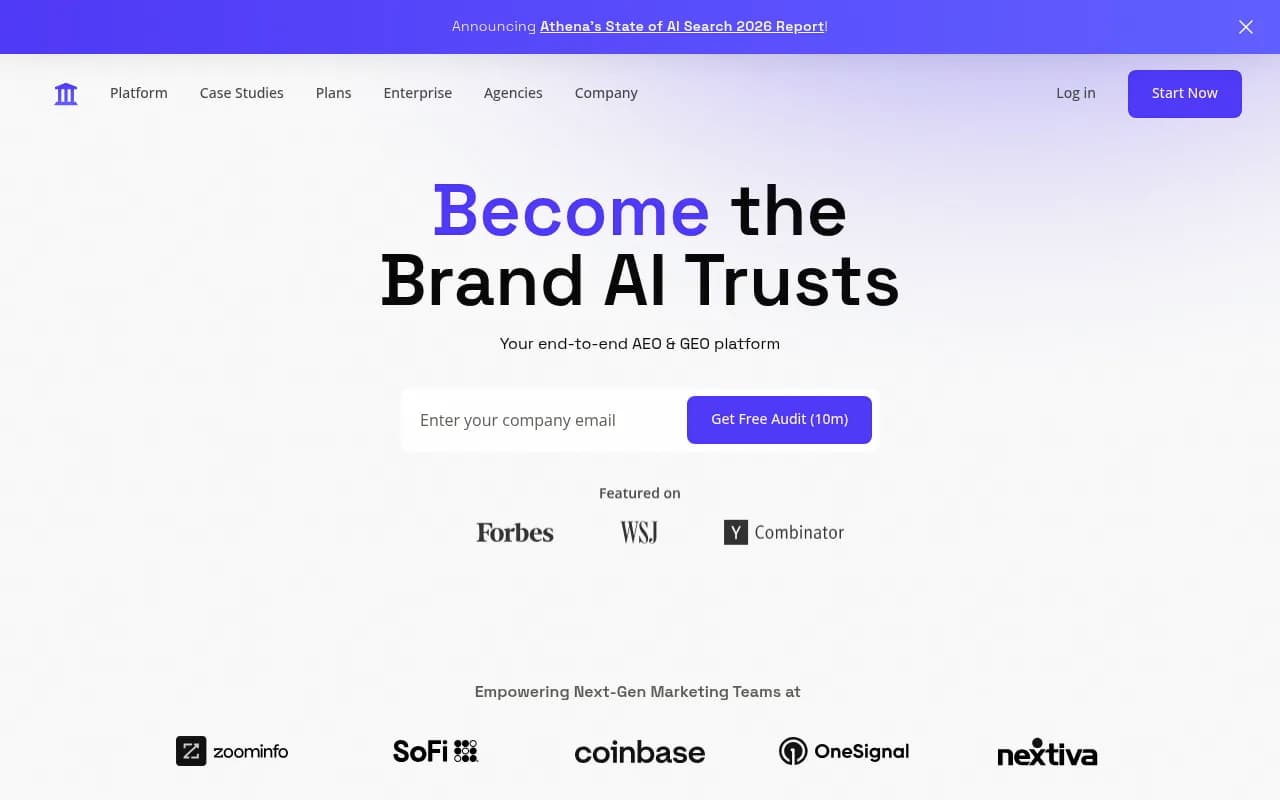
AthenaHQ -- monitoring-focused with clean UI
AthenaHQ covers 8+ AI search engines and has a clean interface that makes it easy to get started. The competitive tracking is decent. Like Otterly, though, it's primarily a monitoring tool -- there's no content optimization or generation capability, which means you're still doing the "what do I do with this data" work yourself.
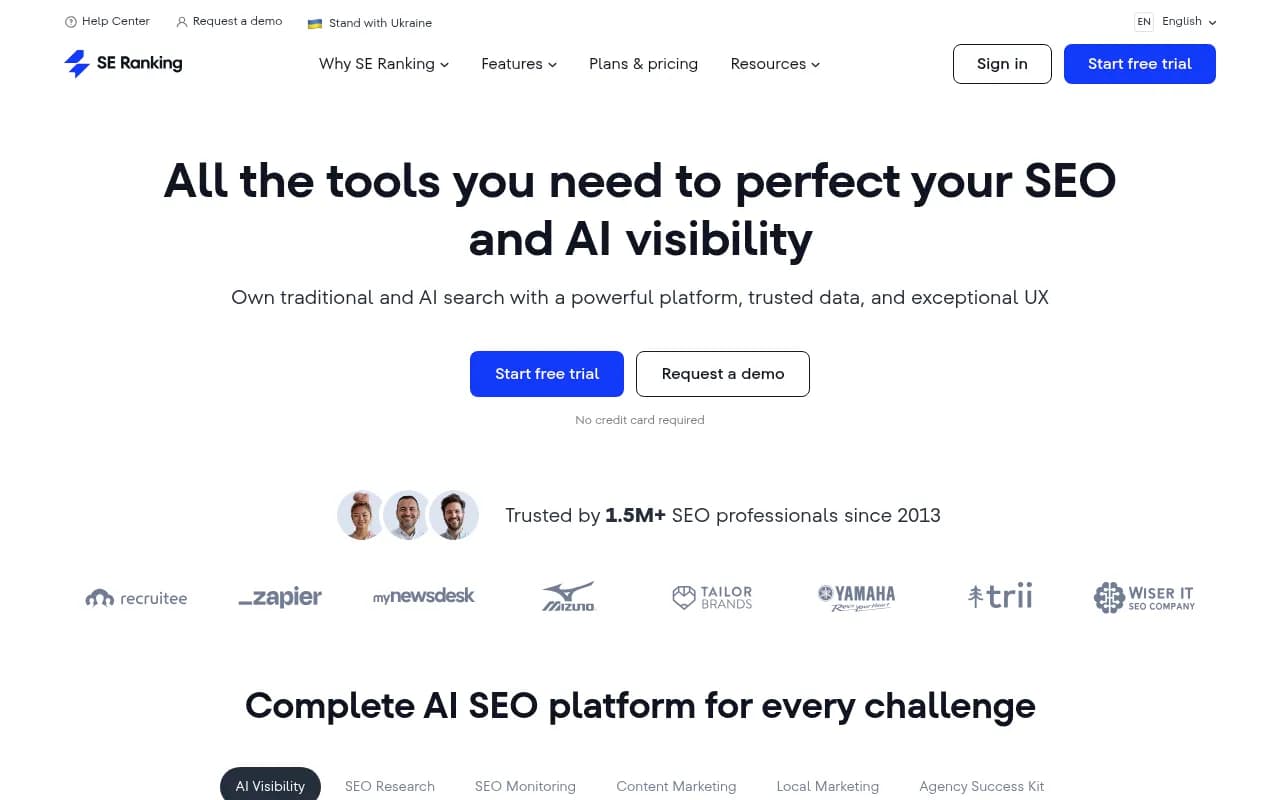
SE Ranking (AI Visibility Toolkit) -- best for teams already in SE Ranking
SE Ranking has added an AI visibility module to its existing SEO platform. If you're already using SE Ranking for traditional SEO, the AI visibility add-on is a natural extension. As a standalone AI visibility tool, it's functional but not as deep as purpose-built platforms. Good for smaller teams that want everything in one place.
Semrush -- familiar but limited on AI depth
Semrush has added AI visibility features, but the approach uses fixed prompt sets rather than customizable queries. That's a meaningful constraint -- your customers don't search with Semrush's default prompts. There's also no AI traffic attribution, which makes it hard to connect AI visibility to actual business outcomes. Useful if you're already deep in the Semrush ecosystem and want a basic read on AI presence.
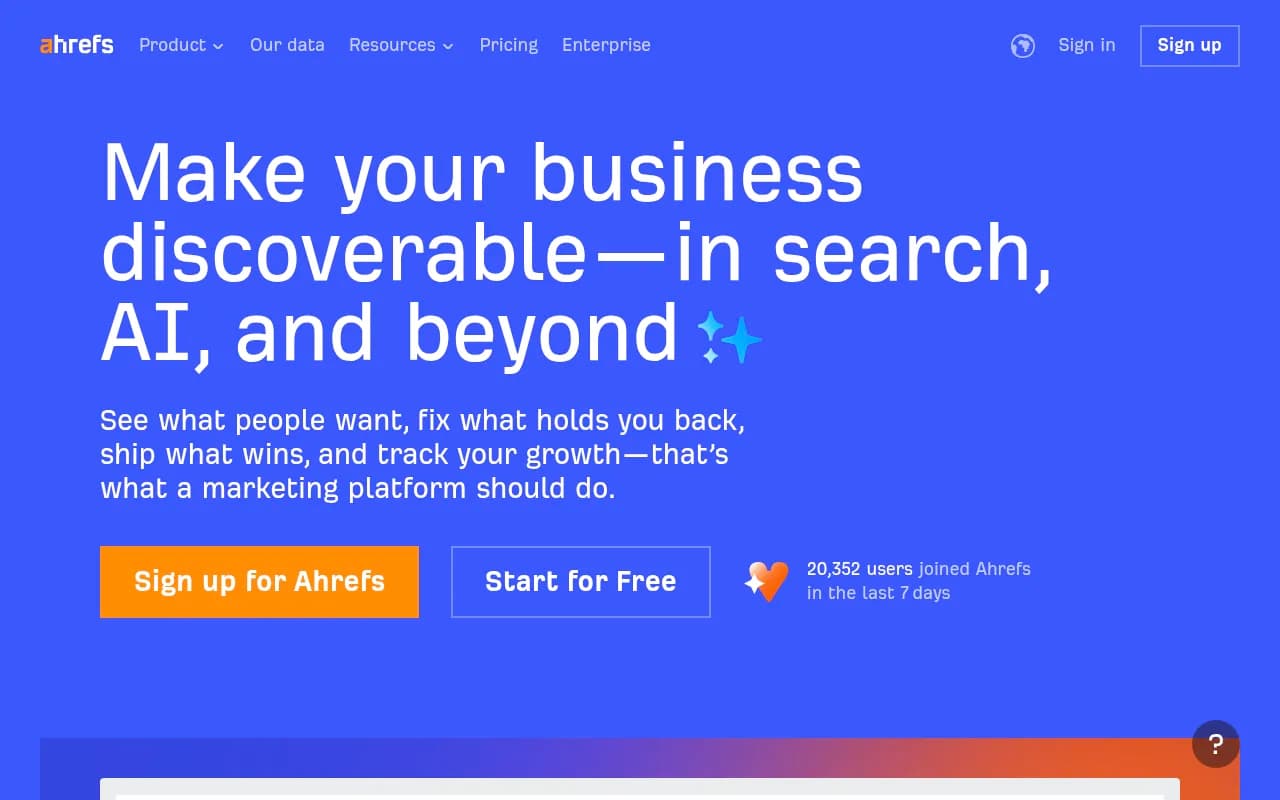
Ahrefs Brand Radar -- early-stage AI tracking
Ahrefs Brand Radar is the AI visibility component of the Ahrefs suite. It's early-stage compared to purpose-built GEO platforms -- fixed prompts, no AI traffic attribution, limited model coverage. Worth watching as Ahrefs continues to develop it, but not a primary tool for teams serious about GEO in 2026.
Peec AI -- solid multi-language tracking
Peec AI stands out for multi-language and multi-region support, which matters if you're running campaigns across different markets. The monitoring capabilities are good. Like most mid-tier tools, it doesn't have content generation or deep gap analysis built in, but for international teams that need visibility data across languages, it's worth evaluating.

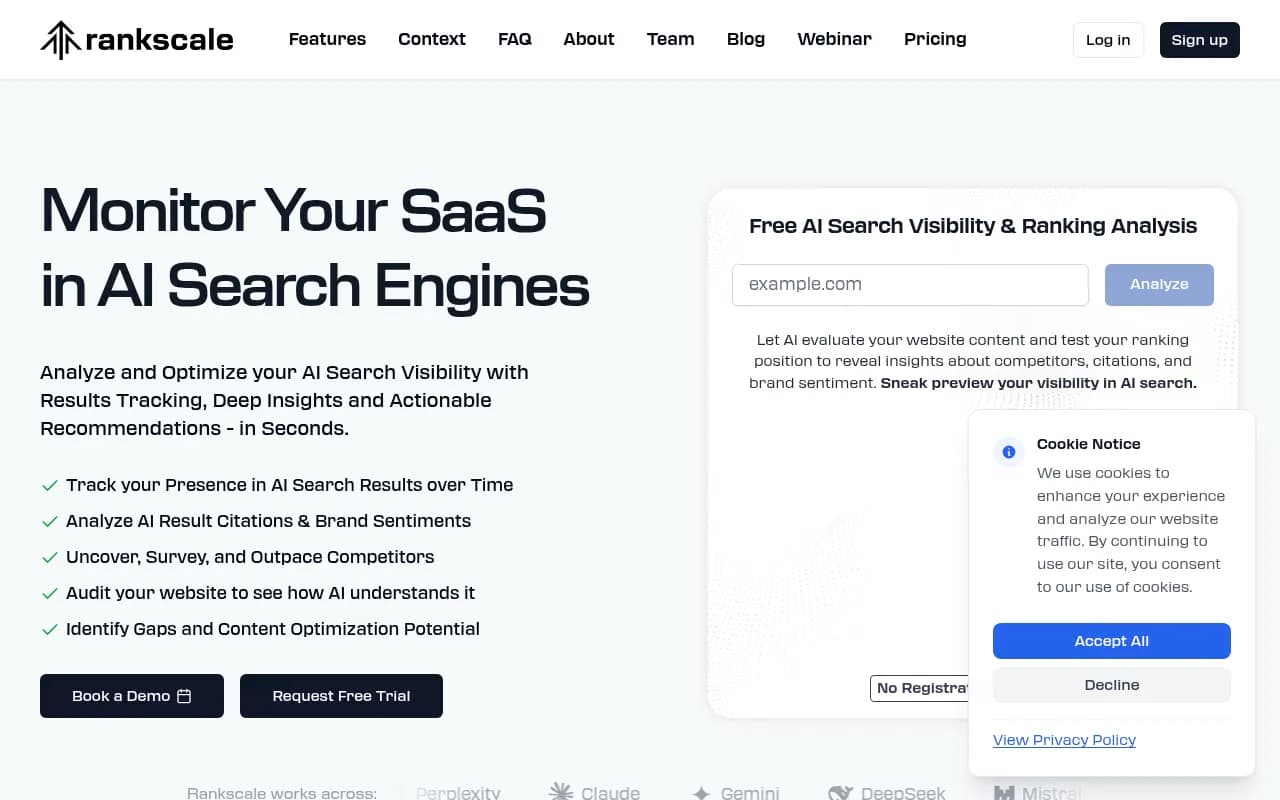
Rankscale -- good for prompt-level granularity
Rankscale focuses on AI search ranking and has decent prompt-level analytics. It's a more technical tool that works well for SEO-oriented teams who want to dig into which specific queries they're winning or losing. Less suited to marketing teams that need content workflows alongside the data.
Search Party -- agency-oriented
Search Party is built with agencies in mind. It has multi-client management features and decent reporting. The gap is on prompt metrics -- there's no prompt volume or difficulty scoring, and no content gap analysis. Fine for agencies that need to report AI visibility to clients, less useful for teams that want to act on the data.
Feature comparison table
| Tool | Models tracked | Custom prompts | Content generation | Crawler logs | Traffic attribution | Reddit/YouTube tracking | Starting price |
|---|---|---|---|---|---|---|---|
| Promptwatch | 10 | Yes | Yes (built-in) | Yes | Yes | Yes | $99/mo |
| Profound | 6+ | Yes | No | No | Limited | No | Higher |
| Otterly.AI | 4+ | Limited | No | No | No | No | Low |
| AthenaHQ | 8+ | Yes | No | No | No | No | Mid |
| SE Ranking | 4+ | Limited | No | No | No | No | Add-on |
| Semrush | 4+ | No (fixed) | No | No | No | No | Add-on |
| Ahrefs Brand Radar | 3+ | No (fixed) | No | No | No | No | Add-on |
| Peec AI | 5+ | Yes | No | No | No | No | Mid |
| Rankscale | 5+ | Yes | No | No | No | No | Mid |
| Search Party | 5+ | Yes | No | No | No | No | Mid |
What the "monitoring-only" problem actually costs you
It's worth being direct about this. If you're paying for a tool that only monitors, you're paying for a report. Reports don't improve your AI visibility. Content does.
The workflow gap looks like this: you get your weekly visibility report, you see you're at 34% share of voice, you see three competitors above you, and then you open a blank Google Doc and try to figure out what to write. That's the moment where most GEO programs stall. The data is there. The action isn't.
The platforms that have solved this -- and Promptwatch is the clearest example -- treat content generation as part of the product, not an afterthought. The gap analysis feeds directly into a writing workflow that produces content grounded in what AI models actually cite. You're not guessing what to write. You're writing what the data says is missing.
Which tool is right for your team?
The honest answer depends on where you are in the GEO journey.
If you're just starting out and want to understand your baseline, Otterly.AI or SE Ranking's AI module will get you oriented without a big investment. You'll hit the ceiling quickly, but it's a reasonable first step.
If you're past the "what's our score" phase and want to actually improve your visibility, you need a platform with gap analysis and content workflows. Promptwatch is the clear choice here -- it's the only platform that combines monitoring, gap analysis, content generation, and traffic attribution in a single workflow.
If you're an agency managing multiple clients, look at Promptwatch's agency tier or Search Party for the multi-client management features.
If you're an enterprise with complex multi-region, multi-language needs, Promptwatch's Business and Enterprise tiers cover that, as does Peec AI for teams that prioritize international coverage above all else.
A note on Reddit and YouTube
One thing most tools ignore entirely: Reddit threads and YouTube videos are significant sources for AI citations. When ChatGPT or Perplexity answers a question about your category, they're often pulling from Reddit discussions and YouTube transcripts alongside traditional web content. If you're not tracking which Reddit threads and YouTube videos are influencing AI recommendations in your space, you're missing a meaningful part of the picture.
Promptwatch surfaces this data. Most competitors don't. It's a small feature on paper but it changes how you think about content strategy -- sometimes the highest-leverage thing you can do is participate in a Reddit thread, not publish a new blog post.
The bottom line
The AI visibility tool market in 2026 is crowded, and most of what's in it is monitoring software with a GEO badge. That's fine for awareness. It's not fine for results.
Marketing teams that want to actually improve their AI visibility -- not just track it -- need platforms that close the loop between data and action. That means gap analysis, content generation grounded in citation data, and traffic attribution that connects AI visibility to revenue.
That's a short list of tools. Promptwatch sits at the top of it.