Key takeaways
- Share of voice in AI search means how often your brand gets cited or mentioned in AI-generated answers -- and it's now a core metric alongside traditional rankings.
- Most tools on the market only monitor; the best ones help you act on what you find by identifying content gaps and generating optimized content.
- Coverage varies significantly: some tools track 2-3 AI models, others cover 10+. Match the tool to the models your audience actually uses.
- Pricing ranges from free tiers to $500+/month for enterprise plans -- the right choice depends on how many prompts, sites, and AI models you need to track.
- The tools that deliver the most ROI combine monitoring, gap analysis, and content optimization in a single workflow.
Why share of voice in AI search actually matters now
A year ago, "AI SEO" was still a niche concern. Now it's a budget line item. ChatGPT alone has crossed 1 billion users, Perplexity is growing fast among research-oriented audiences, and Google's AI Overviews appear at the top of roughly half of all search results. When someone asks one of these systems "what's the best project management tool for remote teams?" or "which accounting software do small businesses use?", the answer they get shapes their buying decision -- and your brand is either in that answer or it isn't.
That's what share of voice in AI search means: the percentage of relevant AI-generated responses where your brand appears, compared to your competitors. It's a different metric from keyword rankings. You're not trying to be #1 for a query -- you're trying to be cited, mentioned, or recommended in the response itself.
The problem is that traditional SEO tools weren't built for this. Google Search Console doesn't tell you whether ChatGPT cited your blog post. Semrush's rank tracker doesn't show you that Perplexity is recommending your competitor for 40% of prompts in your category. You need a different kind of tool.
This guide covers what's actually available in 2026, what each tool does well, and where the gaps are.
What to look for in an AI share-of-voice tool
Before diving into specific tools, it's worth being clear about what separates a useful platform from a dashboard that just looks impressive.
Model coverage. Some tools only track ChatGPT and Perplexity. Others cover Google AI Overviews, Gemini, Claude, Grok, DeepSeek, and Copilot. If your audience uses Google AI Mode heavily, a tool that ignores it is giving you an incomplete picture.
Prompt customization. Fixed prompt libraries are a limitation. You want to track the specific questions your customers are actually asking -- not a generic set of industry prompts someone else defined.
Refresh frequency. AI responses change. A tool that updates weekly gives you stale data. Daily or near-real-time tracking matters for competitive monitoring.
Competitor benchmarking. Knowing your own visibility score is useful. Knowing how it compares to three specific competitors is much more useful.
Content gap analysis. This is where most tools fall short. Monitoring tells you where you're invisible. Gap analysis tells you why -- which prompts competitors rank for that you don't, and what content you'd need to create to compete.
Traffic attribution. Can the tool connect AI citations to actual website traffic and revenue? This closes the loop between visibility and business outcomes.
The tools worth knowing about in 2026
Promptwatch -- the most complete option
Promptwatch sits at the top of the category because it's built around a full optimization loop, not just monitoring. Most tools show you a visibility score and leave you to figure out what to do next. Promptwatch shows you the gaps, then helps you fill them.
The Answer Gap Analysis feature identifies specific prompts where competitors appear but you don't -- not as a vague category insight, but as concrete, actionable prompt-level data. From there, a built-in AI writing agent generates articles and comparisons grounded in citation data from 880M+ analyzed citations. You're not getting generic content; you're getting pieces engineered around what AI models actually want to cite.
It tracks 10 AI models (ChatGPT, Perplexity, Google AI Overviews, Google AI Mode, Claude, Gemini, Meta/Llama, DeepSeek, Grok, Mistral, Copilot), supports multi-language and multi-region monitoring, and includes AI crawler logs that show which pages AI bots are actually reading on your site -- something most competitors don't offer at all.
Pricing starts at $99/month for the Essential plan (1 site, 50 prompts, 5 articles), $249/month for Professional (2 sites, 150 prompts, crawler logs), and $579/month for Business (5 sites, 350 prompts). A free trial is available.

Semrush AI Toolkit
Semrush added AI visibility tracking to its existing platform, which is a natural fit if you're already using Semrush for traditional SEO. The AI Toolkit tracks brand mentions across ChatGPT, Perplexity, Gemini, and Google AI Overviews, and surfaces them alongside your regular keyword and ranking data.
The limitation is that Semrush uses fixed prompt sets rather than fully custom prompts, and there's no AI traffic attribution built in. It's a solid addition for existing Semrush users who want a first look at their AI visibility without adopting a new platform. For teams that need deep prompt customization or content gap workflows, it's not enough on its own.
Ahrefs Brand Radar
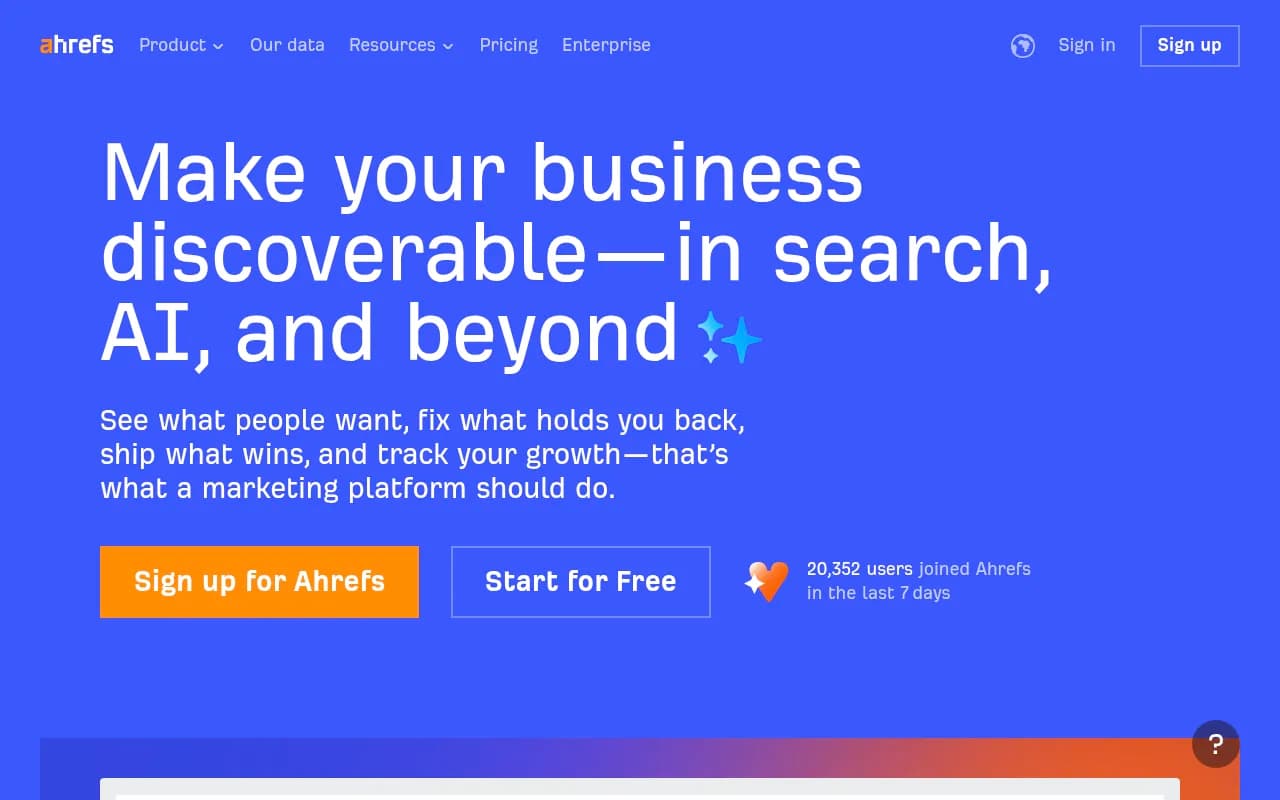
Ahrefs launched Brand Radar as a beta feature, and it does what you'd expect from Ahrefs: clean data, reliable tracking, and a familiar interface. It monitors brand mentions in AI-generated responses and shows how visibility changes over time.
The constraints are similar to Semrush -- fixed prompts, no AI traffic attribution, and the feature set is still maturing. Worth watching, especially if you're already deep in the Ahrefs ecosystem.
Peec AI
Peec AI focuses on visibility analytics across Gemini, ChatGPT, Perplexity, Claude, Google AI Mode, AI Overviews, and DeepSeek. It's a monitoring-first platform with multi-language support and a clean dashboard for tracking share of voice over time.
It's a reasonable mid-market option, particularly for teams that need multi-language coverage. The gap is on the optimization side -- Peec AI shows you the data but doesn't help you act on it.

Otterly.AI
Otterly is one of the more affordable options in the category, starting around $29/month. It covers the major AI models and gives you a reasonable view of brand mentions and competitor comparisons. For small teams or early-stage monitoring, it's a low-risk way to start tracking AI visibility.
The trade-off is depth. No crawler logs, no content generation, no traffic attribution. It's a monitoring dashboard, and a fairly basic one. Fine for getting started; not enough if you're trying to build a systematic GEO program.

Profound
Profound is an enterprise-focused platform with strong analytics and a higher price point (starting around $399/month with no free trial). It tracks brand visibility across major AI answer engines and provides detailed competitive analysis.
It's a serious tool for enterprise teams with dedicated analytics resources. The absence of content generation capabilities means you'll still need a separate workflow to act on what you find.

AthenaHQ
AthenaHQ takes a more technical approach to AI visibility, with automation features and tracking across 8+ AI search engines. It's monitoring-focused with some optimization tooling, though content generation isn't a core part of the workflow.

Scrunch AI
Scrunch AI positions itself at the enterprise end of the market with deep analysis capabilities and custom pricing. It's worth a demo if you're at a large organization with complex multi-brand monitoring needs.
Rankscale
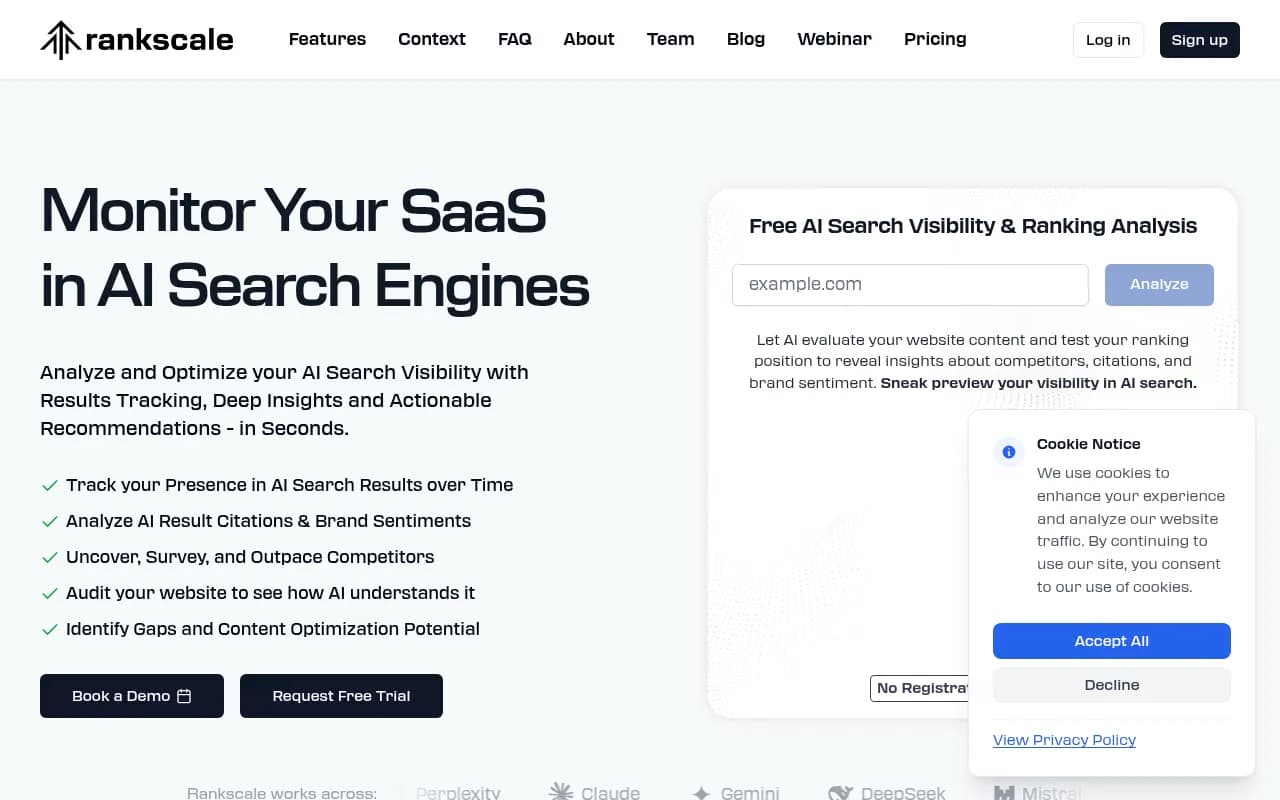
Rankscale is a more affordable option that covers AI search ranking and visibility tracking. It's a reasonable choice for smaller teams that need basic share-of-voice data without the enterprise price tag.
SE Ranking AI Visibility
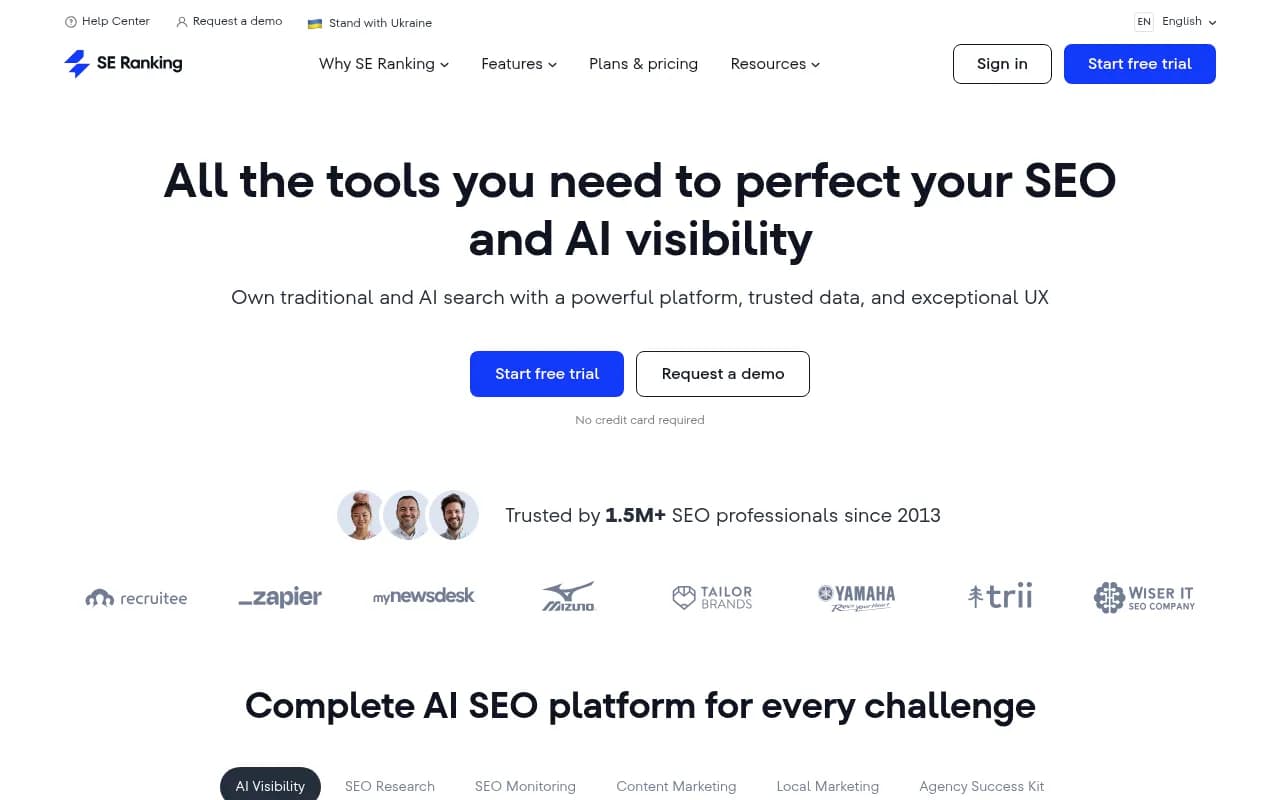
SE Ranking has built AI visibility tracking into its broader SEO platform. Like Semrush, it benefits from being part of an all-in-one toolkit -- you get AI monitoring alongside traditional rank tracking, site audits, and keyword research in one subscription.
Head-to-head comparison
Here's how the main platforms stack up across the features that matter most for share-of-voice tracking:
| Tool | AI models tracked | Custom prompts | Content generation | Crawler logs | Traffic attribution | Starting price |
|---|---|---|---|---|---|---|
| Promptwatch | 10 | Yes | Yes (built-in) | Yes | Yes | $99/mo |
| Semrush AI Toolkit | 4 | Limited (fixed) | No | No | No | $99/mo |
| Ahrefs Brand Radar | 3-4 | Limited (fixed) | No | No | No | $129/mo+ |
| Peec AI | 7 | Yes | No | No | No | €89/mo |
| Profound | 5+ | Yes | No | No | No | $399/mo |
| Otterly.AI | 4 | Yes | No | No | No | $29/mo |
| AthenaHQ | 8+ | Yes | Limited | No | No | $295/mo |
| Scrunch AI | 5+ | Yes | No | No | No | Custom |
| SE Ranking | 4 | Limited | No | No | No | Varies |
| Rankscale | 3-4 | Yes | No | No | No | $49/mo |
A few things stand out from this table. First, most tools cluster around monitoring-only functionality -- they'll show you visibility scores and competitor comparisons, but the workflow stops there. Second, crawler logs are rare; Promptwatch is one of the few platforms that shows you which pages AI bots are actually crawling and how often. Third, traffic attribution (connecting AI citations to actual site visits and revenue) is almost entirely absent outside of Promptwatch.
How to actually use these tools to grow share of voice
Buying a monitoring tool and checking your visibility score every week isn't a strategy. Here's a workflow that actually moves the needle.
Step 1: Map your prompt universe
Start by identifying the 30-50 prompts that matter most for your business. These should be the questions your customers are actually asking AI systems -- not just broad category terms. "What's the best CRM for a 10-person sales team?" is more useful than "CRM software." Tools with prompt volume data (like Promptwatch's Prompt Intelligence feature) help you prioritize by search volume and difficulty.
Step 2: Baseline your current visibility
Run your prompt set across the AI models your audience uses. You want to know: for each prompt, which AI models mention you, how prominently, and who else appears in those responses. This is your baseline share of voice.
Step 3: Find the gaps
This is the step most teams skip. Look at the prompts where competitors appear but you don't. What content do they have that you don't? What angles are they covering? Tools with answer gap analysis make this systematic rather than manual.
Step 4: Create content that fills the gaps
AI models cite content that directly and comprehensively answers the questions users are asking. If you're missing from responses about "project management for construction teams," you probably don't have a piece of content that addresses that specific use case. Create it -- and make it genuinely useful, not thin filler.
Step 5: Track the impact
After publishing new content, monitor whether your visibility scores improve for the target prompts. Page-level tracking shows which specific pages are getting cited and by which models. Traffic attribution closes the loop by connecting those citations to actual visits and conversions.
This cycle -- find gaps, create content, track results -- is the core of what GEO actually looks like in practice.
Which tool is right for you?
The honest answer depends on where you are and what you need.
If you're just starting out and want to understand your AI visibility without a big investment, Otterly.AI or Rankscale give you a low-cost entry point. You won't get deep optimization features, but you'll get a baseline.
If you're already using Semrush or Ahrefs heavily, their AI visibility features are worth activating as a first step. The fixed prompt sets are a limitation, but the integration with your existing workflow has real value.
If you're serious about building a systematic GEO program -- tracking gaps, creating content, measuring impact -- Promptwatch is the most complete option. The combination of 10-model coverage, custom prompts, gap analysis, built-in content generation, and traffic attribution is genuinely differentiated from the rest of the market. Most other tools make you stitch together multiple platforms to get the same workflow.
If you're at an enterprise with complex multi-brand needs and a dedicated analytics team, Profound or Scrunch AI are worth evaluating alongside Promptwatch.
The broader picture
AI search isn't replacing traditional search overnight, but it's changing the distribution of attention in ways that compound over time. A brand that's consistently cited in AI responses builds a kind of authority that's hard to displace once established. A brand that ignores AI search for another 12 months will find the gap harder to close.
The tools in this guide give you the infrastructure to compete. The strategy -- understanding your audience's questions, creating content that actually answers them, and tracking what works -- is still fundamentally a human job. The tools just make it faster and more systematic.
Start with a clear prompt set, pick a tool that matches your current maturity level, and treat AI visibility as an ongoing program rather than a one-time audit.