Key takeaways
- Most AEO tools are built for single brands -- agencies need platforms that handle multiple clients, white-label reporting, and repeatable workflows without tripling the workload.
- The market splits into two camps: monitoring-only dashboards (useful but limited) and full optimization platforms that help you find gaps, create content, and track results.
- For agencies, the most important features are multi-client workspace management, prompt-level analytics, content gap analysis, and some form of traffic attribution to prove ROI.
- Pricing varies wildly -- from $39/month add-ons to $500+ enterprise contracts -- so matching the tool to your client tier matters more than picking the "best" option in a vacuum.
- The tools that will define agency AEO in 2026 are the ones that close the loop between visibility data and actual content deliverables.
Clients used to ask agencies about Google rankings. Now they ask whether their brand shows up when someone asks ChatGPT for a recommendation, whether Perplexity cites their product pages, and whether Gemini is sending their competitors traffic instead of them. That shift has created a new category of tooling -- and a real headache for agencies trying to serve multiple clients at once.
The problem isn't that AEO tools don't exist. There are dozens of them now. The problem is that most were built for in-house marketing teams managing a single brand. They're fine for that. But when you're running AEO for 10, 20, or 50 clients, you need something different: separate workspaces, scalable prompt management, white-label exports, and ideally a way to turn visibility data into actual content deliverables without rebuilding the workflow from scratch for every account.
This guide is for agency owners and leads who need to build a defensible AEO stack that scales. I've organized it by what agencies actually need, not just what looks good in a feature comparison.
What agencies need from an AEO tool (that single-brand tools miss)
Before getting into specific tools, it's worth being clear about what makes agency use cases different.
Single-brand teams care about their own visibility. Agencies care about visibility across a portfolio -- and they need to report on it, justify it, and improve it for clients who may have wildly different industries, budgets, and AI search maturity levels.
The features that matter most for agencies:
- Multi-client workspace management (not just multiple "projects" in one account)
- White-label reporting or at minimum clean exports that don't look like a vendor dashboard
- Prompt libraries that can be customized per client without starting from zero
- Competitor tracking that works across different competitive sets per client
- Content gap analysis -- knowing what prompts a client is invisible for is only useful if you can do something about it
- Traffic attribution, because clients want to know if AI visibility is driving actual visits and revenue
- Reasonable per-seat or per-client pricing that doesn't make the economics fall apart at scale
Most tools in this space check two or three of those boxes. Very few check all of them.
The tools worth knowing about
Promptwatch -- best for agencies that want to close the loop
Promptwatch is the platform I'd recommend first for agencies that want to go beyond monitoring. The core difference from most competitors is that it's built around an action cycle: find gaps, create content, track results.

The Answer Gap Analysis feature shows exactly which prompts competitors are visible for but your client isn't -- not just "you're missing visibility here" but the specific topics and questions AI models want answered that aren't on the client's site. That's a deliverable agencies can actually use. The built-in AI writing agent generates articles and comparisons grounded in citation data (over 880 million citations analyzed), so the content it produces isn't generic filler -- it's engineered to get cited by ChatGPT, Claude, Perplexity, and others.
For agencies specifically, the page-level tracking shows which pages are being cited, how often, and by which AI models. Traffic attribution connects that visibility to actual visits via a code snippet, Google Search Console integration, or server log analysis. That's the kind of data that justifies retainers.
It also covers AI crawler logs -- real-time logs of ChatGPT, Claude, Perplexity, and other crawlers hitting client sites, including which pages they read and errors they encounter. Most competitors don't have this at all.
Pricing starts at $99/month for the Essential plan (1 site, 50 prompts), $249/month for Professional (2 sites, 150 prompts, crawler logs), and $579/month for Business (5 sites, 350 prompts). Agency and enterprise pricing is available for larger portfolios.
Nightwatch -- best for agencies already doing traditional SEO
Nightwatch has been a solid rank tracker for years, and its AI visibility add-on makes it genuinely interesting for agencies that don't want to run two separate platforms.
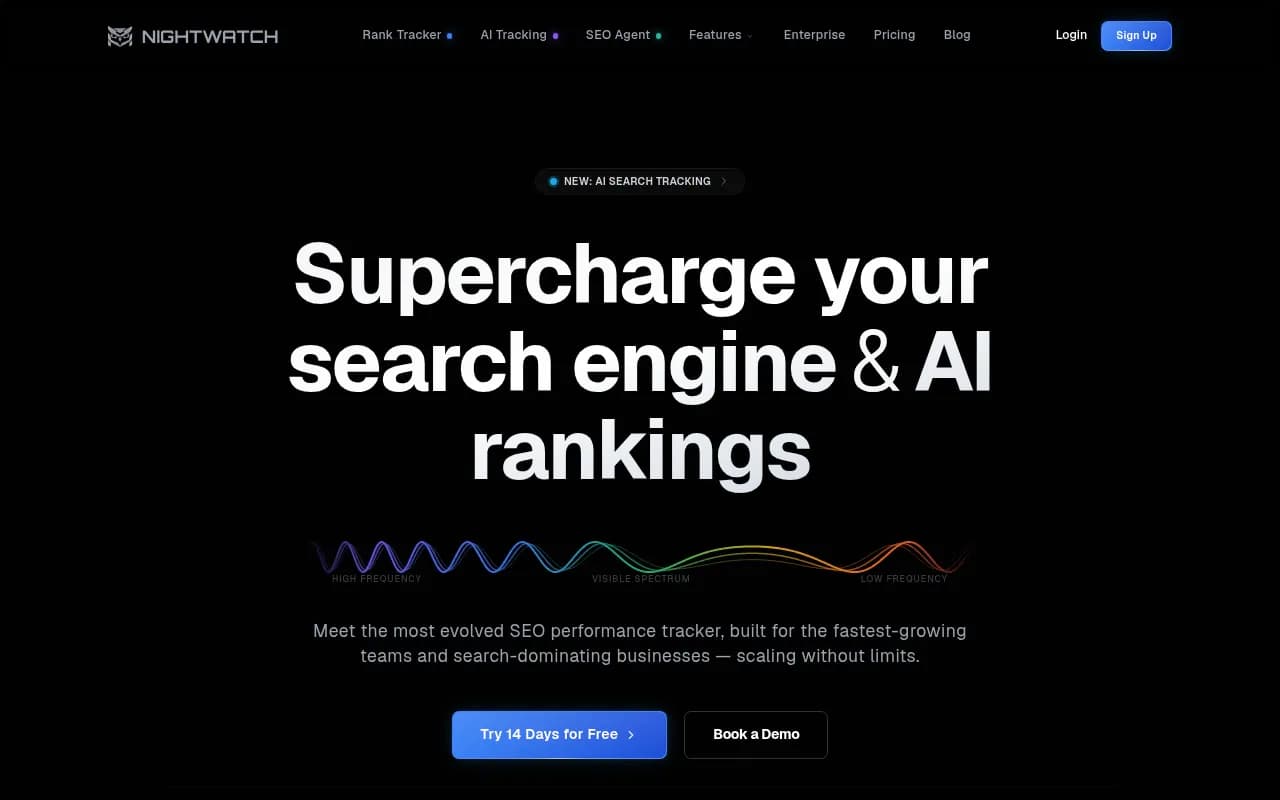
The base plan starts at $39/month with a $99/month AI add-on. It covers ChatGPT, Google AI Overviews, Bing Copilot, Perplexity, and Claude. The zip-code level tracking is a real differentiator for agencies doing local SEO -- you can monitor AI visibility at a hyper-local level that most other tools don't support. If your agency has a lot of local business clients, this is worth serious consideration.
The limitation is that it's still primarily a tracking tool. There's no content generation workflow built in, so you'll need to pair it with something else to turn the data into deliverables.
Scrunch -- best for enterprise clients and content delivery infrastructure
Scrunch has built something genuinely different with its Agent Experience Platform. Rather than just monitoring what AI models say about a brand, it focuses on how AI agents actually consume and interact with your content -- site maps for AI, agent traffic analysis, and optimized content delivery for LLMs.
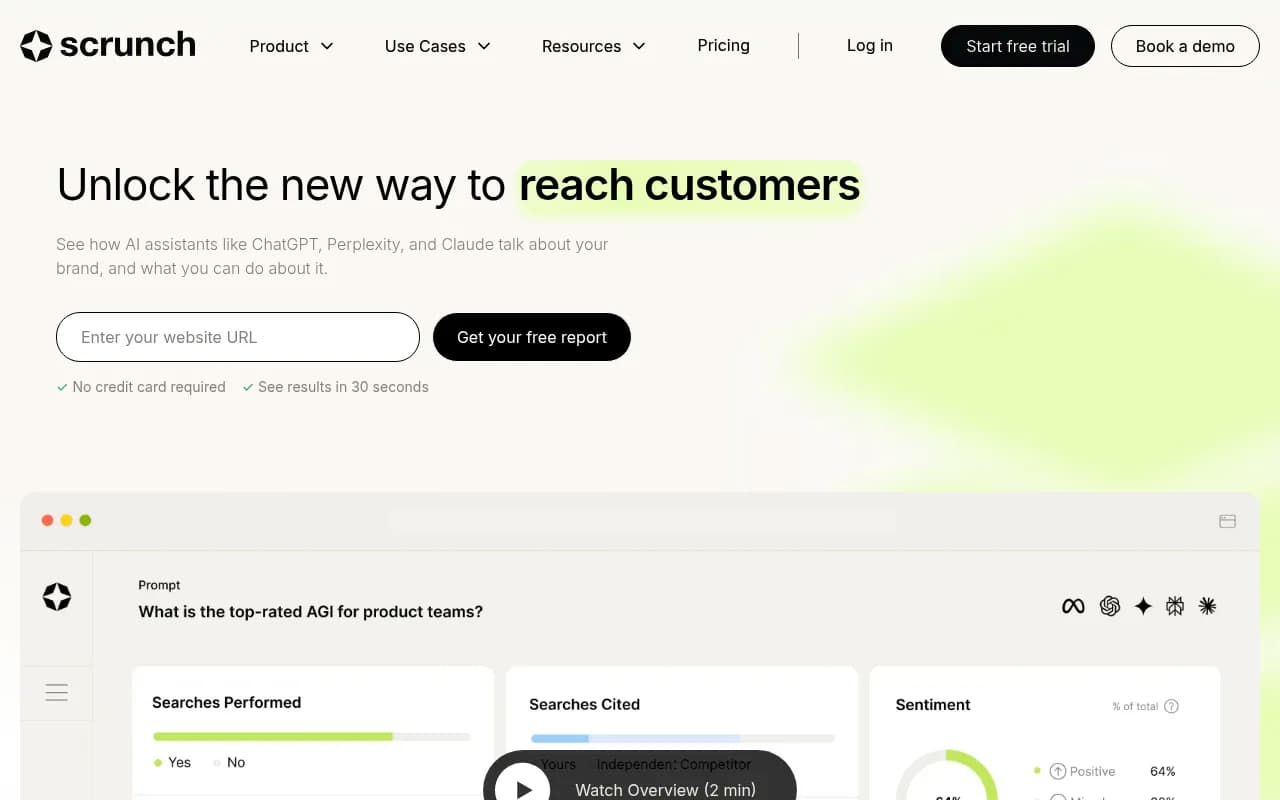
For agencies with enterprise clients who need more than a visibility dashboard, Scrunch's approach is compelling. The shopping-level tracking (seeing AI search performance at the product level) is particularly useful for e-commerce clients. The downside is that it's positioned as an enterprise product, which means pricing and implementation complexity that may not fit smaller agency clients.
SE Visible -- best for agencies that need clean, shareable reporting
SE Visible (from SE Ranking) covers AI Overviews, AI Mode, Gemini, ChatGPT, and Perplexity with a focus on strategic brand visibility insights. The sentiment scoring and competitor share-of-voice tracking make it easy to build client reports that tell a clear story.
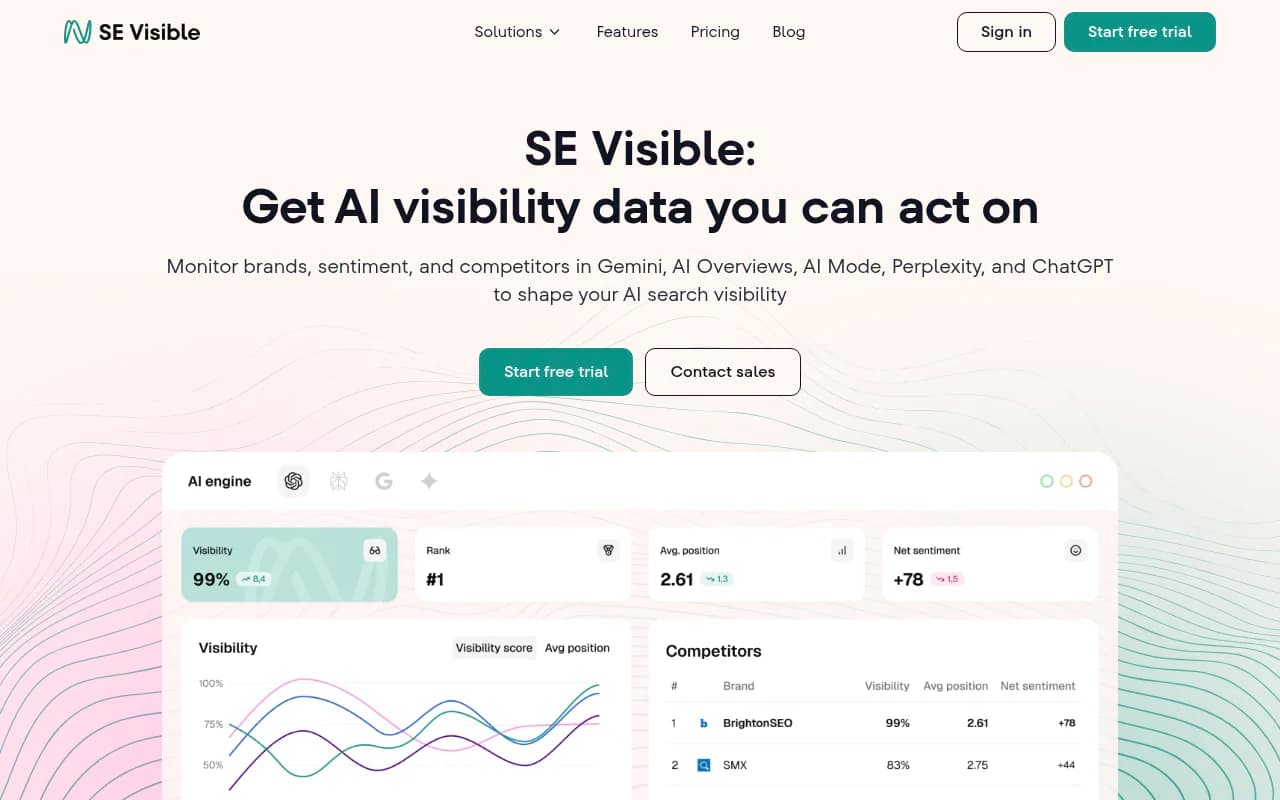
At $99/month, it's competitively priced. The reporting interface is clean enough that you can share it directly with clients without a lot of customization. It's a monitoring-first tool, so like Nightwatch, you'll need a separate workflow for content optimization -- but for agencies where reporting is the primary deliverable, it's a strong option.
Otterly.AI -- best for budget-conscious agencies starting out
Otterly.AI is frequently cited as a good entry point for marketing agencies managing multiple client brands. It's lighter on features than the enterprise options but significantly cheaper, which matters when you're building out a new AEO service offering and don't want to over-invest before you've validated client demand.

The trade-off is that it's a monitoring tool without content generation or deep gap analysis. It shows you data but leaves the "what to do about it" question to you. For agencies that already have strong content workflows and just need visibility data to feed them, that's fine. For agencies that want the tool to do more of the heavy lifting, it'll feel limiting quickly.
AthenaHQ -- best for tracking across a wide range of AI models
AthenaHQ covers 8+ AI search engines with a clean interface and solid competitor tracking. It's monitoring-focused, which puts it in the same category as Otterly.AI in terms of what it can and can't do -- but it covers more AI models than most tools at its price point.

Profound -- best for teams that want deep data without building custom infrastructure
Profound has a strong feature set with detailed analytics and good data depth. It's positioned toward teams that want serious data without having to build their own tracking infrastructure.

The pricing is higher than most tools in this space, and it lacks some features that matter for agencies specifically -- no Reddit tracking, no ChatGPT Shopping monitoring. But if your clients are in categories where AI search data depth matters more than breadth of features, it's worth evaluating.
Peec AI -- best for international agencies
Peec AI's multi-language support makes it the obvious choice for agencies with clients in non-English markets. Most AEO tools are built around English-language AI responses, which creates a real gap for international work.

Rankability -- best for agencies that want research, writing, and optimization in one place
Rankability positions itself as a unified platform connecting research, writing, optimization, and AI visibility tracking. The SPI (Search Performance Index) score attempts to unify traditional, local, AI, citation, and video visibility into a single metric -- which is either exactly what you want for client reporting or an oversimplification, depending on how you think about it.
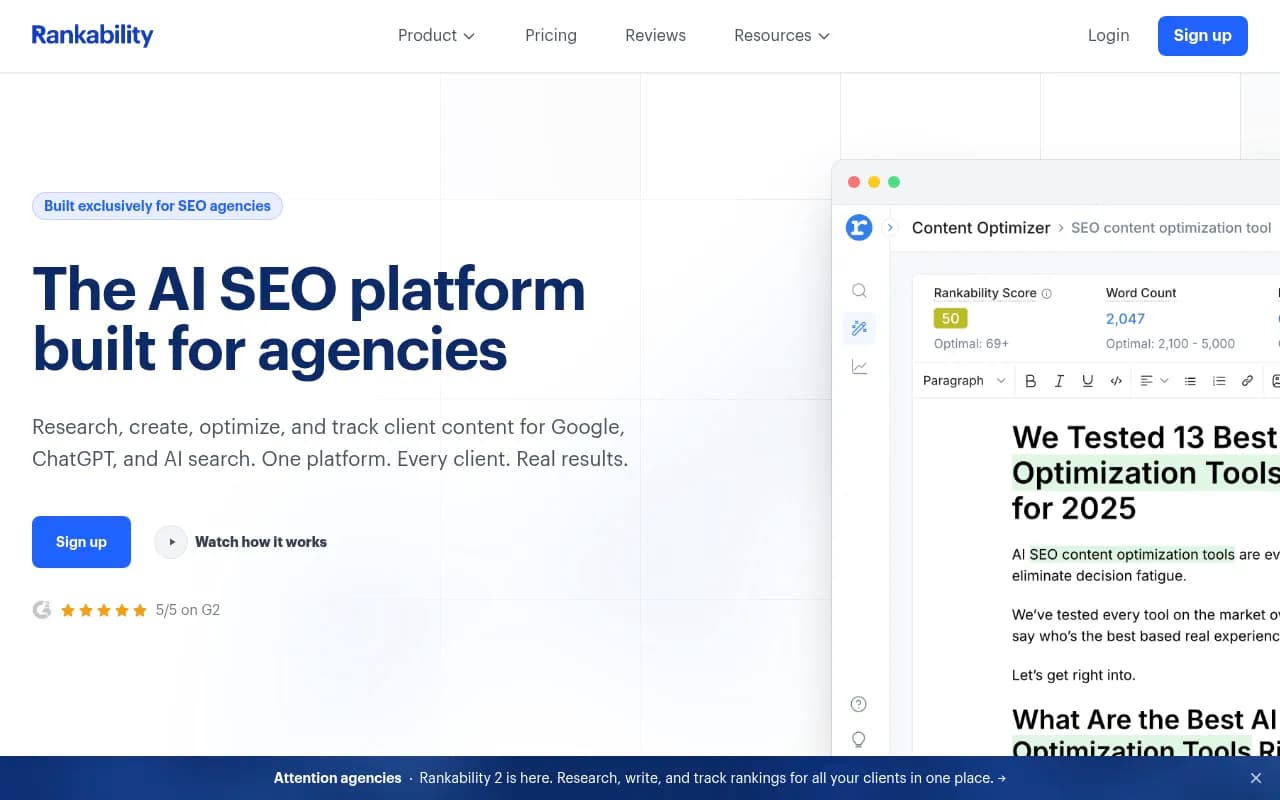
For agencies that want to reduce the number of tools in their stack and don't need the depth of a dedicated AEO platform, it's a reasonable option.
Cairrot -- built specifically for agencies
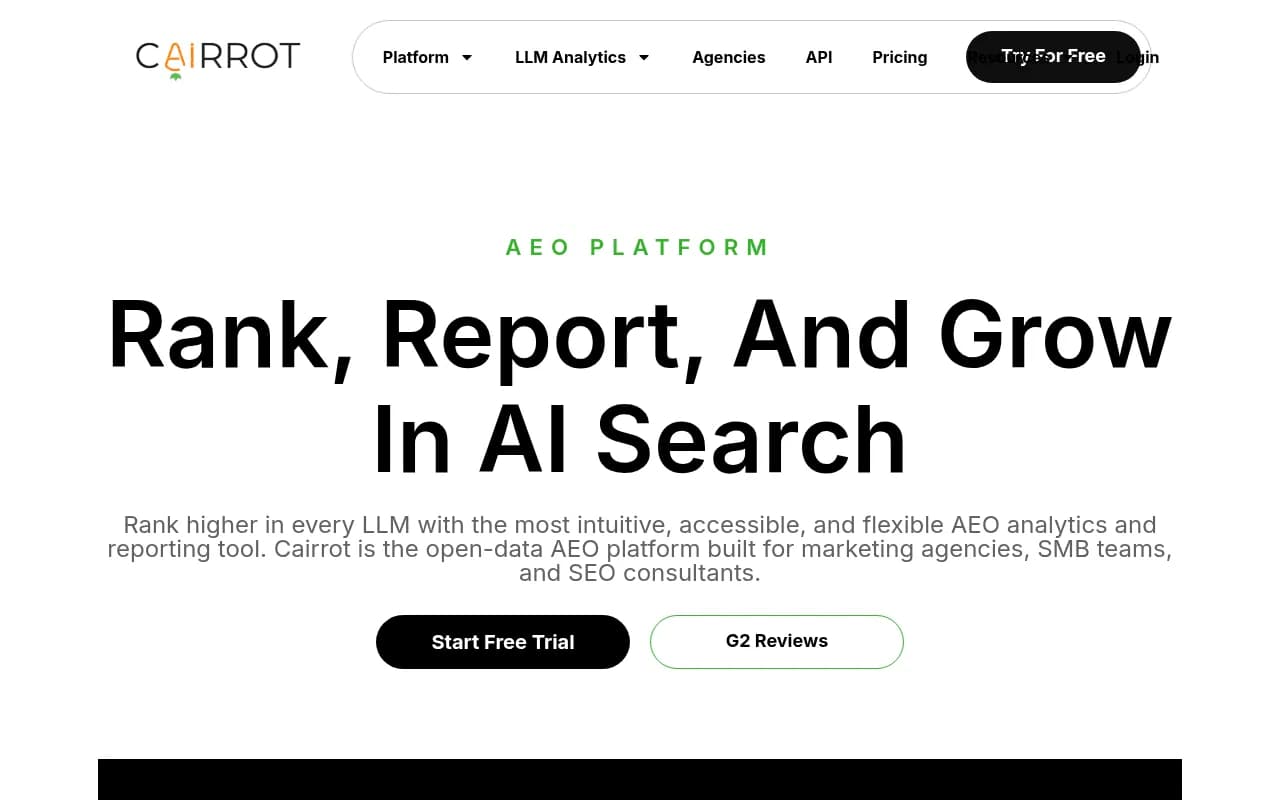
Cairrot is worth mentioning because it's one of the few tools explicitly designed for marketing agencies rather than adapted from a single-brand product. Agency-specific features like client workspace separation and reporting workflows are built in from the start rather than bolted on.
Wellows -- good for smaller agency portfolios
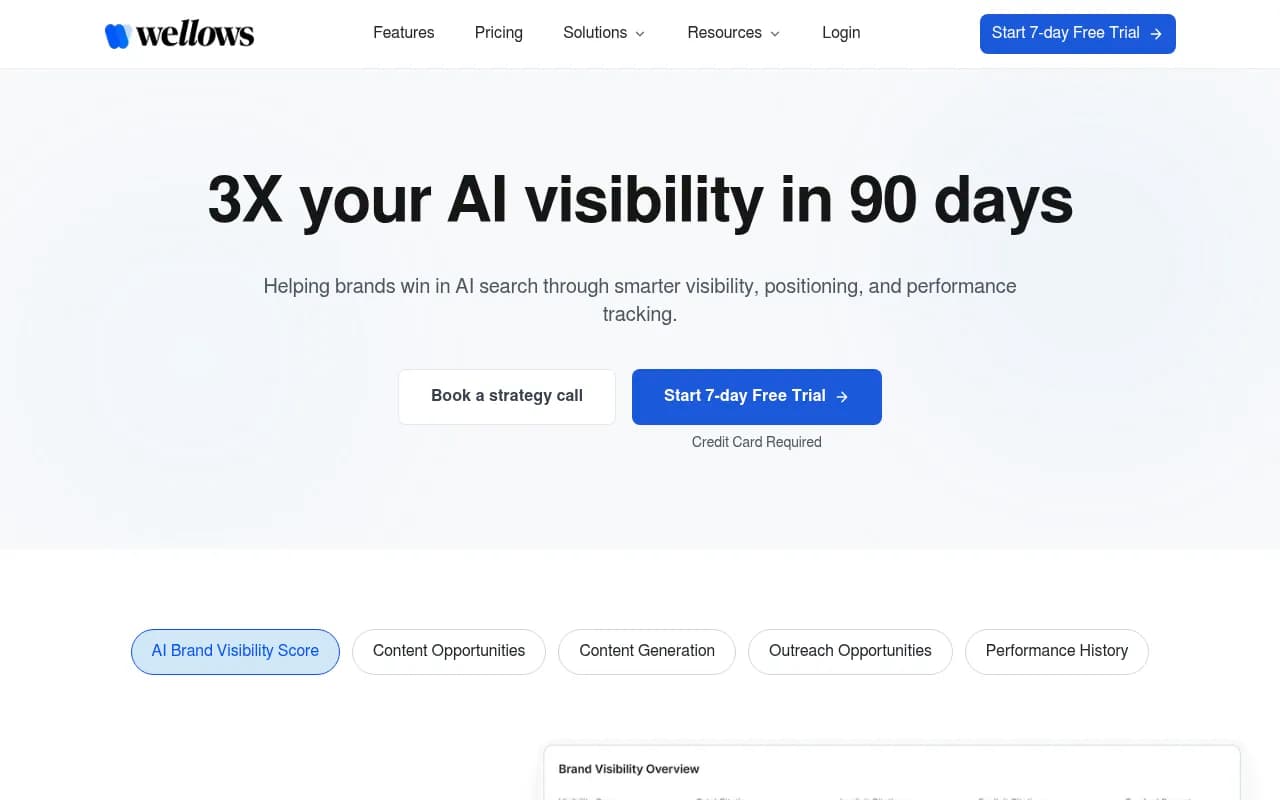
Wellows covers AI search visibility tracking for both brands and agencies, with a simpler interface that works well for smaller portfolios where you don't need enterprise-level complexity.
How these tools compare
Here's a practical comparison across the dimensions that matter most for agency use:
| Tool | Multi-client support | Content generation | AI models covered | Traffic attribution | Starting price | Best for |
|---|---|---|---|---|---|---|
| Promptwatch | Yes (agency plans) | Yes (built-in AI writer) | 10+ (ChatGPT, Claude, Perplexity, Gemini, Grok, DeepSeek, etc.) | Yes (GSC, snippet, logs) | $99/mo | Full-cycle AEO: gap analysis + content + tracking |
| Nightwatch | Yes | No | 5 (ChatGPT, AI Overviews, Copilot, Perplexity, Claude) | Limited | $39/mo + $99 AI add-on | Agencies combining traditional SEO + AI tracking |
| Scrunch | Yes (enterprise) | Partial (content delivery) | Multiple | Yes (agent traffic) | Enterprise pricing | Enterprise clients needing AI content delivery |
| SE Visible | Yes | No | 5 (AIOs, AI Mode, Gemini, ChatGPT, Perplexity) | No | $99/mo | Clean reporting, brand sentiment tracking |
| Otterly.AI | Yes | No | Multiple | No | Budget tier | Entry-level agency AEO monitoring |
| AthenaHQ | Yes | No | 8+ | No | Mid-range | Wide AI model coverage |
| Profound | Yes | No | Multiple | No | Higher tier | Data-heavy enterprise clients |
| Peec AI | Yes | No | Multiple | No | Mid-range | International/multi-language clients |
| Rankability | Yes | Yes (content workflow) | Multiple | Limited | Contact for pricing | Unified research + writing + tracking |
| Cairrot | Yes (agency-first) | No | Multiple | No | Agency pricing | Agencies wanting purpose-built client management |
How to build an agency AEO stack that actually works
The mistake most agencies make is treating AEO as a monitoring problem. They buy a tracking tool, set up dashboards, and report on visibility scores. Clients nod along for a few months and then ask what's actually changed.
The agencies that are winning at AEO in 2026 treat it as a content problem with a measurement layer on top. The workflow looks like this:
- Identify which prompts matter for the client's category and buying journey
- Run gap analysis to find where competitors are visible and the client isn't
- Create content specifically designed to get cited by AI models (not just optimized for Google)
- Track whether that content gets picked up, by which models, and whether it drives traffic
- Report on the full cycle, not just the visibility score
That workflow requires tools that can do more than monitor. It requires prompt intelligence, gap analysis, content generation that's grounded in citation data, and attribution that connects AI visibility to business outcomes.
Tools like Promptwatch are built around exactly that cycle. Most others cover one or two steps and leave you to figure out the rest.
Practical advice for agencies pricing AEO services
A few things worth knowing before you commit to a tool and a pricing model:
Prompt volume limits matter more than you think. Most tools charge by the number of prompts you monitor. An agency with 20 clients, each tracking 50 prompts, needs 1,000 prompt slots. At $249/month for 150 prompts (Promptwatch Professional), you'd need the Business plan or agency pricing. Build this into your client pricing before you sign contracts.
White-label matters for some clients, not all. Smaller clients often don't care what tool you're using. Enterprise clients sometimes do -- they want reports that look like your agency's work, not a vendor dashboard. Check whether the tool supports white-label exports or at minimum clean PDF/CSV exports before committing.
Traffic attribution is the hardest part to get right. Visibility scores are easy to report. Connecting AI visibility to actual revenue is hard. Tools that offer server log analysis or GSC integration give you a much stronger story than tools that only show citation counts.
Don't over-tool early. If you're just starting to offer AEO services, one solid monitoring tool plus a good content workflow is enough. Add depth as you understand what clients actually need from you.
The bottom line
The AEO tool market in 2026 is crowded but still maturing. Most tools do monitoring well. Fewer do optimization. Almost none do the full cycle from gap identification to content creation to traffic attribution out of the box.
For agencies, the tools that will justify their cost are the ones that reduce the time between "we found a visibility gap" and "we shipped content that fixes it." That's the metric worth optimizing for when you're evaluating platforms -- not feature count, not the number of AI models covered, not the dashboard design.
The monitoring-only tools have their place, especially at the entry level. But the agencies building durable AEO practices in 2026 are the ones treating visibility data as an input to a content workflow, not as the final deliverable.