DeepSeeQ Review 2026
AI visibility platform specializing in deep analysis and optimization of brand presence across multiple AI search engines and answer engines
Summary
- Specialized bioinformatics service for NGS data analysis, not an AI visibility platform
- Custom, question-driven analysis rather than standardized pipeline outputs
- Led by biologists with 20+ years of research experience from institutes in India, UK, and USA
- Serves academic and research clients including Indian Institute of Science and CDFD
- Pricing and service details require direct inquiry via email
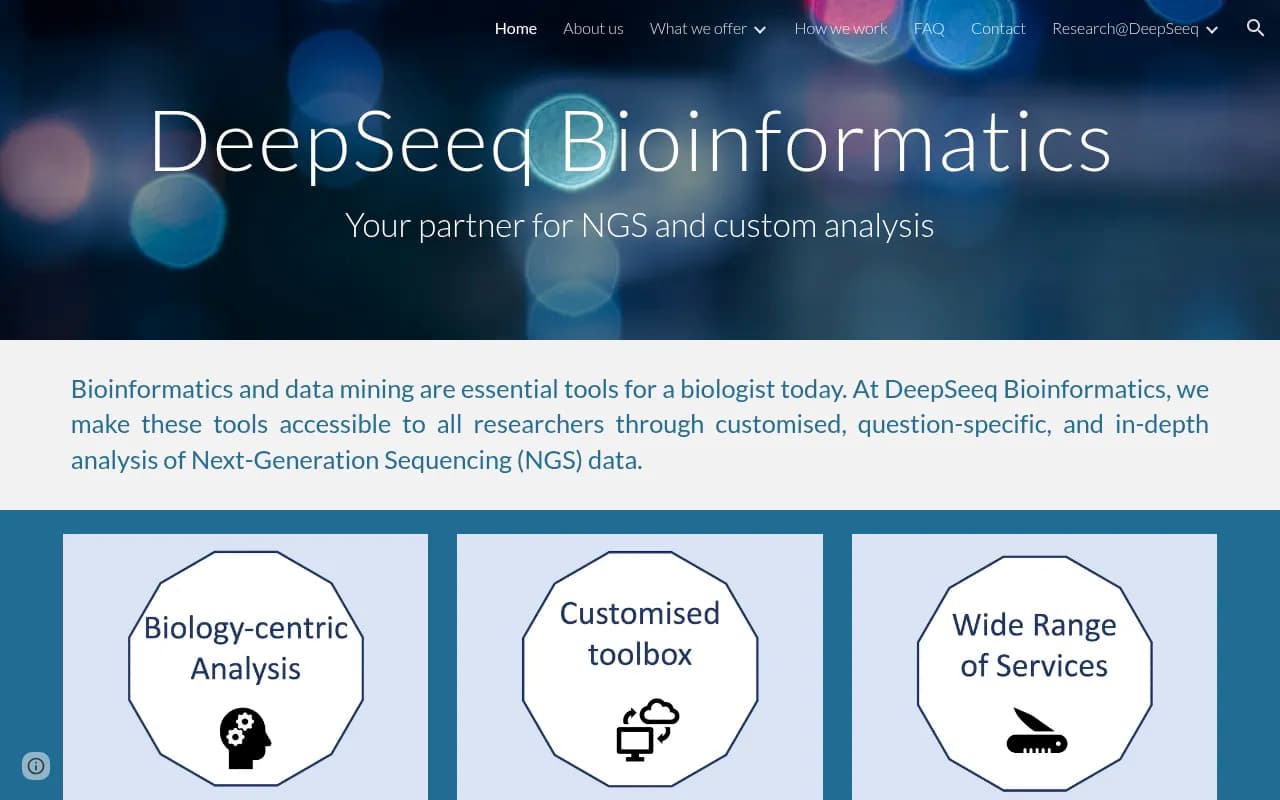
DeepSeeq Bioinformatics is a specialized bioinformatics consulting service that helps biological researchers extract meaningful insights from Next-Generation Sequencing (NGS) data. The company positions itself at the intersection of biology and bioinformatics, offering customized analysis tailored to specific research questions rather than generic pipeline outputs.
The core problem DeepSeeq solves
Modern biological research generates massive amounts of sequencing data, but extracting biologically relevant information from this data requires specialized expertise. Many researchers lack the bioinformatics skills to analyze their own NGS data, and standard analysis pipelines often fail to address the nuances of specific research questions. DeepSeeq bridges this gap by providing expert analysis that interprets data in the context of the biological question being asked.
The target audience is primarily academic researchers, research institutes, and biotechnology labs conducting NGS experiments. Their client list includes scientists from the Indian Institute of Science, Centre for DNA Fingerprinting and Diagnostics (CDFD), Indian Veterinary Research Institute, National Environmental Engineering Research Institute, and St John's Research Institute.
Customized analysis approach
The defining characteristic of DeepSeeq's service is customization. Rather than running data through a standard pipeline and delivering generic results, they begin with a detailed discussion with the client about the research question and the type of output needed. This consultation-first approach means the analysis is designed around what the researcher actually needs to know, not what a standard workflow can produce.
This flexibility extends to working with clients at any step of the analysis pipeline. Some clients may need full end-to-end analysis from raw sequencing files to publication-ready figures. Others may have already completed initial processing and need help with specific downstream analysis or interpretation. DeepSeeq adapts to where the client is in their workflow.
Standard NGS analysis services
DeepSeeq offers analysis for the major types of NGS experiments:
Transcriptome analysis (RNA-seq): Differential gene expression analysis, pathway enrichment, co-expression networks, and alternative splicing analysis. This is one of the most common NGS applications, used to understand which genes are active under different conditions or in different tissues.
ChIP-seq analysis: Analysis of DNA-protein interactions to identify where transcription factors or other proteins bind to the genome. This includes peak calling, motif discovery, and integration with gene expression data.
Small RNA analysis: Analysis of microRNAs, siRNAs, and other small regulatory RNAs. This includes identification of novel small RNAs, target prediction, and differential expression analysis.
Genome assembly: De novo assembly of genomes from sequencing reads, particularly useful for organisms without reference genomes or for identifying structural variations.
Variant calling: Identification of SNPs, indels, and structural variants from whole-genome or exome sequencing data. This is critical for population genetics studies, disease gene identification, and breeding programs.
Custom analysis and data mining
Beyond standard NGS workflows, DeepSeeq offers custom analysis services that go beyond what typical bioinformatics pipelines provide:
Custom database mining: Extracting specific information from biological databases (GenBank, UniProt, Ensembl, etc.) based on particular criteria. This might involve identifying all genes with specific functional annotations, finding orthologs across species, or extracting sequence features for downstream analysis.
Pattern recognition: Identifying specific sequence patterns, motifs, or structural features in genomic or proteomic data. This could include finding regulatory elements, predicting protein domains, or identifying conserved regions across species.
Integration of multiple data types: Combining NGS data with other experimental data (proteomics, metabolomics, phenotypic data) to build comprehensive models of biological systems.
This custom analysis capability is particularly valuable for researchers working on non-model organisms, novel biological questions, or projects that don't fit standard analysis frameworks.
The team and expertise
DeepSeeq is led by biologists with over 20 years of research experience. The founders have worked at reputed research institutes in India, the UK, and the USA, supervised multiple research projects, and authored numerous scientific publications. This research background is a key differentiator -- they understand the biological context and can interpret results in ways that pure bioinformaticians might miss.
The emphasis on being "experienced biologists working at the interface between biology-bioinformatics" is deliberate. Many bioinformatics services are run by computer scientists or statisticians who excel at data processing but may not fully grasp the biological implications. DeepSeeq's team can have scientific discussions with clients, suggest experimental designs, and interpret results in the context of biological mechanisms.
Working process and client interaction
The workflow begins with a detailed consultation to understand the research question, experimental design, and desired outputs. This discussion helps DeepSeeq understand what the client needs to learn from their data, not just what analysis to run.
Analysis is conducted with transparency -- clients receive not just results but also explanations of the methods used, quality control metrics, and interpretation of findings. This educational component helps researchers understand their data and make informed decisions about next steps.
DeepSeeq values thorough, transparent, and timely research. They aim to deliver results within agreed timelines and maintain clear communication throughout the project. The flexibility to work at any step of the pipeline means they can jump in to help with a specific bottleneck or provide full-service analysis from start to finish.
Limitations and considerations
Pricing information is not publicly available on the website. Potential clients need to contact DeepSeeq directly via email ([email protected]) to discuss project scope and get a quote. This makes it difficult to budget for services without initial consultation.
The website provides limited detail about specific analysis methods, software tools used, or example outputs. Researchers evaluating the service would benefit from seeing sample reports or case studies demonstrating the depth and quality of analysis.
There is no information about turnaround times, project capacity, or how many projects the team can handle simultaneously. For researchers with tight publication deadlines, understanding typical timelines would be valuable.
The service appears to be primarily focused on the Indian research market based on the client list, though there's no indication they're limited to working with Indian institutions. International researchers may want to clarify time zone compatibility and communication preferences.
No information is provided about data security, confidentiality agreements, or how unpublished data is handled. For researchers working on sensitive or proprietary projects, these details would be important to establish upfront.
Who should use DeepSeeq
DeepSeeq is best suited for biological researchers who have generated NGS data but lack the bioinformatics expertise to analyze it themselves. This includes:
- Academic researchers at universities and research institutes who need expert analysis for publications
- PhD students and postdocs who have sequencing data but limited computational skills
- Small biotech companies without in-house bioinformatics teams
- Researchers working on non-model organisms or novel biological questions that don't fit standard pipelines
- Scientists who need custom analysis or database mining beyond what standard tools provide
The service is particularly valuable for researchers who want to have scientific discussions about their data with someone who understands both the biology and the computational methods. The consultation-driven approach means you're not just getting data processing -- you're getting interpretation and insight.
DeepSeeq may not be the best fit for large-scale projects requiring high-throughput analysis of hundreds of samples, or for organizations that need ongoing bioinformatics support rather than project-based consulting. Researchers with straightforward analysis needs that fit standard pipelines might find faster or more cost-effective options through automated platforms.
Bottom line
DeepSeeq Bioinformatics offers expert, customized NGS data analysis for biological researchers who need more than standard pipeline outputs. The combination of deep biological expertise and bioinformatics skills makes them particularly valuable for complex or non-standard projects. Best for academic researchers and small labs that need thoughtful, question-driven analysis and interpretation of their sequencing data.
Similar and alternative tools to DeepSeeQ