Summary
- AI search engines (ChatGPT, Perplexity, Google AI Overviews) now drive 4,700% more shopping traffic and 3,500% more travel searches than a year ago -- if your brand isn't showing up in AI-generated answers, you're invisible to a massive segment of potential customers
- The three core steps: audit your current AI visibility to find gaps, optimize your content and data so AI models can read and cite you, then track results with page-level attribution to close the feedback loop
- Structured data (schema markup, product identifiers, FAQ schemas), third-party citations from trusted sources, and clear entity definitions (Wikidata, Wikipedia) are the new ranking signals -- AI models prioritize sources they can verify and understand
- Unlike traditional SEO where you optimize for keywords, AI search optimization (GEO/AEO) requires optimizing for prompts, personas, and citability -- you need content that answers real questions in formats AI models prefer
- Monitoring tools like Promptwatch help you see which pages AI models cite, which prompts you're missing, and where competitors are beating you -- then generate content to fill those gaps

The shift from search results to AI-generated answers
Google's AI Overviews now appear in 15% of all searches. ChatGPT processes 1 billion queries per week. Perplexity handles 100 million searches monthly. These aren't experimental features anymore -- they're how millions of people discover brands, compare products, and make purchasing decisions.
The problem: most companies have no idea if they're showing up in these AI-generated answers. You can rank #1 on Google for a keyword and still be completely absent from ChatGPT's response to the same query. AI models don't crawl the web the way Google does. They don't rank pages by backlinks. They cite sources based on trustworthiness, clarity, and how well your content matches the structure they expect.
If your brand isn't optimized for AI search, you're losing visibility to competitors who are.
Step 1: Audit your current AI visibility
You can't fix what you can't measure. Start by understanding where your brand appears (or doesn't appear) in AI-generated responses.
Run manual spot checks
Open ChatGPT, Claude, Perplexity, and Google (in AI Overview mode). Search for prompts your customers would actually use:
- "Best [your product category] for [use case]"
- "[Your brand name] vs [competitor name]"
- "How to [solve problem your product addresses]"
- "Top [product type] companies in [your region]"
Does your brand show up? If yes, what does the AI say about you? If no, which competitors are being cited instead?
This gives you a baseline. Manual checks are free but time-consuming and don't scale.
Use AI visibility tracking tools
For systematic monitoring, you need a platform that tracks AI citations across models. Promptwatch monitors 10 AI engines (ChatGPT, Perplexity, Google AI Overviews, Claude, Gemini, Meta AI, DeepSeek, Grok, Mistral, Copilot) and shows you:
- Which prompts your brand appears in (and which ones competitors dominate)
- Page-level citation data -- exactly which URLs AI models are citing
- Visibility scores over time so you can track improvement
- Answer Gap Analysis that shows prompts competitors rank for but you don't
Other tools worth considering:


| Tool | Models tracked | Content generation | Crawler logs | Starting price |
|---|---|---|---|---|
| Promptwatch | 10 (ChatGPT, Perplexity, Google AI, Claude, Gemini, Meta, DeepSeek, Grok, Mistral, Copilot) | Yes (AI writing agent) | Yes | $99/mo |
| Otterly.AI | 4 (ChatGPT, Perplexity, Gemini, Claude) | No | No | $49/mo |
| AthenaHQ | 8+ | No | No | $99/mo |
| Peec.ai | 5 (ChatGPT, Perplexity, Gemini, Claude, Bing) | No | No | $79/mo |
The key difference: most tools stop at monitoring. Promptwatch includes Answer Gap Analysis (shows you exactly which content you're missing) and an AI writing agent that generates articles engineered to get cited by AI models. That's the difference between a dashboard and an optimization platform.
Identify your visibility gaps
Once you have tracking in place, look for patterns:
- Which product categories or topics are you invisible in?
- Which competitors consistently outrank you?
- Are you cited for branded searches but missing from category searches?
- Do certain AI models favor you while others ignore you?
These gaps tell you where to focus your optimization efforts.
Step 2: Optimize your content and data for AI citability
AI models don't just scrape your homepage and call it a day. They look for specific signals that indicate your content is trustworthy, structured, and worth citing.
Fix your entity and structured data
AI models need to understand what your company is and what it does. Start with the basics:
Wikidata and Wikipedia: If your brand has a Wikipedia page, make sure it's accurate and up to date. If you don't have one, create a Wikidata entry with your company name, industry, founding date, and key facts. AI models use Wikidata as a source of truth for entity information.
Schema markup: Add Organization schema to your homepage. Include your name, logo, address, contact info, and social profiles. For product pages, use Product schema with complete attributes: SKU, brand, price, availability, reviews, images. AI models prioritize pages with structured data because it's easier to parse.
FAQ schema: If you have an FAQ page, mark it up with FAQPage schema. AI models love FAQ content because it directly answers questions -- exactly what they're trying to do.
Here's a basic Organization schema example:
{
  "@context": "https://schema.org",
  "@type": "Organization",
  "name": "Your Company Name",
  "url": "https://yourcompany.com",
  "logo": "https://yourcompany.com/logo.png",
  "contactPoint": {
    "@type": "ContactPoint",
    "telephone": "+1-555-555-5555",
    "contactType": "Customer Service"
  },
  "sameAs": [
    "https://twitter.com/yourcompany",
    "https://linkedin.com/company/yourcompany"
  ]
}
Build third-party citations
AI models trust external validation. A single mention in a trusted publication can do more for your AI visibility than 100 blog posts on your own site.
Focus on:
- Industry publications: Get featured in trade journals, industry reports, and expert roundups
- Reddit and forums: Participate authentically in relevant subreddits. AI models cite Reddit heavily because it surfaces real user opinions
- YouTube: Product reviews and tutorials on YouTube influence AI recommendations. Encourage customers and influencers to create video content about your product
- Review sites: G2, Capterra, Trustpilot, Google Business Profile reviews all feed into AI models' understanding of your brand
- News coverage: Press mentions in reputable outlets signal authority
Promptwatch's Reddit and YouTube insights show you which discussions are influencing AI recommendations -- a channel most competitors ignore entirely.
Create content that AI models want to cite
AI-generated answers pull from content that directly answers questions. That means:
Write for prompts, not keywords: Traditional SEO optimizes for "best project management software." AI search optimization (GEO/AEO) optimizes for "what's the best project management tool for remote teams with under 20 people?" -- longer, more specific, more conversational.
Use clear headings and structure: AI models scan for headings that match the user's question. If someone asks "How does X work?" and your page has a heading "How X Works," you're more likely to get cited.
Provide complete, factual answers: Vague marketing copy doesn't get cited. Specific details, numbers, comparisons, and step-by-step explanations do.
Include comparisons and alternatives: AI models love comparison content. "X vs Y" articles, feature comparison tables, and "best alternatives to Z" guides perform well.
Embed rich media: Screenshots, diagrams, and videos make your content more useful and more likely to be cited.
Promptwatch's AI writing agent generates articles grounded in real citation data (880M+ citations analyzed), prompt volumes, persona targeting, and competitor analysis. This isn't generic SEO filler -- it's content engineered to get cited by ChatGPT, Claude, Perplexity, and other AI models.
Optimize for Google AI Overviews specifically
Google's AI Overviews pull from a mix of sources: featured snippets, knowledge panels, and high-authority pages. To increase your chances:
- Target long-tail keywords with clear question-based intent
- Structure content with concise, direct answers in the first paragraph
- Use lists, tables, and bullet points -- AI Overviews love scannable formats
- Optimize for featured snippets (paragraph, list, or table format)
- Build topical authority by covering related subtopics in depth
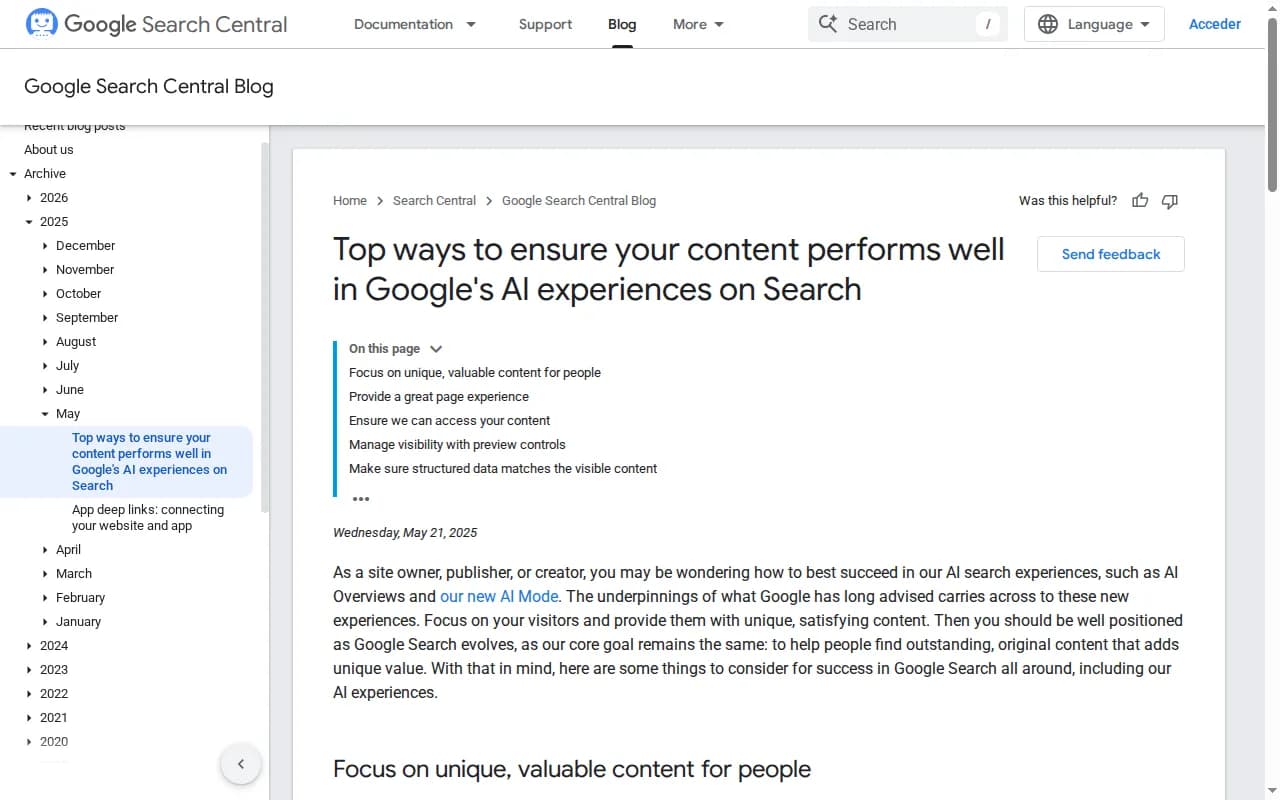
Google's own guidance (from their Search Central Blog) is simple: "Focus on your visitors and provide them with unique, satisfying content. Then you should be well positioned as Google Search evolves."
Make sure AI crawlers can access your content
AI models send crawlers to read your website. If they can't access your pages, you won't get cited.
Check your robots.txt: Make sure you're not blocking AI crawlers. Common user-agents to allow:
GPTBot(OpenAI/ChatGPT)Claude-Web(Anthropic/Claude)PerplexityBot(Perplexity)Google-Extended(Google's AI training crawler)Bytespider(ByteDance/TikTok)Applebot-Extended(Apple Intelligence)
Monitor crawler activity: Promptwatch's AI Crawler Logs show you in real-time which AI crawlers are hitting your site, which pages they're reading, errors they encounter, and how often they return. Most competitors lack this entirely. If you see errors or low crawl frequency, you know there's a problem.
Fix technical issues: Broken links, slow load times, and poor mobile experience hurt your AI visibility just like they hurt traditional SEO.
Step 3: Track results and close the feedback loop
Optimization without measurement is guesswork. You need to know what's working.
Monitor visibility scores over time
Track your brand's citation frequency across AI models. Are you showing up more often this month than last month? Are your visibility scores improving?
Promptwatch shows visibility trends over time and breaks them down by AI model, so you can see if your optimization efforts are paying off.
Track page-level citations
Which specific pages are AI models citing? If you published a new comparison guide, is it getting picked up? If not, why?
Page-level tracking tells you which content formats and topics work. Double down on what's getting cited.
Connect AI visibility to traffic and revenue
The ultimate question: is AI search driving actual business results?
Promptwatch offers three ways to attribute traffic:
- Code snippet: Add a tracking script to your site to see which visitors came from AI search engines
- Google Search Console integration: Connect GSC to see AI-driven organic traffic
- Server log analysis: Parse server logs to identify AI referral traffic
This closes the loop. You can see which prompts drive visibility, which pages get cited, and which citations convert into traffic and revenue.
Use competitive heatmaps to prioritize
Promptwatch's competitor heatmaps show you where competitors are winning and where you have opportunities. If a competitor dominates a high-value prompt, analyze their content and figure out why AI models prefer it.
Then create something better.
Advanced tactics: Reddit, YouTube, and ChatGPT Shopping
Most companies focus on their own website and ignore the channels AI models actually cite.
Reddit optimization
AI models cite Reddit constantly. Perplexity and ChatGPT pull heavily from subreddit discussions. If your product is mentioned positively in a relevant subreddit, that citation can drive significant visibility.
Tactics:
- Participate authentically in relevant subreddits (no spam, no self-promotion)
- Answer questions and provide value
- Encourage satisfied customers to share their experiences on Reddit
- Monitor Reddit mentions with Promptwatch's Reddit insights
YouTube optimization
Product reviews, tutorials, and comparison videos on YouTube influence AI recommendations. AI models cite YouTube videos as sources.
Tactics:
- Create product demo videos and tutorials
- Encourage influencers and customers to review your product on YouTube
- Optimize video titles and descriptions for prompt-based queries
- Monitor YouTube mentions with Promptwatch's YouTube insights
ChatGPT Shopping tracking
ChatGPT now includes shopping recommendations and product carousels. If you sell physical products, this is a massive opportunity.
Promptwatch tracks when your brand appears in ChatGPT's shopping results. Monitor this closely and optimize product listings (descriptions, images, pricing, availability) to increase your chances of being recommended.
Common mistakes to avoid
Mistake 1: Treating AI search like traditional SEO
Keyword density and backlinks matter less. Citability, structured data, and third-party mentions matter more.
Mistake 2: Ignoring third-party sources
Your website alone won't cut it. AI models trust external validation. Get cited in industry publications, Reddit, YouTube, and review sites.
Mistake 3: Writing for robots instead of humans
AI models prioritize content that's genuinely helpful to humans. Generic, keyword-stuffed content gets ignored.
Mistake 4: Not tracking results
You can't optimize what you don't measure. Use a tracking platform to monitor visibility, citations, and traffic.
Mistake 5: Blocking AI crawlers
Check your robots.txt. If you're blocking GPTBot, Claude-Web, or PerplexityBot, you're invisible by choice.
Tools to help you succeed
Here's a breakdown of tools that support different parts of the AI visibility workflow:
| Tool | Best for | Key feature |
|---|---|---|
| Promptwatch | End-to-end AI search optimization | Answer Gap Analysis + AI content generation + crawler logs |
| Semrush | Traditional SEO + basic AI Overview tracking | All-in-one SEO platform with limited AI search features |
| Clearscope | Content optimization for Google and AI | Content scoring and optimization recommendations |
| Ahrefs Brand Radar | Brand monitoring in AI search | Tracks brand mentions across AI models |
| Otterly.AI | Affordable AI visibility monitoring | Basic tracking across 4 AI models |
For most companies, Promptwatch is the best choice because it's the only platform that combines monitoring, content gap analysis, AI content generation, and crawler logs in one place. Most competitors stop at monitoring -- they show you data but leave you stuck. Promptwatch helps you take action.
The action loop: find gaps, create content, track results
Here's the cycle that actually improves AI visibility:
-
Find the gaps: Use Answer Gap Analysis to see which prompts competitors are visible for but you're not. Identify the specific content your website is missing.
-
Create content that ranks in AI: Use the AI writing agent to generate articles, listicles, and comparisons grounded in real citation data, prompt volumes, and competitor analysis. This is content engineered to get cited by ChatGPT, Claude, Perplexity, and other AI models.
-
Track the results: Monitor your visibility scores as AI models start citing your new content. Use page-level tracking to see which pages are being cited and how often. Connect visibility to traffic with attribution tools.
Repeat the loop. This is what separates optimization platforms from monitoring-only dashboards.
Final thoughts
AI search isn't replacing traditional search -- it's adding a new layer on top of it. Customers still use Google, but now they also ask ChatGPT, Perplexity, and Claude for recommendations. If your brand isn't showing up in AI-generated answers, you're invisible to a growing segment of your audience.
The good news: most companies haven't figured this out yet. You have a window to get ahead. Start with an audit, fix your structured data and entity definitions, build third-party citations, create content optimized for prompts, and track your results.
The brands that win in AI search are the ones that take action now.