Key takeaways
- Promptwatch is the strongest all-around alternative -- it monitors 10+ AI models, includes AI crawler logs, content gap analysis, and a built-in content generation agent. The only platform that closes the full loop from gap identification to content creation to traffic attribution.
- AthenaHQ is worth considering for US-based enterprise teams that want a polished monitoring dashboard and are backed by Y Combinator, but it's monitoring-heavy with less emphasis on content creation.
- Otterly.AI is the budget pick -- solid for small teams or agencies that just need basic brand mention tracking without spending a lot.
- Peec AI suits multilingual teams that need to track AI visibility across multiple countries and languages at a reasonable price point.
- Profound is the enterprise-grade option with deep prompt volume data and AI agents, but pricing is opaque and likely starts in the thousands per month.
- Semrush makes sense if you're already paying for it -- the AI Visibility add-on is decent, but it's not a dedicated GEO platform and uses fixed prompts.
- Search Party is not really a GEO tool -- it's an AI automation consultancy, so it belongs in a different category entirely.
- Scrunch AI is a viable mid-market option but lacks the depth of Promptwatch or Profound at a similar price point.
Meteoria is a French GEO platform that launched with a clear pitch: measure, compare, and optimize how your brand appears in AI-generated responses. It covers ChatGPT, Google AI Overview, Perplexity, Gemini, and Grok, and it's priced accessibly for European marketing teams -- starting at €75/month for 25 prompts.
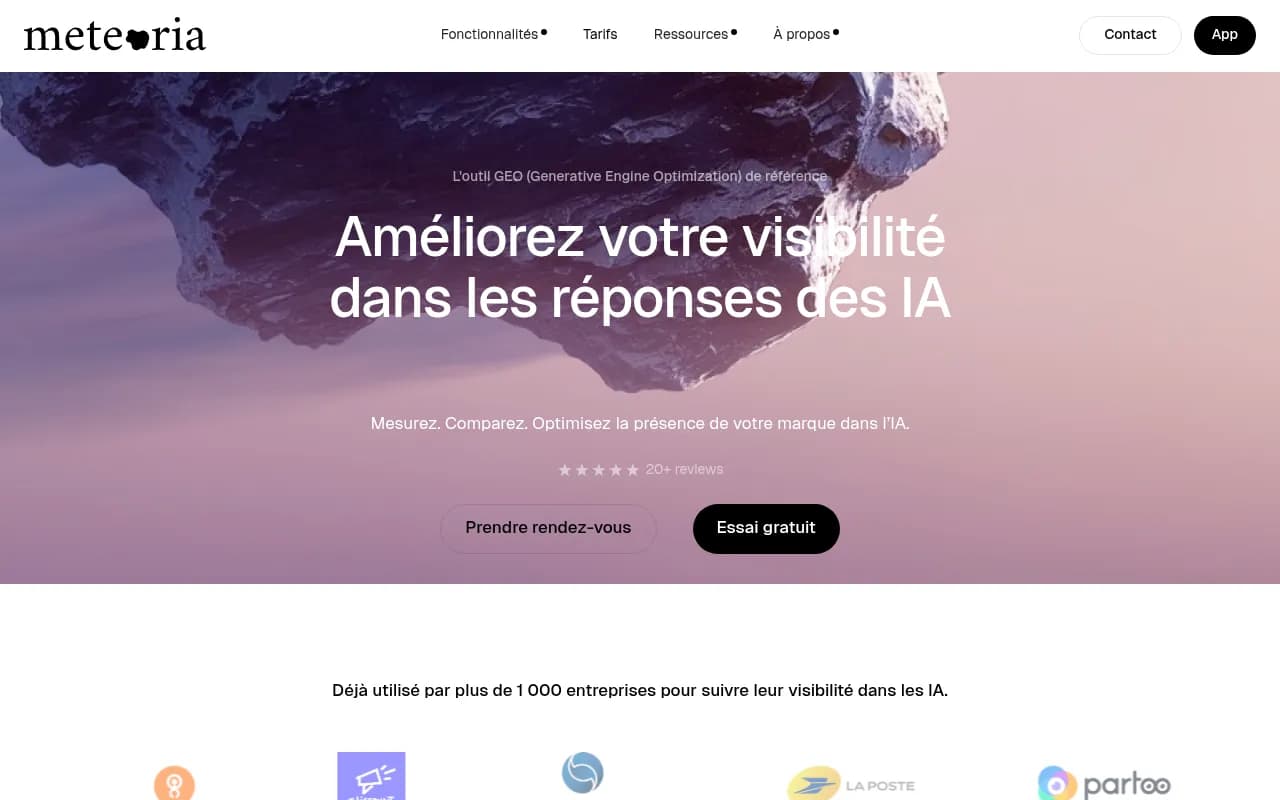
That said, there are real reasons you might be looking elsewhere. Meteoria's prompt limits are tight at lower tiers (25 prompts on Basic is not much if you're tracking a competitive category). The platform is primarily French-language in its interface and marketing, which can be a friction point for international teams. And like many monitoring tools in this space, it's stronger on measurement than on helping you actually do something with what you find. If you want to go beyond dashboards and start fixing your AI visibility gaps, you'll likely hit a ceiling.
Here's how the main alternatives stack up.
Promptwatch

Promptwatch is the most complete GEO platform available right now. Where Meteoria focuses on measuring and comparing, Promptwatch adds a third layer that most tools skip entirely: actually helping you fix the problem.
The core workflow is: find your gaps, create content to fill them, then track whether it worked. The Answer Gap Analysis shows you exactly which prompts competitors rank for in AI responses that you don't -- not just "you're invisible here" but "here's the specific content your site is missing." Then the built-in AI writing agent generates articles, listicles, and comparison pages grounded in real citation data from 880M+ analyzed citations. After publishing, page-level tracking shows which of your pages are being cited by which AI models, and by how much.
That loop -- gap analysis, content creation, result tracking -- is what separates Promptwatch from monitoring-only tools. Meteoria can tell you your visibility score. Promptwatch tells you why it's low and gives you a path to improve it.
A few things Promptwatch has that Meteoria doesn't:
- AI Crawler Logs: real-time logs of when ChatGPT, Claude, Perplexity, and others crawl your site, which pages they read, and what errors they hit. This is genuinely useful for diagnosing indexing issues.
- Reddit and YouTube tracking: surfaces discussions that influence AI recommendations, a channel most tools ignore.
- ChatGPT Shopping tracking: monitors when your brand appears in ChatGPT's product recommendation carousels.
- Query fan-outs: shows how one prompt branches into sub-queries, so you can understand the full scope of what you need to cover.
- Traffic attribution: connects AI visibility to actual website traffic via a code snippet, Google Search Console integration, or server log analysis.
Promptwatch monitors 10 AI models (ChatGPT, Perplexity, Google AI Overviews, Google AI Mode, Claude, Gemini, Meta/Llama, DeepSeek, Grok, Mistral, Copilot) versus Meteoria's five.
Pricing: $99/mo (Essential, 1 site, 50 prompts), $249/mo (Professional, 2 sites, 150 prompts, crawler logs), $579/mo (Business, 5 sites, 350 prompts). That's slightly more than Meteoria's Basic tier in dollar terms, but the prompt limits are more generous and the feature set is substantially deeper.
Best for: Marketing teams and agencies that want to actually improve their AI visibility, not just monitor it. If you're serious about GEO as a growth channel, Promptwatch is the most actionable platform available.
AthenaHQ

AthenaHQ came out of Y Combinator and has been featured in Forbes and the Wall Street Journal. It tracks 8+ AI models and positions itself as an "end-to-end AEO and GEO platform" -- though in practice it leans more toward monitoring and analysis than content creation.
Compared to Meteoria, AthenaHQ has a more polished enterprise feel. The dashboard is built around different team roles (AEO managers, CMOs, SEO specialists, PR teams), and it includes citation source analysis, competitor benchmarking, and automated content optimization recommendations. Clients include Coinbase, Volkswagen, and ZoomInfo, which signals it's targeting larger organizations.
Where it falls short relative to Promptwatch: there's no built-in content generation agent, no AI crawler logs, and no Reddit or YouTube tracking. The content optimization recommendations are suggestions, not an actual writing tool. It's a strong monitoring platform that tells you where you stand but leaves the "what to do about it" question largely to you.
Pricing is a real issue. Self-serve starts at $295/month (or $95/month on annual billing, which seems like a significant discount that may reflect the platform's current growth stage). There's no free trial, which is a meaningful barrier when Meteoria offers 7 days free and Promptwatch also offers a trial.
Best for: Enterprise marketing teams in the US that want a well-designed monitoring dashboard and are comfortable doing their own content strategy work on top of the data.
Semrush
Semrush is a different kind of tool. It's a full digital marketing suite -- SEO, PPC, content, social, competitive intelligence -- that added AI visibility tracking as a module. If you're already paying for Semrush, the AI Visibility Toolkit ($99/month add-on) is worth enabling. If you're not, buying Semrush primarily for GEO doesn't make much sense.
The AI Visibility features cover brand monitoring across ChatGPT, Perplexity, Gemini, and Google AI Overviews. You get sentiment analysis, competitor perception data, and tips to improve your strategy. It also has an AI PR module for finding media outlets trusted by LLMs and launching outreach campaigns, which is a genuinely useful angle that most dedicated GEO tools don't cover.
The limitations are real though. Semrush uses fixed prompts rather than letting you define your own, which means you're tracking what Semrush thinks is relevant rather than what's actually strategic for your business. There's no AI traffic attribution, no crawler logs, and no content generation specifically engineered for AI citation. It's a broad tool doing GEO as one of many things, not a platform built from the ground up for this problem.
Pricing: Semrush One starts at $165/month (annual billing) plus the $99/month AI Visibility add-on, so you're looking at $264/month minimum for the full package. That's more expensive than Meteoria's Pro tier and comparable to Promptwatch's Professional plan, but with less GEO depth.
Best for: Teams already using Semrush for traditional SEO who want to add basic AI visibility tracking without switching tools. Not the right choice if GEO is your primary focus.
Otterly.AI

Otterly.AI is the most affordable dedicated GEO monitoring tool in this comparison. At $29/month for the Lite plan (15 prompts) and $189/month for Standard (100 prompts), it's significantly cheaper than Meteoria at comparable prompt volumes.
The feature set covers the basics well: brand mention tracking, website citation tracking, share of voice across ChatGPT, Google AI Overviews, Perplexity, Google AI Mode, Gemini, and Copilot. It also has a GEO Audit tool that analyzes 25+ on-page factors to identify what's holding your site back from earning more citations -- a useful feature that goes slightly beyond pure monitoring.
What it doesn't have: no content generation, no AI crawler logs, no traffic attribution, no Reddit or YouTube tracking. It's a monitoring tool, and a good one for the price, but it won't help you create content that ranks in AI search. You'll need to take the insights and act on them yourself.
The 14-day free trial is generous compared to Meteoria's 7 days.
Best for: Small businesses, solo marketers, or agencies managing multiple clients on a tight budget who need basic AI visibility data without the overhead of a more complex platform.
Peec AI

Peec AI is a solid mid-range option with a particular strength in multilingual and multi-region tracking. If you need to monitor AI visibility across multiple countries and languages -- say, tracking how ChatGPT responds to prompts in French, German, and Spanish simultaneously -- Peec AI handles this more naturally than most alternatives.
The platform tracks visibility, position, and sentiment across ChatGPT, Perplexity, and Gemini. It has a clean interface and is trusted by 2,000+ marketing teams. Pricing starts at €89/month (Starter), €199/month (Professional), with enterprise custom pricing -- comparable to Meteoria's Pro tier.
The gap compared to Promptwatch or Profound is the same story: it's monitoring-focused. There's no content generation, no crawler logs, no traffic attribution. The "smart suggestions" it offers are lightweight compared to a full content gap analysis. But for what it is -- a clean, multilingual AI visibility tracker -- it does the job.
Best for: European marketing teams or international brands that need multi-language AI visibility tracking and want a clean, straightforward interface without a lot of extra complexity.
Profound

Profound is the enterprise-grade option in this space. It's used by MongoDB, Ramp, and Zapier, and it's built for marketing teams that are treating AEO/GEO as a serious strategic priority with dedicated headcount and budget.
The platform has genuine depth. Prompt Volumes shows you what millions of people are actually asking AI models, which is useful for prioritizing which topics to target. Agent Analytics tracks AI crawler behavior. The Agents feature builds automated content workflows -- FAQ generators, article outlines, optimization pipelines -- that run autonomously. It covers ChatGPT, Perplexity, Claude, Gemini, Grok, Copilot, Meta AI, DeepSeek, and Google AI Overviews.
The problem is access. Profound doesn't publish pricing, and based on the enterprise positioning, you're likely looking at $1,000-$3,000+ per month. There's no free trial and no self-serve signup -- you have to book a demo. For a team that's just getting started with GEO or is working with a modest budget, that's a non-starter.
Compared to Meteoria, Profound is in a completely different tier -- more features, more data, more automation, and a price to match. Compared to Promptwatch, the feature sets are more comparable, but Promptwatch is more accessible (public pricing, free trial, lower starting price) and has some capabilities Profound lacks, like Reddit/YouTube tracking and ChatGPT Shopping monitoring.
Best for: Enterprise marketing teams with dedicated AEO budgets who need the deepest possible data and are comfortable with a sales-led buying process.
Search Party
Search Party is worth mentioning because it shows up in GEO tool comparisons, but it's not really a GEO platform. It's an AI automation consultancy. They embed engineering teams into your business to build custom automation systems -- think workflow automation, agentic systems, and process optimization across sales, marketing, and operations.
If you're looking for a tool to track your brand's visibility in ChatGPT, Search Party is not that. If you're looking for someone to build a custom AI system that automates a specific internal workflow, they might be relevant. Pricing is custom and likely starts at $50,000+ for an engagement.
Best for: Mid-market companies that want bespoke AI automation built into their operations, not GEO monitoring.
Scrunch AI
Scrunch AI is a GEO monitoring platform built for marketing teams and agencies. It covers prompt tracking, competitor analysis, and website auditing across ChatGPT, Perplexity, and Gemini. Pricing starts at around $300/month for self-serve, with enterprise custom pricing above that.
At that price point, it's competing directly with Promptwatch's Professional plan ($249/month) and Profound's lower end. The honest assessment: Scrunch AI is a capable monitoring tool, but it doesn't have the content generation, crawler logs, Reddit/YouTube tracking, or traffic attribution that Promptwatch offers at a similar or lower price. It's a reasonable choice if you specifically prefer Scrunch's interface or have a particular workflow that fits it, but it's hard to make a strong case for it over more feature-complete alternatives at the same price.
Best for: Marketing teams or agencies that want a dedicated GEO monitoring tool at a mid-market price and have found Scrunch's specific feature set fits their workflow.
Which one should you pick?
Here's the honest summary:
If you're currently using Meteoria and hitting its limits -- whether that's prompt volume, the lack of content creation tools, or wanting more AI models covered -- Promptwatch is the most direct upgrade. It covers more models, has more prompts at each tier, and actually helps you create content that gets cited rather than just showing you where you're missing. The price difference is modest.
If budget is the primary constraint and you just need basic monitoring, Otterly.AI at $29/month is hard to argue with for getting started.
If you're a large enterprise with a dedicated AEO team and a real budget, Profound is worth evaluating -- just go in knowing you'll need to talk to sales before you see any pricing.
If you're already deep in the Semrush ecosystem, the AI Visibility Toolkit add-on is the path of least resistance, even if it's not the most powerful GEO-specific option.
For multilingual tracking specifically, Peec AI is worth a look.
And if someone recommends Search Party as a Meteoria alternative, they're thinking about a different problem entirely.