Key Takeaways
- Promptwatch is the best overall alternative -- it goes beyond monitoring to help you fix visibility gaps with content generation, crawler logs, and Reddit/YouTube tracking that LLMrefs lacks
- Semrush is ideal if you already use their SEO suite and want to add AI visibility tracking without switching platforms, though it uses fixed prompts
- Otterly.AI offers the most affordable entry point at $29/mo, but it's monitoring-only with no content optimization or crawler analytics
- Profound is built for enterprise teams with deep budgets who need prompt volume data and shopping tracking, but expect to pay $1,000-$3,000+/month
- Writesonic combines AI visibility tracking with content creation tools, making it a solid pick if you need both monitoring and writing assistance in one platform
LLMrefs entered the AI search analytics space as a straightforward tracking tool for brands wanting to monitor their visibility across ChatGPT, Perplexity, Claude, and other AI models. It does what it says -- tracks keyword rankings, citations, and brand mentions with automatic prompt variations pulled from real conversations. The interface is clean, the data is reliable, and the pricing ($79/mo starting point) sits in the middle of the pack.
But here's the problem: LLMrefs shows you where you're invisible, then leaves you to figure out what to do about it. No content gap analysis. No AI crawler logs. No Reddit or YouTube tracking. No built-in content generation. You get the data, then you're on your own.
That's why teams are looking at alternatives. Some want more actionable insights. Others need deeper analytics or lower prices. A few are hunting for platforms that don't just monitor but actually help you improve your AI search rankings.
Promptwatch

Promptwatch is the only AI visibility platform that closes the loop from tracking to action to results. While LLMrefs and most competitors stop at showing you data, Promptwatch tells you exactly what's missing from your website, generates the content AI models want to cite, then tracks the results as your visibility improves.
The core difference is Answer Gap Analysis. Promptwatch analyzes 880M+ citations to show you which prompts competitors rank for but you don't -- then surfaces the specific topics, angles, and questions your site is missing. From there, the built-in AI writing agent creates articles, listicles, and comparisons grounded in real citation data, prompt volumes, and competitor analysis. This isn't generic SEO filler. It's content engineered to get cited by ChatGPT, Claude, Perplexity, and other AI models.
Promptwatch monitors 10 AI models (ChatGPT, Perplexity, Google AI Overviews, Google AI Mode, Claude, Gemini, Meta AI, DeepSeek, Grok, Mistral, Copilot) and includes capabilities LLMrefs doesn't offer: AI crawler logs that show which pages AI bots are reading and errors they encounter, Reddit and YouTube insights that surface discussions influencing AI recommendations, ChatGPT Shopping tracking for product recommendations, and multi-language/multi-region monitoring with customizable personas.
Page-level tracking shows exactly which pages are being cited, how often, and by which models. Traffic attribution (code snippet, GSC integration, or server log analysis) connects visibility to actual revenue. The Looker Studio integration and API let you export data for custom reporting or build on the API for custom workflows.
Pricing is transparent: Essential $99/mo (1 site, 50 prompts, 5 articles), Professional $249/mo (2 sites, 150 prompts, 15 articles, crawler logs, state/city tracking), Business $579/mo (5 sites, 350 prompts, 30 articles). Annual billing saves 25%. Free trial available.
Best for: Marketing teams, SEO teams, and agencies that want to actually improve their AI visibility, not just track it. If you're tired of monitoring-only dashboards that leave you stuck, Promptwatch is the platform that helps you take action.
Semrush
Semrush added AI visibility tracking as part of their Semrush One suite in late 2024. If you're already paying for Semrush's traditional SEO tools, adding the AI Visibility Toolkit ($99/mo add-on) makes sense -- you get brand mention tracking across ChatGPT, Perplexity, Gemini, and Google AI Overviews without switching platforms.
The integration is the selling point. Your AI visibility data sits alongside your keyword rankings, backlink profiles, and site audits. For teams already living in Semrush, that's convenient. But the AI tracking itself is basic compared to dedicated platforms. Semrush uses a fixed set of prompts -- you can't add your own or customize them. No crawler logs. No Reddit or YouTube tracking. No content generation. No traffic attribution.
The AI Visibility Toolkit shows you where your brand appears, sentiment analysis, and competitor comparisons. That's it. You're paying for monitoring, not optimization. The new AI PR feature (part of the toolkit) helps you find journalists and media outlets that AI models cite, which is useful if you're running outreach campaigns.
Pricing is steep if you're starting from scratch: Semrush One starts at $165.17/mo (annual billing), then add $99/mo for the AI Visibility Toolkit. That's $264/mo minimum. For teams already on Semrush, the add-on is reasonable. For everyone else, you're paying a lot for limited AI features.
Best for: Existing Semrush customers who want to add basic AI visibility tracking without leaving the platform. Not recommended if AI search is a priority -- the fixed prompts and lack of optimization tools make it a monitoring-only solution.
Otterly.AI

Otterly.AI is the budget option. At $29/mo for the Lite plan (15 prompts), it's the cheapest way to start tracking brand mentions across ChatGPT, Perplexity, Google AI Overviews, AI Mode, Gemini, and Copilot. The interface is clean, the data is reliable, and setup takes minutes.
But you get what you pay for. Otterly is monitoring-only. No crawler logs. No visitor analytics. No content generation. No Reddit or YouTube tracking. No traffic attribution. The GEO Audit tool analyzes 25+ on-page factors and tells you what's holding your site back, which is helpful, but it doesn't help you fix it.
The Standard plan ($189/mo, 100 prompts) adds more tracking capacity but no new features. Premium (custom pricing, unlimited prompts) is for agencies running multiple clients. Even at the top tier, you're still just monitoring. Otterly shows you where you're invisible, then leaves you to figure out the rest.
The 14-day free trial is generous -- you can test the platform and decide if basic monitoring is enough for your needs. For most teams, it's not. You'll hit the limits quickly and start looking for a platform that helps you take action.
Best for: Small businesses or solo marketers on tight budgets who just want to see where they stand in AI search. Not recommended if you need to actually improve your visibility -- Otterly doesn't give you the tools to do that.
Peec AI

Peec AI is a European platform (based in the Netherlands, like Promptwatch) with strong multi-language support and a focus on marketing teams. It tracks brand mentions across ChatGPT, Perplexity, Claude, and Gemini with three core metrics: Visibility (share of mentions), Position (ranking within responses), and Sentiment (how AI models perceive your brand).
The interface is polished and the data is presented clearly. You can organize prompts with tags, track across all countries, and add your own custom prompts. The competitive benchmarking is solid -- you see how you stack up against competitors across different personas, topics, and geographies.
But like most competitors, Peec is monitoring-focused. No crawler logs. No content generation. No Reddit or YouTube tracking. The platform gives you smart suggestions for improving visibility, which is more than Otterly or LLMrefs offer, but it doesn't help you execute on those suggestions.
Pricing starts at €89/mo (Starter), €199/mo (Professional), and custom for Enterprise. Annual billing is required for the lower tiers. There's a free trial, but no freemium plan. The multi-language support is the standout feature -- if you're tracking AI visibility in multiple languages or regions, Peec handles that better than most competitors.
Best for: European marketing teams or brands operating in multiple languages who need clean, reliable monitoring with good multi-region support. Not ideal if you need content optimization or deeper analytics.
Profound

Profound is the enterprise Answer Engine Optimization (AEO) platform used by MongoDB, Ramp, and Zapier. It's built for teams with serious budgets who need the most comprehensive feature set available: prompt volume data, AI crawler analytics, shopping tracking, and automated content creation through their Agents feature.
The Agents feature is Profound's answer to the content gap problem. You pick topics, prompts, and audience segments, then Profound generates content using proven formats (listicles, how-tos, comparisons) designed to drive citations. You control the agents, set human-in-the-loop checkpoints, and integrate with your existing content stack. It's similar to Promptwatch's AI writing agent but with more enterprise-focused workflows.
Profound tracks ChatGPT, Perplexity, Claude, Gemini, Grok, Copilot, Meta AI, DeepSeek, and Google AI Overviews. The prompt volume data (how often each prompt is being asked) is valuable for prioritization -- you can focus on high-volume, winnable prompts instead of guessing. The shopping tracking shows when your brand appears in ChatGPT's product recommendations, which is critical for e-commerce brands.
The downside is cost. Profound doesn't publish pricing, but based on competitor analysis and customer reports, expect to pay $1,000-$3,000+/month for enterprise plans. There's no free trial, no self-service signup, and no transparent pricing. You have to book a demo and go through a sales process.
Best for: Enterprise marketing teams with budgets to match who need the most comprehensive feature set and don't mind paying for it. Not recommended for startups or small businesses -- the pricing is prohibitive.
Scrunch
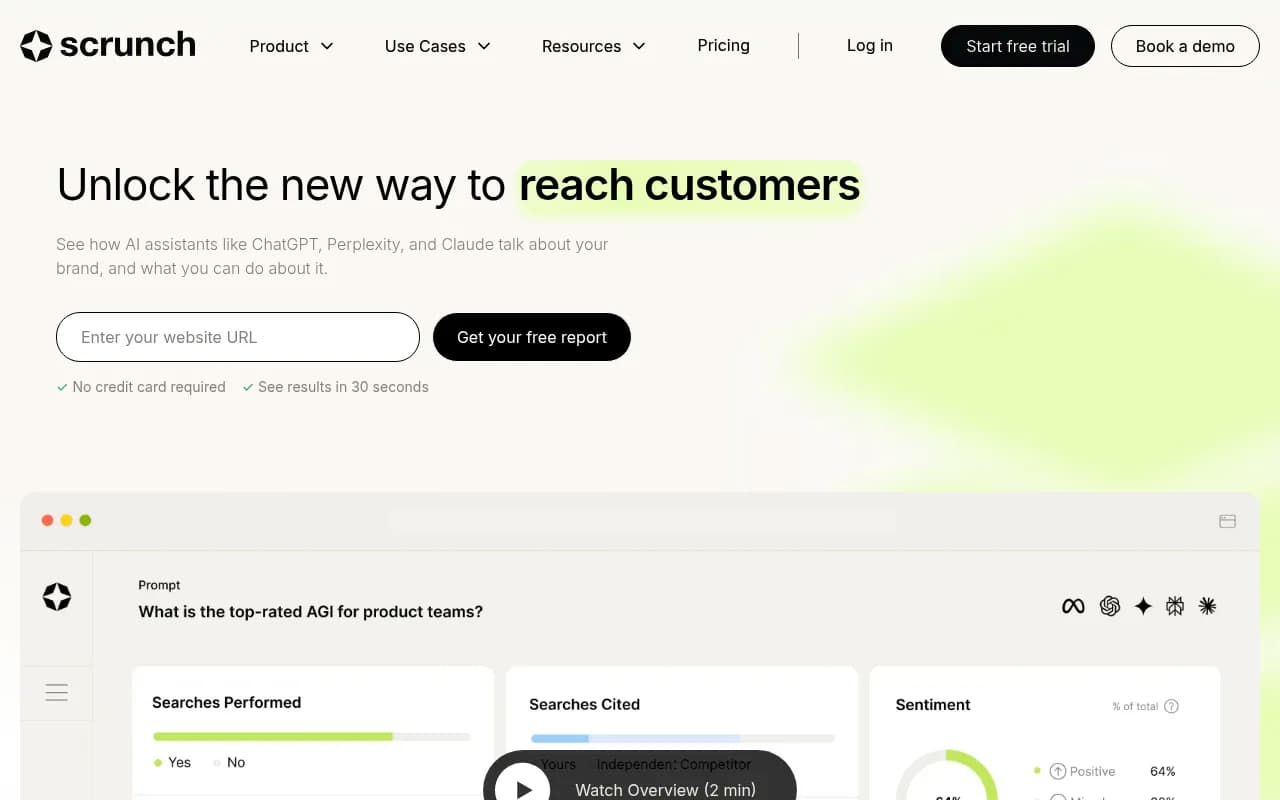
Scrunch positions itself as an "AI Customer Experience Platform" that goes beyond monitoring to help you optimize how AI engines see your site. The core idea: create a parallel version of your site translated for AI traffic using their Agent Experience Platform (AXP).
The monitoring side is solid. Scrunch tracks brand presence, performance, and position across ChatGPT, Perplexity, Claude, and other LLMs. You get performance tracking by competitor, persona, topic, and geography. Prompt analytics show trends, citations, competitors, and rankings. AI traffic tracking gives you a real-time feed of AI bots crawling your site.
The Insights module analyzes how AI interprets your site and gives you actionable tips to improve visibility. Citation analysis shows which sites AI models love to cite. Error detection spots when AI bots can't crawl your site so you can fix it.
The AXP feature is unique -- you create AI-optimized versions of your pages that AI bots see instead of your regular HTML. It's an interesting approach, but it adds complexity. You're maintaining two versions of your content, and it's not clear how much this actually improves citations compared to just optimizing your existing pages.
Pricing starts at $250/mo (Starter, billed annually), $417/mo (Growth), and custom for Enterprise. There's a 7-day free trial. The focus on influencer marketing and social media visibility sets Scrunch apart, but it's not clear this is better than platforms that focus purely on AI search.
Best for: Brands with strong social media and influencer marketing programs who want to track how that content influences AI recommendations. The AXP feature is interesting but unproven -- most teams will get better results optimizing their existing content.
SE Ranking
SE Ranking is a comprehensive SEO platform that added AI visibility tracking as an optional add-on. Like Semrush, it's designed for teams already using SE Ranking's traditional SEO tools (rank tracking, site audits, backlink analysis, keyword research) who want to add AI search monitoring without switching platforms.
The AI Search add-on (from $71.20/mo) tracks brand mentions across ChatGPT, Perplexity, Google AI Overviews, and other AI models. You get visibility tracking, sentiment analysis, and competitor comparisons. The integration with SE Ranking's existing tools is the main selling point -- your AI data sits alongside your traditional SEO metrics.
But the AI features are basic. No crawler logs. No content generation. No Reddit or YouTube tracking. No traffic attribution. You're paying for monitoring, not optimization. The Agency Pack add-on ($69/mo) adds white-label reporting and client management, which is useful for agencies, but it doesn't add AI features.
Pricing is more affordable than Semrush: Core plan starts at $103.20/mo, then add $71.20/mo for AI Search. That's $174.40/mo total, compared to $264/mo for Semrush. The 14-day free trial (no credit card required) is generous.
Best for: Existing SE Ranking customers who want to add basic AI visibility tracking. Not recommended if AI search is a priority -- the limited features make it a monitoring-only solution.
Writesonic
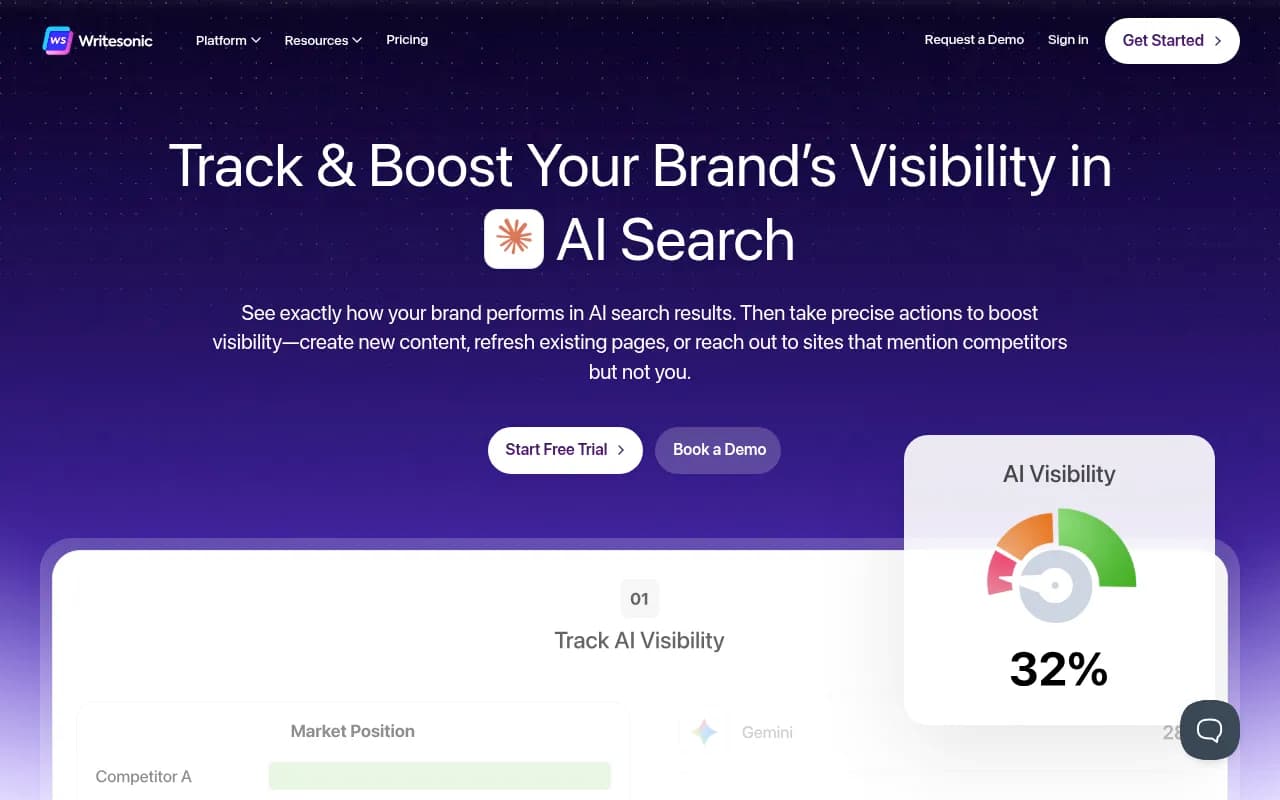
Writesonic started as an AI writing tool and expanded into AI search visibility tracking in 2025. The platform combines monitoring across ChatGPT, Perplexity, Gemini, and 10+ AI models with content creation tools designed to improve your rankings.
The tracking side covers the basics: brand mentions, citation gaps, competitor analysis, and visibility scores. The content side is where Writesonic differentiates itself. The platform identifies citation gaps (prompts where competitors rank but you don't), then helps you create optimized content to fill those gaps. You can also refresh existing pages to make them more citation-worthy.
The Reddit and UGC forum targeting is interesting -- Writesonic helps you find relevant discussions where you can contribute and build the kind of third-party mentions that AI models cite. This is similar to Promptwatch's Reddit tracking but with more of a content creation focus.
Pricing is aggressive: Lite $39/mo, Professional $99/mo, Advanced $499/mo. Enterprise custom pricing. Annual billing saves 20%. Free trial available. The lower tiers are cheaper than most competitors, but they come with limits on prompts, content generation, and features.
The platform feels like two products bolted together -- the AI visibility tracking and the content creation tools don't integrate as smoothly as Promptwatch's unified workflow. But if you need both monitoring and writing assistance and want to pay for one platform instead of two, Writesonic is worth considering.
Best for: Content teams and marketers who need both AI visibility tracking and content creation tools in one platform. The Reddit targeting and content refresh features are useful, but the platform feels less polished than dedicated AI visibility tools.
Which LLMrefs alternative should you choose?
If you want to actually improve your AI visibility (not just track it), Promptwatch is the clear choice. It's the only platform that shows you what's missing, helps you create the content AI models want, and tracks the results as your visibility improves. The crawler logs, Reddit/YouTube tracking, and content generation capabilities make it the most complete solution available.
If you're already paying for Semrush or SE Ranking and just want to add basic AI monitoring, their add-ons make sense. But be aware you're getting monitoring-only features with fixed prompts and no optimization tools.
If budget is tight and you only need basic tracking, Otterly.AI at $29/mo is the cheapest entry point. Just know you'll hit the limits quickly.
If you're an enterprise team with a big budget and need prompt volume data and shopping tracking, Profound is worth the premium price. But for most teams, Promptwatch delivers better value at a fraction of the cost.
The AI search landscape is moving fast. Monitoring-only tools like LLMrefs show you the problem. Optimization platforms like Promptwatch help you fix it. Choose accordingly.