Key takeaways
- Kai Footprint's website is currently down (the domain is parked at Porkbun with no live product), so anyone looking for an AEO/AI visibility platform needs a working alternative right now.
- Promptwatch is the most complete option -- it's the only platform in this space that combines monitoring, content gap analysis, AI content generation, and traffic attribution in one place.
- Profound and AthenaHQ are strong enterprise picks with solid feature sets, but both cost significantly more and neither offers the full optimization loop Promptwatch does.
- Otterly.AI and Peec AI are the budget-friendly monitoring options -- good for smaller teams who just need basic tracking without content tools.
- Semrush makes sense if you're already paying for their SEO suite and want AI visibility as an add-on, not as a standalone investment.
- BrightEdge and Authoritas are better fits for large enterprises that need AI visibility layered on top of a full traditional SEO platform.
If you landed here looking for Kai Footprint, here's the situation: the domain currently redirects to a Porkbun parking page. There's no live product, no login, no documentation. Whether it's a rebrand, an acquisition, or a project that never launched, the result is the same -- you need something that actually works today.
The good news is the AEO and AI visibility space has grown quickly. There are now real, mature platforms doing exactly what Kai Footprint described: tracking brand mentions across ChatGPT, Perplexity, Claude, Gemini, and other AI engines, and helping you do something about the gaps. Below is an honest comparison of the best options available in 2026.
The alternatives
Promptwatch

Promptwatch is the most complete AI visibility platform available right now, and it's the one I'd recommend to most teams looking for a Kai Footprint replacement.
The core difference between Promptwatch and most competitors is that it doesn't stop at monitoring. A lot of tools will show you a dashboard with your brand's "share of voice" across AI models and then leave you to figure out what to do next. Promptwatch has an actual action loop built in: you find the gaps (which prompts competitors appear for but you don't), you generate content to fill those gaps using the built-in AI writing agent, and then you track whether that content starts getting cited.
The Answer Gap Analysis is particularly useful. It shows you the specific prompts where competitors are visible and you're not -- not just a vague "you're missing content about X" but the actual questions AI models are answering without referencing your site. The content generation tool then creates articles and comparisons grounded in citation data from 880M+ analyzed citations, so it's not generic filler.
A few things Promptwatch does that most competitors don't:
- AI Crawler Logs: Real-time logs of when ChatGPT, Claude, Perplexity, and other crawlers visit your site, which pages they read, and what errors they hit. This is genuinely useful for diagnosing why AI models aren't citing you.
- Reddit and YouTube tracking: Surfaces discussions on those platforms that directly influence AI recommendations. Most tools completely ignore this.
- ChatGPT Shopping tracking: Monitors when your brand appears in ChatGPT's product recommendation carousels.
- Traffic attribution: Connects AI visibility to actual website traffic via a code snippet, GSC integration, or server log analysis.
It covers 10+ AI models including ChatGPT, Perplexity, Claude, Gemini, Grok, DeepSeek, Copilot, Meta AI, and Google AI Overviews. Multi-language and multi-region monitoring is included, along with customizable personas.
Pricing starts at $99/mo (Essential: 1 site, 50 prompts, 5 articles/mo), $249/mo (Professional: 2 sites, 150 prompts, crawler logs), and $579/mo (Business: 5 sites, 350 prompts). There's a 7-day free trial. For context, that's the same entry price as Kai Footprint was reportedly offering, but with a product that's actually live and used by 7,000+ brands including Booking.com and Center Parcs.
Best for: Marketing and SEO teams that want to both track and improve AI visibility, not just observe it. Also strong for agencies managing multiple clients.
AthenaHQ

AthenaHQ is a solid GEO platform that's been getting attention since coming out of Y Combinator. It tracks visibility across 8+ AI models and has a reasonably well-built command center for AEO/GEO managers. The platform covers the monitoring basics well: share of voice, citation source analysis, competitor benchmarking, and content optimization recommendations.
Where it falls short compared to Promptwatch is on the action side. AthenaHQ gives you recommendations but doesn't generate content for you. There's no built-in AI writing agent, no crawler logs, and no Reddit/YouTube tracking. It's primarily a monitoring and analysis tool, which is fine if that's all you need.
Pricing is $295/mo on the self-serve plan (or $95/mo billed annually, which is a significant discount). Enterprise pricing is custom. There's no free trial, which is a real friction point when Promptwatch and Otterly.AI both offer trials.
The client list is impressive -- ZoomInfo, Coinbase, PagerDuty -- so it clearly works for enterprise teams. But at $295/mo for monitoring-only, it's hard to justify over Promptwatch's $249/mo Professional plan that includes content generation and crawler logs.
Best for: Enterprise marketing teams that want a dedicated GEO monitoring platform and don't need content generation built in.
Semrush
Semrush is the obvious choice if you're already a Semrush customer. Their AI Visibility Toolkit ($99/mo add-on to Semrush One, which starts at $165/mo) tracks brand mentions across AI search engines and gives you a visibility score. It's integrated with their existing keyword research, backlink analysis, and content tools, which is genuinely useful if you're managing a full SEO program.
The limitations are real though. Semrush uses fixed prompt sets rather than letting you define your own prompts, which means you're tracking what they think matters rather than the specific questions your customers are actually asking. There's no AI traffic attribution, no crawler logs, and no content generation specifically engineered for AI citation.
For someone coming from Kai Footprint specifically, Semrush is probably overkill if you just want AI visibility tracking. You'd be paying for a lot of traditional SEO infrastructure you may not need. But if you're running a full digital marketing program and want AI visibility as one component, it's a reasonable way to consolidate tools.
Best for: Teams already using Semrush for SEO who want to add AI visibility monitoring without switching platforms.
Otterly.AI

Otterly.AI is the budget option in this space, and it's genuinely good at what it does. It monitors brand mentions and website citations across ChatGPT, Google AI Overviews, Perplexity, Google AI Mode, Gemini, and Copilot. The GEO Audit tool analyzes 25+ on-page factors to identify what's holding your site back from earning more citations.
The pricing is accessible: $29/mo for 15 prompts (Lite), $189/mo for 100 prompts (Standard), with a 14-day free trial. For a small brand or solo marketer who just wants to know whether they're showing up in AI search, this is probably enough.
What you don't get: content generation, crawler logs, Reddit/YouTube tracking, traffic attribution, or prompt volume data. It's monitoring and auditing, full stop. The GEO Audit is a nice touch that some pricier tools don't have, but it gives you recommendations rather than doing the work.
Best for: Small businesses and individual marketers who want basic AI visibility monitoring at a low price point.
Peec AI

Peec AI focuses on three core metrics -- visibility, position, and sentiment -- and tracks them across ChatGPT, Perplexity, and Gemini. The multi-language support is a genuine differentiator; if you're a European brand or operating in multiple markets, Peec handles that better than several pricier competitors.
The interface is clean and the competitor benchmarking is straightforward. Pricing starts at €89/mo (Starter) with a free trial available.
Like Otterly.AI, it's a monitoring tool. There's no content generation, no crawler logs, no traffic attribution. The "smart suggestions" feature gives you optimization hints, but you're implementing them yourself. For teams that need multi-language AI tracking on a budget, it's worth considering. For teams that want to actually move the needle, you'll outgrow it quickly.
Best for: European brands and multilingual teams that need AI visibility tracking across multiple languages without a large budget.
Profound

Profound is one of the more feature-complete platforms in this space. It covers prompt volumes (what millions of people actually ask AI), answer engine insights, AI crawler analytics, and automated content creation through its Agents feature. The client list -- MongoDB, Ramp, Zapier -- signals it's built for serious marketing teams.
The catch is pricing. Profound doesn't publish rates, but estimates put it at $1,000-$3,000+/month for enterprise contracts. There's no self-serve option and no free trial. You're booking a demo and going through a sales process.
For a team replacing Kai Footprint, that's a significant jump. Profound makes sense for large organizations with dedicated AEO teams and budgets to match. For everyone else, Promptwatch covers most of the same ground at a fraction of the cost.
Best for: Enterprise marketing teams with dedicated AEO/GEO budgets who need a full-stack platform and don't mind the sales process.
BrightEdge
BrightEdge is an enterprise SEO platform that has added AI search visibility tracking to its existing suite. It has a large proprietary dataset (4B+ keyword data points), AI-powered content optimization tools (Copilot/Autopilot), and now tracks visibility across traditional and AI search engines.
Pricing is custom and typically runs $10,000-$30,000+ annually. This is not a tool you buy to replace Kai Footprint -- it's a tool you buy when you're running a large, complex SEO program and want AI visibility as part of that infrastructure.
The AI visibility features feel like an addition to an existing platform rather than a purpose-built AEO tool. If you're already a BrightEdge customer, it's worth exploring. If you're not, there's no reason to start here just for AI tracking.
Best for: Large enterprises already invested in BrightEdge's SEO platform that want AI visibility layered in.
Authoritas AI Tracker

Authoritas takes an interesting approach with credit-based pricing for AI tracking, separate from their SEO platform subscription. The AI Tracker monitors brand mentions, sentiment, and citations across ChatGPT, Perplexity, Claude, Gemini, DeepSeek, Google AI Overviews, and Bing AI.
The credit system (free tier at 50 credits, then £90/mo for 2,000 credits) is flexible but can get confusing. Different AI models cost different amounts of credits per query, so your effective prompt volume depends on which models you're querying. The SEO platform is priced separately on top of that.
Authoritas has a specific angle for publishers -- tracking how AI platforms use your content and identifying licensing opportunities. That's a genuinely unique use case that most competitors don't address. For brands (not publishers), it's a solid mid-market option with good model coverage.
Best for: Publishers tracking how AI models use their content, and mid-market brands that want combined AI + traditional SEO monitoring from one platform.
Xfunnel
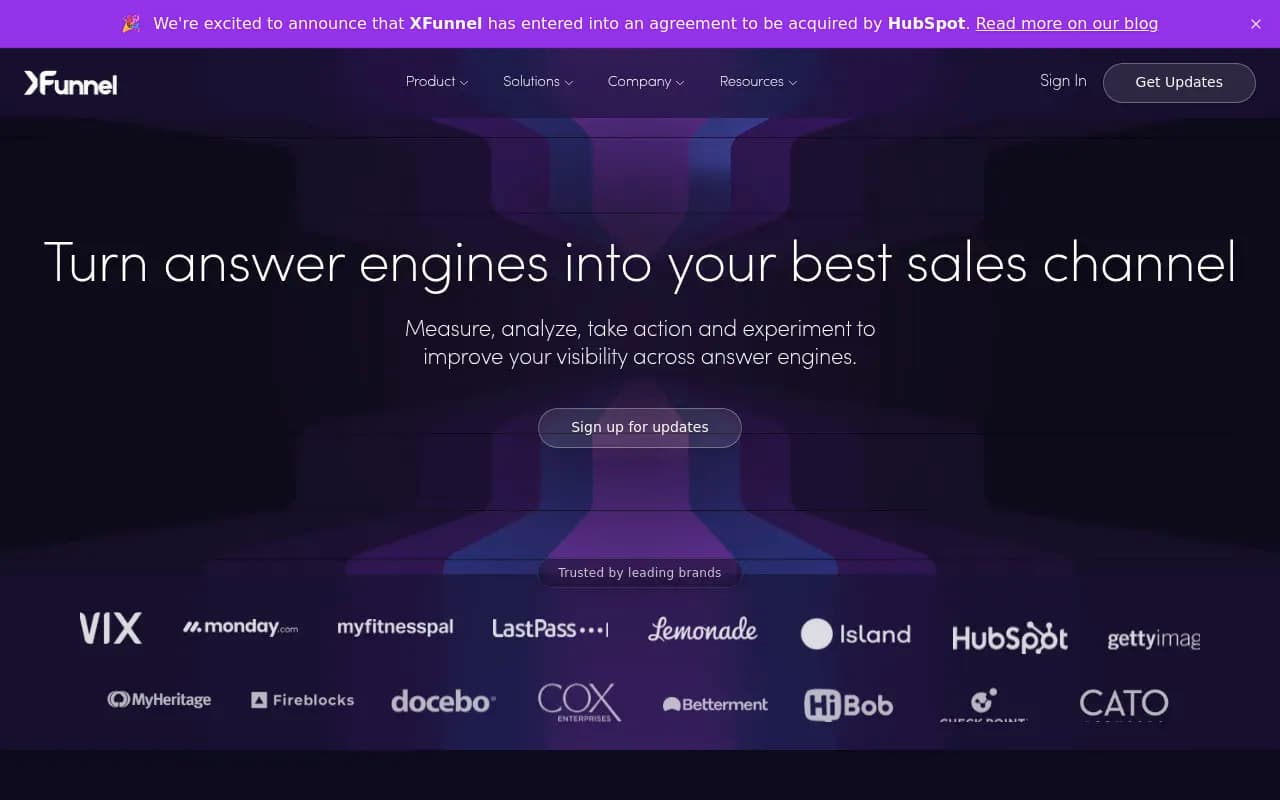
Xfunnel is worth mentioning with a significant caveat: HubSpot has announced an acquisition agreement. The product is still operating, but its future roadmap is now tied to whatever HubSpot decides to do with it post-acquisition.
Before the acquisition news, Xfunnel was known for combining AI visibility monitoring with expert-led optimization playbooks -- a more hands-on approach than most self-serve tools. Clients like Wix, Monday.com, and Getty Images used it. Pricing is enterprise-only with no public tiers.
If you're evaluating tools for a multi-year commitment, the acquisition uncertainty is a real concern. You'd be betting on HubSpot integrating it well rather than sunsetting it. For a Kai Footprint replacement, I'd look elsewhere until the acquisition situation is clearer.
Best for: Enterprise teams comfortable with the acquisition uncertainty, particularly those already in the HubSpot ecosystem.
Scrunch AI
Scrunch AI monitors brand visibility across ChatGPT, Perplexity, Gemini, and other LLMs. It's positioned for marketing teams and agencies and starts at $250/mo for 350 prompts and 3 personas.
At that price point, it's competing directly with Promptwatch's Professional plan ($249/mo), which includes more prompts, crawler logs, content generation, and traffic attribution. Scrunch AI doesn't have those additional layers. It's a monitoring platform without the optimization tools.
That said, if you specifically want a clean, agency-friendly monitoring dashboard without the extra features, Scrunch is worth evaluating. The persona support (3 personas at the base tier) is a nice touch for teams tracking how different customer types see their brand.
Best for: Agencies that want a straightforward AI monitoring dashboard for client reporting without needing content generation tools.
How to choose
Here's a simple way to think about it:
You want to monitor and optimize (not just watch): Promptwatch is the clear choice. It's the only platform in this list that closes the loop from gap identification to content creation to traffic attribution, and it does it at a price point that's accessible to teams that aren't enterprise-only.
You're enterprise-only and have budget: Profound or AthenaHQ. Both are strong. Profound has more automation; AthenaHQ has a cleaner command center interface. Neither is cheap.
You're on a tight budget and just need basic monitoring: Otterly.AI at $29/mo or Peec AI at €89/mo. Both work. Peec is better for multilingual needs; Otterly has a slightly better audit tool.
You're already using Semrush: Just add the AI Visibility Toolkit. It's not the best standalone AI tracking tool, but it's good enough if you're already in the ecosystem.
You're a publisher worried about AI using your content: Authoritas has a specific feature set for that use case that nobody else really addresses.
You're evaluating Xfunnel: Wait until the HubSpot acquisition closes and the roadmap is clear.
The Kai Footprint concept -- measuring and improving brand footprint across AI-powered search -- is exactly the right problem to be solving in 2026. The tools above are all actively working on it. The difference is how far each one goes beyond just showing you the data.