Key takeaways
- Best overall alternative: Promptwatch -- the only platform that closes the full loop from gap analysis to content generation to traffic attribution. Starts at $99/mo.
- Best for enterprise budgets: Profound -- deep prompt volume data and agent workflows, but expect $1,000+/mo and no self-serve option.
- Best budget pick: Otterly.AI at $29/mo for basic monitoring, or Rankscale if you want a free entry point with surprisingly broad AI engine coverage.
- Best for teams already using SEO tools: SE Ranking or Semrush, both of which bolt AI visibility onto existing SEO workflows.
- Best for agencies needing white-label reporting: AthenaHQ or Promptwatch (both have agency tiers).
- ChatRank's main weakness: It monitors ChatGPT and Google AI search but not the broader LLM ecosystem (Claude, Perplexity, Grok, DeepSeek, etc.), and its freemium model doesn't publicly disclose what's included at each tier.
ChatRank has a genuinely clever angle. The "one hour per week" inbox workflow is designed to remove the friction of actually acting on AI visibility data -- you get a pre-drafted blog post, a LinkedIn update, a few questions to answer, and you're done. For small teams or solo founders who don't want to become GEO experts, that's appealing.
But there are real reasons people look for alternatives. ChatRank's monitoring scope appears limited to ChatGPT and Google AI search, which matters less as Perplexity, Claude, and Gemini collectively account for a growing share of AI-driven discovery. The pricing is opaque -- no public tiers means you can't compare it without booking a demo. And if you need deeper analytics, crawler logs, competitor heatmaps, or multi-region tracking, the inbox-workflow model starts to feel constraining.
Here's a thorough look at what else is out there.
Promptwatch

Promptwatch is the most complete AI search visibility platform available right now, and the one most worth comparing seriously against ChatRank. Where ChatRank focuses on simplifying the workflow, Promptwatch focuses on depth -- and then builds tools to act on that depth.
The core difference is what happens after you see the data. ChatRank generates pre-drafted content based on its own gap detection. Promptwatch does the same thing, but grounds its content generation in 880M+ analyzed citations, prompt volume scores, difficulty ratings, and competitor analysis. The resulting articles are engineered to get cited by ChatGPT, Claude, Perplexity, and other models -- not just SEO-optimized in the traditional sense.
A few things Promptwatch does that ChatRank doesn't:
- Monitors 10+ AI models: ChatGPT, Claude, Perplexity, Gemini, Grok, DeepSeek, Copilot, Mistral, Meta AI, Google AI Overviews, and Google AI Mode
- Real-time AI crawler logs showing which pages ChatGPT, Claude, and Perplexity are actually reading on your site, and which are throwing errors
- Reddit and YouTube citation tracking -- surfaces the discussions that directly influence AI recommendations
- ChatGPT Shopping tracking for product-focused brands
- Query fan-outs showing how one prompt branches into sub-queries
- Traffic attribution via GSC integration, code snippet, or server log analysis -- so you can connect AI visibility to actual revenue
Pricing is transparent: $99/mo (Essential, 1 site, 50 prompts), $249/mo (Professional, 2 sites, 150 prompts, crawler logs), $579/mo (Business, 5 sites, 350 prompts). Agency and enterprise pricing available. There's a 7-day free trial.
The honest trade-off: Promptwatch requires more engagement than ChatRank's inbox model. You're working inside a platform, not just responding to weekly emails. If you want the full picture and the tools to act on it, that's a feature. If you want minimal cognitive load, it might feel like more than you need.
Best for: Marketing and SEO teams at brands or agencies who want to understand their full AI search presence and have the capacity to act on detailed data.
AthenaHQ
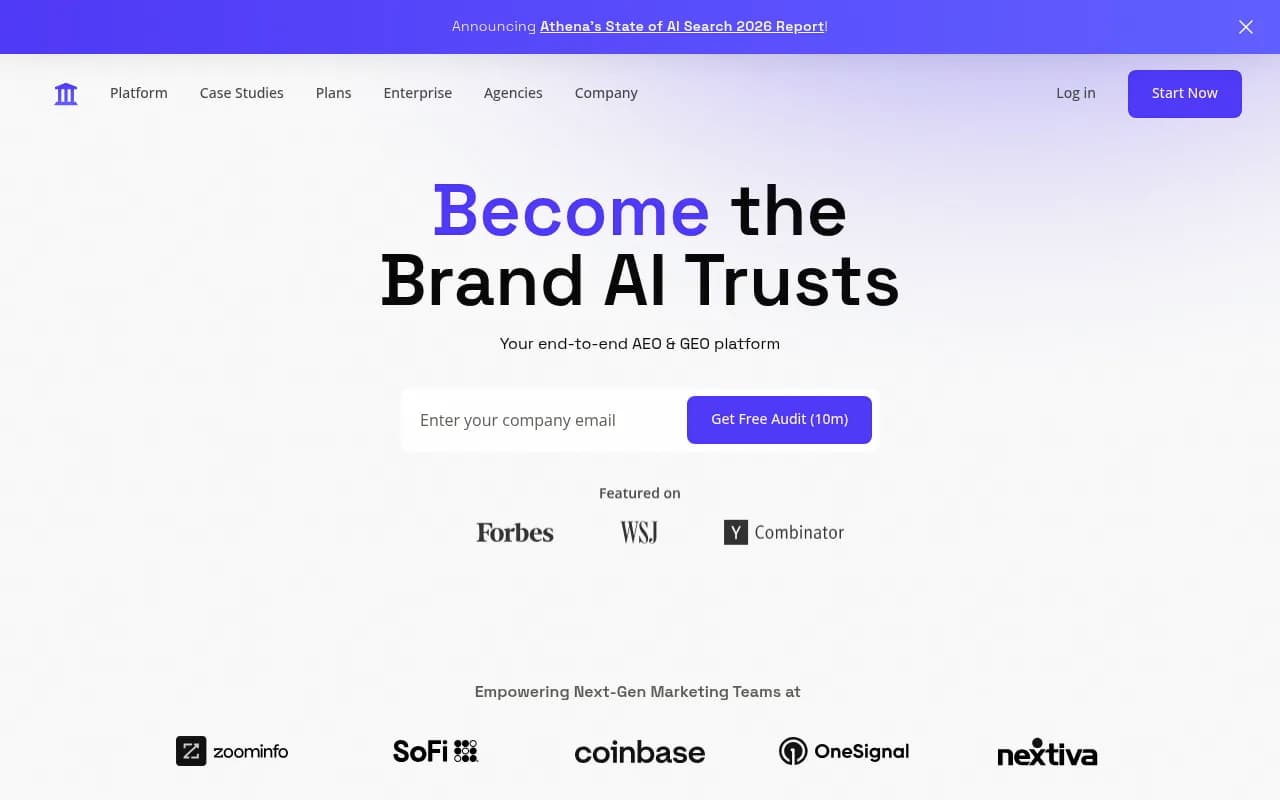
AthenaHQ is a well-funded GEO platform (Y Combinator-backed) with a strong client list including Coinbase, SoFi, and PagerDuty. It covers 8+ AI engines and positions itself as an "end-to-end AEO & GEO platform" -- which is accurate in the sense that it has monitoring, content recommendations, and citation analysis.
Compared to ChatRank, AthenaHQ is considerably more powerful on the analytics side. You get cross-platform visibility tracking, citation source analysis, and a command center view that works well for teams with dedicated AEO/GEO managers. The executive dashboard is genuinely useful for reporting upward.
Where it falls short relative to other options: AthenaHQ is primarily monitoring-focused. The content optimization features are more "recommendations" than actual generation -- you still need to write the content yourself. There's also no free trial, and the entry price of $295/mo (or $95/mo on annual billing) is higher than most self-serve alternatives. No public information on crawler log access or traffic attribution.
Pricing: From $295/mo (self-serve) or $95/mo annual. Enterprise custom.
Best for: Mid-market and enterprise brands that need strong analytics and executive reporting, and have content teams to act on the recommendations.
Semrush
Semrush is now an Adobe company, which tells you something about its trajectory -- it's a large, mature platform that has added AI visibility as a module rather than building around it from scratch. The AI Visibility Toolkit ($99/mo add-on on top of the base Semrush One plan at $165/mo+) gives you brand monitoring across AI search engines, but the implementation uses fixed prompts rather than custom ones you define.
That's a meaningful limitation. If you want to track the specific questions your customers are actually asking AI models, fixed prompts won't cut it. Semrush also lacks AI traffic attribution -- you can see visibility scores but can't connect them to actual site traffic or revenue.
What Semrush does well: everything else. Keyword research, backlink analysis, competitive intelligence, content marketing tools, local SEO, social media management. If you're already paying for Semrush and just want a basic AI visibility layer, the add-on is a reasonable choice. If AI search is your primary concern, it's not the right starting point.
Pricing: Semrush One from $165.17/mo (annual). AI Visibility Toolkit $99/mo add-on. 7-14 day free trial.
Best for: Teams already deeply embedded in the Semrush ecosystem who want to add AI monitoring without switching platforms.
Otterly.AI
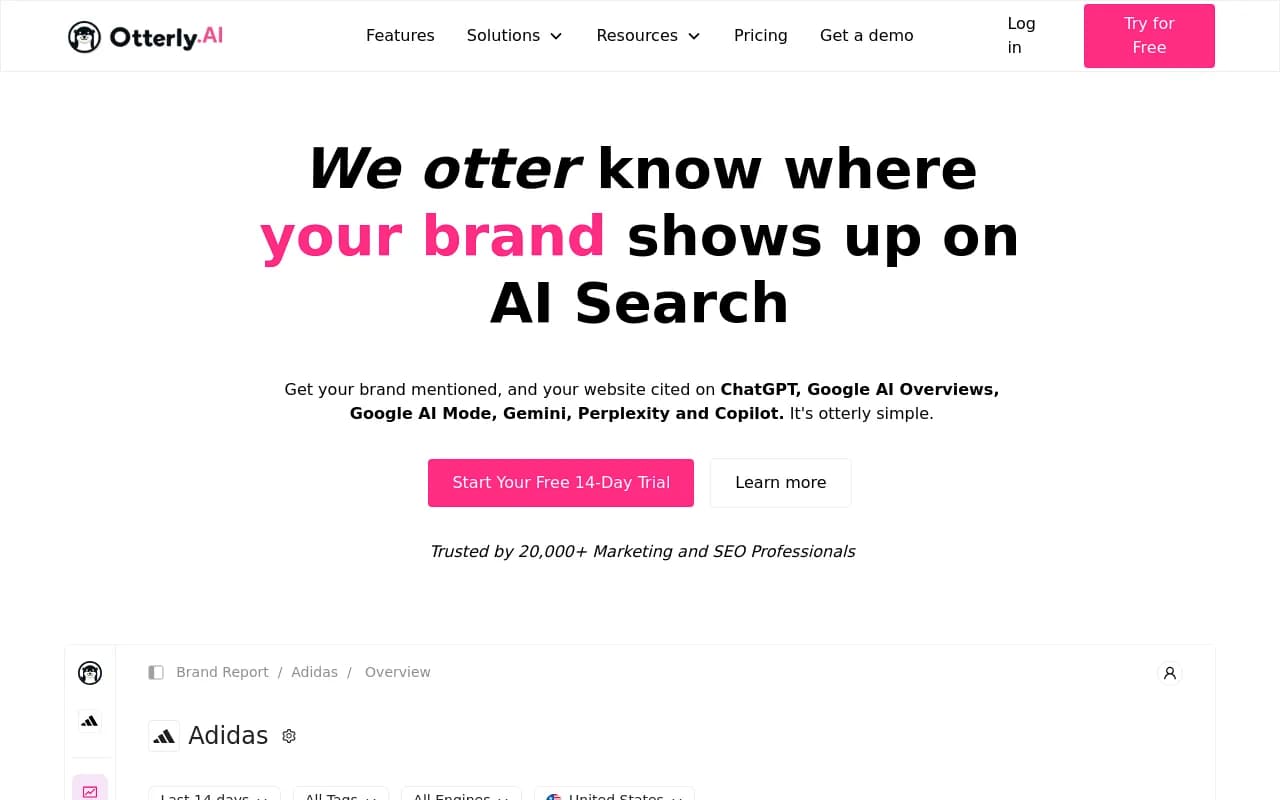
Otterly.AI is one of the more popular budget options in this space, with 25,000+ marketing professionals reportedly using it. The interface is clean, the brand coverage charts are easy to read, and the $29/mo Lite plan (15 prompts) makes it accessible for small teams or individuals just getting started.
The monitoring itself is solid -- you get brand mentions, competitor comparisons, share of voice trends, and basic citation tracking. The 14-day free trial lets you actually test it before committing.
The honest limitation: Otterly.AI is a monitoring tool. It shows you data but doesn't help you act on it. There's no content generation, no crawler logs, no traffic attribution, and no prompt volume data. If you're trying to understand your AI visibility, it works. If you're trying to improve it, you'll need other tools alongside it.
Compared to ChatRank, Otterly.AI gives you more data visibility but less workflow support. ChatRank's inbox model at least pushes you toward action. Otterly shows you the problem and leaves the solution to you.
Pricing: $29/mo (Lite: 15 prompts), $189/mo (Standard: 100 prompts), Custom (Premium). 14-day free trial.
Best for: Small teams or individuals who want affordable AI visibility monitoring and don't need content generation or deep analytics.
Peec AI
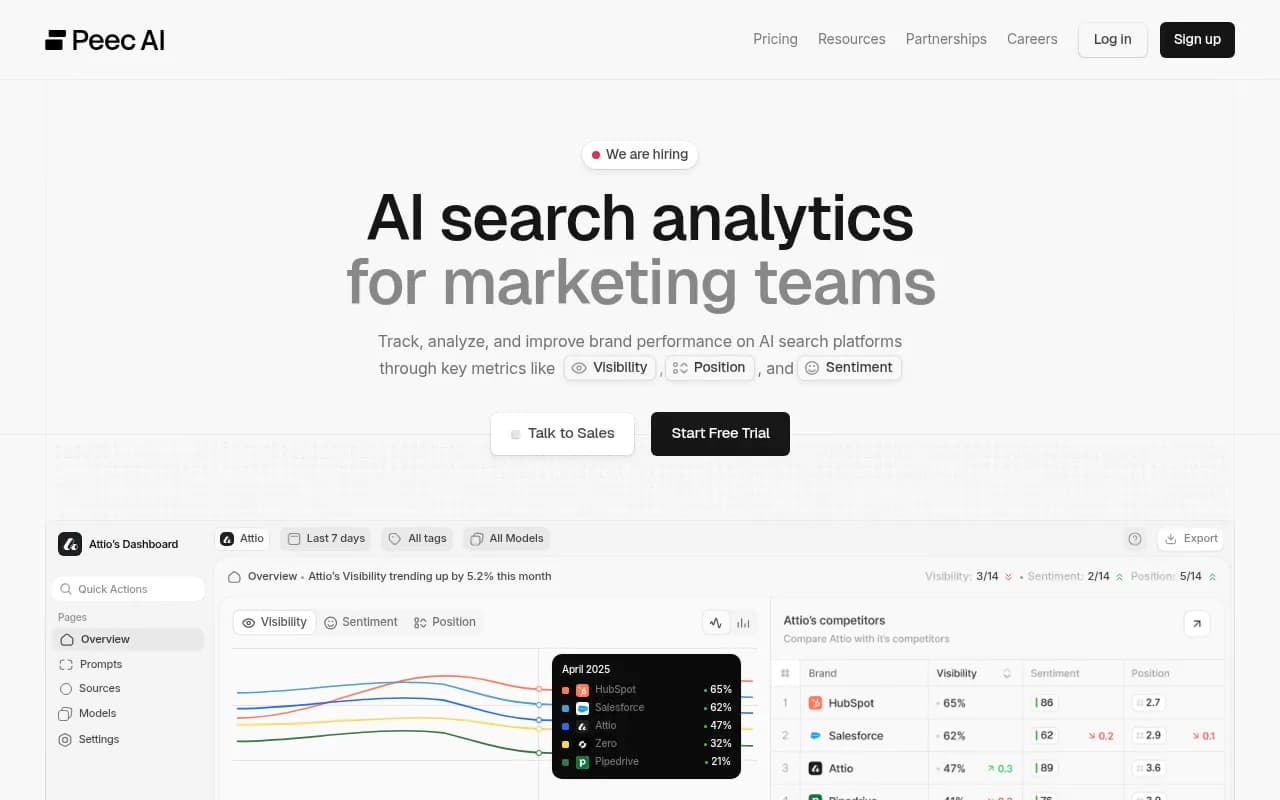
Peec AI is a clean, focused monitoring platform trusted by 2,000+ marketing teams. Its standout feature is multi-language and multi-country support -- if you're tracking AI visibility across markets in different languages, Peec handles that well. The dashboard tracks visibility, position, and sentiment across ChatGPT, Perplexity, and Gemini.
Like Otterly.AI, Peec is primarily a monitoring tool. The "smart suggestions" feature gives you some optimization guidance, but there's no built-in content generation. The pricing is reasonable at €89/mo for the Starter plan.
Compared to ChatRank, Peec gives you more granular analytics (position tracking, sentiment scoring) but less workflow automation. You won't get pre-drafted content in your inbox -- you'll get data and need to decide what to do with it.
Pricing: €89/mo (Starter), €199/mo (Professional), Enterprise custom. Free trial available.
Best for: Marketing teams in multi-language markets who need clean visibility tracking without the complexity of a full GEO platform.
Profound

Profound is the enterprise-grade option in this space. Used by MongoDB, Ramp, and Zapier, it covers the full stack: prompt volume data (showing what millions of people actually ask AI), answer engine insights, agent analytics (AI crawler logs), and automated content creation via agents. The platform covers ChatGPT, Perplexity, Claude, Gemini, Grok, Copilot, Meta AI, DeepSeek, and Google AI Overviews.
The feature set is genuinely impressive. Prompt volume data -- seeing actual search demand for specific AI queries -- is something most competitors don't offer at all. The content agents can generate AEO-optimized FAQs and articles grounded in real data.
The catch: pricing. Profound is custom enterprise, estimated at $1,000-$3,000+/month, with no self-serve option and no free trial. You need to talk to sales to get started. For a startup or mid-market brand, that's a hard sell when Promptwatch offers comparable capabilities starting at $99/mo.
Compared to ChatRank, Profound is in a completely different weight class -- both in capability and cost.
Pricing: Custom enterprise (estimated $1,000-$3,000+/mo). No free trial.
Best for: Enterprise marketing teams with dedicated AEO budgets who need the deepest available data on prompt volumes and AI search behavior.
SE Ranking
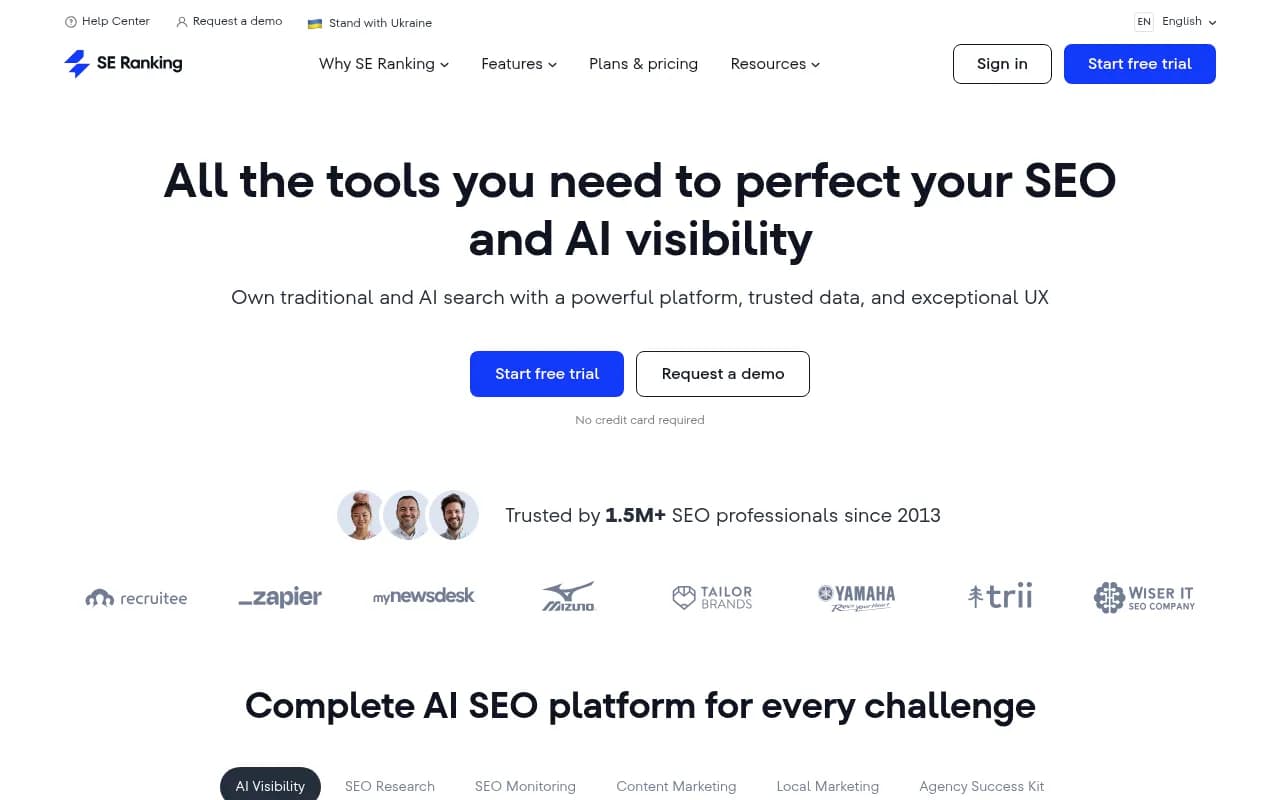
SE Ranking is a traditional SEO platform that has added a solid AI Search add-on. The base platform covers keyword tracking, site audits, backlink analysis, and competitive research -- all the SEO fundamentals. The AI Search add-on ($71.20/mo) layers in AI visibility monitoring across multiple models.
The integration is genuinely useful if you're already doing SEO work. Having your traditional rankings and AI visibility in the same platform reduces context-switching and makes it easier to see how your SEO efforts correlate with AI visibility. The 14-day free trial (no credit card required) is a low-friction way to test it.
The limitation is depth. SE Ranking's AI visibility features are solid but not specialized -- you won't get crawler logs, Reddit/YouTube citation tracking, or the kind of content generation tools that purpose-built GEO platforms offer. It's AI visibility as a feature, not as a core product.
Compared to ChatRank, SE Ranking gives you more SEO context but less AI-specific workflow support.
Pricing: From $103.20/mo (Core). AI Search add-on from $71.20/mo. 14-day free trial.
Best for: SEO teams who want to add AI visibility monitoring to an existing SEO workflow without switching platforms.
Authoritas AI Tracker

Authoritas has been around as an SEO platform for years, and its AI Tracker is a more recent addition that covers ChatGPT, Perplexity, Claude, Gemini, DeepSeek, Google AI Overviews, and Bing AI. The credit-based pricing model is unusual -- you buy credits and spend them on queries, which gives you flexibility but makes cost estimation harder.
The free tier (50 credits) lets you try it without committing, which is genuinely useful. The platform also has a publisher-specific angle -- tracking how AI platforms use your content and potentially unlocking licensing revenue -- which is unique in this space.
The SEO platform and AI Tracker are priced separately, which can add up. The AI Tracker alone starts at £90/mo for 2,000 credits. Combined with the SEO platform, you're looking at meaningful monthly spend.
Compared to ChatRank, Authoritas is more analytics-focused and less workflow-driven. No inbox model, no pre-drafted content.
Pricing: Free (50 credits), £90/mo (2,000 credits), £225/mo (6,000 credits), up to £1,125/mo (42,000 credits). SEO platform separate.
Best for: Publishers tracking how AI uses their content, or brands that want combined SEO + AI visibility in a single platform and are comfortable with credit-based pricing.
Rankscale AI
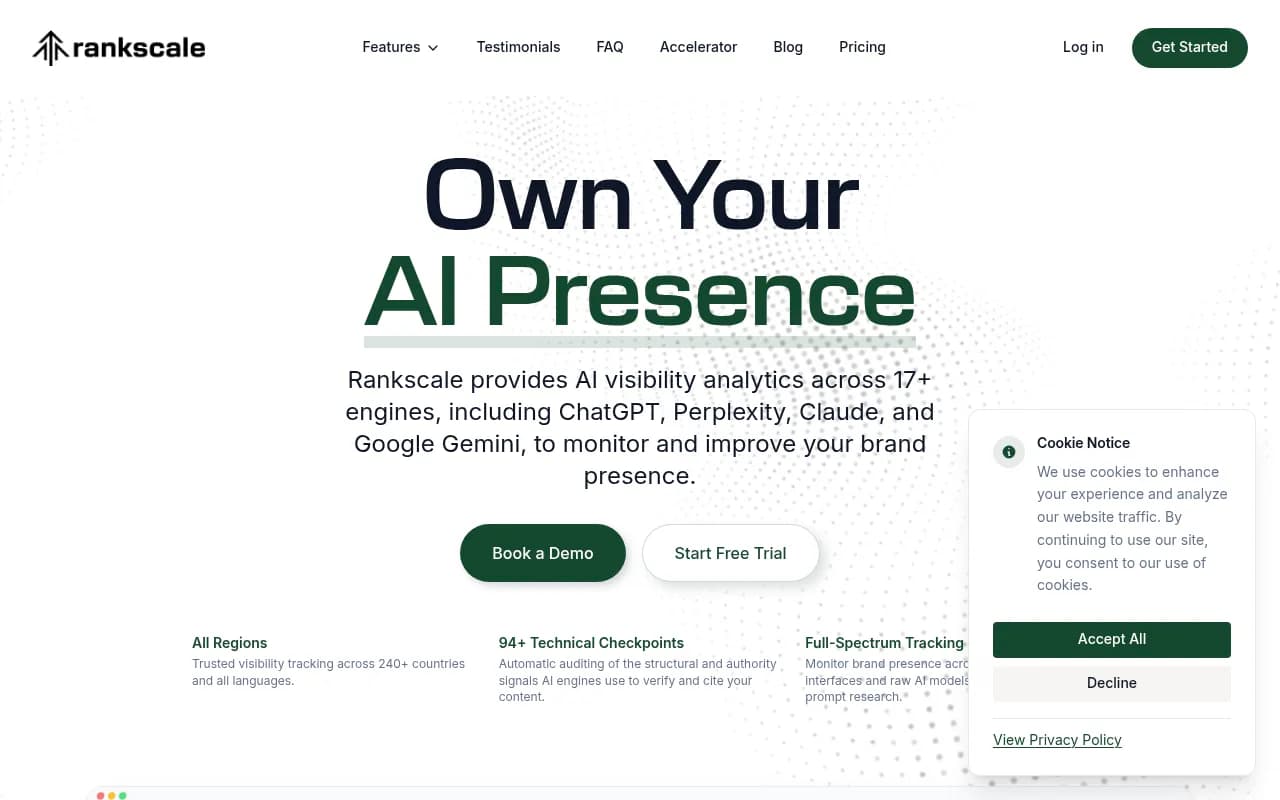
Rankscale tracks AI visibility across 17+ engines -- more than most competitors -- including ChatGPT, Perplexity, Claude, Gemini, DeepSeek, Grok, Copilot, Mistral, AI Overviews, and Google AI Mode. The 94+ technical checkpoint audit is a differentiator: it automatically checks the structural and authority signals AI engines use to verify and cite content, which gives you actionable technical fixes beyond just "create more content."
The prompt research feature estimates search volume through semantic reconstruction, which is useful for prioritizing which prompts to target. The competitor analysis auto-identifies rivals in AI search results, which saves setup time.
Pricing starts at around €20/mo on a credit-based model, with a free trial available. For the price, the breadth of coverage is impressive. The trade-off is that Rankscale is primarily an analytics and auditing tool -- content generation isn't part of the picture.
Compared to ChatRank, Rankscale gives you far broader AI engine coverage and technical auditing, but none of the workflow automation or content drafting.
Pricing: Freemium, paid from ~€20/mo (credit-based). Free trial available.
Best for: Technically-minded marketers who want broad AI engine coverage and actionable technical audits at a low price point.
Scrunch AI
Scrunch AI is a monitoring platform aimed at marketing teams and agencies. It tracks brand visibility across ChatGPT, Perplexity, Gemini, and other LLMs, with persona-based tracking (3 personas on the base plan) that lets you simulate how different types of users prompt AI models.
The $250/mo starting price is mid-range, and the 350-prompt allowance at that tier is reasonable. The persona feature is genuinely useful -- different customer segments ask AI questions differently, and tracking visibility across those segments gives you a more realistic picture than generic prompts.
What Scrunch doesn't have: content generation, crawler logs, traffic attribution, or the depth of analytics you'd get from Promptwatch or Profound. It's a clean monitoring tool with a useful persona angle.
Compared to ChatRank, Scrunch gives you more monitoring depth but less workflow automation.
Pricing: From $250/mo (350 prompts, 3 personas).
Best for: Marketing teams and agencies that want persona-based AI visibility monitoring and are comfortable building their own content strategy from the data.
Which tool should you pick?
The right choice depends on what you actually need from an AI visibility tool.
If ChatRank's appeal was the low-effort inbox workflow, but you want broader AI engine coverage and more transparency on pricing, Promptwatch is the natural upgrade. It covers 10+ models, generates content grounded in real citation data, and starts at $99/mo with a free trial.
If you're on a tight budget and just want to start monitoring, Otterly.AI at $29/mo or Rankscale at ~€20/mo are the most accessible entry points. Neither will help you create content, but they'll tell you where you stand.
If you're already paying for Semrush or SE Ranking and don't want to add another platform, their AI visibility add-ons are a reasonable starting point -- just know you're getting AI monitoring as a feature, not a specialized tool.
If you're at an enterprise with a real AEO budget and need the deepest available data, Profound is worth the conversation despite the price. AthenaHQ is a strong alternative if you want a self-serve enterprise option.
And if you're tracking content across multiple languages and markets, Peec AI's multi-language support makes it worth a look at the €89/mo price point.
The one thing all these tools share: they're only useful if you act on the data. A monitoring dashboard that shows you're invisible in AI search doesn't help unless you do something about it. That's the real question to ask when evaluating any of these platforms -- not just "what does it track?" but "what does it help me fix?"