Key takeaways
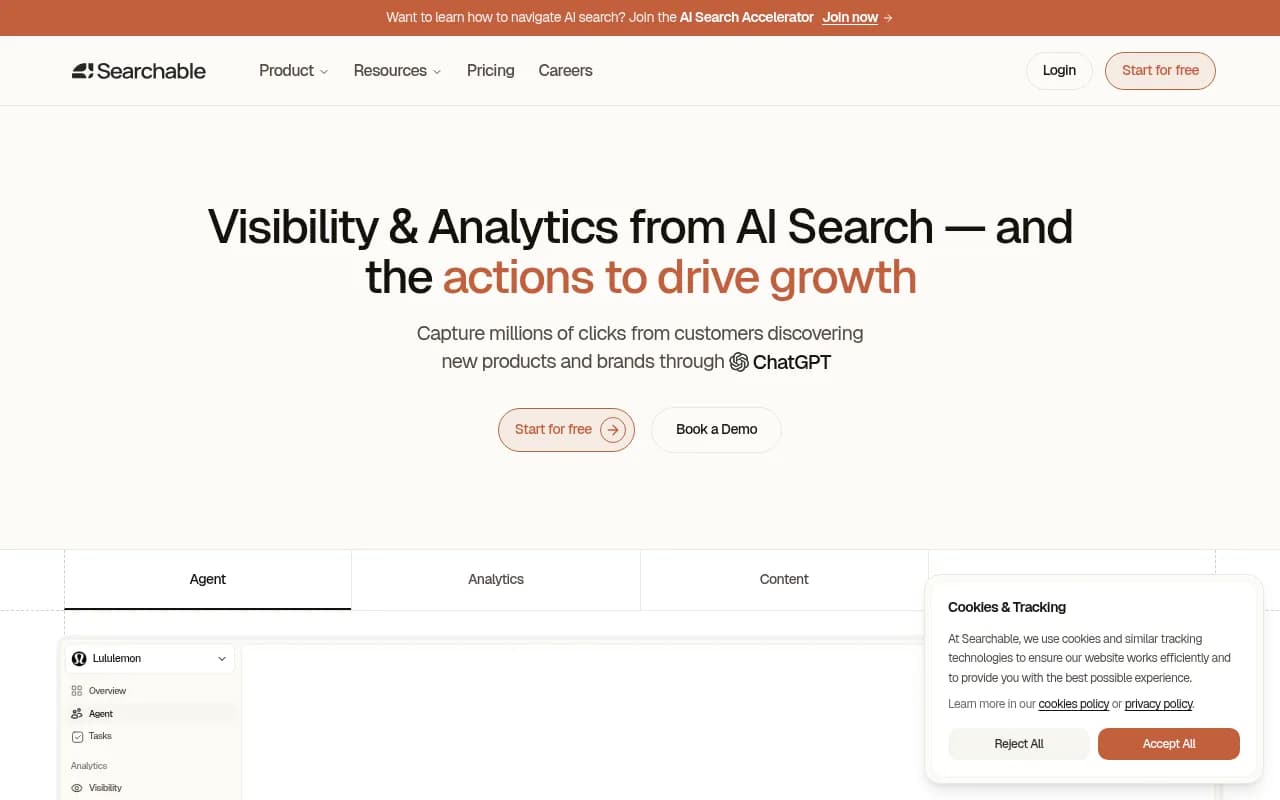
- Searchable covers only 5 AI engines (ChatGPT, Claude, Perplexity, Google AI Overviews, Copilot) -- Gemini and Google AI Mode are missing
- Most alternatives in this list offer more AI platform coverage, lower starting prices, or deeper content optimization capabilities
- The biggest gap in Searchable (and most competitors) is the jump from "seeing data" to "doing something about it" -- only a few tools in this space close that loop
- Teams with multilingual needs, agency white-labeling requirements, or heavy content production workflows will likely outgrow Searchable quickly
- Free trials are available across most options, so testing before committing is straightforward
Searchable launched in late 2025 and made a strong first impression. The founding team has real credentials, the GA4 and Search Console integrations are genuinely rare at the $50/month price point, and the product's "end-to-end operating system" framing is at least honest about what it's trying to be.
But honest framing doesn't paper over real limitations. Five AI engines covered. No Gemini. No Google AI Mode. White-label reporting locked behind the $400/month Scale plan. API access requiring an Enterprise conversation. And content generation features that feel more like a checkbox than a core capability.
If any of those are blockers for your team -- or if you just want to see what else is out there before committing -- here are 8 alternatives worth a serious look.
What to look for in a Searchable alternative
Before getting into the list, it's worth being clear about what actually matters when evaluating these tools. Most AI visibility platforms will show you a dashboard. The question is what happens after you see the data.
A few things worth checking:
- How many AI engines does it monitor? (ChatGPT, Perplexity, Claude, Gemini, Google AI Mode, Grok, DeepSeek, Meta AI, Copilot, Mistral are the main ones)
- Does it track prompt volume and difficulty, or just presence/absence?
- Can it identify content gaps -- prompts where competitors appear but you don't?
- Does it help you create content to close those gaps, or just show you they exist?
- How does it handle traffic attribution -- can you connect AI visibility to actual revenue?
- Does it track AI crawler activity on your site?
- What's the white-label and agency story?
Keep those questions in mind as you read through the options below.
The 8 best Searchable alternatives in 2026
1. Promptwatch -- best for teams that want to act on their data, not just read it
Promptwatch is the most complete option on this list if your goal is optimization rather than observation. Most tools in this space show you where you're visible and where you're not. Promptwatch goes further: it identifies the specific prompts where competitors appear but you don't, then helps you create content designed to get cited by AI models.

The content generation isn't generic. It's grounded in 880M+ citations analyzed, prompt volume data, competitor visibility, and persona targeting. The output is articles and comparisons engineered to get picked up by ChatGPT, Claude, Perplexity, and others -- not just SEO filler.
Beyond content, Promptwatch also logs AI crawler activity in real time (which pages ChatGPT, Claude, and Perplexity are reading, how often, what errors they hit), tracks ChatGPT Shopping appearances, and surfaces Reddit and YouTube discussions that directly influence AI recommendations. That last one is a channel most competitors ignore entirely.
Coverage spans 10 AI models: ChatGPT, Perplexity, Google AI Overviews, Google AI Mode, Claude, Gemini, Meta/Llama, DeepSeek, Grok, Mistral, and Copilot. Searchable misses Gemini and AI Mode entirely.
Pricing starts at $99/month (Essential: 1 site, 50 prompts, 5 articles), $249/month for Professional (2 sites, 150 prompts, 15 articles, crawler logs), and $579/month for Business (5 sites, 350 prompts, 30 articles). Agency and enterprise pricing is available on request.
The honest caveat: if you genuinely only need basic monitoring and have no interest in content optimization, Searchable's $50/month Starter is cheaper. But for teams that want to close the loop between visibility data and actual results, Promptwatch is the more complete tool.
2. Otterly.AI -- best for teams that want proven monitoring at a low entry price
Otterly.AI has been around long enough to accumulate real third-party validation -- Gartner Cool Vendor 2025, G2 High Performer credentials -- which matters when you're evaluating a category where most tools launched in the last 12 months.

The GEO Audit feature is a genuine differentiator: it analyzes your existing content and scores how well it's positioned to be cited by AI models. That's more structured than what Searchable offers at the same tier. Starting price is $29/month, which undercuts Searchable by $21/month.
The limitation is that Otterly.AI is primarily a monitoring and audit tool. It doesn't generate content or close the gap between "here's what's missing" and "here's the article that fixes it." For teams that want to act on the data, you'll need to pair it with a separate content workflow.
3. Peec AI -- best for global brands with multilingual requirements
If your brand operates across multiple languages and regions, Peec AI is worth serious consideration. It covers 115+ languages and has documented enterprise outcomes for global brands -- something Searchable, which launched only months ago, simply can't match yet.

Starting at $85/month, it's slightly more expensive than Searchable's Starter but covers more AI platforms and handles localization at a depth that most competitors don't attempt. The platform is monitoring-focused rather than content-generation-focused, so the same caveat applies as with Otterly.AI: you'll see the gaps, but filling them is on you.
4. Profound -- best for enterprise teams that need depth and credibility
Profound is the G2 Winter 2026 Leader in AI visibility, covers 10 AI platforms, and includes prompt volume data -- a feature that helps teams prioritize which prompts are actually worth optimizing for rather than treating all gaps equally.

Starting at $99/month, it's priced similarly to Promptwatch's Essential tier. The platform is strong on monitoring and analytics. Where it falls short relative to Promptwatch is on the content side: Profound doesn't have a built-in content generation agent, so the workflow from "gap identified" to "content published" requires more manual work.
For enterprise teams with dedicated content teams who just need better data to work from, that's fine. For smaller teams that need the full loop automated, it's a meaningful difference.
5. Airefs -- best budget option for teams just getting started
Airefs starts at $24/month, which is less than half of Searchable's Starter price. For teams that are new to AI visibility tracking and want to understand the landscape before committing to a more expensive platform, that's a reasonable place to start.
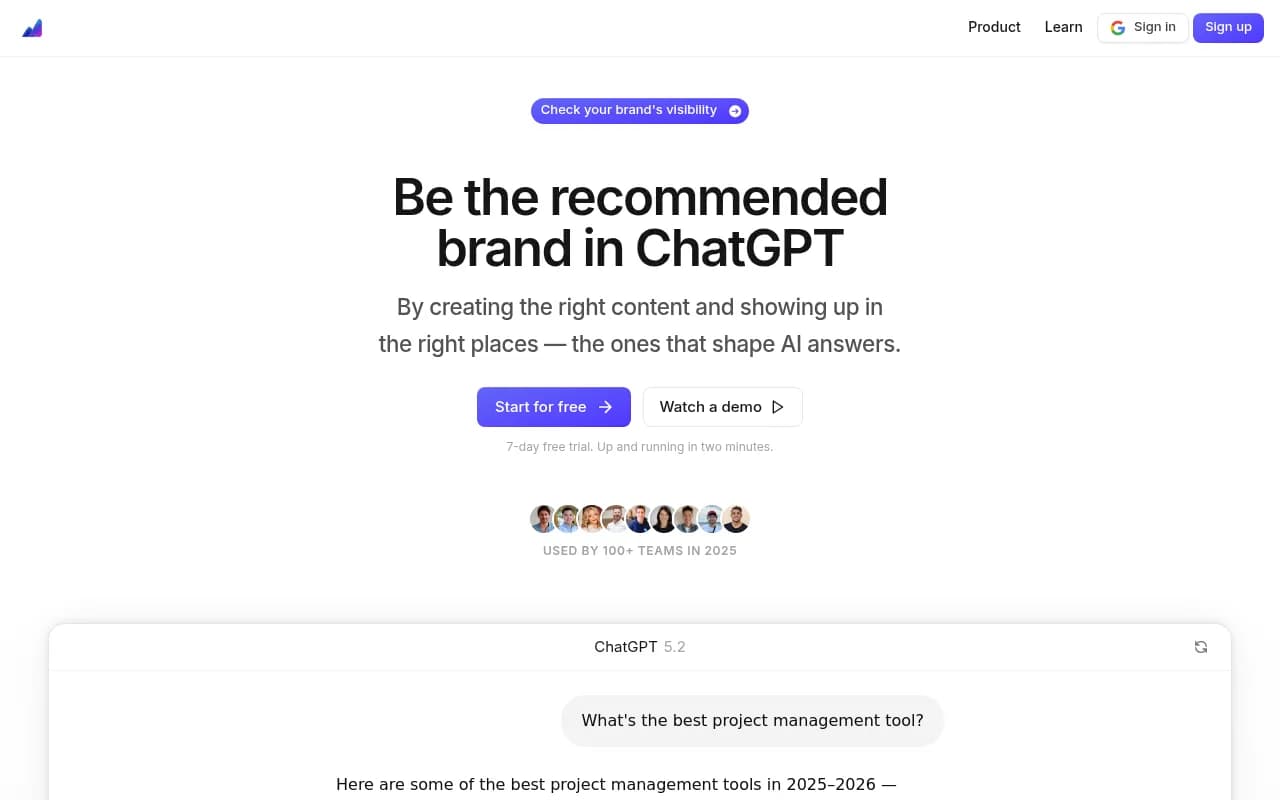
It includes Reddit monitoring -- an active opportunity discovery layer that Searchable doesn't offer -- and covers the major AI platforms. The trade-off is depth: Airefs is a lighter tool, and teams with serious optimization goals will likely outgrow it.
Worth noting: the low price point makes it a good option for agencies that want to run a quick audit for a client before recommending a more comprehensive solution.
6. Rankshift -- best for clean, no-frills LLM tracking
Rankshift covers ChatGPT, AI Overviews, Perplexity, and Copilot by default, with AI Mode and Gemini available as add-ons. The interface is clean and the learning curve is low, which matters for teams that don't want to spend a week getting up to speed.
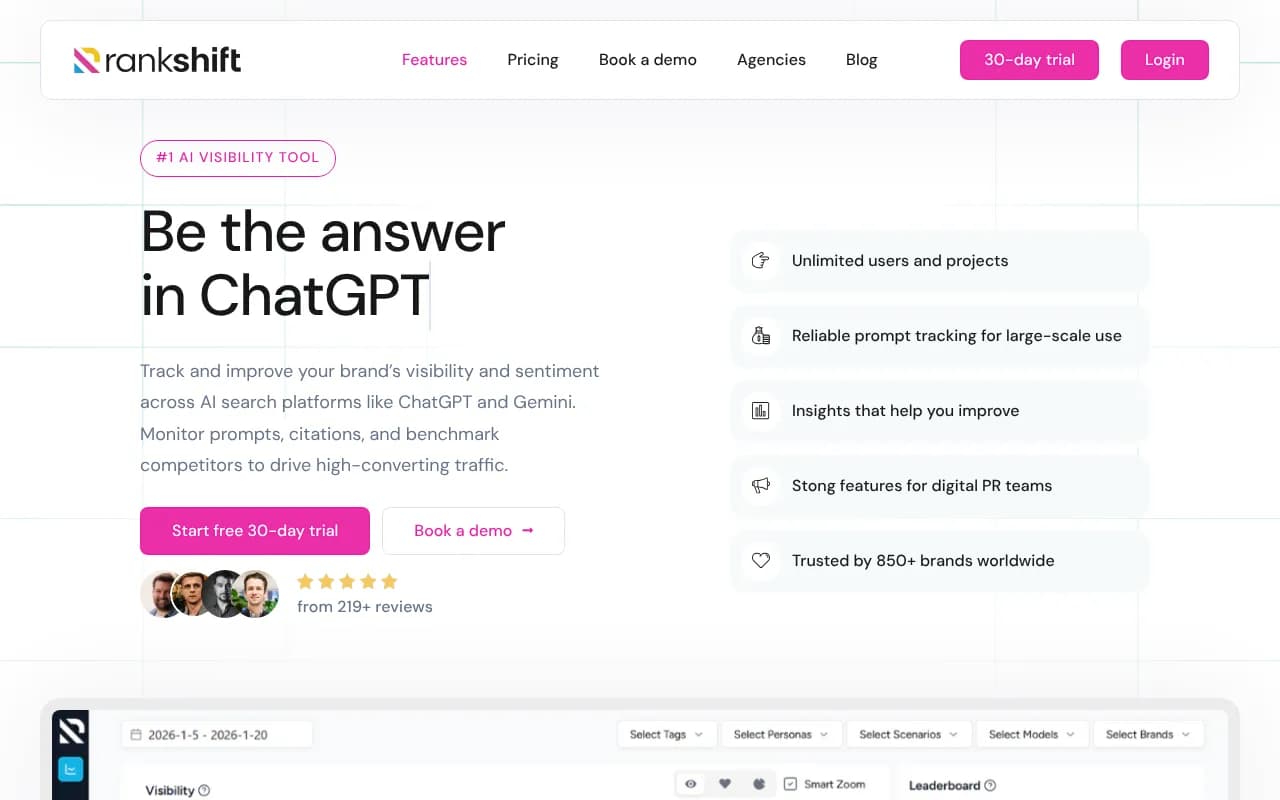
It's a solid monitoring tool without much in the way of content optimization or gap analysis. If your team already has a content workflow and just needs reliable visibility data to feed into it, Rankshift does that job well without unnecessary complexity.
7. Semrush -- best for teams already invested in the Semrush ecosystem
If your team already uses Semrush for traditional SEO, adding AI visibility tracking through the same platform has obvious workflow advantages. You're not managing another login, another billing relationship, or another data silo.
The honest limitation: Semrush's AI visibility features use fixed prompts rather than letting you define your own, and there's no AI traffic attribution. For teams that need custom prompt tracking or want to connect AI visibility to revenue, that's a real constraint. But for teams that want "good enough" AI monitoring layered into a tool they already use daily, it's a reasonable choice.
8. LLM Pulse -- best for teams that want straightforward LLM response tracking
LLM Pulse focuses specifically on tracking how LLMs respond to prompts relevant to your brand. It's less feature-heavy than some options on this list, which is either a pro or a con depending on what you need.
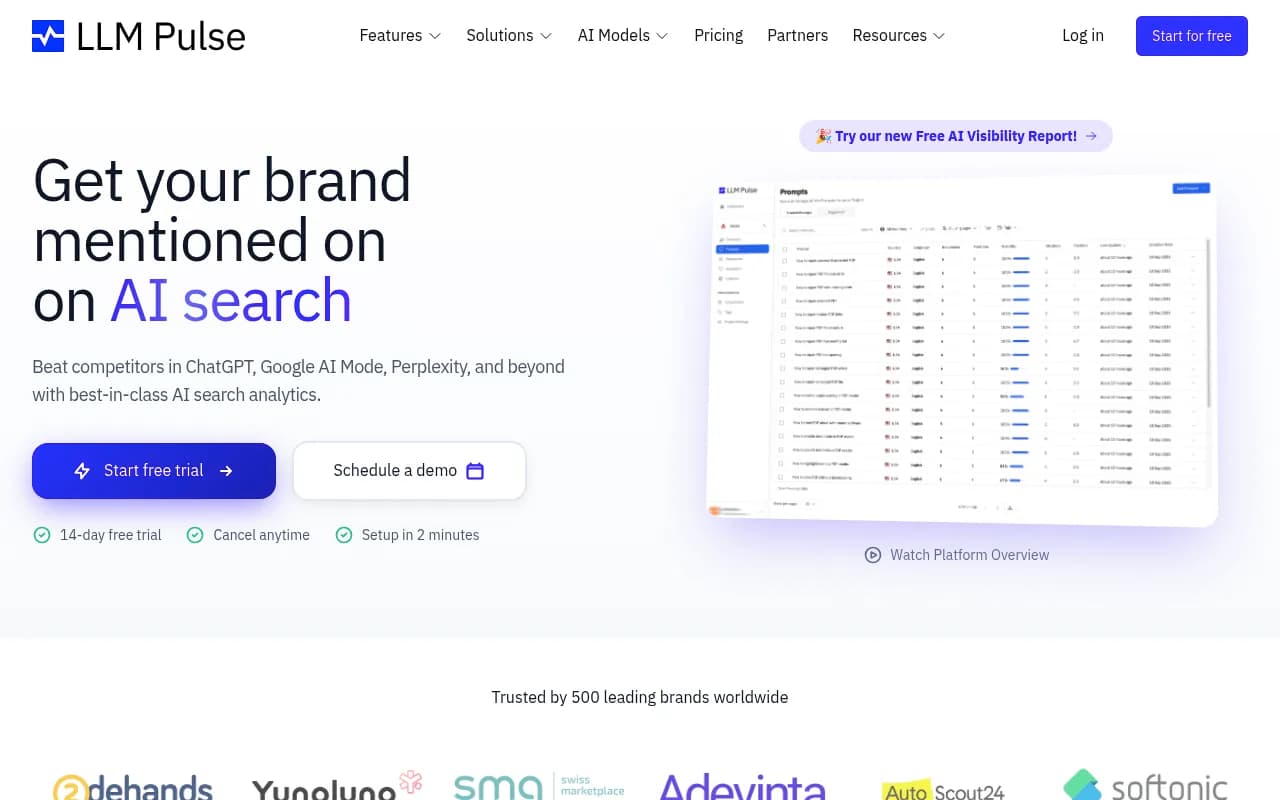
The pricing is accessible, the setup is quick, and the core monitoring functionality works. It's a good fit for teams that want to understand their LLM presence without committing to a full-featured platform. Like most monitoring-only tools, it shows you the data but doesn't help you act on it.
Side-by-side comparison
| Tool | Starting price | AI engines covered | Content generation | Crawler logs | Reddit/YouTube tracking | Best for |
|---|---|---|---|---|---|---|
| Promptwatch | $99/mo | 10 | Yes (citation-grounded) | Yes | Yes | Full optimization loop |
| Otterly.AI | $29/mo | 6+ | No | No | No | Proven monitoring + GEO audit |
| Peec AI | $85/mo | 8+ | No | No | No | Multilingual/global brands |
| Profound | $99/mo | 10 | No | No | No | Enterprise analytics depth |
| Airefs | $24/mo | 5+ | No | No | Yes (Reddit) | Budget entry point |
| Rankshift | Custom | 4-6 | No | No | No | Clean, simple LLM tracking |
| Semrush | $139/mo+ | 4 (fixed prompts) | No | No | No | Existing Semrush users |
| LLM Pulse | Low | 5+ | No | No | No | Lightweight monitoring |
| Searchable | $50/mo | 5 | Yes (basic) | No | No | All-in-one starter |
How to choose
The right tool depends on where your team is in the AI visibility journey.
If you're just starting out and want to understand what AI models say about your brand, Airefs at $24/month or Otterly.AI at $29/month are low-risk starting points. You'll get real data without a significant financial commitment.
If you're at a global brand with multilingual requirements and enterprise stakeholders who need documented outcomes, Peec AI or Profound are the more credible choices. Both have third-party validation that Searchable (launched 6 months ago) doesn't yet have.
If you're already a Semrush power user and just want AI visibility bolted onto your existing workflow, the Semrush integration is the path of least resistance -- just go in knowing the fixed-prompt limitation.
And if your goal is to actually move the needle on AI visibility -- not just measure it -- the tools that only monitor will leave you stuck. You'll see the gaps but have no structured way to close them. That's where the distinction between a monitoring dashboard and an optimization platform matters most. Promptwatch is the only tool on this list that covers the full cycle: find gaps, generate content grounded in citation data, track the results, and connect visibility to traffic and revenue.
The category is moving fast. Most of these tools will look different in 6 months. But the fundamental question -- "does this tool help me fix the problem, or just describe it?" -- will still be the right one to ask.