Key takeaways
- Peec.ai is a solid entry-level AI visibility tracker, but agencies consistently hit its limits around multi-client management, engine coverage, and actionability.
- The best alternatives in 2026 go beyond monitoring -- they help you identify content gaps, generate optimized content, and attribute AI traffic to real revenue.
- For agencies that need to scale across clients, tools with white-label reporting, multi-workspace support, and built-in content workflows are worth the higher price point.
- The right choice depends on your team size, client volume, and whether you need monitoring only or a full optimization loop.
- Most tools offer free trials -- test two or three before committing.
Peec.ai had a strong 2025. It was one of the first platforms to give SEOs a clear view of brand presence in AI-generated answers, and for solo practitioners or small in-house teams, it still does that job reasonably well.
But agencies are a different story.
When you're managing visibility across 10, 20, or 50 clients -- each with different industries, competitors, and prompt sets -- you need more than a dashboard that shows you where you're mentioned. You need multi-client workspaces, repeatable reporting workflows, content gap analysis, and ideally some way to act on what you find. Peec.ai wasn't built for that, and the gaps show.
The SEO community noticed. Threads in r/SEO and Slack groups like TrafficThinkTank were flagging the same issues through 2025: costs scaling badly for large prompt sets, limited engine coverage as Perplexity and Claude grew in importance, and no clear path from "you're not visible here" to "here's what to do about it."
This guide covers seven alternatives that agencies are actually switching to in 2026, what each one does well, and where each falls short.

What to look for before switching
Before jumping to alternatives, it's worth being clear about what "better for agencies" actually means. A few things matter more than the feature list:
Engine coverage. AI search is no longer just ChatGPT and Google AI Overviews. Perplexity, Claude, Gemini, Grok, DeepSeek, Copilot, and Meta AI all influence how people discover brands. A tool that only monitors two or three of these is already behind.
Multi-client architecture. Can you manage separate client workspaces without logging in and out? Can clients see their own data without seeing yours or other clients'? Role-based access control matters more than it sounds.
Actionability. Monitoring tells you where you're invisible. Optimization helps you fix it. Most tools stop at monitoring. The ones that don't -- with content gap analysis, AI writing tools, or structured recommendations -- are worth a serious look.
Reporting. Client-ready exports, white-label options, Looker Studio integrations. Agencies live and die by reporting, and tools that make it painful will cost you hours every month.
Pricing that scales. Per-prompt pricing can get expensive fast. Understand the cost model before you commit.
The 7 best Peec.ai alternatives for agencies in 2026
1. Promptwatch
Promptwatch is the most complete option on this list for agencies that want to move from monitoring into actual optimization. Where most tools show you a visibility score and leave you to figure out the rest, Promptwatch is built around a closed loop: find the gaps, create content that fixes them, track the results.
The Answer Gap Analysis is the standout feature for agencies. It shows you exactly which prompts your competitors are appearing for that you're not -- not just "you're missing coverage here" but the specific questions and topics AI models want to answer that your client's site doesn't address. From there, the built-in AI writing agent generates articles, listicles, and comparisons grounded in citation data from over 880 million citations analyzed. That's not generic content -- it's engineered to get cited by ChatGPT, Claude, Perplexity, and others.
For multi-client work specifically: Promptwatch monitors 10 AI models (ChatGPT, Perplexity, Google AI Overviews, Google AI Mode, Claude, Gemini, Meta/Llama, DeepSeek, Grok, Copilot), has AI crawler logs showing which pages each model reads and how often, and supports traffic attribution through a code snippet, GSC integration, or server log analysis. That last piece -- connecting AI visibility to actual revenue -- is something almost no competitor offers.
Pricing starts at $99/month for a single site, $249/month for the Professional tier (2 sites, crawler logs, city-level tracking), and $579/month for Business (5 sites). Agency and enterprise pricing is available on request.

2. Profound
Profound has positioned itself as the enterprise-grade option, and it earns that label in a few specific ways. The conversation-level analytics are genuinely deeper than most competitors -- you can see not just whether your brand was mentioned but the context around the mention, which matters when you're trying to understand brand narrative rather than just presence.
The Agency mode is worth noting: it includes separate brand configurations and what Profound calls "pitch environments," which makes it easier to demo AI visibility data to prospective clients. That's a thoughtful feature for business development.
Where Profound falls short for some agencies is price. The Lite tier starts at $499/month, which is a significant jump from Peec.ai's entry point. And while the data is rich, the content optimization side is thinner -- you get excellent monitoring but less help acting on what you find.

3. AthenaHQ
AthenaHQ covers eight or more AI search engines and is one of the more reliable options for multi-engine monitoring at scale. The interface is clean, the data is updated frequently, and it handles competitive benchmarking well -- you can see how your client stacks up against specific competitors across different AI models.
The limitation is that AthenaHQ is primarily a monitoring platform. It doesn't have content generation, crawler logs, or traffic attribution built in. For agencies that already have content production workflows and just need solid visibility data to feed into them, that's fine. For agencies looking for an end-to-end solution, you'll need to bolt on other tools.
Starting price is around $295/month.

4. Scrunch AI
Scrunch takes a different angle. Rather than focusing purely on citation counts or mention frequency, it analyzes brand narrative -- how AI models describe your brand, what descriptors they use, and whether those descriptors match what you actually want to be known for. For brand-conscious clients, this is genuinely useful data that most other tools don't surface.
Scrunch also has what it calls an "Agent Experience Platform" (AXP), which serves AI-optimized content to crawlers. That's an interesting approach to optimization, though it's more technical to implement than a standard content workflow.
The Starter tier is around $300/month. Worth considering for agencies with clients in competitive brand-narrative categories -- luxury, professional services, consumer goods -- where how you're described matters as much as whether you're mentioned.
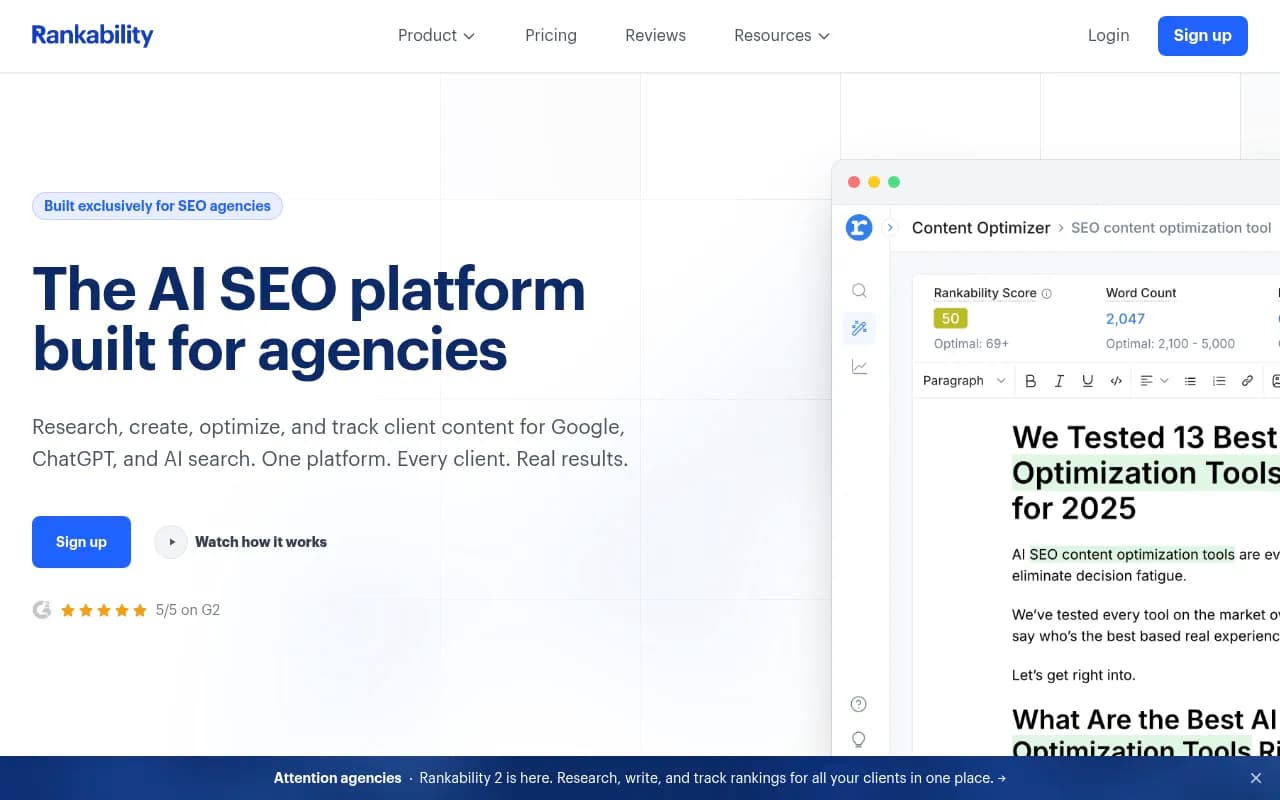
5. Rankability
Rankability is built specifically for agencies, and it shows. The Reporter product handles AI visibility tracking across ChatGPT, Gemini, Claude, Perplexity, Copilot, Google AI Overviews, and AI Mode. What makes it stand out is the integration with Rankability's content optimizer -- you can move from "this prompt isn't mentioning our client" to editing and optimizing content within the same platform.
For agencies that want a tighter connection between visibility data and content production, this is one of the better options. The suite pricing starts around $124/month billed annually, which is competitive for what you get.
The trade-off: it's less strong on the analytics and attribution side. If your clients want to see AI traffic connected to conversions, you'll need additional tooling.
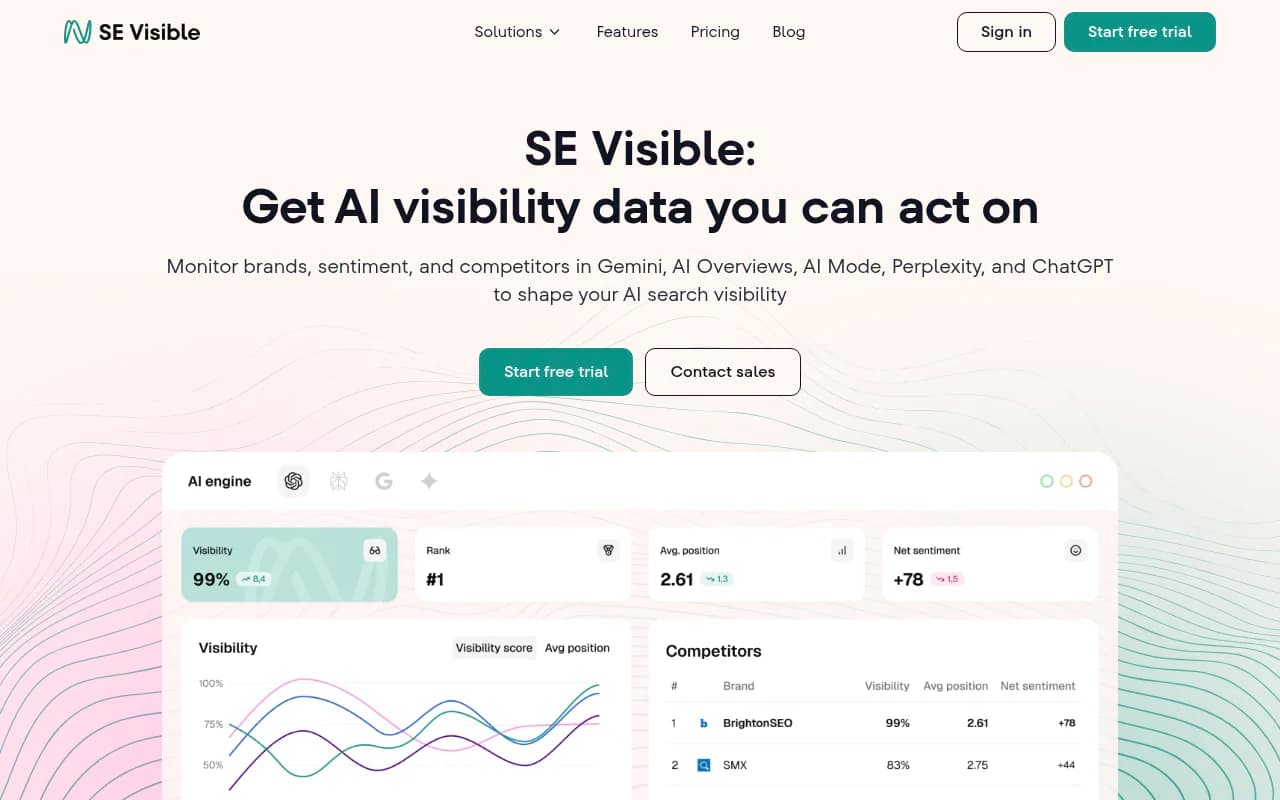
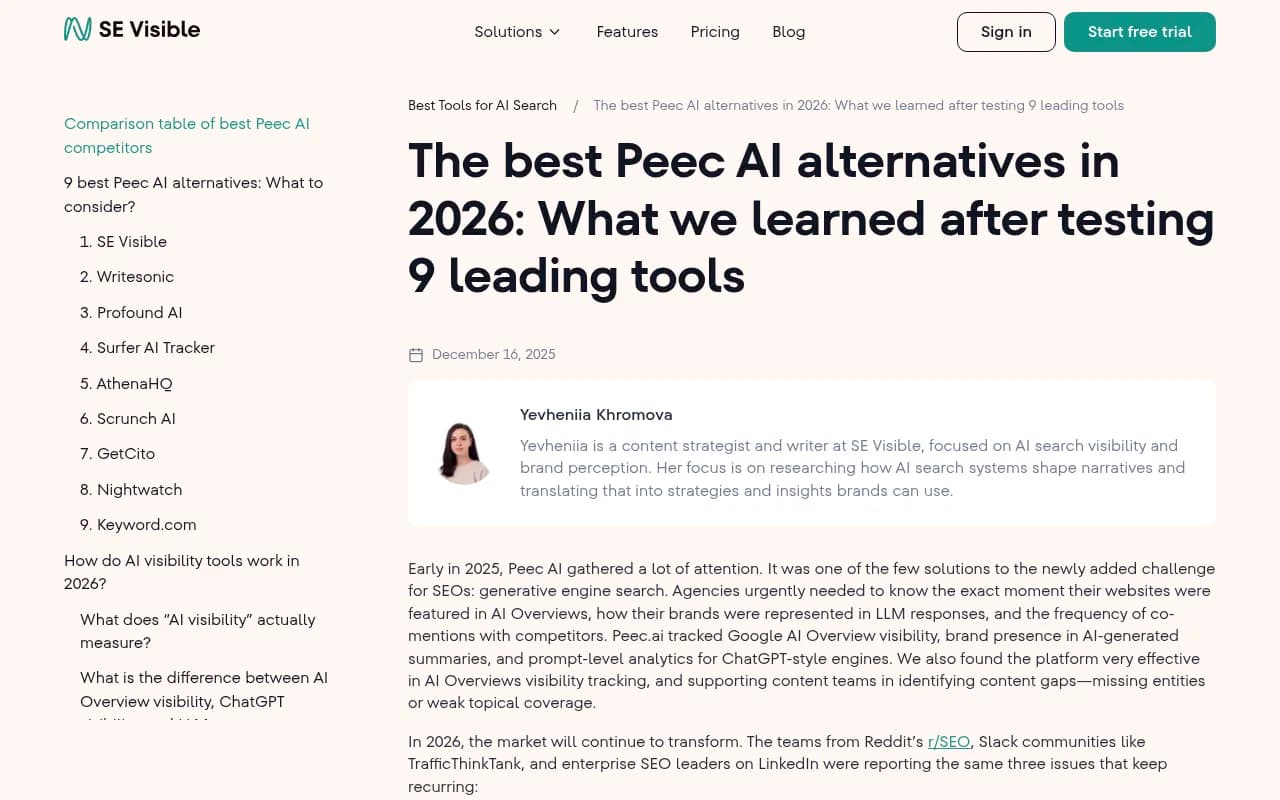
6. SE Visible
SE Visible (from SE Ranking) is a solid mid-market option that covers Google AI Overviews, Perplexity, ChatGPT, and Claude. It's particularly strong on competitor benchmarking and sentiment analysis -- useful for agencies whose clients care about how they're perceived relative to competitors, not just whether they appear.
The interface is approachable, and SE Ranking's existing customer base means it integrates reasonably well with traditional SEO workflows. If your agency is already using SE Ranking for rank tracking and site audits, SE Visible is a natural extension rather than a new tool to learn.
Starting price is around $189/month. Not the deepest feature set on this list, but reliable and well-supported.
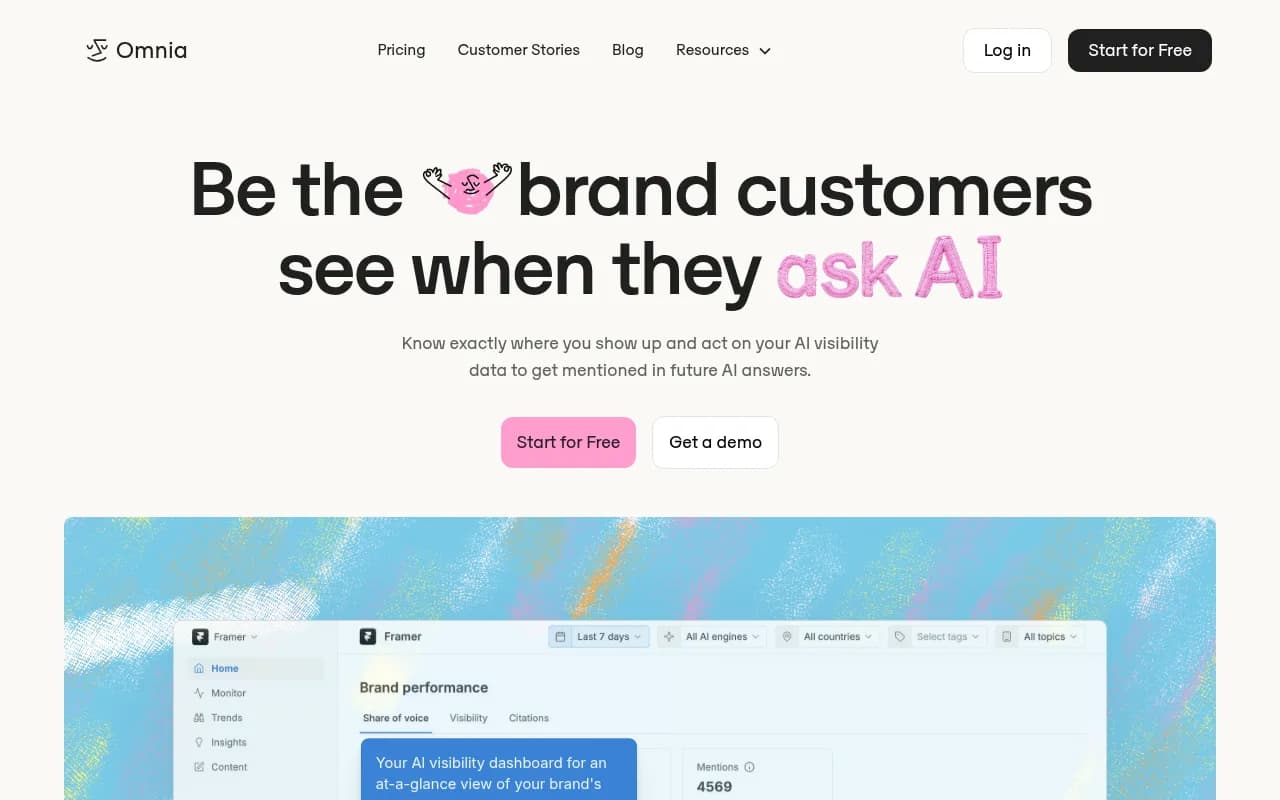
7. Omnia
Omnia focuses on AI-powered share of voice analytics, which is a slightly different framing than most tools on this list. Rather than tracking individual citations or mentions, it's oriented around understanding your client's position relative to the competitive set -- how much of the AI "conversation" in a given category is yours versus competitors'.
For agencies reporting to CMOs and brand leaders (rather than SEO teams), this framing often lands better. "Your share of voice in AI search increased 12 points this quarter" is a cleaner story than a citation count.
Omnia has a free tier, which makes it easy to test. The paid tiers add more depth on competitive benchmarking and automated insights.
Side-by-side comparison
| Tool | Best for | Engine coverage | Content optimization | Multi-client support | Starting price |
|---|---|---|---|---|---|
| Promptwatch | Full optimization loop | 10 models | Yes (AI writing agent, gap analysis) | Yes (agency/enterprise plans) | $99/mo |
| Profound | Enterprise analytics | ChatGPT, Perplexity, Google AIO | Limited | Yes (Agency mode) | $499/mo |
| AthenaHQ | Multi-engine monitoring | 8+ models | No | Yes | $295/mo |
| Scrunch AI | Brand narrative analysis | ChatGPT, Perplexity, Gemini, Claude, AIO | Yes (AXP) | Yes | $300/mo |
| Rankability | Agency content workflows | ChatGPT, Gemini, Claude, Perplexity, Copilot, AIO | Yes (optimizer integration) | Yes | ~$124/mo |
| SE Visible | Competitor benchmarking | Google AIO, Perplexity, ChatGPT, Claude | No | Yes | $189/mo |
| Omnia | Share of voice reporting | Multiple (varies by plan) | No | Yes | Free tier available |
How to choose
The honest answer is that the right tool depends on what's actually slowing you down.
If your main problem is that you can't show clients what's happening in AI search at all, almost any tool on this list will solve that. Start with something affordable -- Omnia's free tier or Rankability's entry plan -- and upgrade when you hit the limits.
If your problem is that you can see the gaps but can't fix them fast enough, you need a tool with content optimization built in. Promptwatch and Rankability are the strongest options here. Promptwatch goes further on the attribution side, which matters if clients are asking whether AI visibility actually drives revenue.
If your clients are enterprise brands with complex competitive landscapes and deep pockets, Profound's conversation-level analytics justify the price. The Agency mode features are genuinely useful for business development.
If brand narrative matters more than citation counts -- you're working with clients who care about how AI describes them, not just whether it mentions them -- Scrunch is worth a serious look.
One thing worth saying directly: most agencies in 2026 are still in the "we need to show clients something" phase. The tools that help you move from monitoring to optimization are the ones that will matter more as clients get more sophisticated about what they're paying for. A dashboard full of visibility scores is easy to produce. A clear story about why visibility changed and what content drove it is harder -- and that's where the better tools earn their keep.
Final thoughts
Peec.ai was a reasonable starting point when AI visibility tracking was new. In 2026, the category has matured enough that agencies need more than a starting point.
The tools above cover the range from affordable monitoring to full optimization platforms. None of them are perfect -- every one has trade-offs on price, coverage, or depth. But all of them are meaningfully better than Peec.ai for agencies managing multiple clients who need repeatable workflows, client-ready reporting, and some path from "here's where you're invisible" to "here's what we did about it."
Test a few. Most offer free trials. The one that fits your workflow is the one you'll actually use.