Key takeaways
- AI visibility platforms vary wildly in depth: most tools stop at monitoring, while a handful go further to help you actually fix gaps and create content that gets cited.
- Promptwatch is the only platform rated "Leader" across all evaluation categories in a 2026 comparison of 12 GEO tools, largely because it closes the loop from gap analysis to content creation to traffic attribution.
- Profound and AthenaHQ are strong enterprise-grade options, but come at higher price points and lack some channels (Reddit, ChatGPT Shopping) that matter for brand discovery.
- Peec.ai and Otterly.AI are solid entry points if your budget is tight, but expect to hit walls once you want to optimize rather than just observe.
- The right tool depends on whether you need to monitor, optimize, or both — and that distinction matters more than any feature checklist.
Why AI visibility became a real marketing problem in 2025
A year ago, most marketing teams were still treating AI search as a curiosity. By mid-2025, that changed. Brands started noticing that prospects were arriving with opinions already formed — not from Google, but from ChatGPT conversations, Perplexity summaries, and Gemini answers. If your brand wasn't in those answers, you weren't in the consideration set.
The problem is that traditional SEO tools don't measure this. Your rank tracker shows you position 3 for a target keyword. It says nothing about whether ChatGPT recommends you when someone asks "what's the best [your category] tool for a mid-size team?" Those are different questions, and the answer to the second one is increasingly what drives pipeline.
This is what Generative Engine Optimization (GEO) addresses. And the platforms below are the ones that teams actually used to get a handle on it in 2025.
How we evaluated these platforms
Every tool below was assessed on four dimensions:
- Platform coverage: How many AI models does it track? (ChatGPT, Perplexity, Claude, Gemini, Grok, DeepSeek, Copilot, AI Overviews, etc.)
- Monitoring depth: Does it show citations, share of voice, sentiment, and source analysis — or just mention counts?
- Optimization capabilities: Can it help you fix gaps, generate content, or give you a roadmap? Or does it just show you data?
- Pricing and accessibility: Is it priced for the value it delivers?
The monitoring-only vs. optimization distinction is the most important split in this market. Most tools do the former. Very few do both.
The top 10 AI visibility platforms from 2025
1. Promptwatch
Promptwatch is the platform that moved furthest from pure monitoring in 2025. Where most tools show you a dashboard and leave you to figure out what to do next, Promptwatch runs a loop: find gaps, create content, track results.
The Answer Gap Analysis is the core of this. It shows you exactly which prompts your competitors appear in that you don't — not as a vague "you're missing coverage here" note, but as specific questions and topics that AI models are answering without citing your site. From there, a built-in AI writing agent generates articles and listicles grounded in citation data from 880M+ analyzed citations, targeting the prompts where you're invisible.
The crawler logs are also worth calling out. Most platforms have no idea which AI crawlers are hitting your site, which pages they're reading, or whether they're hitting errors. Promptwatch surfaces this in real time, which matters because you can't fix indexing problems you can't see.
Other capabilities: prompt volume and difficulty scoring, query fan-outs (how one prompt branches into sub-queries), Reddit and YouTube citation tracking, ChatGPT Shopping monitoring, competitor heatmaps across 10+ AI models, and traffic attribution via GSC integration or server log analysis.
Pricing starts at $99/mo (Essential: 1 site, 50 prompts, 5 articles). Professional is $249/mo, Business $579/mo. Free trial available.

2. Profound
Profound is the go-to enterprise option for teams that need breadth and depth of monitoring. It tracks 10+ AI platforms including ChatGPT, Perplexity, Claude, Gemini, Grok, Copilot, Meta AI, DeepSeek, and AI Overviews. The platform shows which sources and citations drive AI answers, which is genuinely useful for understanding why competitors are getting cited and you're not.
Where Profound is strong: prompt volume data, citation source analysis, and a clean interface that enterprise teams can actually get stakeholder buy-in on. Where it's weaker: no Reddit or YouTube tracking, no ChatGPT Shopping monitoring, and the optimization layer is thinner than Promptwatch's. It's more of a "here's what's happening" tool than a "here's how to fix it" tool.
Pricing starts at $99/mo and scales significantly for enterprise tiers.

3. AthenaHQ
AthenaHQ tracks 8 AI platforms (ChatGPT, Perplexity, AI Overviews, AI Mode, Gemini, Claude, Copilot, Grok) and has built a reputation for strong case studies and a clean UX. It's YC-backed, which has driven a lot of attention, and the team has been responsive to product feedback.
The monitoring quality is solid. Share of voice tracking, citation analysis, and competitive benchmarking are all well-executed. The gap is on the optimization side — AthenaHQ is primarily a monitoring platform, and teams that want to move from "we see the problem" to "we're fixing it" will need to bring their own content workflow.
Pricing starts at $95/mo on annual billing.

4. Peec.ai
Peec.ai gathered a lot of attention early in 2025 for its accuracy-focused approach and smart opportunity prioritization. It tracks ChatGPT, Perplexity, and AI Overviews by default, with additional models available at extra cost per tier.
The standout feature is how it surfaces actionable suggestions — rather than just showing you where you're invisible, it flags which gaps are worth pursuing based on competitive difficulty and potential impact. That's more useful than a raw list of missing prompts. Multi-language support is also strong, which matters for brands operating across markets.
The limitation is that it's still primarily a monitoring and prioritization tool. Content generation and crawler log analysis aren't part of the offering. For teams that want a simple, accurate tracker with smart prioritization, it's a good fit. For teams that want to close the loop end-to-end, it's a starting point.
Pricing starts at $85/mo.

5. Otterly.AI
Otterly.AI is the most accessible entry point in this market. It tracks ChatGPT and AI Overviews at minimum, with a clean interface and pricing that doesn't require budget approval. For small teams or solo marketers who want to start tracking AI visibility without committing to an enterprise contract, it's a reasonable first step.
The trade-offs are real: no crawler logs, no visitor analytics, no content generation, and limited prompt intelligence. It's a monitoring dashboard, and a fairly basic one. But "basic monitoring" is still better than no monitoring, and Otterly.AI executes the basics cleanly.

6. Brandlight
Brandlight tracks 11+ AI platforms including some less common ones like Llama and AI Mode, and has positioned itself toward enterprise and agentic commerce use cases. CB Insights ranked it #1 in its category, which drove significant attention in 2025.
It's a capable platform with strong coverage breadth. The pricing is custom (enterprise-only), which means it's not accessible for most mid-market teams. For large brands that need comprehensive monitoring across every major AI model and want enterprise support, it's worth evaluating.
7. SE Visible (by SE Ranking)
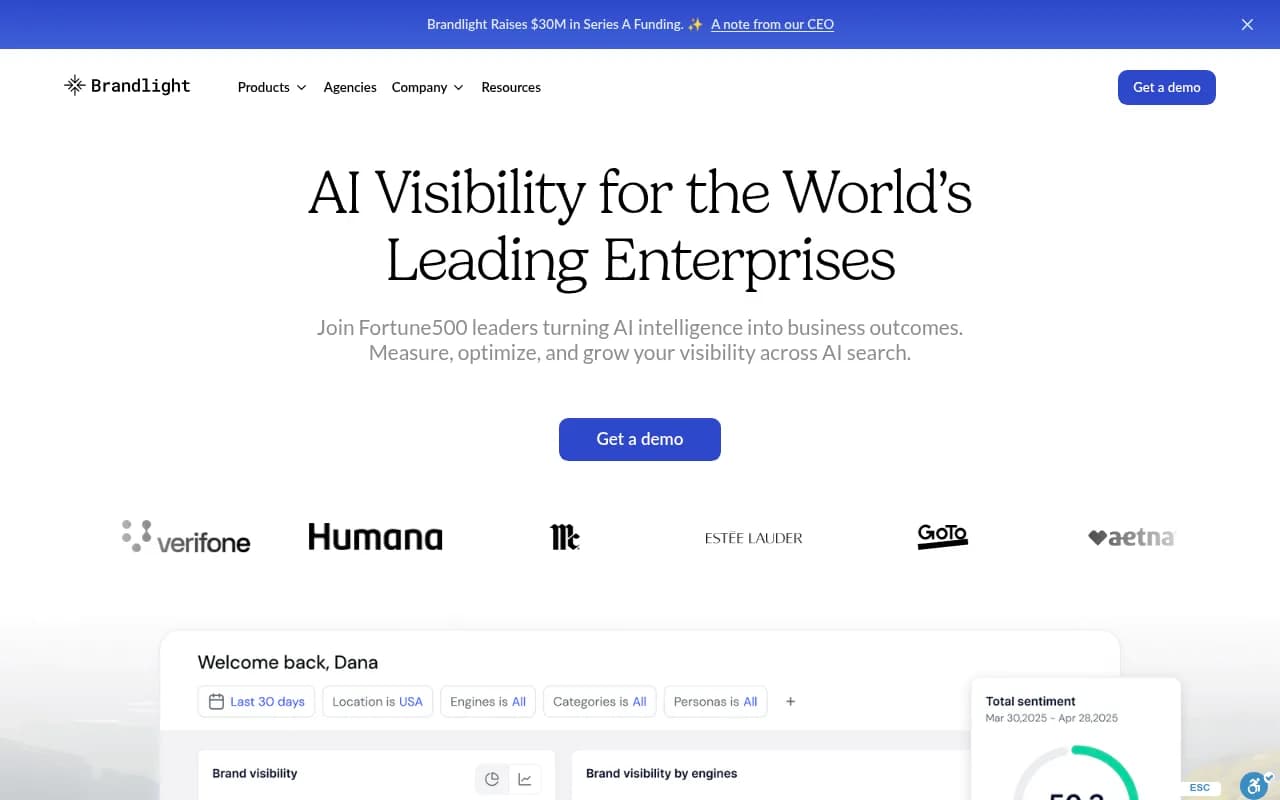
SE Visible is SE Ranking's dedicated AI visibility product, and it benefits from being built on top of an established SEO data infrastructure. The interface is user-friendly, the onboarding is smooth, and teams already using SE Ranking for traditional SEO will find the transition natural.
Coverage is solid across major AI platforms. The main limitation is that it's more of a monitoring add-on than a standalone GEO platform — optimization capabilities are limited, and it doesn't have the depth of prompt intelligence or citation analysis that purpose-built GEO tools offer.
8. Scrunch AI
Scrunch AI is a newer entrant that made noise in 2025 for its clean monitoring interface and competitive benchmarking features. It tracks major AI models and provides share of voice comparisons that are easy to present to stakeholders.
It's a monitoring-focused tool without deep optimization capabilities, but the UX is genuinely good and the competitive heatmap view is one of the better implementations in the market. For teams that need to report on AI visibility to leadership without building a complex workflow, it's worth a look.
9. Airefs
Airefs takes a different angle: it focuses on source-level citation discovery and Reddit monitoring, starting at $24/mo. That price point makes it accessible to almost anyone, and the Reddit tracking is a genuine differentiator — Reddit threads are a significant source of AI citations that most platforms ignore entirely.
The trade-off is coverage breadth. Airefs defaults to ChatGPT and adds other models on request. It's not a full-stack GEO platform, but as a focused tool for understanding which sources and communities are influencing AI recommendations in your category, it's useful and affordable.
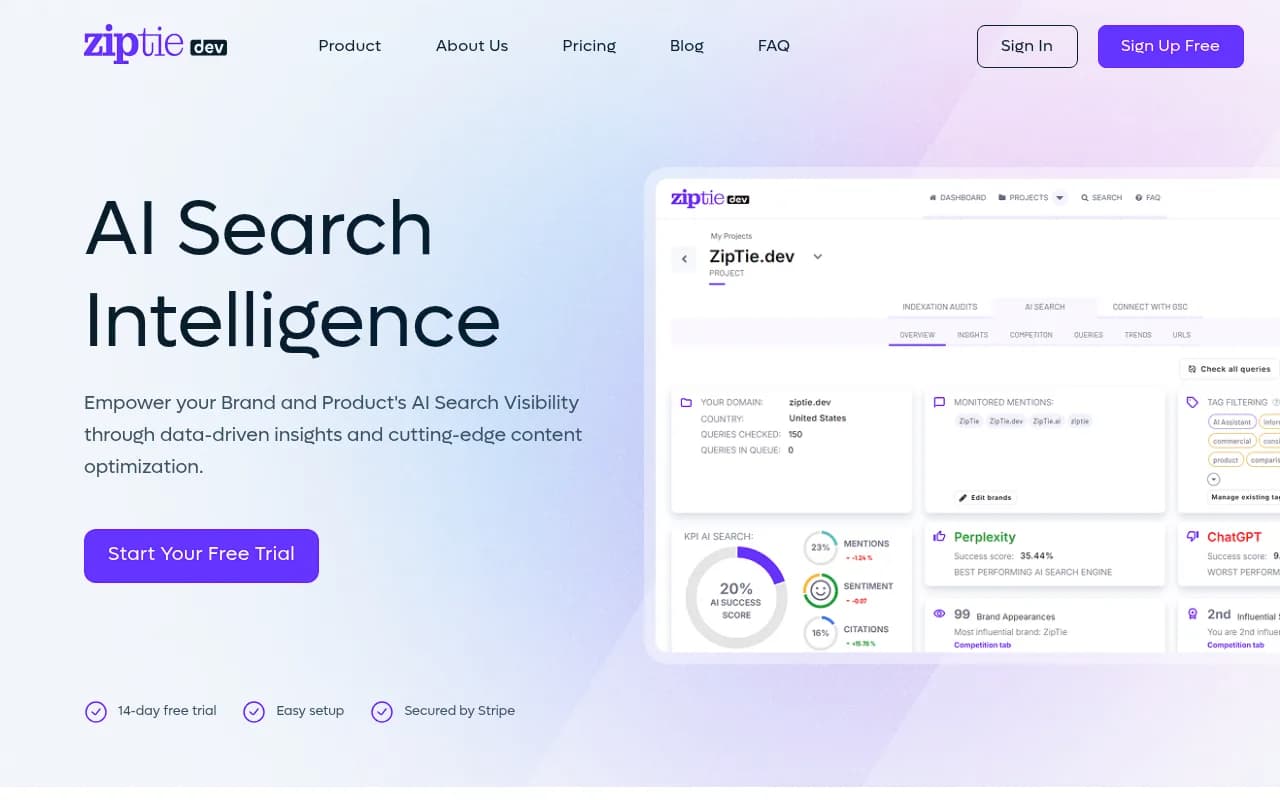
10. Ziptie.dev
Ziptie.dev positions itself as an action-oriented platform and was one of the first to offer AI Overviews tracking with built-in optimization guidance. The content optimization module is a genuine differentiator compared to pure monitoring tools, and the query generation feature helps teams identify prompts they hadn't thought to track.
It's a focused tool — strong on AI search, less useful if you need traditional SEO metrics alongside it. For teams that want optimization guidance without moving to a full enterprise platform, it's a solid mid-tier option.
Side-by-side comparison
| Platform | AI models tracked | Monitoring depth | Content optimization | Crawler logs | Reddit/YouTube tracking | Starting price |
|---|---|---|---|---|---|---|
| Promptwatch | 10+ (ChatGPT, Claude, Perplexity, Gemini, Grok, DeepSeek, Copilot, Mistral, Meta AI, AI Overviews) | Deep (citations, share of voice, page-level, prompt volume) | Yes (built-in AI writing agent) | Yes | Yes | $99/mo |
| Profound | 10+ | Deep (citations, source analysis) | Limited | No | No | $99/mo |
| AthenaHQ | 8 | Strong | No | No | No | $95/mo (annual) |
| Peec.ai | 3 default (+more at cost) | Good (accuracy-focused) | No | No | No | $85/mo |
| Otterly.AI | 2+ | Basic | No | No | No | Low |
| Brandlight | 11+ | Strong | Limited | No | No | Custom |
| SE Visible | Major platforms | Good | No | No | No | Bundled with SE Ranking |
| Scrunch AI | Major platforms | Good | No | No | No | Varies |
| Airefs | ChatGPT + others | Source-level focus | No | No | Reddit only | $24/mo |
| Ziptie.dev | AI Overviews, ChatGPT, Perplexity | Good | Yes (guidance) | No | No | Varies |
What separates the leaders from the trackers
The honest summary: most tools in this space are monitoring dashboards. They show you citation rates, share of voice, and competitive comparisons. That's useful data. But data without a path to action is just expensive reporting.
The platforms that stood out in 2025 were the ones that helped teams move from "we know we're invisible" to "we published content and our visibility improved." That requires three things: gap analysis that's specific enough to act on, content generation that's grounded in real citation data, and tracking that closes the loop back to traffic and revenue.
Promptwatch is the most complete implementation of that loop. Profound and AthenaHQ are strong on the monitoring side. Peec.ai is the best option if you want smart prioritization without a big budget commitment. And Airefs is worth adding to any stack if Reddit and source-level citation analysis are relevant to your category.
Which platform should you choose?
A few honest recommendations based on team type:
- If you're a marketing or SEO team that wants to monitor AND fix AI visibility gaps, Promptwatch is the most complete option. The action loop (gap analysis → content generation → traffic attribution) is what makes it different from everything else on this list.
- If you're an enterprise team that needs deep monitoring and stakeholder-ready reporting, Profound or AthenaHQ are worth evaluating. Expect to build your own optimization workflow on top.
- If you're just starting out and want to understand the landscape before committing budget, Peec.ai or Otterly.AI give you a low-friction entry point.
- If source-level citation analysis and Reddit monitoring are priorities (they should be for most B2B brands), add Airefs to whatever else you're using.
The category is moving fast. Tools that were monitoring-only in early 2025 are adding optimization features. The gap between the leaders and the rest is narrowing. But right now, the difference between a platform that shows you the problem and one that helps you solve it is still significant — and that's the most important thing to evaluate when choosing.