Key takeaways
- AI search now accounts for over 40% of searches globally, but most traditional SEO tools were never built to track it
- The biggest gap isn't monitoring -- it's that most platforms stop at showing you data and don't help you fix anything
- True multi-engine coverage means tracking at least ChatGPT, Perplexity, Google AI Overviews, Gemini, and Claude in one place
- A handful of platforms in 2026 now close the full loop: find gaps, generate content, track results
- Pricing ranges from ~$59/month for entry-level tools to enterprise contracts for Fortune 500 use cases
Here's a scenario that's playing out in marketing teams everywhere right now: your domain authority is solid, your keyword rankings are fine, and then someone asks ChatGPT to recommend a tool in your category. Your brand doesn't appear. Not even close.
That's the blind spot. AI search engines now handle over 2 billion queries daily on ChatGPT alone. Perplexity attracts a disproportionately senior B2B audience -- roughly 30% hold leadership roles. Google AI Overviews are reshaping how people interact with search results before they ever click a link. If you're not tracking visibility across all of these, you're flying blind.
The problem is that most tools were built for one engine, or built purely for monitoring without any path to actually improving your visibility. This guide covers the 10 strongest platforms in 2026 that give you real multi-engine coverage in a single dashboard -- with honest notes on what each one does well and where it falls short.
What to look for before picking a tool
Before getting into the list, it's worth being clear about what separates a genuinely useful AI visibility platform from a dashboard that just looks impressive.
Multi-engine coverage is the obvious starting point. Your audience doesn't use a single AI -- they use ChatGPT for some queries, Perplexity for research, Google AI Overviews when they start a search, and Gemini when they're in Google's ecosystem. A tool that only monitors one of these gives you a partial picture at best.
But coverage alone isn't enough. The more important question is: what can you do with the data? Most platforms will show you that you're invisible for a certain prompt. Fewer will tell you why. Almost none will help you create the content that fixes it.
The other things worth checking: prompt volume estimates (so you can prioritize high-traffic queries), page-level citation tracking (so you know which of your pages AI models are actually reading), and competitor benchmarking (so you understand relative visibility, not just absolute numbers).
With that in mind, here's how the top 10 stack up.
The top 10 AI search visibility tools in 2026
1. Promptwatch
Promptwatch is the most complete platform in this category right now. It monitors 10 AI engines -- ChatGPT, Perplexity, Google AI Overviews, Google AI Mode, Claude, Gemini, Meta/Llama, DeepSeek, Grok, Mistral, and Copilot -- from a single dashboard. That's the widest coverage of any tool on this list.
What makes it different from most competitors is that it doesn't stop at monitoring. The Answer Gap Analysis shows you exactly which prompts competitors are visible for that you're not -- not as a vague suggestion, but as specific topics and questions your site is missing. From there, a built-in AI writing agent generates articles, listicles, and comparisons grounded in citation data from over 880 million citations analyzed. The content is engineered to get cited, not just to fill a content calendar.
It also has AI Crawler Logs -- real-time logs of when ChatGPT, Claude, Perplexity, and other crawlers hit your site, which pages they read, and what errors they hit. Most competitors don't have this at all. Add prompt volume estimates, query fan-outs, Reddit and YouTube citation tracking, ChatGPT Shopping monitoring, and traffic attribution via GSC or server logs, and you get a platform that actually closes the loop between visibility and revenue.
Pricing: Essential at $99/month (1 site, 50 prompts), Professional at $249/month (2 sites, 150 prompts, crawler logs), Business at $579/month (5 sites, 350 prompts). Free trial available.

2. Profound
Profound covers 10+ AI engines including ChatGPT, Perplexity, and Google AI Overviews, with citation-level sentiment analysis that goes deeper than most tools. It's particularly strong for regulated industries where understanding the tone and framing of AI responses matters as much as whether you appear at all.
The content workflow features are solid, though the platform leans more toward intelligence than execution. You'll get rich data on what's happening -- less direct help on what to do about it. Pricing starts at $99/month, but enterprise tiers push significantly higher.

3. Semrush (AI Toolkit)
Semrush added an AI visibility toolkit as an add-on to its existing platform. If your team is already deep in Semrush for traditional SEO, this is a natural extension -- you get ChatGPT, Gemini, and Google AI Overviews tracking without switching tools.
The limitation is that the prompts are fixed, which means you're tracking what Semrush decides to track rather than the specific queries your customers are actually using. There's no content generation layer, and AI traffic attribution isn't available. Still, for teams that want basic AI monitoring alongside their existing SEO workflow, it's a reasonable starting point.
4. Peec AI
Peec AI covers ChatGPT, Gemini, Perplexity, and DeepSeek with multi-language support that makes it a strong choice for agencies managing clients across different markets. The interface is clean, reporting is solid, and the multi-client management features are well-built.
Where it falls short is execution. Like many tools in this category, Peec AI is a monitoring platform -- it shows you the data but doesn't help you act on it. No crawler logs, no content generation, no traffic attribution. Starting price is around $95/month.

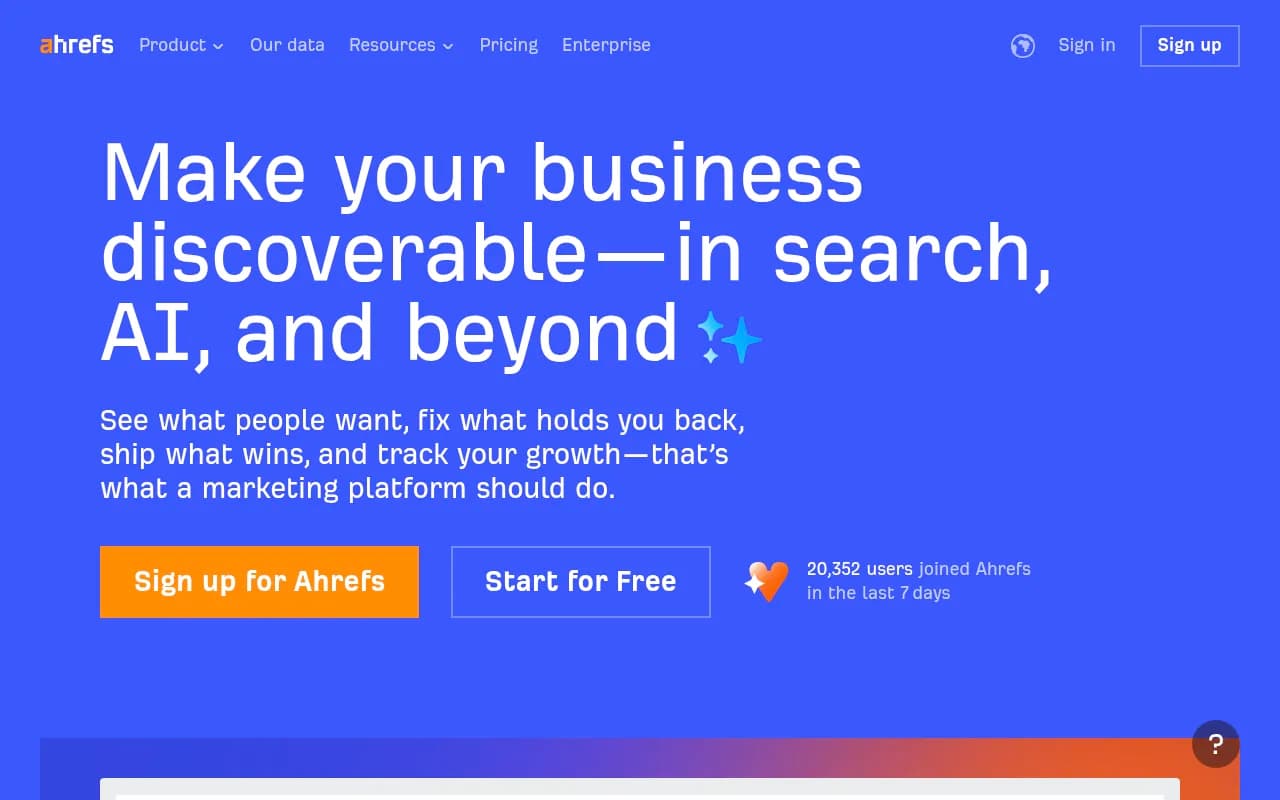
5. Ahrefs Brand Radar
Ahrefs Brand Radar brings the familiar Ahrefs data quality to AI search monitoring, covering ChatGPT and a handful of other engines. If you trust Ahrefs for traditional SEO data, the brand monitoring extension is a credible addition.
The main constraints: fixed prompts (you can't customize what you track), no AI traffic attribution, and coverage that doesn't yet match the breadth of dedicated GEO platforms. It's a solid supplementary tool for Ahrefs users, less compelling as a standalone AI visibility solution.
6. AthenaHQ
AthenaHQ tracks 8+ AI search engines with a clean interface and good competitive benchmarking features. It's monitoring-focused, which means the data quality is strong but the path from insight to action is left to you.
For teams that have a content operation already running and just need reliable visibility data to feed into it, AthenaHQ works well. For teams that need the full loop -- track, identify gaps, create content, measure results -- it's only part of the answer.

7. Otterly.AI
Otterly.AI is one of the more affordable options in this space, making it accessible for smaller teams and solo marketers who want to start tracking AI visibility without a large budget. It covers the major engines and gives you brand mention tracking and basic competitor comparisons.
The trade-off is depth. Otterly.AI is a monitoring-only tool -- no content generation, no crawler logs, no prompt volume data. It's a good entry point, but teams that grow into more sophisticated GEO programs will likely outgrow it.

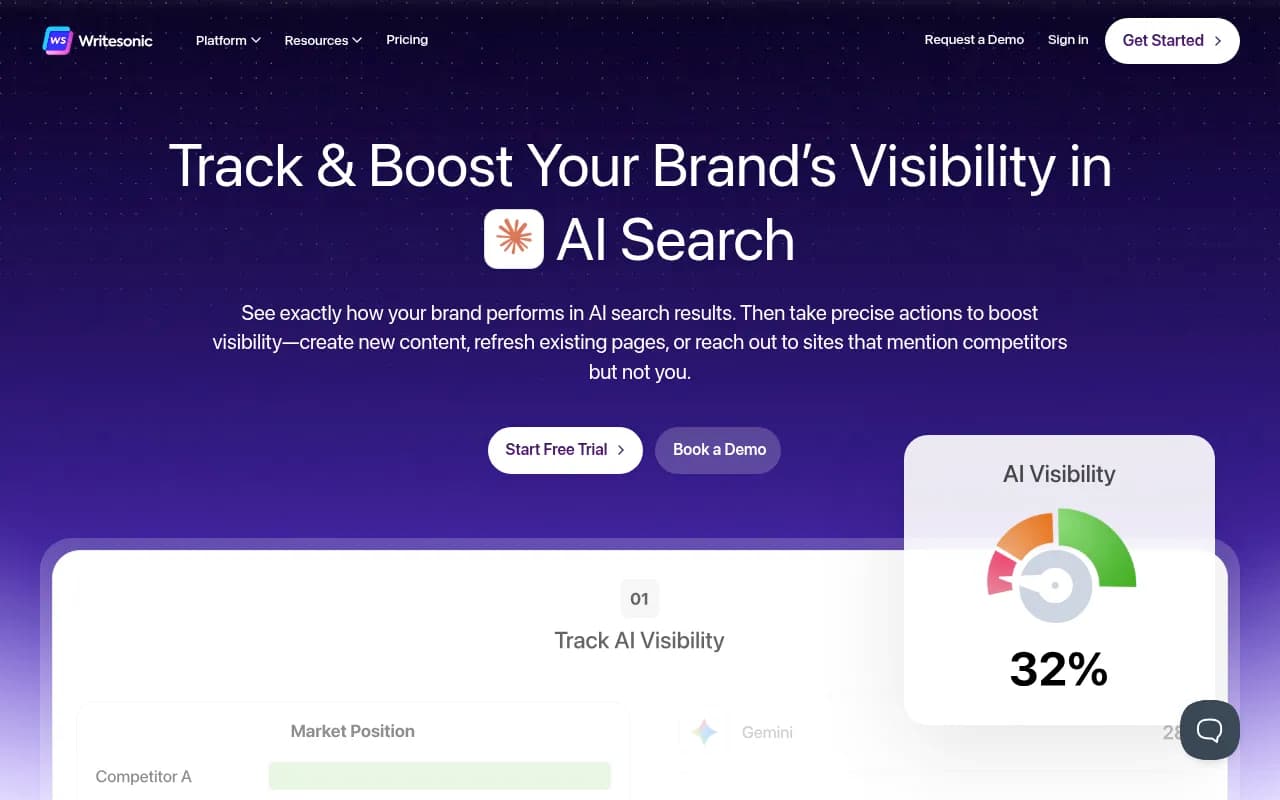
8. Writesonic
Writesonic has expanded well beyond its content generation roots into a full AI visibility platform. It tracks Google AI Overviews, AI Mode, ChatGPT, Perplexity, Gemini, Claude, and others, and combines that with an in-platform action center that helps teams prioritize fixes.
The SEO workflow integration is strong, and multi-client management is built in -- making it a reasonable option for agencies. The source-level analysis isn't as deep as some competitors, but the combination of tracking and content tools in one place is genuinely useful.
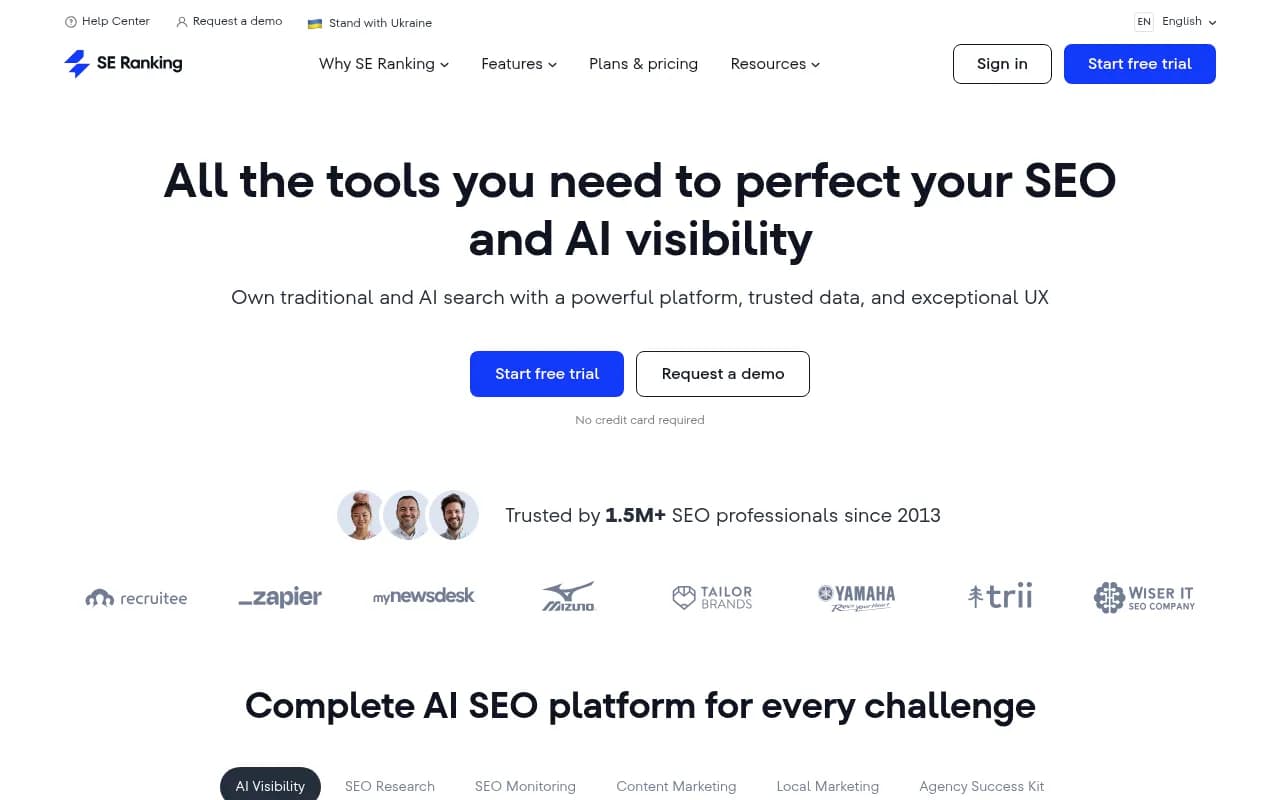
9. SE Ranking (AI Visibility Toolkit)
SE Ranking's AI visibility toolkit sits inside an all-in-one SEO platform, which is either a strength or a limitation depending on how you look at it. For teams that want SEO and AI monitoring in one place without paying for two separate tools, it's efficient. The AI coverage includes major engines, and the interface is approachable for teams that aren't deeply technical.
Like most of the traditional SEO platforms that have added AI monitoring, the depth of the AI-specific features doesn't yet match dedicated GEO platforms. But for mid-market teams on a budget, it's a practical option.
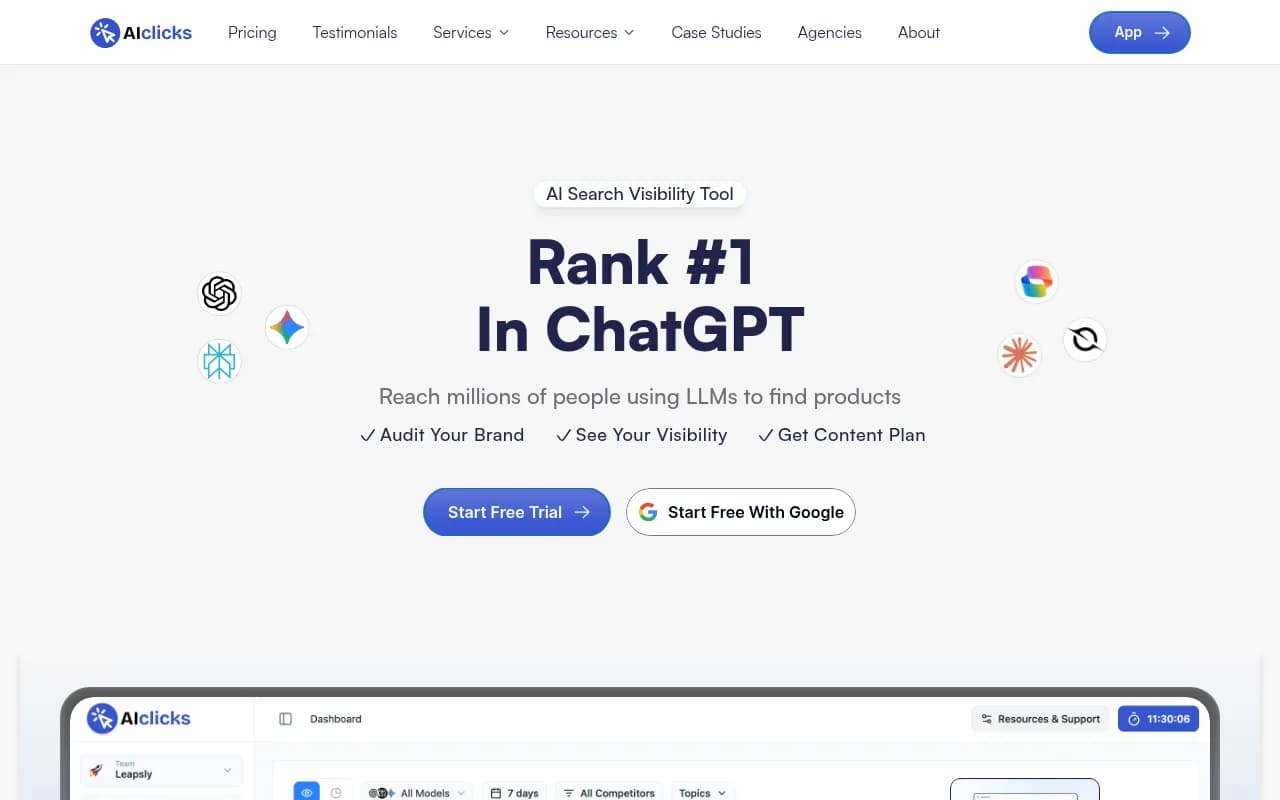
10. AIClicks
AIClicks covers a wide range of AI engines -- ChatGPT, Perplexity, Gemini, Google AI Overviews, Claude, Grok, DeepSeek, Meta AI, and Copilot -- and goes beyond simple mention counting to show which external domains AI systems cite, how much traffic those pages get, and whether your brand appears there. The source intelligence layer is one of its stronger differentiators.
It also includes prompt-level tracking, competitor benchmarking, an AI-optimized content creation module, and GA4/IndexNow integrations. Pricing starts at $59/month with a full refund guarantee, making it one of the more accessible options with meaningful depth.
How these tools compare at a glance
| Tool | AI engines covered | Content generation | Crawler logs | Prompt customization | Starting price |
|---|---|---|---|---|---|
| Promptwatch | 10+ | Yes (AI writing agent) | Yes | Yes | $99/mo |
| Profound | 10+ | No | No | Yes | $99/mo |
| Semrush AI Toolkit | 3 (ChatGPT, Gemini, AIO) | No | No | No (fixed) | $99/mo add-on |
| Peec AI | 4 | No | No | Yes | $95/mo |
| Ahrefs Brand Radar | 2-3 | No | No | No (fixed) | Bundled with Ahrefs |
| AthenaHQ | 8+ | No | No | Yes | Custom |
| Otterly.AI | 4-5 | No | No | Yes | ~$49/mo |
| Writesonic | 7+ | Yes | No | Yes | ~$99/mo |
| SE Ranking | 5+ | Limited | No | Yes | ~$65/mo |
| AIClicks | 9+ | Yes (basic) | No | Yes | $59/mo |
The monitoring vs. optimization gap
One pattern is hard to ignore when you look at this market: most platforms are monitoring dashboards. They show you where you're invisible. They don't help you become visible.
That gap matters more than it might seem. Knowing that a competitor appears in ChatGPT responses for "best project management tool for remote teams" is useful. But if your platform can't tell you what content you're missing, can't help you create it, and can't tell you whether it worked -- you're stuck in a loop of looking at data without moving the needle.
The tools that close this loop are still a minority. Promptwatch is the clearest example of a platform built around the full cycle: find gaps, generate content that's grounded in real citation data, track whether it gets cited. Writesonic and AIClicks have content features but with less depth on the citation-grounding side. Most others stop at step one.
For teams that are just starting out with AI visibility, a monitoring-only tool is a fine place to begin. For teams that want to actually improve their AI search presence, the execution layer matters.
Which tool is right for your situation
If you're an enterprise team or agency managing multiple brands and need the full picture -- monitoring, gap analysis, content generation, crawler logs, traffic attribution -- Promptwatch is the most complete option available in 2026. The breadth of engine coverage and the action loop it provides are genuinely differentiated.
If you're already deep in Semrush or Ahrefs and want to add basic AI monitoring without switching tools, the add-on options from those platforms are a practical starting point, with the understanding that you'll hit their limitations as your GEO program matures.
If budget is the primary constraint and you want meaningful coverage without enterprise pricing, AIClicks at $59/month offers solid engine coverage and source intelligence that punches above its price point.
If you're an agency managing multilingual or multi-region clients, Peec AI's language support and client management features are worth a close look.
The one thing worth avoiding: picking a tool based on its monitoring dashboard alone. The market has moved fast enough that visibility data is table stakes. What separates the useful platforms from the impressive-looking ones is what happens after you see the data.