Key takeaways
- MCP (Model Context Protocol) is an open standard, created by Anthropic in November 2024, that lets AI assistants connect to external tools and data sources through one consistent interface instead of a custom integration for every pairing.
- More than 10,000 active public MCP servers exist as of early 2026, according to Anthropic, and marketing-specific ones are a small, fast-growing slice of that number.
- GEO and AI-visibility platforms (Semrush, Ahrefs, Profound, Frase, seoClarity, and others) are shipping MCP servers so marketers can pull citation, ranking, and visibility data straight into Claude or ChatGPT instead of exporting CSVs.
- MCP comes with real security baggage: tool poisoning, "rug pull" updates to approved tools, and path-traversal bugs have all shown up in audits of live servers. Treat a new MCP connection the way you'd treat a new vendor with database access.
- MCP doesn't fix bad data. It just gives an AI agent a faster way to ask bad questions of it.
What MCP actually is, without the hand-waving
Every explainer about MCP eventually reaches for the same metaphor: USB-C for AI. It's a decent metaphor and I'll use it too, but it undersells what's actually changed.
Before MCP, if you wanted Claude or ChatGPT to pull live data from your CRM, your ad accounts, or your internal database, someone had to write a custom integration. A real one, with auth handling, rate limits, and error translation, built specifically for that one pairing of AI model and data source. Multiply that by every tool in your marketing stack and every AI model your team wants to use, and you get an integration problem that scales quadratically. Nobody wants to build forty connectors.
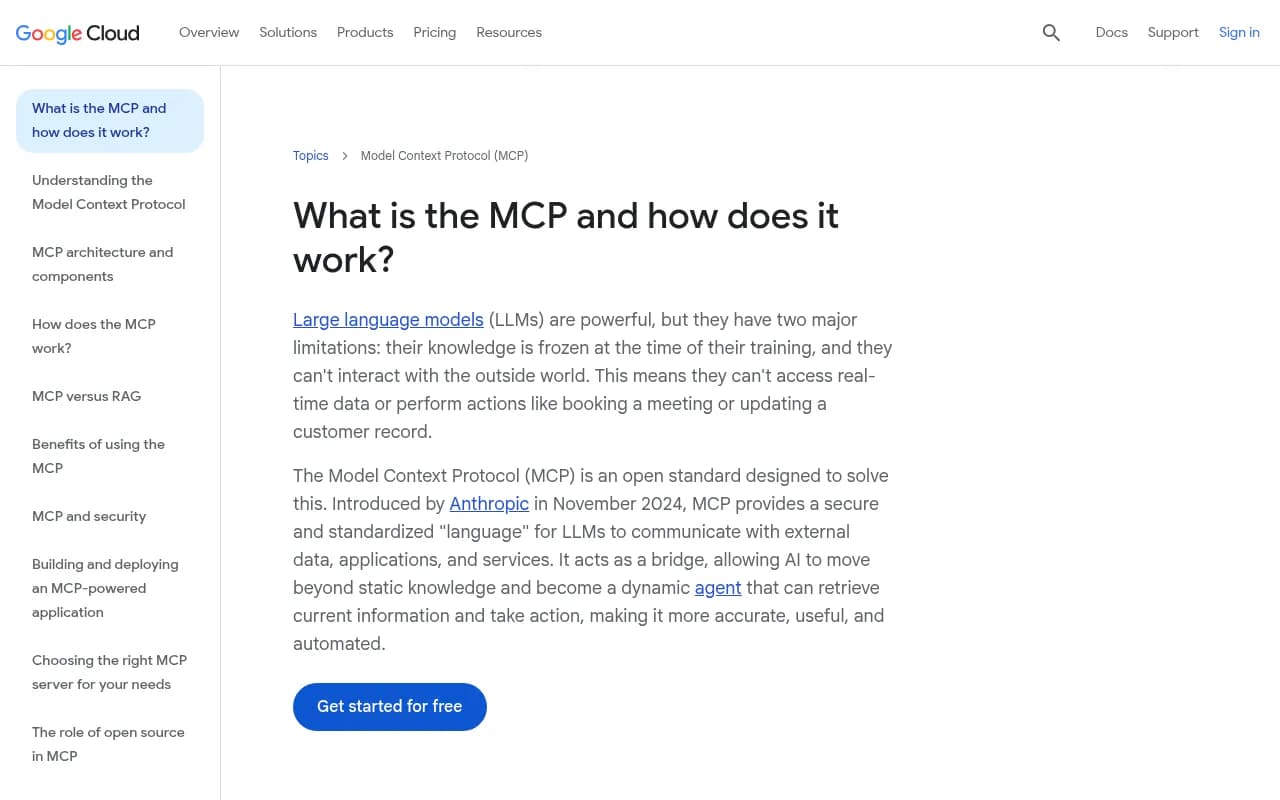
Anthropic open-sourced the Model Context Protocol in November 2024 to solve exactly this. MCP standardizes the connection itself. Build one MCP server for your data source, and any MCP-compatible AI client, Claude, ChatGPT, Gemini, Cursor, whatever comes next, can use it without custom code on either side. In December 2025, Anthropic handed governance of the protocol to a new Agentic AI Foundation under the Linux Foundation, which is usually the sign a technology has stopped being one company's pet project and started being infrastructure.
The growth numbers back that up. Anthropic now counts more than 10,000 active public MCP servers. A separate pull from the official MCP Registry in May 2026 counted 9,652 distinct "latest" server records, and community directories like MCP.so list over 19,000 submissions (though that figure almost certainly double-counts abandoned or duplicate entries). Either way, this isn't a niche experiment anymore.
The three roles in every MCP conversation
It helps to keep three terms straight, because people use them interchangeably and shouldn't.
The MCP host is the AI application itself, the thing with the chat window: Claude Desktop, a custom agent, an IDE copilot. The MCP client lives inside the host and handles translation, turning the model's requests into protocol calls and the server's replies back into something the model can reason about. The MCP server is the external piece, the connector that actually talks to your CRM, your ad platform, or your database and hands back structured data.
When people say "we built an MCP server for our product," they mean the third one. That's the piece vendors are racing to ship.
The glossary: terms marketers will actually run into
Tools, resources, and prompts
MCP defines a handful of capabilities a server can expose, and the distinction matters because it determines who's in control.
Tools are model-controlled. The AI decides on its own, based on reasoning, when to call one. If you ask "what was my cost per lead on Google Ads last week," the model picks a tool like get_campaign_spend without you naming it.
Prompts are user-controlled. These are pre-built workflows a human explicitly triggers, like a slash command or a menu item that runs "Weekly Sales Report."
Resources are application-controlled. The host app decides when to pull reference material, like a schema or a dashboard, into the model's context. They're passive and read-only.
In practice, almost every marketing MCP server today only implements tools. Resources are barely supported on the client side, and prompts remain rare. If a vendor's MCP pitch sounds impressive, ask specifically which of these three it actually ships, not just which one it mentions in a blog post.
Transport: stdio vs. remote
MCP servers connect over one of two transports. Stdio runs locally, a subprocess your AI client starts and talks to over stdin/stdout. No network exposure, one client at a time, and it inherits whatever permissions you're logged in with. Remote (Streamable HTTP) runs over the network, supports many concurrent users, and is how most SaaS vendors, including the marketing platforms below, expose their servers.
The tradeoff is blunt: stdio keeps data on your machine but gives a compromised tool your full local privileges. Remote servers are easier to govern and share across a team, but you're trusting the vendor's security posture with every query your agent sends.
Read-only vs. read-write
This is the distinction that actually matters for budgeting your expectations. A read-only MCP server lets an AI agent query your data: pull a ranking report, check a citation count, fetch spend. A read-write server lets the agent take action: publish a page, update a CRM record, change a campaign setting.
Most MCP servers in marketing today are read-only. Semrush's and Ahrefs' hosted MCP servers retrieve data; neither lets an agent modify anything. HubSpot's MCP server is a genuine exception, giving agents both read and write access to CRM records. Frase markets itself as read-write across the whole content pipeline, from research through publishing to a CMS. Know which kind you're connecting before you assume an agent can "just fix it."
Why GEO and SEO platforms are building MCP servers
The honest answer is that marketers kept doing the same tedious thing: open five browser tabs, pull numbers from each, paste them into a deck or a spreadsheet, repeat weekly. An MCP server removes the tab-switching. You ask Claude "which campaigns are over budget this week" or "did our citation rate on ChatGPT move after the last content push," and the agent queries the connected platform directly instead of you doing it by hand.
A few concrete examples of what's shipped so far:
Semrush MCP runs as a hosted remote server and supports agent workflows that monitor competitors or flag ranking drops on a schedule, not just on demand.
Ahrefs MCP is bundled into Lite-tier subscriptions and above, but it's explicitly scoped for AI assistant use rather than general programmatic access, and Ahrefs tells users to prompt the agent to use it explicitly, since the model won't automatically prefer it over a generic web search.
Profound shipped a native MCP server connecting ChatGPT, Claude, and Cursor directly to its AI visibility and citation data, read-only.
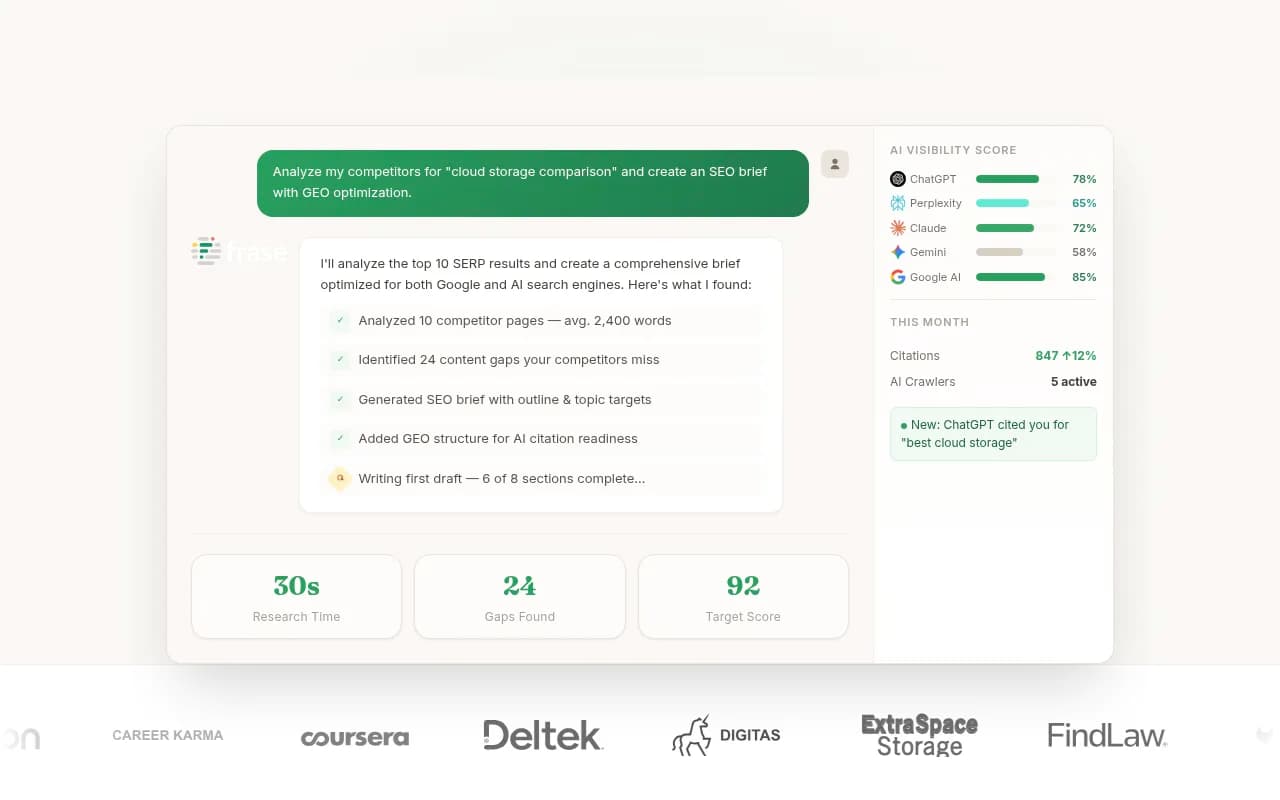
Frase's MCP server is the one vendor in this space claiming read-write across the full lifecycle, research, drafting, SEO and GEO optimization, and publishing to WordPress, Webflow, Wix, or Sanity.
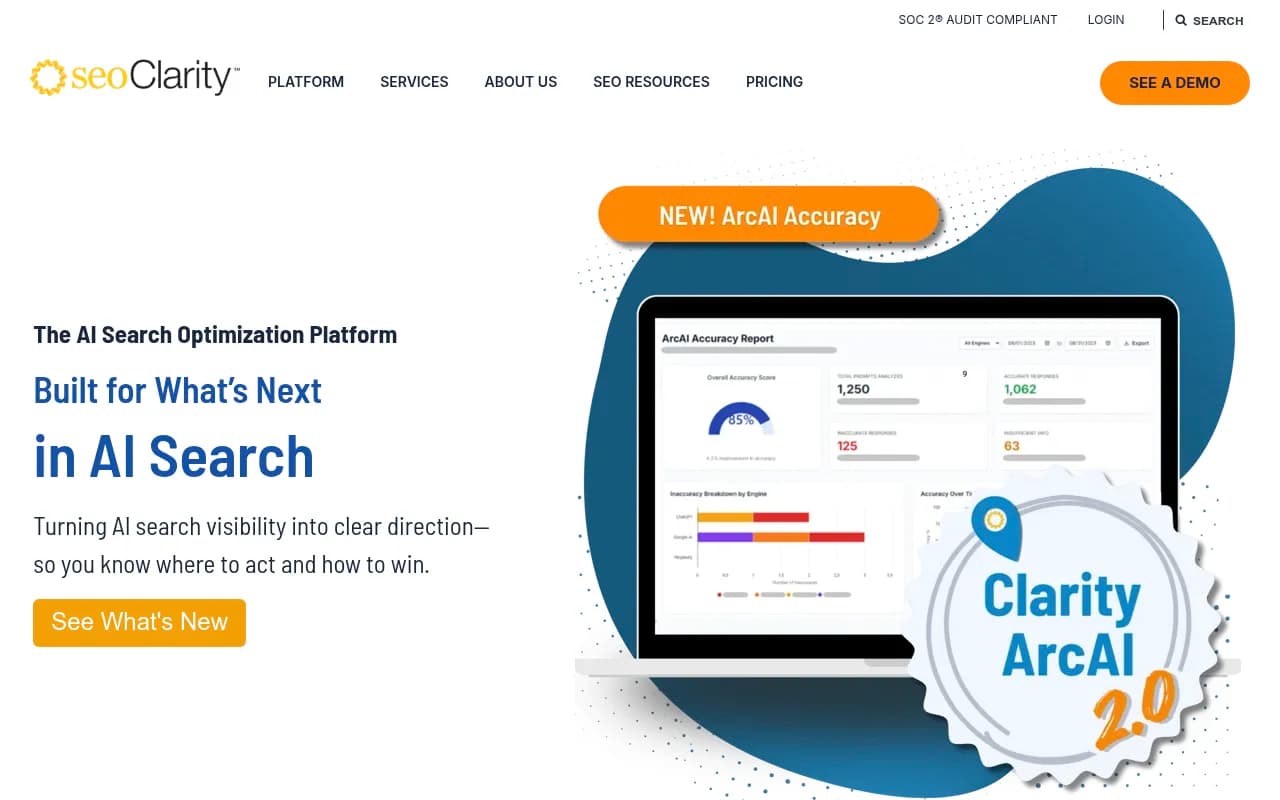
seoClarity's ArcAI MCP server lets teams run natural-language queries against brand mention, sentiment, and citation data for AEO work.
Here's the comparison in one place:
| Platform | Access level | What it connects to | Notable limitation |
|---|---|---|---|
| Semrush MCP | Read-only | Keyword, backlink, competitor data | No publishing or write-back |
| Ahrefs MCP | Read-only | Rankings, backlinks, site audits | Bundled into Lite+ plans only, not a general API |
| Profound MCP | Read-only | AI visibility, citations, sentiment, shopping data | No content generation |
| Frase MCP | Read-write | Research, briefs, content, publishing, AI visibility | Smaller keyword/backlink dataset than Semrush or Ahrefs |
| HubSpot MCP | Read-write | CRM records, contacts, deals | CRM-only, not SEO/GEO data |
| seoClarity ArcAI MCP | Read-only | Brand mentions, citations, AEO signals | Enterprise-oriented pricing |
Notice what's missing from that list: nothing marketing-specific cracks the top 10 most-searched MCP servers globally in 2026 (Playwright, Figma, GitHub, Context7, Cursor, Supabase, and similar developer tools dominate that list). Marketing MCP adoption is real, but it's early relative to the dev-tools ecosystem that built MCP's initial momentum.
Why this matters beyond convenience
It's tempting to file MCP under "nice workflow shortcut" and move on. I'd push back on that a little. The deeper reason GEO platforms are racing to build MCP servers is that AI systems are increasingly treating the web, and your own data, as something to be queried directly rather than crawled passively.
Promptwatch's crawler data shows this shift is already happening at the infrastructure level: on August 8, 2026, ChatGPT Search started using the site: search operator at scale, jumping from roughly 0.4% to nearly 17% of all fanout queries almost overnight, per Promptwatch's analysis of ChatGPT's site-operator fanouts. That's not a gradual drift, it's a model or system-prompt change that made AI treat a brand's own domain as a direct retrieval target. MCP servers are the same instinct applied to your internal tools: instead of an AI guessing at your data from a public web crawl, it asks your platform a structured question and gets a structured answer.
The crawler mix behind all this is also moving faster than most teams have noticed. OpenAI's share of verified AI crawler requests dropped from 94.8% in the week of June 8-14, 2026 to 79.8% by the week of August 31-September 6, a 15-point swing in under three months, according to Promptwatch's AI crawler traffic data. If you're only watching one crawler's behavior, you're missing a growing slice of how AI systems actually reach your content.

If you're already tracking brand visibility across ChatGPT, Gemini, Perplexity, and AI Overviews, an MCP connection to that platform means your team (or an agent acting for your team) can ask "did our citation share change after last week's content push" without opening a dashboard. That's the practical payoff. Promptwatch tracks this kind of citation and crawler data across 12+ AI models and makes it queryable the same way.
The part nobody puts in the pitch deck: MCP's security problems
I'd be doing you a disservice if I wrapped this up without the risk section, because MCP's convenience comes with a genuinely new attack surface, and it's not theoretical.
Tool poisoning attacks embed malicious instructions inside a tool's metadata or description, invisible to the human user but readable by the model, which can manipulate which tool gets called. Invariant Labs first disclosed this in April 2025, and it's still showing up in audits.
"Rug pulls" are worse in a quiet way: a tool you approved once can be silently changed later by whoever operates the remote server, without triggering a new approval prompt. You thought you approved a read-only reporting tool. Six weeks later it might not be the same tool anymore.
The numbers from a 2026 security survey of 2,614 live MCP servers are not comforting: 82% had path-traversal exposure and 34% had command-injection exposure. A popular mcp-remote package, downloaded over 437,000 times, carried a CVSS 9.6 vulnerability that triggered simply by connecting to an untrusted server. OWASP now maintains a dedicated MCP Top 10, separate from its general LLM risk list, and "Shadow MCP Servers", unapproved connections spun up by individual marketers or data teams outside any security review, made the list by name.
None of this means don't use MCP. It means treat every new MCP connection the way you'd treat granting a new vendor read access to your CRM: who operates the server, what scopes does it actually request, and what happens if that server gets compromised six months after you approved it.
A few things MCP will not fix for you
MCP servers are connectors, not data platforms. If your Google Ads and Meta campaigns use inconsistent naming, the MCP server won't reconcile them, it'll just hand the inconsistency to the AI agent faster. If your CRM has duplicate contact records, the agent will surface the duplicates right alongside the real ones. If nobody's defined an attribution model, no amount of structured protocol access lets the AI calculate contribution that doesn't exist yet.
The governance work, clean schemas, consistent naming, a defined source of truth, has to happen before MCP touches the data. MCP just makes the gaps visible faster, because an AI agent asking rapid-fire structured questions will expose a naming inconsistency in about the third query, where a human analyst might not notice it for months.
Where to start if you're evaluating this
If your team is weighing whether to connect an MCP server to a marketing platform, a few practical filters help:
Check whether the server is read-only or read-write before you assume it can do anything beyond reporting. Confirm the transport, local stdio keeps data on one machine; remote HTTP is shared but depends on the vendor's security practices. Ask who maintains the server and how often tool definitions change, since "rug pull" risk is really a question of vendor trust over time. And don't connect a server just because it exists; the marketing MCP ecosystem is still thin enough that most teams will only need one or two connections (a visibility platform and maybe a CRM) to cover real use cases.
If you want to browse what's out there beyond the handful covered here, the GEO software directory at bestgeosoftware.com and the agentic SEO tools directory at agenticseotools.com both track a wider set of platforms building toward this kind of agent-native access.
MCP isn't going away, and the number of marketing-specific servers will keep climbing through 2026 and 2027. But it's infrastructure, not magic. It moves the bottleneck from "how do I get this data into my AI tool" to "is my data clean enough and my access controls tight enough to hand to an agent." That second question was always the harder one.