Key takeaways
- Surfer SEO and Clearscope are content optimization tools built for traditional Google rankings -- they help you write better pages, but they don't tell you whether ChatGPT or Perplexity are citing you.
- Promptwatch operates in a different category entirely: it tracks your brand's visibility across 10+ AI models, identifies the content gaps causing you to be invisible, and generates content engineered to get cited.
- Organic click-through rates dropped 61% on queries where Google AI Overviews appear, according to Seer Interactive's analysis of 25.1 million impressions. AI-referred traffic grew 527% year-over-year per Semrush's 2025 data. These two facts together explain why the tool you choose in 2026 matters more than ever.
- The right answer depends on your goal: if you're optimizing existing pages for Google, Surfer or Clearscope still do that job well. If you want to appear in AI-generated answers, you need a different kind of tool.
The problem with comparing these three tools
Most comparisons of Promptwatch, Surfer SEO, and Clearscope treat them as competitors in the same category. They're not. Putting them in a head-to-head feels a bit like comparing a GPS to a speedometer -- both live in your car, both give you useful information, but they're solving different problems.
Surfer SEO and Clearscope are traditional AI-augmented SEO tools. They analyze Google SERPs, score your content against top-ranking pages, and tell you what to add, cut, or restructure to rank better. They've been doing this for years, they're good at it, and if your primary goal is ranking in Google's blue-link results, they're still worth considering.
Promptwatch is something else. It's a Generative Engine Optimization (GEO) platform -- built specifically to track and improve how your brand appears inside AI-generated answers from ChatGPT, Claude, Perplexity, Gemini, Google AI Overviews, and seven other models. It doesn't just show you where you're invisible. It tells you why, and helps you create the content that fixes it.
That distinction matters enormously right now. Roughly 60% of Google searches result in zero clicks. AI Overviews appear on a growing share of queries. ChatGPT has over 400 million weekly active users. If your brand isn't being cited in those answers, you're losing visibility in places your rank tracker can't even see.
So this guide won't pretend these three tools are neck-and-neck alternatives. Instead, it'll explain what each one actually does, where each one falls short, and which one (or combination) makes sense depending on what you're trying to accomplish.
Surfer SEO: still the benchmark for on-page optimization
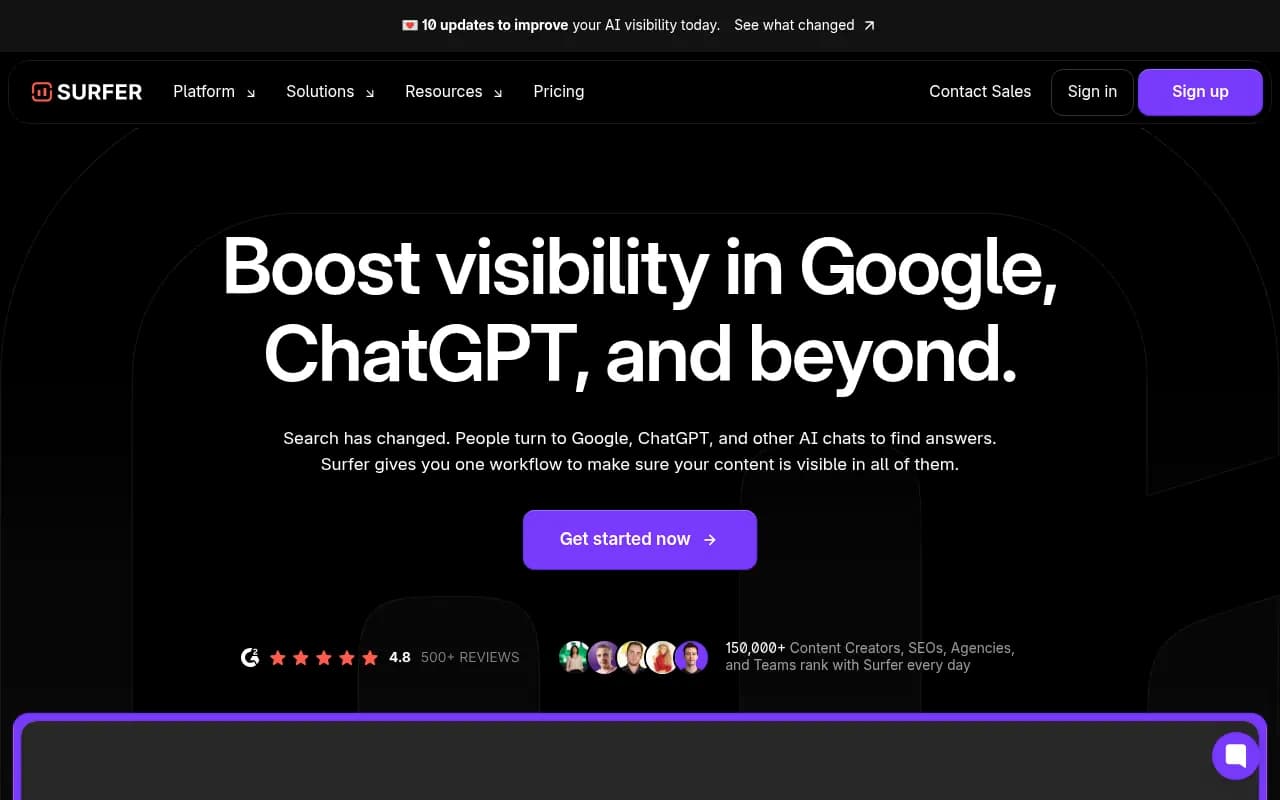
Surfer SEO has been around long enough to earn genuine credibility. Its core product is a content editor that analyzes the top-ranking pages for a given keyword and gives you a real-time score based on how well your draft matches the patterns Google rewards -- word count, keyword usage, heading structure, NLP terms, and more.
What it does well:
- The Content Score gives writers a clear, actionable target. You can watch it improve as you write, which keeps teams focused.
- SERP Analyzer lets you reverse-engineer what's working for competitors on any keyword.
- Topical Map helps you build content clusters around a subject, not just individual pages.
- The AI writing features have improved -- you can generate outlines and draft sections directly inside the editor.
Where it falls short:
- It's built entirely around Google's traditional ranking signals. It has no visibility into whether ChatGPT or Perplexity are citing your content.
- Content Score optimization can push writers toward keyword stuffing patterns if they chase the number too aggressively.
- It tells you how to optimize what you're writing, but it doesn't tell you what topics you're missing compared to competitors in AI search.
Pricing sits around $89-$219/month depending on the plan. There's a free trial available.
Surfer SEO remains one of the strongest tools for on-page content optimization using AI-driven SERP analysis. But teams evaluating it as their sole "AI SEO tool" in 2026 are optimizing for a search landscape that's changing faster than the tool can track.
Clearscope: the content grader that editors trust
Clearscope takes a slightly different approach. Rather than a real-time editor score, it focuses on content grading -- you paste in your content (or a competitor's), and it tells you which relevant terms and topics you're covering well and which you're missing.

It's popular with content teams and editors because the interface is clean, the grading is straightforward, and it integrates with Google Docs and WordPress. Writers don't have to learn a new tool from scratch.
What it does well:
- Term recommendations are based on NLP analysis of top-ranking content, so they're genuinely useful rather than just keyword frequency counts.
- The Google Docs integration makes it easy to use without disrupting existing workflows.
- Reporting features let content managers track how well their pages are optimized over time.
- It's particularly good at helping writers understand topical depth -- not just "use this keyword" but "cover this concept."
Where it falls short:
- Like Surfer, it's entirely Google-focused. No AI search monitoring, no citation tracking, no visibility into how LLMs perceive your content.
- It lacks broader SEO features, so teams end up using it alongside other tools to fill the gaps.
- It's on the pricier end for what it does -- plans start around $170/month, which is a lot for a tool that's essentially a content grader.
- No content generation features -- it grades what you write, but doesn't help you write it.
Clearscope is genuinely good at what it does. If you have a content team that needs a reliable, editor-friendly way to optimize pages for Google, it earns its place. But it's a narrow tool, and in 2026, narrow tools require more justification.
Promptwatch: built for the search landscape that's actually emerging
This is where the comparison gets interesting. Promptwatch isn't trying to compete with Surfer SEO or Clearscope on their home turf. It's solving a different problem: your brand's visibility in AI-generated answers.
Promptwatch monitors how 10 AI models -- ChatGPT, Claude, Perplexity, Gemini, Google AI Overviews, Google AI Mode, Grok, DeepSeek, Meta AI, Copilot, and Mistral -- respond to prompts relevant to your industry. It shows you when you're cited, when you're not, and crucially, which competitors are being recommended instead.

But monitoring is just the starting point. What separates Promptwatch from most GEO tools is what happens after you see the data.
Finding the gaps
The Answer Gap Analysis shows you exactly which prompts your competitors appear in that you don't. You can see the specific questions AI models are answering without citing your content -- the topics and angles your website is missing. This isn't a vague "you should write more about X" suggestion. It's a specific list of prompts where you're invisible and your competitors aren't.
Creating content that gets cited
Promptwatch has a built-in AI writing agent that generates articles, listicles, and comparison pages grounded in real citation data. It's analyzed over 880 million citations to understand what kinds of content AI models actually cite -- the structure, the depth, the specificity. The content it generates is engineered to get cited, not just to rank in Google.
This is the part most GEO tools skip entirely. Tools like Otterly.AI and Peec.ai show you monitoring data but leave you to figure out what to do with it. Promptwatch closes that loop.
Tracking the results
Page-level tracking shows which specific pages are being cited, how often, and by which AI models. Traffic attribution (via a code snippet, Google Search Console integration, or server log analysis) connects AI visibility to actual website traffic and revenue. You can see whether the content you published is actually being cited more over time.
Other capabilities worth knowing about
- AI Crawler Logs show you in real time which AI crawlers (ChatGPT, Claude, Perplexity, etc.) are visiting your site, which pages they're reading, and what errors they're hitting. Most competitors don't have this at all.
- Prompt Intelligence gives you volume estimates and difficulty scores for each prompt, so you can prioritize high-value, winnable opportunities instead of guessing.
- Reddit and YouTube tracking surfaces discussions that directly influence AI recommendations -- a channel most tools ignore.
- ChatGPT Shopping tracking monitors when your brand appears in ChatGPT's product recommendations and shopping carousels.
- Multi-language and multi-region monitoring lets you track AI responses in any language, from any country, with customizable personas.
Pricing: Essential at $99/month (1 site, 50 prompts, 5 articles), Professional at $249/month (2 sites, 150 prompts, 15 articles, crawler logs), Business at $579/month (5 sites, 350 prompts, 30 articles). Free trial available.
Head-to-head comparison
| Feature | Surfer SEO | Clearscope | Promptwatch |
|---|---|---|---|
| On-page content scoring | Yes | Yes | No |
| Google SERP analysis | Yes | Yes | No |
| AI model monitoring (ChatGPT, Claude, etc.) | No | No | Yes (10 models) |
| Content gap analysis vs competitors | Partial (topical maps) | No | Yes (Answer Gap Analysis) |
| AI content generation | Yes (basic) | No | Yes (citation-grounded) |
| Citation tracking | No | No | Yes (880M+ citations) |
| AI crawler logs | No | No | Yes |
| Reddit/YouTube tracking | No | No | Yes |
| ChatGPT Shopping tracking | No | No | Yes |
| Traffic attribution from AI search | No | No | Yes |
| Prompt volume and difficulty scoring | No | No | Yes |
| Multi-language/multi-region | Limited | No | Yes |
| Starting price | ~$89/mo | ~$170/mo | $99/mo |
| Free trial | Yes | Yes | Yes |
| Best for | Google content optimization | Content grading for editors | AI search visibility and GEO |
Who should use which tool
The honest answer is that these tools serve different goals, and the right choice depends on what you're actually trying to accomplish.
Use Surfer SEO if your primary goal is ranking in Google's traditional blue-link results and you want a real-time content editor that scores your work as you write. It's particularly good for content teams that produce a high volume of pages and need a consistent optimization workflow. The Topical Map feature is genuinely useful for building content clusters.
Use Clearscope if you have a content team that lives in Google Docs and needs a clean, editor-friendly grading tool. It's better suited to editorial workflows than Surfer -- less gameable, more focused on topical depth. The higher price point is harder to justify for smaller teams, but larger editorial operations often find it worth it.
Use Promptwatch if you care about appearing in AI-generated answers -- which, in 2026, you probably should. If your organic traffic has been declining despite stable rankings, if you've noticed competitors being recommended in ChatGPT responses, or if you're trying to build a strategy for AI search rather than just traditional Google, Promptwatch is the tool built for that problem. The combination of monitoring, gap analysis, content generation, and traffic attribution makes it an optimization platform rather than just a tracker.
Use both if you have the budget and the team. Surfer or Clearscope handles your Google optimization workflow. Promptwatch handles your AI search visibility. They don't overlap much, so there's a reasonable case for running them in parallel -- especially if you're at a brand or agency where AI search visibility is becoming a board-level concern.
The broader context: why this comparison matters now
The ZipTie.dev analysis of the AI SEO landscape put it plainly: "AI SEO tools" now means two fundamentally different things. Traditional AI-augmented SEO platforms help you write better content for Google. Dedicated AI search visibility platforms tell you whether AI engines are mentioning your brand at all.
For most of the last decade, the first category was all you needed. That's changing. Seer Interactive's study found a 61% drop in click-through rates on queries where Google AI Overviews appear. Semrush's 2025 data showed AI-referred traffic growing 527% year-over-year. These aren't marginal shifts -- they're structural changes to how people find information.
Surfer SEO and Clearscope are well-built tools for a search environment that's being disrupted. They're not going away, and they're not useless -- Google's traditional results still exist and still drive traffic. But if you're only optimizing for that channel, you're leaving a growing share of visibility on the table.
Promptwatch is built for the channel that's growing. The action loop -- find gaps, generate content, track results -- is what makes it an optimization platform rather than a monitoring dashboard. Most GEO tools stop at showing you data. Promptwatch helps you do something about it.
If you're evaluating tools in 2026 and you haven't yet mapped out where your brand appears (or doesn't appear) in AI-generated answers, that's the most important gap to close first.
Bottom line
Surfer SEO and Clearscope are solid tools for what they do. If you're optimizing content for Google and you need a content editor or grader, either one is worth evaluating based on your workflow and budget.
But the more pressing question for most brands in 2026 isn't "how do I score higher in Surfer's content editor?" It's "why isn't ChatGPT recommending us?" That's a different problem, and it requires a different tool. Promptwatch is the one built to answer it -- and more importantly, to fix it.