Key takeaways
- Most GEO platforms stop at monitoring -- they show you where you're invisible but won't help you fix it. Only a few have genuine content automation built in.
- Promptwatch is the most complete option: it finds content gaps, generates articles grounded in real citation data, and tracks whether those articles actually get cited by AI models.
- SnowSEO auto-generates content at volume but lacks the citation intelligence to know what to write.
- Whitebox takes an agentic approach, shipping narrative fixes automatically -- useful for brands that want a hands-off loop.
- Atomic AGI covers both traditional SEO and LLM tracking but content automation is still maturing compared to dedicated GEO platforms.
The GEO platform market has fragmented fast. A year ago, most tools were basic dashboards that told you whether ChatGPT mentioned your brand. Now there's a new tier of platforms claiming to close the loop entirely -- not just tracking visibility but generating and publishing content that gets cited by AI models.
Four platforms are getting the most attention for this specific capability: Promptwatch, SnowSEO, Whitebox, and Atomic AGI. They all promise some version of "automated GEO content publishing," but they approach it very differently. This guide breaks down exactly what each one does, where each one falls short, and which is worth your time depending on what you actually need.
What "automated GEO content publishing" actually means
Before comparing tools, it's worth being precise about what this phrase means -- because vendors use it loosely.
There are really three distinct things a platform can automate:
- Finding which content to create (gap analysis, prompt research, competitor analysis)
- Writing the content (AI generation, briefs, drafts)
- Publishing and tracking results (CMS integration, citation tracking, traffic attribution)
A platform that only does step 2 is an AI writer, not a GEO platform. A platform that only does step 1 is a monitoring tool. The interesting question is which platforms genuinely connect all three steps into a working loop.
The four platforms, side by side
| Promptwatch | SnowSEO | Whitebox | Atomic AGI | |
|---|---|---|---|---|
| AI models tracked | 10+ (ChatGPT, Claude, Gemini, Perplexity, Grok, DeepSeek, Copilot, Meta AI, Mistral, Google AI Overviews) | Limited | ChatGPT, Perplexity, others | Google + major LLMs |
| Content gap analysis | Yes (Answer Gap Analysis) | Basic | Yes (narrative gap focus) | Yes |
| AI content generation | Yes (citation-grounded) | Yes (high volume) | Yes (agentic, auto-ships) | Yes |
| Citation data used in writing | Yes (880M+ citations) | No | Partial | No |
| Auto-publishing | No (draft + review) | Yes | Yes (agentic) | Partial |
| Crawler logs | Yes | No | No | No |
| Reddit/YouTube tracking | Yes | No | No | No |
| ChatGPT Shopping tracking | Yes | No | No | No |
| Traffic attribution | Yes (GSC, snippet, server logs) | No | No | Partial |
| Prompt volume/difficulty | Yes | No | No | Yes |
| Starting price | $99/mo | Lower | Mid-range | Mid-range |
| Best for | Teams wanting full GEO loop | High-volume content at low cost | Hands-off narrative automation | Teams bridging traditional SEO + LLMs |
Promptwatch: the full loop

Promptwatch is built around a specific sequence: find the gaps, create content that fills them, then track whether it worked. That sounds simple, but most competitors only do one of those three things.
The gap analysis is where it starts. The Answer Gap Analysis shows you which prompts your competitors appear in but you don't -- not just "you're missing from Perplexity" but the specific questions and topics where AI models are citing your competitors instead of you. That's actionable in a way that a visibility score isn't.
The content generation is grounded in real citation data. Promptwatch has processed over 880 million citations, so when the AI writing agent generates an article, it's working from patterns of what actually gets cited by ChatGPT, Claude, Perplexity, and others -- not just generic SEO best practices. The output includes articles, listicles, and comparisons, all targeted at specific prompts and personas.
What makes Promptwatch different from a pure content tool is the tracking layer. Page-level tracking shows which of your pages are being cited, by which models, and how often. The crawler logs show you when AI crawlers (ChatGPT, Claude, Perplexity) are actually visiting your site and which pages they're reading. And traffic attribution -- via a code snippet, Google Search Console integration, or server log analysis -- connects AI visibility to actual revenue.
One honest caveat: Promptwatch doesn't auto-publish. Content goes through a review step before it goes live, which some teams will see as a feature (quality control) and others as friction (they want fully autonomous publishing). If you want zero human involvement in the publishing loop, Whitebox might suit you better.
Pricing starts at $99/month for the Essential plan (1 site, 50 prompts, 5 articles/month), with Professional at $249/month and Business at $579/month.
SnowSEO: volume-first content generation

SnowSEO's pitch is straightforward: auto-generate content for AI visibility at scale, at a lower price point than most GEO platforms. If you need to publish a lot of pages quickly, it can do that.
The limitation is that the content generation isn't grounded in citation intelligence. SnowSEO doesn't analyze what AI models are actually citing -- it generates content based on keyword and topic inputs, which is closer to traditional SEO content automation than true GEO optimization. You might publish 50 articles and have no way to know whether any of them are structured in a way that makes AI models want to cite them.
There's also no crawler log visibility, no Reddit or YouTube tracking (both of which influence what AI models recommend), and no traffic attribution layer. You can publish content, but you can't close the loop to see if it worked.
For teams with a very tight budget who just need content volume and aren't yet sophisticated about GEO, SnowSEO is a reasonable starting point. For anyone serious about measurable AI visibility improvement, the lack of citation intelligence is a real gap.
Whitebox: agentic and hands-off
Whitebox takes the most autonomous approach of the four. It's positioned as an "agentic GEO platform" -- it identifies narrative gaps in how AI models describe your brand, generates fixes, and ships them automatically without requiring a human to approve each piece.
That's genuinely interesting for brands that want a set-it-and-forget-it loop. The agentic framing means Whitebox can respond to changes in AI model behavior without waiting for a human to notice and react.
The tradeoff is control and depth. Because Whitebox is optimizing for narrative accuracy (how AI models describe your brand) rather than citation volume (how often AI models cite your content), it's better suited to brand reputation use cases than to content marketing. If your goal is to appear in "best [category] tools" listicles in ChatGPT, Whitebox's narrative-fix approach may not be the right tool. If your goal is to make sure ChatGPT describes your product accurately and favorably, it's more relevant.
Whitebox also doesn't have the citation database, prompt volume data, or traffic attribution that Promptwatch offers. The automation is real, but the intelligence layer underneath it is thinner.
Atomic AGI: bridging traditional SEO and LLMs
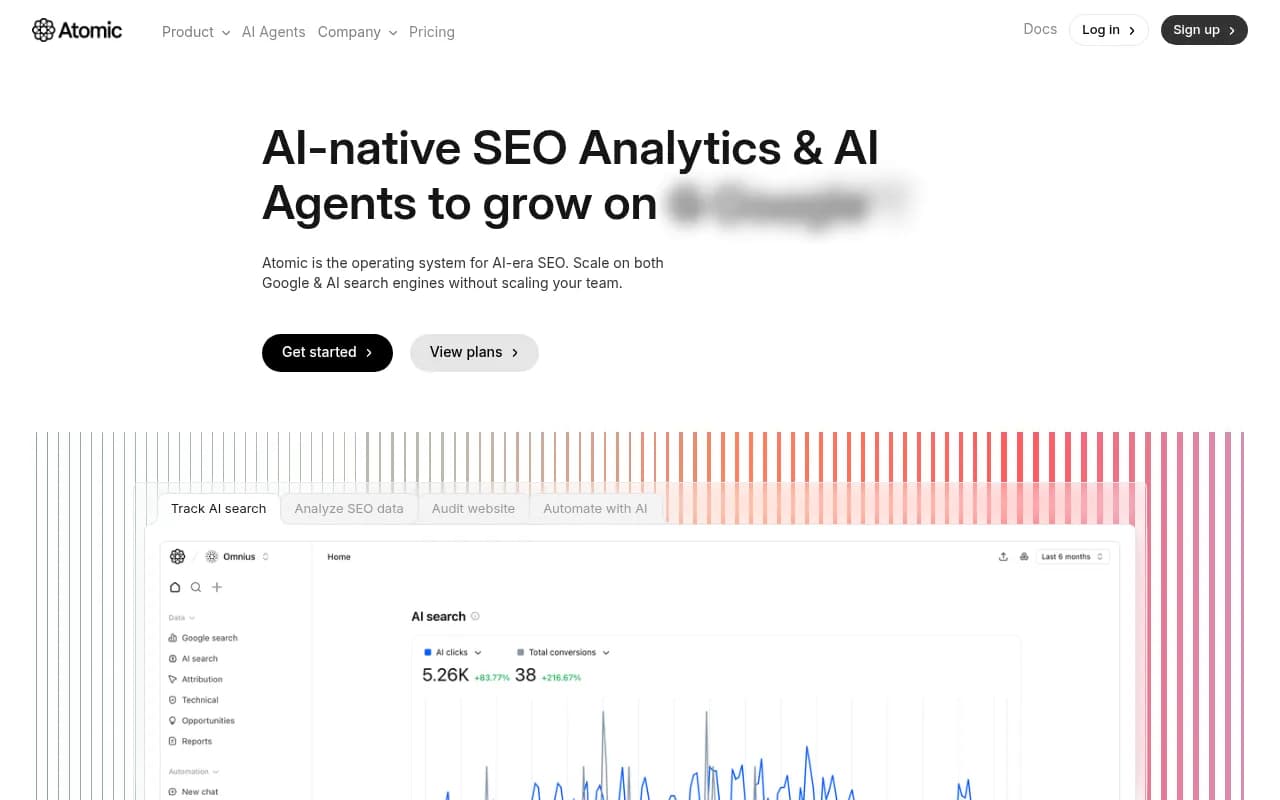
Atomic AGI is trying to solve a different problem: it's built for teams that still care deeply about Google rankings but also need to track LLM visibility. The platform covers keyword research, rank tracking, site audits, and AI search monitoring in one place.
The content automation in Atomic AGI is improving but still feels secondary to the SEO analytics core. It can generate content briefs and drafts, but the GEO-specific intelligence -- citation analysis, prompt-level gap identification, AI crawler behavior -- isn't as developed as in a dedicated GEO platform.
Where Atomic AGI genuinely earns its place is for SEO teams that don't want to manage two separate platforms. If you're already doing traditional SEO work and want to layer in LLM tracking without switching tools entirely, Atomic AGI is a reasonable bridge. The prompt volume and difficulty scoring is useful for prioritization.
The honest limitation: if GEO is your primary focus rather than a secondary concern, you'll hit the ceiling of Atomic AGI's capabilities faster than you'd expect.
How to choose
The right platform depends on what stage you're at and what problem you're actually trying to solve.
If you want the most complete GEO loop -- gap analysis, citation-grounded content generation, and attribution tracking -- Promptwatch is the strongest option. The 880M+ citation database and the Answer Gap Analysis give the content generation a level of specificity that the other three platforms don't match. The lack of auto-publishing is a real tradeoff, but for most marketing teams, reviewing content before it goes live is the right call anyway.
If you want fully autonomous publishing with minimal human involvement, Whitebox is worth evaluating -- particularly if your primary concern is how AI models describe your brand rather than how often they cite your content.
If budget is the primary constraint and you need content volume quickly, SnowSEO gets you publishing faster at lower cost, with the understanding that you're trading citation intelligence for price.
If you're an SEO team that needs to cover both Google and LLMs without fragmenting your toolstack, Atomic AGI is the most practical bridge.
A note on what "automated" really delivers
One thing worth saying plainly: no platform fully automates GEO content publishing in a way that requires zero strategy. The platforms that claim the most automation (Whitebox, SnowSEO) are making tradeoffs on the intelligence layer. The platforms with the strongest intelligence layer (Promptwatch) still require a human to review and publish.
The real automation value isn't in removing humans from the loop entirely -- it's in removing the manual research, analysis, and guesswork that used to precede every content decision. When a platform can tell you exactly which prompts to target, generate a draft grounded in citation data, and then show you whether that draft got cited by Perplexity three weeks later, you've automated the hard parts. The human review step at the end is a feature, not a bug.
That's the loop worth building toward in 2026. The question is which platform gets you there fastest.