Key takeaways
- Otterly.AI is the cheapest entry point ($29/month) but offers monitoring only -- no content tools, no crawler logs, no traffic attribution
- Peec.ai is solid for multi-language tracking (115+ languages) but stops at measurement; no content generation or gap analysis
- Profound is the most feature-rich pure tracker, with strong enterprise analytics starting at $499/month, but it's still primarily a monitoring dashboard
- Promptwatch is the only platform in this comparison that closes the full loop: find visibility gaps, generate content to fix them, and track the results -- all in one place
The AI search visibility market has exploded. Two years ago, barely anyone was asking which AI platforms were citing their brand. Now it's a budget line item at serious marketing teams. And with that growth has come a flood of tools, each claiming to be the definitive way to track your presence in ChatGPT, Perplexity, Gemini, and the rest.
Four names come up constantly in these conversations: Promptwatch, Profound, Peec.ai, and Otterly.AI. They're not all the same thing, even though they're often lumped together. This guide breaks down exactly what each one does, where each one falls short, and which one actually makes sense for your situation.
One thing upfront: this site is operated by Promptwatch, so you should factor that in. That said, the comparison below is based on real feature differences, real pricing, and real use cases -- not spin.
What we're actually comparing
Before getting into the tools, it's worth being clear about what "AI visibility" means in practice, because the platforms interpret it differently.
At the most basic level, AI visibility tracking means: you give the platform a list of prompts ("best CRM for small business", "top project management tools"), it queries AI models like ChatGPT or Perplexity, and it tells you whether your brand appeared in the response. That's the core of all four tools.
Where they diverge is everything that comes after that data point. Does the platform tell you why you're not appearing? Does it help you create content to fix it? Does it show you which pages AI crawlers are actually reading on your site? Does it connect visibility to revenue?
Those are the questions that separate a monitoring dashboard from an optimization platform.
Platform-by-platform breakdown
Otterly.AI
Otterly is the budget option. At $29/month for the entry tier, it's the cheapest way to get started with AI visibility tracking. It monitors a handful of AI engines, shows you brand mentions, and has a GEO Audit feature that gives you a basic content health check.

For solo consultants or small teams that just want to know "am I showing up in ChatGPT responses?" -- Otterly works. It's clean, it's affordable, and it gets you the basic data.
The ceiling hits fast, though. There's no content generation, no crawler logs, no traffic attribution, and limited depth on competitor analysis. You'll know you have a visibility problem. You won't have much help fixing it.
Peec.ai
Peec.ai sits in the mid-market. Pricing starts around €89/month, and the platform's clearest differentiator is multi-language support -- 115+ languages, which is genuinely useful if you're operating across markets. It also covers multiple AI engines and gives you reasonable competitor benchmarking.

The speed of data refresh is another thing Peec.ai users tend to mention positively. For teams that need to monitor brand sentiment across languages and regions, it's a reasonable choice.
But like Otterly, Peec.ai is fundamentally a monitoring tool. There's no built-in content creation, no gap analysis that tells you which specific topics you're missing, and no AI crawler log visibility. You get the data; execution is entirely on you.
Profound
Profound is the most sophisticated pure tracker in this group. At $499/month for the Growth tier, it's priced for enterprise teams, and it delivers enterprise-level depth: 10+ AI engine coverage, agent analytics, prompt volume data, and a reasonably strong competitive intelligence layer.

The platform has invested heavily in its data infrastructure. If your primary need is detailed, reliable measurement of AI visibility across a large prompt set -- and you have a content team ready to act on those insights -- Profound gives you a lot to work with.
The honest limitation: it's still primarily a measurement platform. The content creation and optimization side is thin. You get excellent diagnostics; the treatment is largely up to you. For a $499/month tool, that's a real gap.
Promptwatch
Promptwatch is built around a different premise: measurement is only useful if it leads to action.
Promptwatch covers 10 AI models (ChatGPT, Perplexity, Claude, Gemini, Grok, DeepSeek, Copilot, Meta AI, Google AI Overviews, Google AI Mode) and gives you the tracking data you'd expect -- brand mentions, sentiment, competitor benchmarking, visibility scores. But the platform is designed so that data feeds directly into a workflow for fixing what's broken.

The core loop works like this:
- Answer Gap Analysis shows you which prompts your competitors appear for but you don't -- with the specific topics and angles your site is missing
- The built-in AI writing agent generates articles, listicles, and comparisons grounded in 880M+ citations analyzed, prompt volumes, and competitor data
- Page-level tracking shows which pages AI models are citing, how often, and by which model -- so you can see your visibility scores improve as new content gets picked up
On top of that, Promptwatch has features the others simply don't offer: real-time AI crawler logs (see exactly which pages ChatGPT or Claude are reading on your site), Reddit and YouTube citation tracking, ChatGPT Shopping monitoring, and traffic attribution via code snippet, GSC integration, or server log analysis.
Pricing runs from $99/month (Essential: 1 site, 50 prompts, 5 articles) to $249/month (Professional: 2 sites, 150 prompts, crawler logs) to $579/month (Business: 5 sites, 350 prompts, 30 articles). There's a free trial available.
Feature comparison table
| Feature | Promptwatch | Profound | Peec.ai | Otterly.AI |
|---|---|---|---|---|
| AI engines monitored | 10 | 10+ | Multiple | Several |
| Starting price | $99/mo | $499/mo | ~€89/mo | $29/mo |
| Answer gap analysis | Yes | Limited | No | No |
| Built-in content generation | Yes | No | No | No |
| AI crawler logs | Yes (Pro+) | No | No | No |
| Traffic attribution | Yes | No | No | No |
| Reddit/YouTube tracking | Yes | No | No | No |
| ChatGPT Shopping tracking | Yes | No | No | No |
| Multi-language support | Yes | Yes | Yes (115+ langs) | Limited |
| Prompt volume/difficulty scores | Yes | Yes | No | No |
| Page-level citation tracking | Yes | No | No | No |
| Free trial | Yes | Demo only | Yes | Yes |
| Best for | Full-cycle optimization | Enterprise measurement | Multi-language monitoring | Budget entry-level |
The real question: monitoring vs. optimization
Every platform in this comparison will show you a number. "Your brand appeared in 23% of relevant AI responses this month." Great. Now what?
For Otterly and Peec, the answer is essentially: figure it out yourself. That's not a knock -- it's just the product they've built. For teams with strong content operations already in place, a monitoring-only tool might be all they need.
Profound gives you more context around that number -- better competitive data, more engines, stronger analytics. But the gap between "here's your visibility data" and "here's what to do about it" is still largely on you to bridge.
Promptwatch's argument is that this gap is where most teams get stuck. You see the data, you understand you're invisible for certain prompts, and then... the content backlog is full, the team is stretched, and nothing changes. The platform is built to close that loop rather than just report on it.
Whether that matters depends entirely on your team's situation. If you have a content team that can execute on insights quickly, Profound's depth might serve you better. If you're a lean team or an agency managing multiple clients, having the gap analysis and content generation in the same tool as the tracking is a meaningful difference.
Who should use what
Otterly.AI makes sense if you're just starting to think about AI visibility, have a tight budget, and want basic monitoring without committing to a larger platform. It's a reasonable first step.
Peec.ai is the right call if multi-language monitoring is your primary need -- particularly for European or global brands tracking visibility across markets. The language coverage is genuinely strong.
Profound fits enterprise teams that need deep, reliable measurement data and have the internal resources to act on it. The analytics are solid, but you're paying $499/month for a dashboard that doesn't help you fix what it finds.
Promptwatch is the better fit if you want to actually move the needle -- not just measure it. The combination of gap analysis, content generation, crawler logs, and traffic attribution makes it the only platform here that functions as an end-to-end optimization tool rather than a monitoring dashboard.
A note on the broader market
These four aren't the only players worth knowing about. A few others worth a look depending on your needs:
AthenaHQ covers 8+ AI engines with solid tracking, though it's monitoring-focused like Profound.

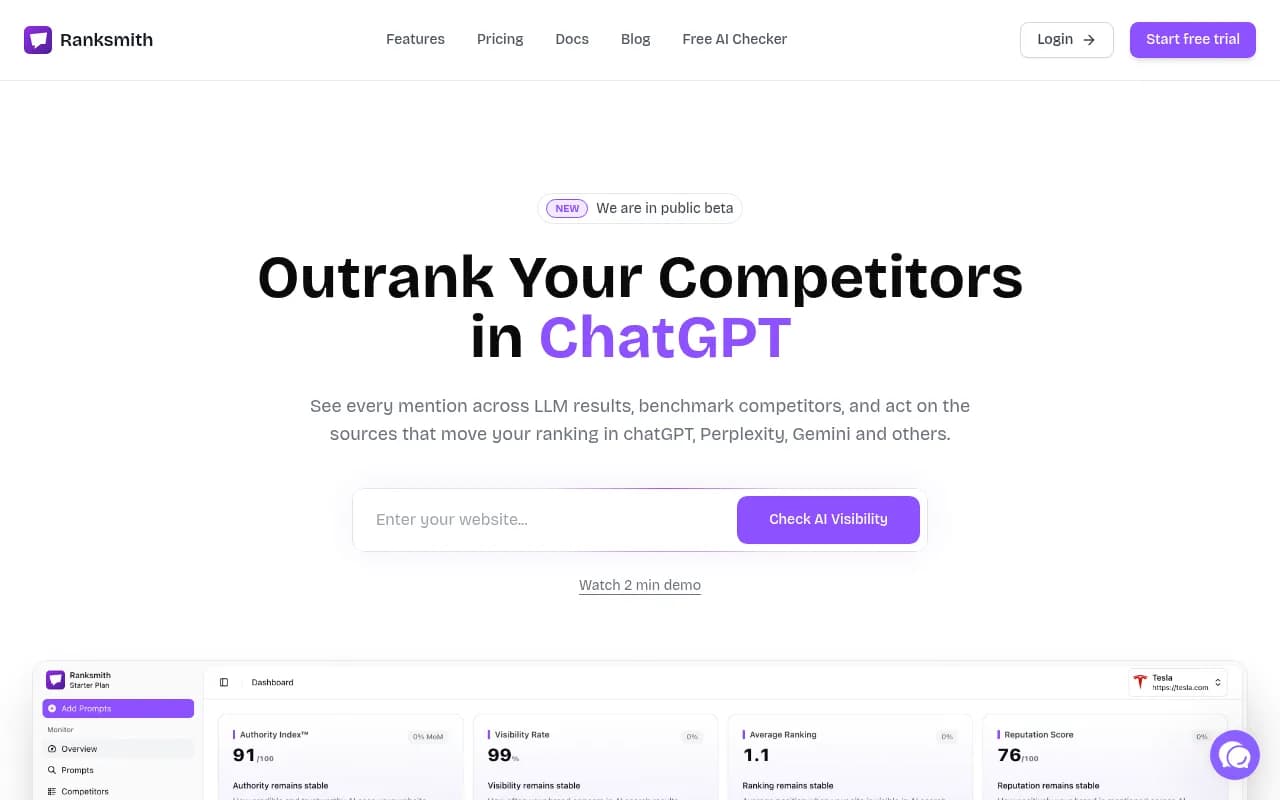
Ranksmith has been getting attention for its source attribution features -- showing which citations are driving AI mentions, which is useful for outreach strategies.
SE Ranking has added AI visibility tracking to its broader SEO suite, which is useful if you want everything in one platform.
For agencies specifically, the multi-client management question matters a lot. Promptwatch has agency and enterprise pricing, and Profound has an agency mode. Otterly and Peec are less optimized for managing multiple client accounts.
Bottom line
The AI visibility platform market is still maturing, and the gap between "we track this" and "we help you fix this" is the defining difference right now.
Otterly and Peec are fine monitoring tools at their respective price points. Profound is the most capable pure tracker in the group, but the price reflects that. Promptwatch is the only one that treats visibility data as the start of a workflow rather than the end product -- and for most marketing teams, that's the part that actually matters.
If you're evaluating these tools, the question to ask isn't "which one has the best dashboard?" It's "which one will actually change my AI visibility six months from now?" That's a different question, and it points toward a different answer.